
This article originally appeared in The Hub.
By Trevor Tombe and Brooks Decillia, April 30, 2026
For all the noise around Western alienation, separatist petitions, and federal-provincial fights, the bigger story is simpler: Albertans and other Canadians agree on more than they disagree.
New survey data from public opinion research firm Vox Pop Labs suggest that while many Albertans are deeply frustrated with Ottawa, most still support the basic idea of sharing wealth across the country, maintaining comparable public services, and improving how the federation works.
Of course, to listen only to the political rhetoric, one could be forgiven for concluding that the divisions between Alberta and Ottawa are wider than ever.
Just hours after Mark Carney’s “elbows-up” election night victory speech, in which he said “President Trump is trying to break us so that America can own us,” Danielle Smith issued an Alberta rallying cry of her own, accusing the Liberals of demeaning and demonizing her oil-rich province during the 2025 federal campaign.
The day after the election, Smith said “a large majority of Albertans” were “deeply frustrated” that the same government had been returned to power after “overtly” attacking the province’s economy for nearly a decade. She also vowed to protect Alberta from “future hostile acts” from Ottawa. “As premier, I will not permit the status quo to continue,” she added.
That rhetoric has been followed by action. Smith launched an “Alberta Next” panel on “Alberta’s future in Canada” and, more recently, has put nine questions to Albertans in a referendum later this year. These include proposals to restrict social services for immigrants and constitutional questions, such as abolishing the Senate.
But the more consequential effort may be outside government: separatist organizers across Alberta continue to collect signatures to hold an independence referendum.
In short, the politics suggest a province at odds with the rest of the country.
The survey data suggest a more complicated picture.
Strong regional grievance among Albertans
Smith’s critics accuse her of fuelling separatist sentiment by repeatedly tapping into long-held grievances and feelings of alienation.
And there is little doubt that Albertans feel a strong antipathy toward the federal government.
Three in 10 Albertans want to break away from Canada, according to the study by Vox Pop Labs, best known for the interactive voter engagement tool Vote Compass. Another recent public poll suggests that about a quarter of Albertans favour independence.
The survey data clearly show that Albertans remain decidedly grumpy about Ottawa.
More than six in 10 Albertans say their province is treated as a lower priority by the federal government, according to the Vox Pop Labs survey. A majority—55 percent—believe Ottawa disadvantages Alberta. Notably, 42 percent of people in Quebec feel La Belle Province is treated as a low priority by the federal government.
While only a quarter of Quebec residents say their province receives less than its fair share from the federal government, nearly six in 10 Albertans (56 percent) say their province gets an equitable amount of money from Ottawa.
Yet even so, 43 percent of Albertans rank Canada as what they feel most attached to, compared to 31 percent who rank their province first. That suggests national identity remains stronger than provincial grievance for a plurality of Albertans.
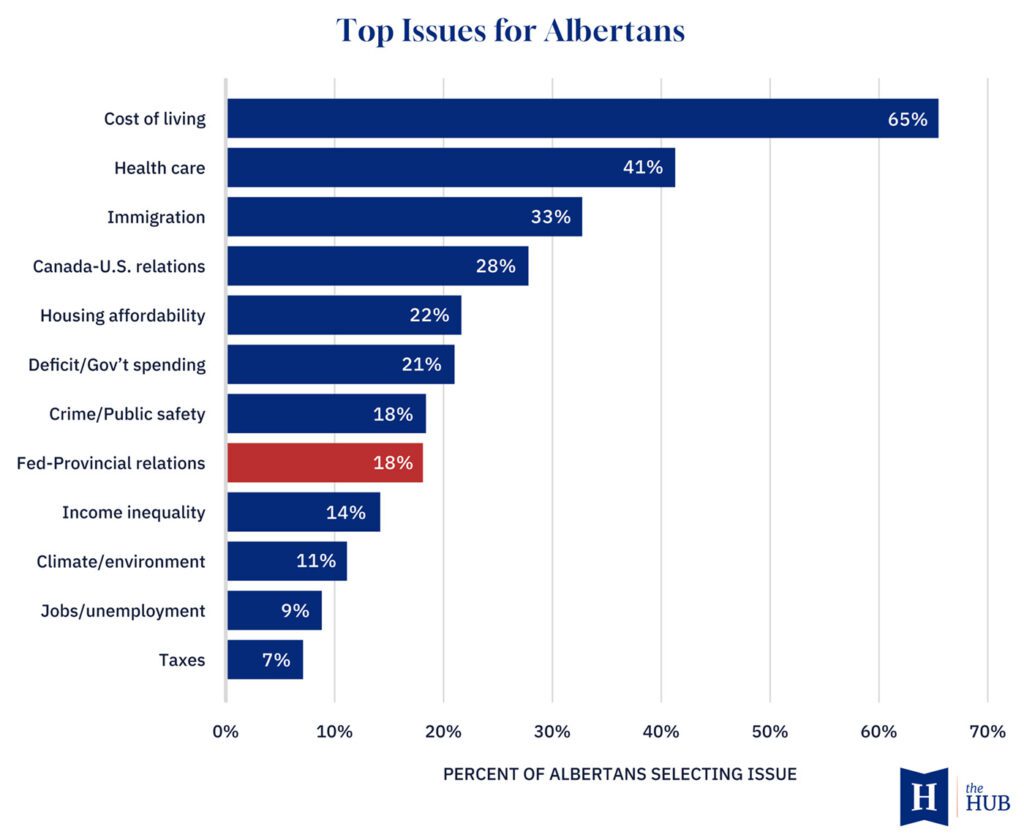
And despite all the vocal hostility to the federal government among those setting up booths along the province’s highways and byways to collect enough signatures to force a referendum, independence is not a top issue for most Albertans. In fact, federal-provincial relations rank seventh on the list of top concerns after the cost of living and the health-care system.
And the Vox Pop Labs survey data also suggest strong support amongst Albertans for federal programs, such as equalization, that help ensure all provinces provide comparable public services.
But while there’s considerable alignment on broad public policy principles, Albertans want to do things differently.
“Equalization” bad, “similar levels of public service” better
Despite the constant cacophony surrounding equalization, three-quarters of Canadians support the federal program that transfers funds to provinces with weaker fiscal capacity.
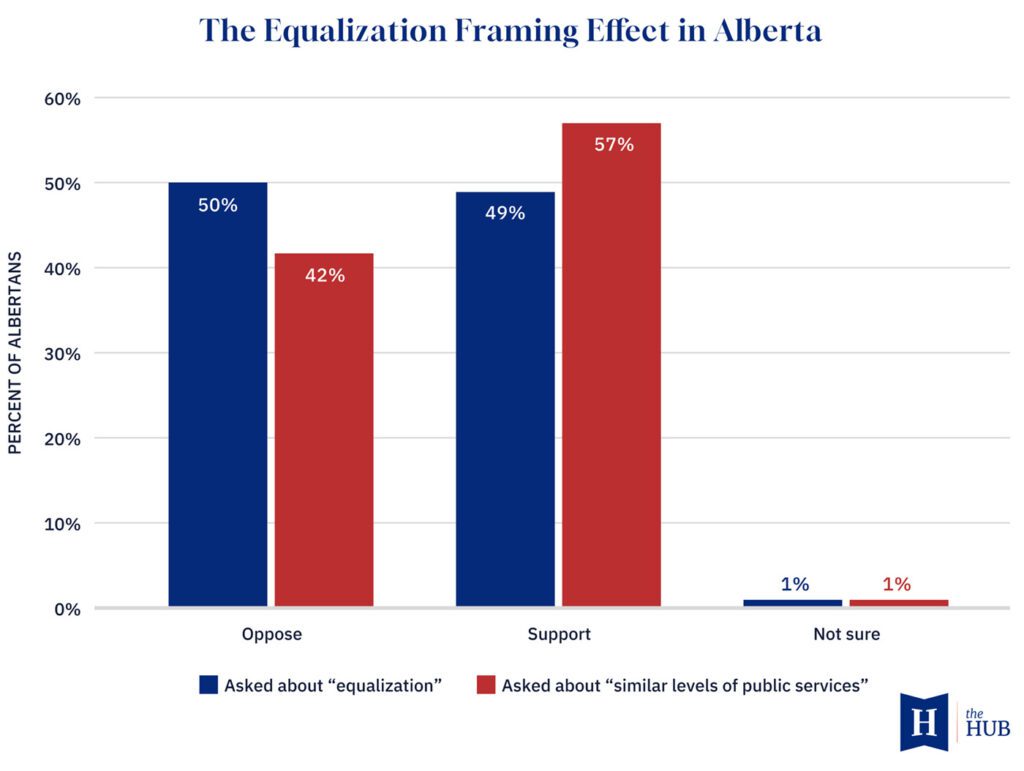
Half of Albertans strongly or somewhat oppose the federal program when asked specifically about “equalization.”
But, opposition dropped by eight points when the question is framed as transferring “money to the poorer provinces in order to ensure that Canadians living in every province have access to similar levels of public services.” With that wording, opposition falls to 42 percent, while 57 percent support it.
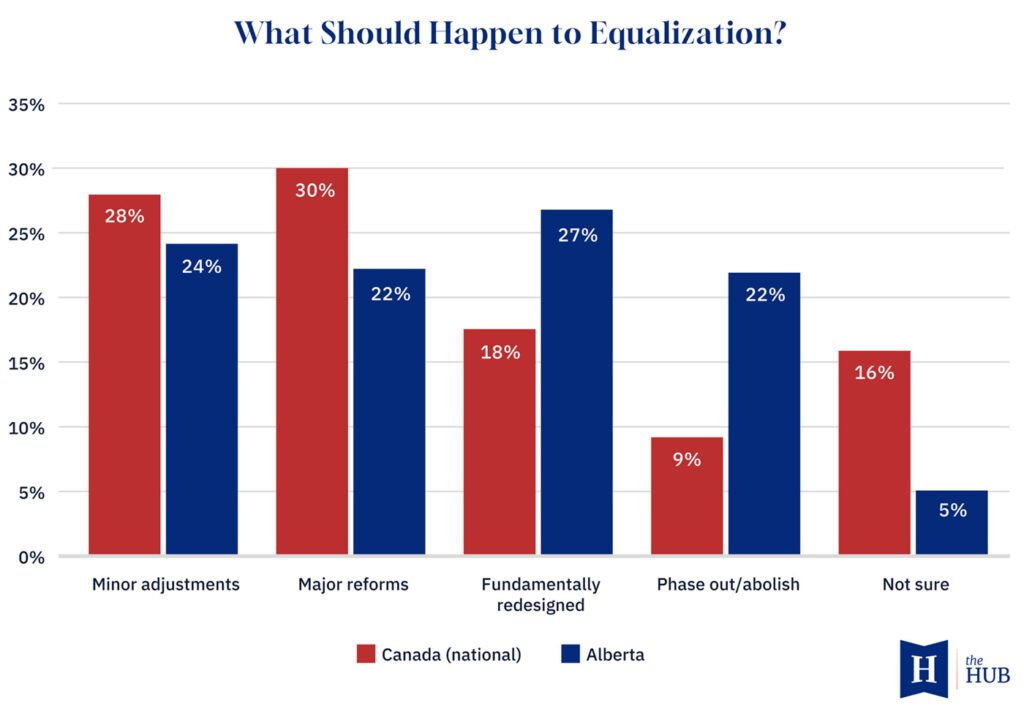
But even among those who oppose the program, there is not an overwhelming desire to phase it out. The survey actually shows that among those who oppose, a majority (56 percent) believe that it simply needs major reforms rather than abolishing it entirely.
And here’s where there may be an opportunity to improve not only the broader functioning of fiscal arrangements in Canada but also public support for specific transfer programs.
Of those who oppose equalization, for example, the survey finds that 79 percent believe the federal government does not make decisions about the program transparently, and 75 percent do not believe decisions are easy to understand.
Details of the program aside, the underlying concept and objective of sharing the country’s wealth is generally accepted. Indeed, 53 percent of equalization opponents believe that transfers should take into account the strengths and weaknesses of each province’s economy, which is more than double the number who think transfers should be based solely on population size. A similar number of Albertans say the same thing.
Realistic (and popular) options for reform
So what might reform look like? Well, roughly eight in 10 Canadians believe the formula should be periodically renewed and reformed to reflect current economic realities. Canada’s formula has been in place for more than two decades without substantial changes. Roughly eight in 10 Canadians also believe that provinces receiving equalization should demonstrate to the federal government that funds are being used responsibly.
And 71 percent of Canadians believe that there should be an independent expert commission to make decisions about equalization payments, much like Australia does, with only 14 percent of Canadians supporting letting politicians continue to sort out the constitutionally required payments
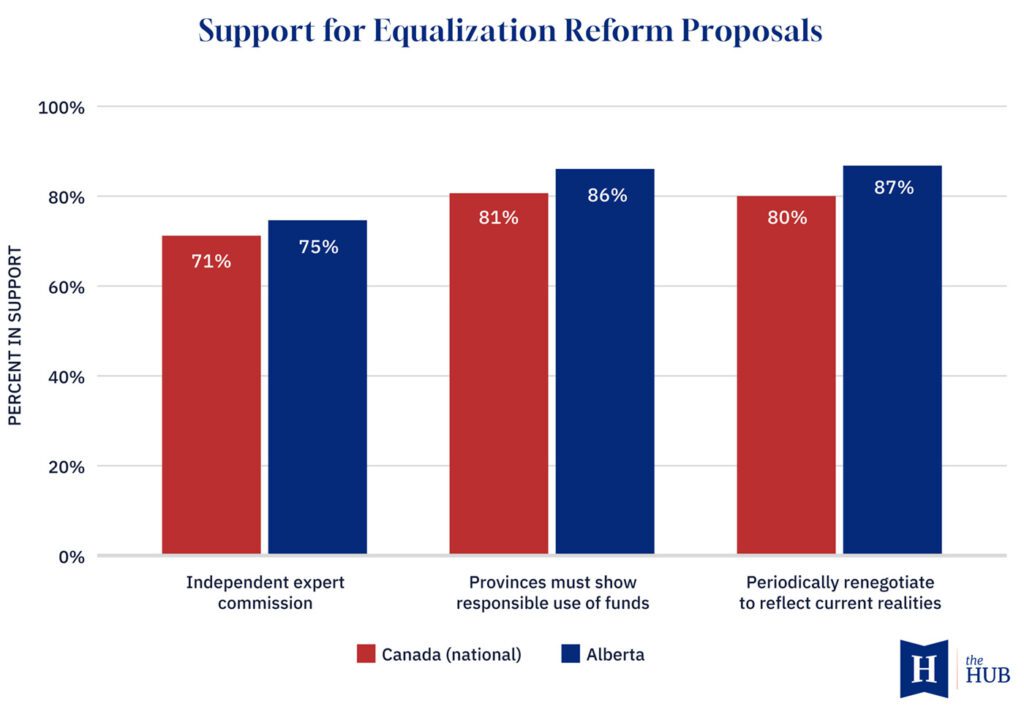
Such a reform might help improve the public understanding of the program, enhance transparency in decision-making, allow for potentially more complex calculations of underlying provincial fiscal capacity, and perhaps even provide a mechanism to report how funds are spent in recipient provinces.
So while opposition may be high in some quarters, support for significant reforms to potentially increase public support for these programs is fairly broad-based.
Broad agreement on functioning as one country
And more generally, concerning issues about the functioning of the federation overall, there’s broad agreement that there are many ways in which Canada might function better.
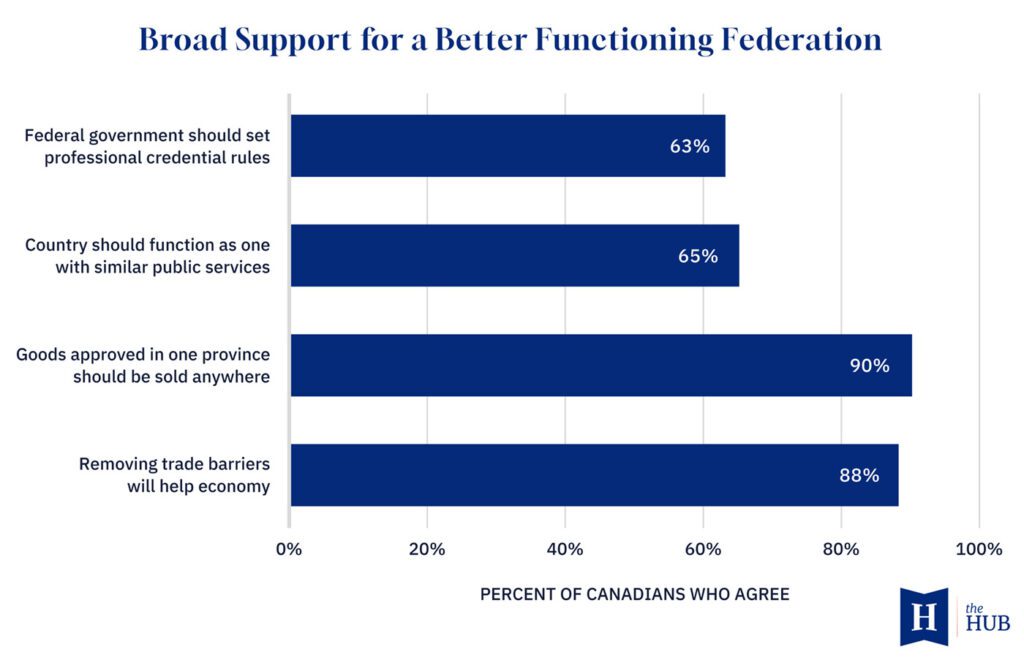
Two-thirds of Canadians (65 percent), for example, believe the country needs to function as one unified system with similar public services across the vast country. And nine out of 10 Canadians (88 percent) say removing interprovincial trade barriers will help their province’s economy. A similar number (90 percent) say goods approved in one province should be available for sale anywhere in Canada. Albertans respond similarly.
Such changes to internal trade would represent a dramatic adjustment in how goods and services are exchanged across provincial boundaries. With the mutual recognition agreement adopted by provincial governments late last year, it is a good first start.
Importantly, though, it excludes services, and many Canadians believe that it should be a lot easier for services to be traded and for professional credentials to be recognized from one part of the country to another.
Indeed, nearly two-thirds of Canadians surveyed believe it would be best for the federal government to set rules on who can do which job with what training or license, rather than the current structure in which provinces take the lead. A similar approach, consistent with Canada’s decentralized system, would be for provinces to adopt mutual recognition of professional credentials and other service-based regulations.
A renewed approach to cooperative federalism?
There are, in fact, early signs that cooperative federalism can deliver results when both orders of government are willing to deal. In November 2025, Prime Minister Carney and Premier Smith signed a sweeping memorandum of understanding on energy, committing to collaborate on a new bitumen pipeline to Asian markets, the world’s largest carbon capture project, streamlined environmental assessments, and a new carbon pricing arrangement for Alberta’s industrial emitters.
It is too early to know whether such initiatives will succeed (or even get off the ground), but the agreement itself is nevertheless a significant milestone. It involved a federal Liberal prime minister on one side and a UCP premier on the other—each representing the two poles of Canada’s federation debate, yet coming together on a wide range of issues, which is exactly the kind of cooperation the survey suggests many Canadians want.
Moving forward
The political theatre of federal-provincial relations—the press releases, the panel launches, the petition drives—can obscure a straightforward finding in this data: Albertans and other Canadians agree on far more than they disagree.
Large majorities in every region want equalization reformed, not abolished. They want it governed by an independent commission rather than politicians, updated regularly to reflect economic realities, and administered with accountability.
They want a country where goods, services, and credentials move freely across provincial borders. And they want their governments to cooperate amid an increasingly hostile trading relationship with the United States.
The gap between Albertans and other Canadians is real, but it is far narrower than some of the more heated sources of rhetoric would suggest.
The challenge for policymakers is to do the more mundane but ultimately more consequential work of reform, so that the federation Canadians say they want starts to look like the one they actually have.
Trevor Tombe is a professor of economics at the University of Calgary, the Director of Fiscal and Economic Policy at The School of Public Policy, a Senior Fellow at the Macdonald-Laurier Institute, and a Fellow at the Public Policy Forum.
Brooks DeCillia spent more than 20 years reporting and producing news with CBC. These days, he’s an assistant professor with Mount Royal University’s School of Communication Studies.