Wednesday, May 20, 2026
No Result
View All Result
  • Media
Macdonald-Laurier Institute
  • Home
  • About
    • Who We Are
    • Who Makes MLI Work
    • Fifteenth Anniversary
  • Experts
    • Experts Directory
    • In Memoriam
  • Issues
    • Domestic Policy
      • Economic Policy
      • Justice
      • Rights and Freedoms
      • Assisted Suicide (MAID)
      • Health Care
      • COVID-19
      • Gender Identity
      • Canada’s Political Tradition
      • AI, Technology and Innovation
      • Media and Telecoms
      • Housing
      • Immigration
      • Agriculture and Agri-Food
      • Competition Policy
    • Energy Policy
      • Energy
      • Environment
    • Foreign Policy
      • Israel-Hamas War
      • Ukraine
      • Taiwan
      • China
      • Europe and Russia
      • Indo-Pacific
      • Middle East and North Africa
      • North America
      • Foreign Interference
      • National Defence
      • National Security
      • Foreign Affairs
    • Indigenous Affairs
  • Projects
    • CNAPS (Center for North American Prosperity and Security)
    • Justice Report Card
    • The Promised Land
    • Voices that Inspire: The Macdonald-Laurier Vancouver Speaker Series
    • Dragon at the door
    • Canada on top of the world
    • Letter to a minister
    • The Great Energy Crisis
    • DisInfoWatch.org
    • Managing Indigenous Prosperity
    • Judicial Foundations
    • Landmark Cases Council
    • Defending The Marketplace of Ideas
    • Reforming the University
    • Past Projects
      • Digital Policy & Connectivity
      • Double Trouble
      • Canada and the Indo-Pacific Initiative
      • The Transatlantic Program
      • COVID Misery Index
        • Provincial COVID Misery Index
        • Beyond Lockdown
        • COVID and after: A mandate for recovery
      • Speak for Ourselves
      • The Eavesdropping Dragon: Huawei
      • Talkin’ in the Free World with Mariam Memarsadeghi
      • An Intellectual Property Strategy for Canada
      • Munk Senior Fellows
      • A Mandate for Canada
      • Confederation Series
      • Fiscal Reform
      • The Canadian Century project
      • Fixing Canadian health care
      • Internal trade
      • From a mandate for change
      • Size of government in Canada
      • Straight Talk
      • Labour Market Report
      • Leading Economic Indicator
      • Centre for Advancing Canada’s Interests Abroad
      • Indigenous Prosperity at a Crossroads
        • Aboriginal Canada and Natural Resources
  • Events
    • Upcoming Events
    • Past Events
      • MLI Dinners
      • Great Canadian Debates
  • Latest News
  • Libraries
    • Columns
    • Commentary
    • Papers
    • Books
    • Video
  • Donate
  • Home
  • About
    • Who We Are
    • Who Makes MLI Work
    • Fifteenth Anniversary
  • Experts
    • Experts Directory
    • In Memoriam
  • Issues
    • Domestic Policy
      • Economic Policy
      • Justice
      • Rights and Freedoms
      • Assisted Suicide (MAID)
      • Health Care
      • COVID-19
      • Gender Identity
      • Canada’s Political Tradition
      • AI, Technology and Innovation
      • Media and Telecoms
      • Housing
      • Immigration
      • Agriculture and Agri-Food
      • Competition Policy
    • Energy Policy
      • Energy
      • Environment
    • Foreign Policy
      • Israel-Hamas War
      • Ukraine
      • Taiwan
      • China
      • Europe and Russia
      • Indo-Pacific
      • Middle East and North Africa
      • North America
      • Foreign Interference
      • National Defence
      • National Security
      • Foreign Affairs
    • Indigenous Affairs
  • Projects
    • CNAPS (Center for North American Prosperity and Security)
    • Justice Report Card
    • The Promised Land
    • Voices that Inspire: The Macdonald-Laurier Vancouver Speaker Series
    • Dragon at the door
    • Canada on top of the world
    • Letter to a minister
    • The Great Energy Crisis
    • DisInfoWatch.org
    • Managing Indigenous Prosperity
    • Judicial Foundations
    • Landmark Cases Council
    • Defending The Marketplace of Ideas
    • Reforming the University
    • Past Projects
      • Digital Policy & Connectivity
      • Double Trouble
      • Canada and the Indo-Pacific Initiative
      • The Transatlantic Program
      • COVID Misery Index
        • Provincial COVID Misery Index
        • Beyond Lockdown
        • COVID and after: A mandate for recovery
      • Speak for Ourselves
      • The Eavesdropping Dragon: Huawei
      • Talkin’ in the Free World with Mariam Memarsadeghi
      • An Intellectual Property Strategy for Canada
      • Munk Senior Fellows
      • A Mandate for Canada
      • Confederation Series
      • Fiscal Reform
      • The Canadian Century project
      • Fixing Canadian health care
      • Internal trade
      • From a mandate for change
      • Size of government in Canada
      • Straight Talk
      • Labour Market Report
      • Leading Economic Indicator
      • Centre for Advancing Canada’s Interests Abroad
      • Indigenous Prosperity at a Crossroads
        • Aboriginal Canada and Natural Resources
  • Events
    • Upcoming Events
    • Past Events
      • MLI Dinners
      • Great Canadian Debates
  • Latest News
  • Libraries
    • Columns
    • Commentary
    • Papers
    • Books
    • Video
  • Donate
No Result
View All Result
Macdonald-Laurier Institute

Backdoor constitutional amendments to the notwithstanding clause and the risk to the integrity of the federation: Dave Snow and F.L. (Ted) Morton in the Constitutional Theory Monitor

At a time when the integrity of the Canadian federal system may again be at risk, this is an opportunity to affirm the features of the Constitution that may play a role in alleviating some of the tensions.

May 20, 2026
in Domestic Policy, Latest News, Judicial Foundations
Reading Time: 7 mins read
A A
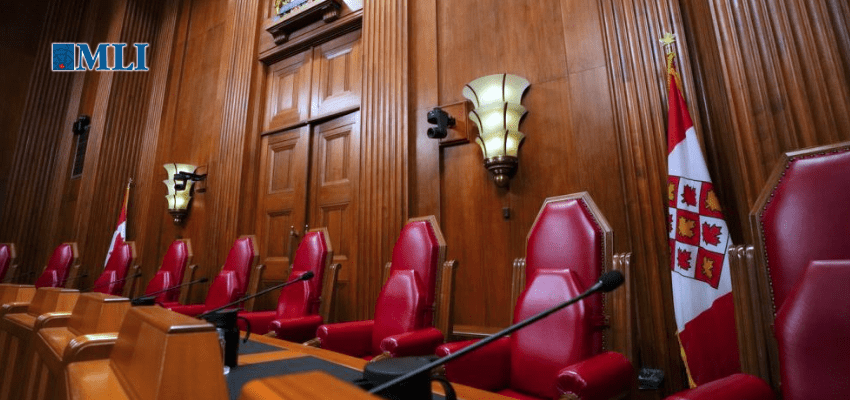
court image

This piece originally appeared in the Notwithstanding Clause Appeals Symposium at the Constitutional Theory Monitor.

By Dave Snow and F.L. (Ted) Morton, May 20, 2026

The Supreme Court of Canada’s hearing concerning Bill 21 and section 33 of the Canadian Charter of Rights and Freedoms (the ‘notwithstanding clause’) raised a number of questions that could be addressed. In this post, we consider what the Attorney General of Alberta calls the “range of creative proposals” that have been advanced by the federal government and various parties and interveners – often funded by Ottawa itself – to restrict the use of the notwithstanding clause. These arguments share common features: they function as backdoor amendments to the Constitution, and risk eroding the legitimacy of the courts and the unity of the Canadian state. Indeed, some commentators are predicting that an adverse ruling against Quebec and its provincial allies could “inflame separatism” and lead to a “national unity” crisis.

Some of the judges acknowledged these points during the hearing. For example, Justice Suzanne Côté asked one party whether it was calling for “a constitutional amendment” (1:40:00 – 2:10:10). This is precisely what these proposals entail. More generally, the Chief Justice, and Justices Côté, Rowe and Kasirer seemed to implicitly highlight through their comments and questions that the notwithstanding clause can play a role in accommodating provincial differences (e.g. 1:40:00 – 2:10:10; 2:11:10 – 2:30:46). At a time when the integrity of the Canadian federal system may again be at risk, this is an opportunity to affirm the features of the Constitution that may play a role in alleviating some of the tensions.

The Proposed Restrictions to the Notwithstanding Clause

This political fight began in 1981. Prime Minister Pierre Trudeau’s original draft of the Canadian Charter had no notwithstanding clause. In the Patriation Reference, the Supreme Court of Canada held as follows:

A substantial degree of provincial con­sent—to be determined by the politicians and not the courts—was conventionally required for the amendment of the Canadian Constitution. The convention existed because the federal principle could not be reconciled with a state of affairs where the federal authorities could unilaterally modify provincial legislative powers. The proposed amendments were not severable despite the fact that the Charter of Rights offended the federal principle and the proposed amending formula did not.

Section 33 was added only after provincial premiers made it clear that they would not accept Trudeau’s proposed Canadian Charter without it. The premiers knew from experience that the text of the Constitution does not speak for itself. At the end of the day, the Constitution usually means what judges say it means. Hard bargaining resulted in a compromise. Trudeau got his Canadian Charter. The provinces got the notwithstanding clause.

This clause allows a legislature to exempt one of its laws from any judicial declaration of invalidity arising under the designated sections of the Canadian Charter. Its practical effect is to give elected legislatures rather than judges the last word when there is a disagreement over the practical meaning of a right.

Outside of Quebec, the notwithstanding clause was little used for three decades. Recently, however, there has been a resurgence in the provincial use of the notwithstanding clause. Section 33 has been used in ten different provincial laws since 2018 — not just by Quebec but also by Ontario, Saskatchewan and Alberta.

Faced with this, the federal government and various parties and interveners have now asked the court to impose new restrictions on when and how a government can use the notwithstanding clause. The proposed restrictions are many, including banning pre-emptive invocations, making invocations subject to “unwritten principles,” and the federal government’s novel proposal to prohibit invocations that would lead to an “irreparable impairment” of rights.

Backdoor Amendments to the Constitution

These arguments contradict both the text of section 33 and its clearly documented purpose.

The purpose of the notwithstanding clause was succinctly explained by former Alberta premier Peter Lougheed in 1983: “We needed to have the supremacy of the legislature over the courts. … we did not (want) to be in a position where public policy was being dictated or determined by non-elected people.” Lougheed argued in a 1991 speech that the notwithstanding clause provided Canada with a “system of checks and balances between the judiciary and legislators before judicial supremacy could assert itself.” The examples of both the United Kingdom and Australia demonstrate that it is possible to have constitutional supremacy without judicial supremacy, the rule of law without the rule of lawyers. That was the deal.

Lougheed’s example is particularly important. He supported the clause. Although he proposed some changes to it—such as preventing standard form use, requiring a qualified majority for its invocation and banning pre-emptive use—his remedy was to amend the Constitution itself. Lougheed recognized that the notwithstanding clause is part of the constitutional settlement that gave us the Canadian Charter, and if that clause is to be altered, it must be done through constitutional amendment, not judicial revision.

If the Supreme Court of Canada accepts the “creative proposals” made by the federal government and several parties and interveners, it will have effectively amended the notwithstanding clause to mean something very different than what Quebec, all the Western premiers and even the Trudeau government understood it to mean in 1982. For the court to impose any new restrictions on the use of the clause would be precisely the judicial overreach that section 33 was designed to prevent.

Judicial Legitimacy and the Integrity of the Canadian Federal System

Although courts remain broadly popular and legitimate in the eyes of Canadians, some recent public opinion data has shown declining confidence in the courts, with the lowest levels from supporters of the Conservatives and the Bloc Québécois. This is unsurprising due to the types of Canadian Charter decisions we have seen coming out of courts.

In recent years, courts have issued injunctions or struck down laws preventing governments from banning drug consumption in public; restricting cross-sex hormones and gender transition surgeries for minors; permitting parental consent for pronoun changes at school; preventing municipalities from making residents mow their lawn; and closing down drug consumption sites, homeless encampments, and even bike lanes. Reasonable people may agree or disagree with these policy outcomes. But the cumulative effect has been a growing public sentiment that federally-appointed courts are simply selecting their preferred policy results in areas of provincial jurisdiction.

Provinces have shown that they will push back against perceived judicial centralization, and the notwithstanding clause is the most obvious instrument they can use. This is especially true for Quebec, where most invocations of the notwithstanding clause have occurred. Ironically, one way in which Canada has arguably been able to move beyond Quebec’s perceived betrayal from patriation in the 1980s has been via the notwithstanding clause—a provision that emerged from patriation itself. We share the view of scholars who have argued that the clause has become one of the primary means by which Quebec’s National Assembly has been able to assert its autonomy—to remain, in the words of Premier Robert Bourassa, “aujourd’hui et pour toujours, une société distincte, libre et capable d’assumer son destin et son développement.”

Both within and outside of Quebec, national unity promises to once again rear its head. In such times, the ability of provinces to legislate within their own jurisdictional domains may be crucial to avoiding cracks in the federation. And as it has sometimes done before, the Supreme Court of Canada has an important role to play to prevent what some predict could be a “national unity crisis.”

Responding to the Patriation Reference, the late great Peter Russell wrote that the court engaged in “Bold statecraft, questionable jurisprudence.” With respect to the notwithstanding clause, the path is far simpler: engage in bold statecraft by rejecting the questionable jurisprudence advocated by today’s opponents of the notwithstanding clause who seek to rewrite the Canadian constitutional bargain by judicial fiat.


Dave Snow is an Associate professor in political science at the University of Guelph and a senior fellow at the Macdonald-Laurier Institute.

F.L. (Ted) Morton is an Executive Fellow at the School of Public Policy and professor emeritus at the University of Calgary. His book, The Charter Revolution and the Court Party, won a Donner Foundation book prize in 2002.

Source: Constitutional Theory Monitor

Related Posts

MAID Committee hearings exposed a deeper problem: Ramona Coelho in The Hill Times
Domestic Policy

MAID Committee hearings exposed a deeper problem: Ramona Coelho in The Hill Times

May 20, 2026
The Alberta-Ottawa pipeline agreement gets Canada off the starting blocks: Heather Exner-Pirot in The Hub
Energy Policy

The Alberta-Ottawa pipeline agreement gets Canada off the starting blocks: Heather Exner-Pirot in The Hub

May 20, 2026
Short circuit – Lessons for Canada from Europe’s tech regulation: Jon Hartley
AI, Technology and Innovation

Short circuit – Lessons for Canada from Europe’s tech regulation: Jon Hartley

May 20, 2026

Newsletter Signup

  Thank you for Signing Up
  Please correct the marked field(s) below.
Email Address  *
1,true,6,Contact Email,2
First Name *
1,true,1,First Name,2
Last Name *
1,true,1,Last Name,2
*
*Required Fields

Follow us on

Macdonald-Laurier Institute

323 Chapel Street, Suite #300
Ottawa, Ontario, K1N 7Z2 Canada

613.482.8327

info@macdonaldlaurier.ca
MLI directory

Support Us

Support the Macdonald-Laurier Institute to help ensure that Canada is one of the best governed countries in the world. Click below to learn more or become a sponsor.

Support Us

  • Inside Policy Magazine
  • Annual Reports
  • Jobs
  • Privacy Policy

© 2023 Macdonald-Laurier Institute. All Rights reserved.

This site uses cookies. By continuing to browse the site you are agreeing to our use of cookies.

Privacy Preference Center

Consent Management

Necessary

Advertising

Analytics

Other

No Result
View All Result
  • Home
  • About
    • Who We Are
    • Who Makes MLI Work
    • Fifteenth Anniversary
  • Experts
    • Experts Directory
    • In Memoriam
  • Issues
    • Domestic Policy
      • Economic Policy
      • Justice
      • Rights and Freedoms
      • Assisted Suicide (MAID)
      • Health Care
      • COVID-19
      • Gender Identity
      • Canada’s Political Tradition
      • AI, Technology and Innovation
      • Media and Telecoms
      • Housing
      • Immigration
      • Agriculture and Agri-Food
      • Competition Policy
    • Energy Policy
      • Energy
      • Environment
    • Foreign Policy
      • Israel-Hamas War
      • Ukraine
      • Taiwan
      • China
      • Europe and Russia
      • Indo-Pacific
      • Middle East and North Africa
      • North America
      • Foreign Interference
      • National Defence
      • National Security
      • Foreign Affairs
    • Indigenous Affairs
  • Projects
    • CNAPS (Center for North American Prosperity and Security)
    • Justice Report Card
    • The Promised Land
    • Voices that Inspire: The Macdonald-Laurier Vancouver Speaker Series
    • Dragon at the door
    • Canada on top of the world
    • Letter to a minister
    • The Great Energy Crisis
    • DisInfoWatch.org
    • Managing Indigenous Prosperity
    • Judicial Foundations
    • Landmark Cases Council
    • Defending The Marketplace of Ideas
    • Reforming the University
    • Past Projects
      • Digital Policy & Connectivity
      • Double Trouble
      • Canada and the Indo-Pacific Initiative
      • The Transatlantic Program
      • COVID Misery Index
      • Speak for Ourselves
      • The Eavesdropping Dragon: Huawei
      • Talkin’ in the Free World with Mariam Memarsadeghi
      • An Intellectual Property Strategy for Canada
      • Munk Senior Fellows
      • A Mandate for Canada
      • Confederation Series
      • Fiscal Reform
      • The Canadian Century project
      • Fixing Canadian health care
      • Internal trade
      • From a mandate for change
      • Size of government in Canada
      • Straight Talk
      • Labour Market Report
      • Leading Economic Indicator
      • Centre for Advancing Canada’s Interests Abroad
      • Indigenous Prosperity at a Crossroads
  • Events
    • Upcoming Events
    • Past Events
      • MLI Dinners
      • Great Canadian Debates
  • Latest News
  • Libraries
    • Columns
    • Commentary
    • Papers
    • Books
    • Video
  • Donate

© 2023 Macdonald-Laurier Institute. All Rights reserved.