Thursday, August 13, 2026
No Result
View All Result
  • Media
Macdonald-Laurier Institute
  • Home
  • About
    • Who We Are
    • Who Makes MLI Work
    • Fifteenth Anniversary
  • Experts
    • Experts Directory
    • In Memoriam
  • Issues
    • Domestic Policy
      • Economic Policy
      • Justice
      • Rights and Freedoms
      • Assisted Suicide (MAID)
      • Health Care
      • COVID-19
      • Gender Identity
      • Canada’s Political Tradition
      • AI, Technology and Innovation
      • Media and Telecoms
      • Housing
      • Immigration
      • Agriculture and Agri-Food
      • Competition Policy
    • Energy Policy
      • Energy
      • Environment
    • Foreign Policy
      • Israel-Hamas War
      • Ukraine
      • Taiwan
      • China
      • Europe and Russia
      • Indo-Pacific
      • Middle East and North Africa
      • North America
      • Foreign Interference
      • National Defence
      • National Security
      • Foreign Affairs
    • Indigenous Affairs
  • Projects
    • CNAPS (Center for North American Prosperity and Security)
    • The Promised Land
    • Dragon at the door
    • Justice Report Card
    • DisInfoWatch.org
    • Managing Indigenous Prosperity
    • Judicial Foundations
    • Landmark Cases Council
    • Closing Canada’s Border, Policing, and Legal Gaps
    • Reforming the University
    • Digital Policy & Connectivity
    • Defending The Marketplace of Ideas
    • Letter to a minister
    • Past Projects
      • The Great Energy Crisis
      • Canada on top of the world
      • Double Trouble
      • Canada and the Indo-Pacific Initiative
      • The Transatlantic Program
      • COVID Misery Index
        • Provincial COVID Misery Index
        • Beyond Lockdown
        • COVID and after: A mandate for recovery
      • Speak for Ourselves
      • The Eavesdropping Dragon: Huawei
      • Talkin’ in the Free World with Mariam Memarsadeghi
      • An Intellectual Property Strategy for Canada
      • Munk Senior Fellows
      • A Mandate for Canada
      • Confederation Series
      • Fiscal Reform
      • The Canadian Century project
      • Fixing Canadian health care
      • Internal trade
      • From a mandate for change
      • Size of government in Canada
      • Straight Talk
      • Labour Market Report
      • Leading Economic Indicator
      • Centre for Advancing Canada’s Interests Abroad
      • Indigenous Prosperity at a Crossroads
        • Aboriginal Canada and Natural Resources
  • Events
    • Voices that Inspire: The Macdonald-Laurier Vancouver Speaker Series
    • Upcoming Events
    • Past Events
      • MLI Dinners
      • Great Canadian Debates
  • Latest News
  • Libraries
    • Columns
    • Commentary
    • Papers
    • Books
    • Video
  • Donate
  • Home
  • About
    • Who We Are
    • Who Makes MLI Work
    • Fifteenth Anniversary
  • Experts
    • Experts Directory
    • In Memoriam
  • Issues
    • Domestic Policy
      • Economic Policy
      • Justice
      • Rights and Freedoms
      • Assisted Suicide (MAID)
      • Health Care
      • COVID-19
      • Gender Identity
      • Canada’s Political Tradition
      • AI, Technology and Innovation
      • Media and Telecoms
      • Housing
      • Immigration
      • Agriculture and Agri-Food
      • Competition Policy
    • Energy Policy
      • Energy
      • Environment
    • Foreign Policy
      • Israel-Hamas War
      • Ukraine
      • Taiwan
      • China
      • Europe and Russia
      • Indo-Pacific
      • Middle East and North Africa
      • North America
      • Foreign Interference
      • National Defence
      • National Security
      • Foreign Affairs
    • Indigenous Affairs
  • Projects
    • CNAPS (Center for North American Prosperity and Security)
    • The Promised Land
    • Dragon at the door
    • Justice Report Card
    • DisInfoWatch.org
    • Managing Indigenous Prosperity
    • Judicial Foundations
    • Landmark Cases Council
    • Closing Canada’s Border, Policing, and Legal Gaps
    • Reforming the University
    • Digital Policy & Connectivity
    • Defending The Marketplace of Ideas
    • Letter to a minister
    • Past Projects
      • The Great Energy Crisis
      • Canada on top of the world
      • Double Trouble
      • Canada and the Indo-Pacific Initiative
      • The Transatlantic Program
      • COVID Misery Index
        • Provincial COVID Misery Index
        • Beyond Lockdown
        • COVID and after: A mandate for recovery
      • Speak for Ourselves
      • The Eavesdropping Dragon: Huawei
      • Talkin’ in the Free World with Mariam Memarsadeghi
      • An Intellectual Property Strategy for Canada
      • Munk Senior Fellows
      • A Mandate for Canada
      • Confederation Series
      • Fiscal Reform
      • The Canadian Century project
      • Fixing Canadian health care
      • Internal trade
      • From a mandate for change
      • Size of government in Canada
      • Straight Talk
      • Labour Market Report
      • Leading Economic Indicator
      • Centre for Advancing Canada’s Interests Abroad
      • Indigenous Prosperity at a Crossroads
        • Aboriginal Canada and Natural Resources
  • Events
    • Voices that Inspire: The Macdonald-Laurier Vancouver Speaker Series
    • Upcoming Events
    • Past Events
      • MLI Dinners
      • Great Canadian Debates
  • Latest News
  • Libraries
    • Columns
    • Commentary
    • Papers
    • Books
    • Video
  • Donate
No Result
View All Result
Macdonald-Laurier Institute

No, Canada’s economy isn’t on fire. Growth is returning, but on a permanently lower path: Trevor Tombe in The Hub

The growth trajectory is on a permanently lower path compared to previous expectations, indicating that the economy is not as robust as it appears.

August 13, 2026
in Domestic Policy, Columns, Latest News, In the Media, Economic Policy, Trevor Tombe
Reading Time: 5 mins read
A A
No, Canada’s economy isn’t on fire. Growth is returning, but on a permanently lower path: Trevor Tombe in The Hub

This article originally appeared in The Hub.

By Trevor Tombe, August 13, 2026

For several months this past year, Canada’s economy was often described as being in a recession. Last week, after a strong jobs report, some described it as “on fire.”

Both reactions are understandable, at least on the surface. Employment rose by 75,000 in July, and the unemployment rate fell. And when the second-quarter GDP arrives later this month, growth may turn out to be the strongest in more than three years.

The numbers are good, and the economy does appear to be turning the corner. That’s very welcome. But the swing from one label to the other tells us more about how fast the mood can shift than about how much the economy has actually changed.

A better way to think about it is this: Canada is gradually returning to normal rates of growth, but along a permanently lower path. And measured against our peers, or even against our own potential, recent performance looks anything but strong.

One report, wide error bars

July was a genuinely good report. Employment rose by 75,000—a solid 0.4 percent gain in a single month, in an economy with roughly 21.2 million workers. The unemployment rate fell to 6.4 percent. The gains were broad, across sectors, age groups, and provinces.

But the Labour Force Survey is a survey. It’s essentially a large, well-run poll asking people whether they’re working (among many other questions). And like any poll, it comes with a margin of error—and that margin is much larger than most people assume. The July gain of 75,000 is actually plus or minus about 66,000, 19 times out of 20. Between June and July, every province except Ontario saw changes within their own respective margins.
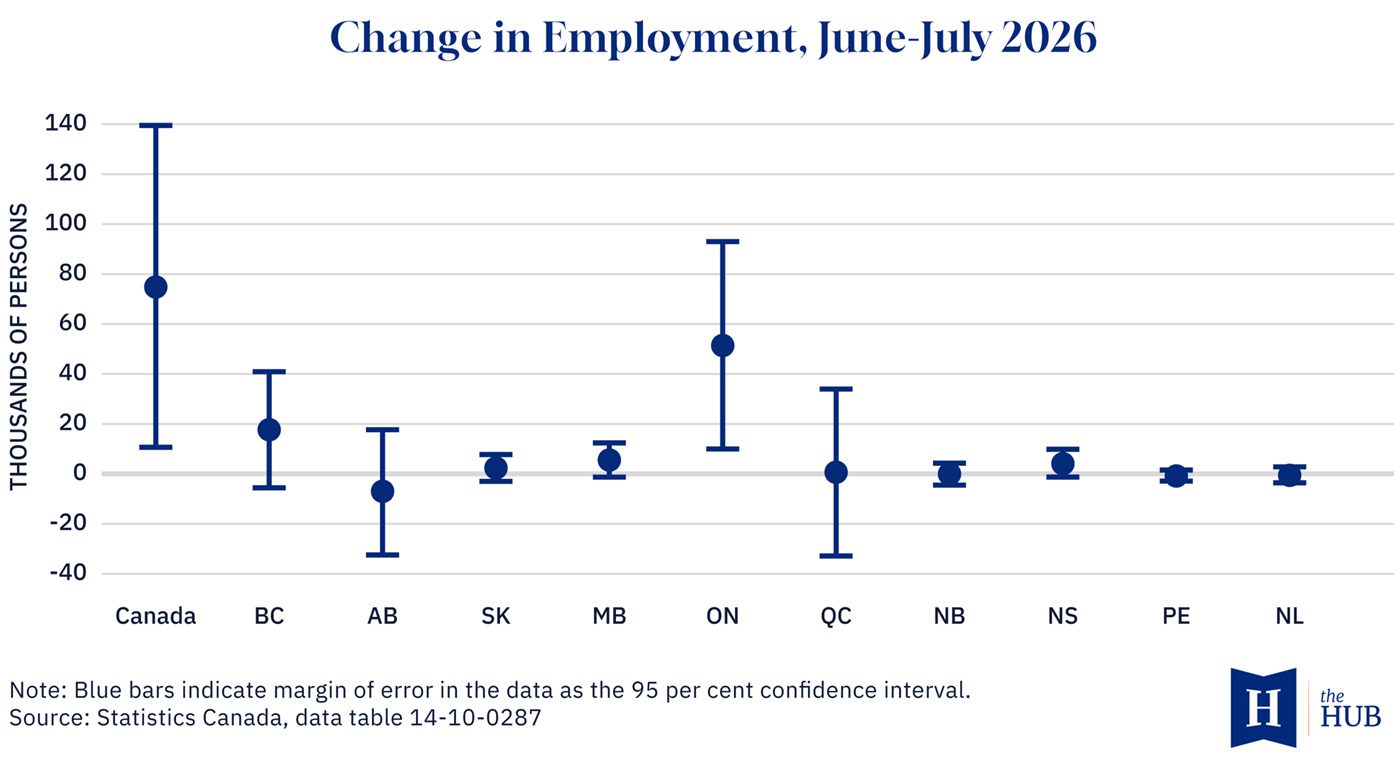
That’s not a knock on Statistics Canada. It’s normal sampling error. But it means any single month tells us very little on its own.

The trend is what matters, and the trend is up—just not as sharply. I estimate that trend employment (calculated similarly to StatCan’s approach) rose by roughly 25,000 in July. One-third the headline growth.

The trend unemployment rate is improving too, and has been since the middle of last year. It now sits near 6.5 percent, down from a peak of 7 but up from roughly 5 percent four years ago.
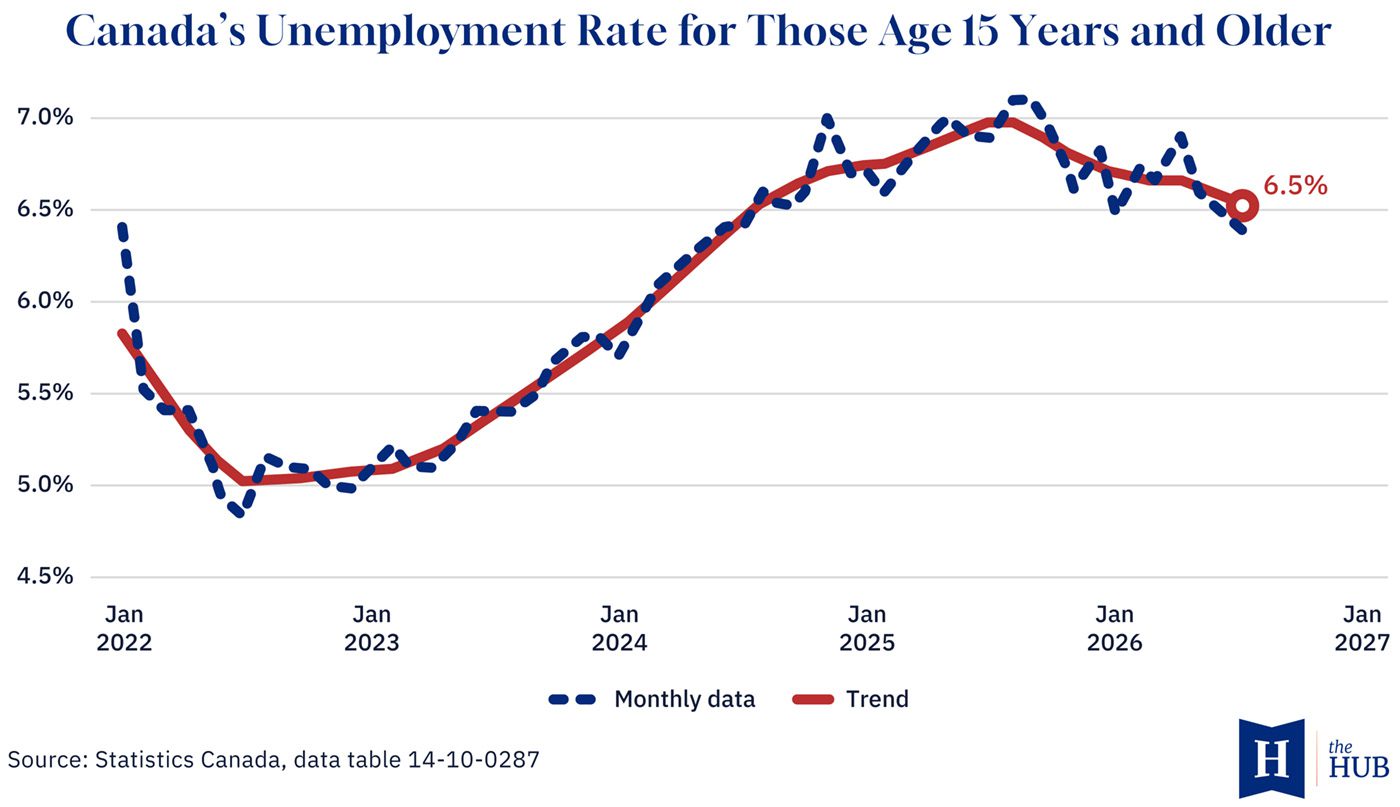
So the labour market is getting better. That’s good news. But it is not an economy on fire.

We’re still far short of where we were headed

The clearest way to see this is to compare where the economy is to where we expected it to be.

Before President Trump changed the trade relationship at the start of 2025, the Bank of Canada projected that by the second quarter of 2026, Canada’s economy would be 2.4 percent larger than it was in the first quarter of 2025.

Instead, the economy has barely grown at all. Output in the second quarter of this year is likely close to where it stood a year and a half earlier. That’s slightly below even the better of the tariff scenarios the Bank laid out in its July 2025 Monetary Policy Report, as I illustrate below.
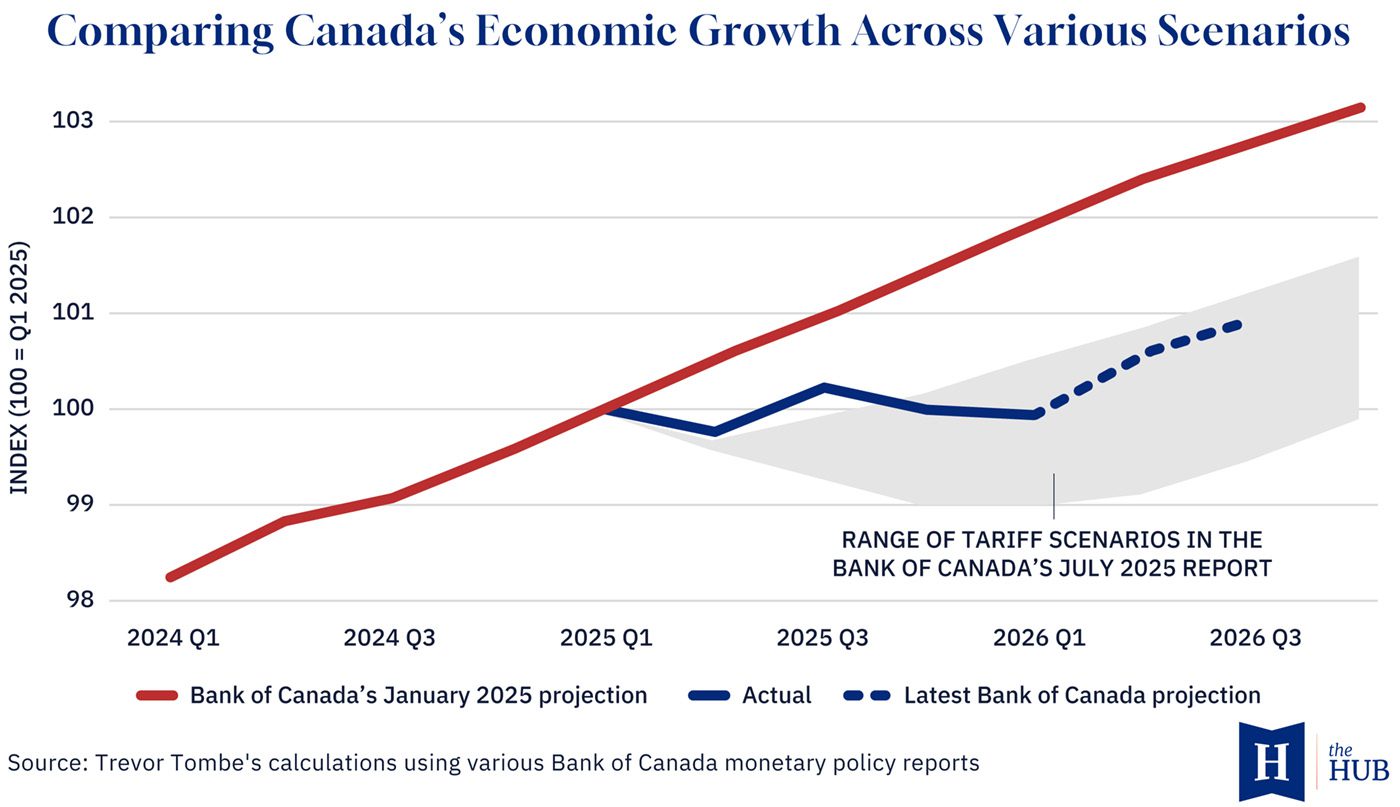
The gap is close to 2 percent. In dollars, that means Canada’s economy is roughly $60 billion, or about $1,400 per Canadian, smaller. That’s large.

And that gap doesn’t close on its own. Even if growth returns to normal rates, we simply continue along a trajectory about 2 percent lower than before. Indeed, the Bank of Canada’s latest projections point to quarterly growth through the third quarter of 2026 that is roughly in line with what it was forecasting back in 2025, which means the gap stays about where it is.

Growth returning, in other words, is not the same as the economy catching fire. It mostly means the adjustment to the new trade reality has worked its way through.

And we’re behind our peers

The international comparison tells the same story.

Since the first quarter of 2025, real GDP across the OECD has grown 1.7 percent on average. Canada’s has shrunk by about 0.1 percent.

Meanwhile, Mexico, also heavily exposed to U.S. trade policy, grew 0.4 percent. The European Union grew 0.8 percent. The United Kingdom, which has had a difficult run since voters chose to make trade with Europe harder with Brexit, grew 0.9 percent. The G7 average was 1.7 percent. Australia grew 2.5 percent. The United States grew 2.7 percent.
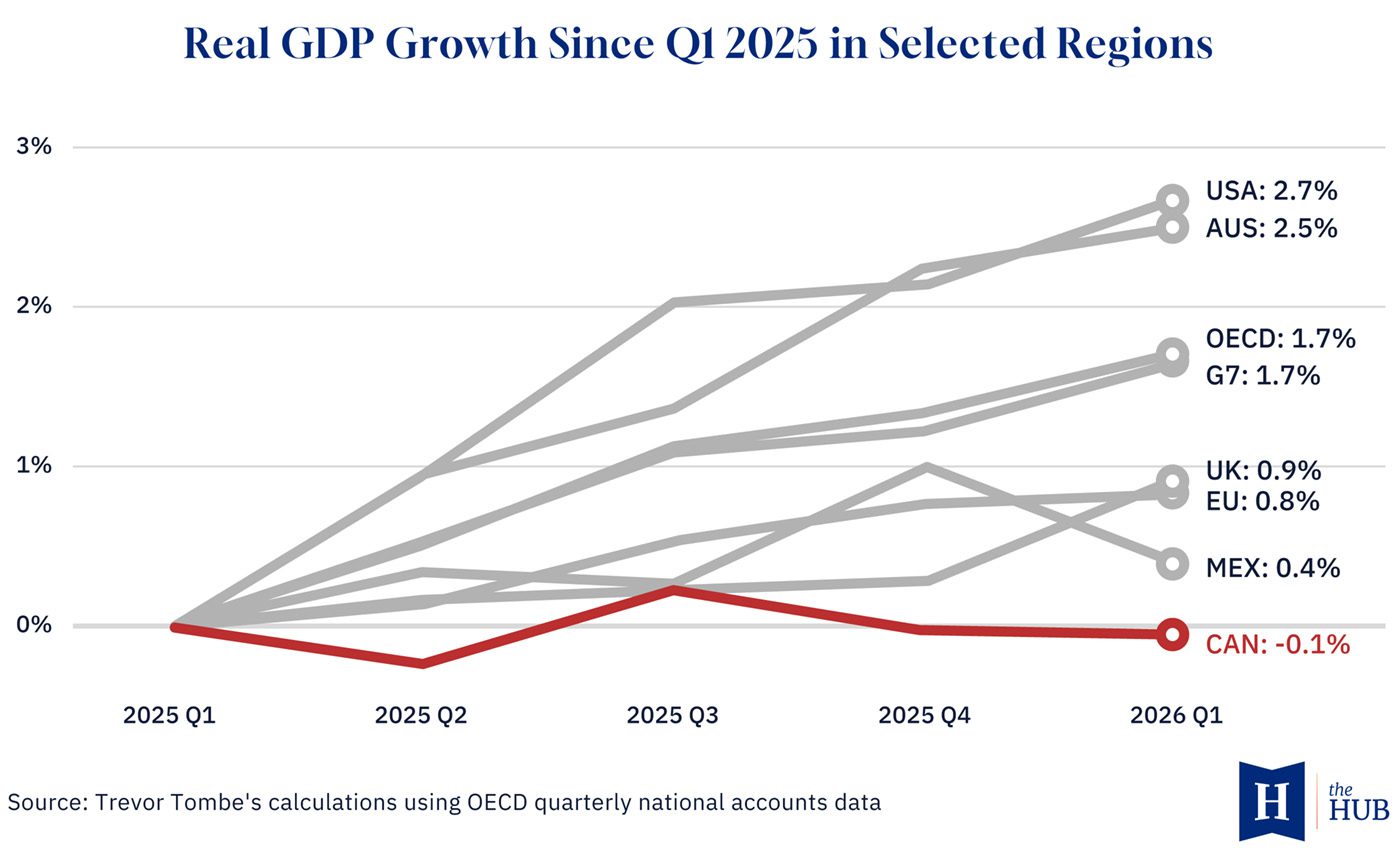
Some of this reflects Canada’s recent slower population growth, so per-person figures may be more relevant. There we’ve done better—real GDP per person was 0.2 percent higher in the first quarter of 2026 than a year earlier. But with the exception of Mexico, every economy above still beats us. The OECD averaged 1.5 percent per person. The G7 averaged 1.6 percent. Australia came in at 1 percent, and the U.K. and EU at 0.7 percent each.

By these measures, Canada has been languishing.

Nor is the problem that we’re running below our own capacity. The Bank of Canada’s most recent estimate puts the economy about 1 percent above its own underlying potential—roughly where it has sat in most quarters over the past four years. The first half of 2026 looks much like the first half of every year going back to 2022. What’s been lagging isn’t output relative to potential. It’s potential itself.

Optimistic, but clear-eyed

None of this makes me a pessimist. I’m genuinely optimistic about the quarters ahead (even despite some additional tariffs that may be headed our way).

The Canadian Chamber of Commerce’s Business Data Lab, for example, runs a really cool real-time nowcasting tool that currently puts second-quarter growth well above most professional forecasts, and I tend to share that optimism. That means unemployment should keep falling (barring new international shocks or a fresh rise in uncertainty, of course) and the Bank of Canada may even begin raising rates early next year (if not earlier, although that’s probably a coin flip at this point).

But rising growth off a lower base is not the same as a strong economy. Canada is getting closer to normal growth rates along a permanently poorer trajectory than the one we were on before January 2025.

That’s the context worth keeping in mind.


Trevor Tombe is a professor of economics at the University of Calgary, the Director of Fiscal and Economic Policy at The School of Public Policy, a Senior Fellow at the Macdonald-Laurier Institute, and a Fellow at the Public Policy Forum.

Source: The Hub

Related Posts

Cambridge missteps in handling of scandal over alleged plagiarism: Peter MacKinnon in the National Post
Education

Cambridge missteps in handling of scandal over alleged plagiarism: Peter MacKinnon in the National Post

August 11, 2026
The new foreign interference law is a good start. Will it work?: Sarah Teich, Marcus Kolga and Gloria Fung in The Globe and Mail
Foreign Interference

The new foreign interference law is a good start. Will it work?: Sarah Teich, Marcus Kolga and Gloria Fung in The Globe and Mail

August 11, 2026
Iran’s demands to reopen Strait of Hormuz includes unfreezing assets, compensation, more: Joe Varner on CTV News
Middle East and North Africa

Iran’s demands to reopen Strait of Hormuz includes unfreezing assets, compensation, more: Joe Varner on CTV News

August 10, 2026

Newsletter Signup

  Thank you for Signing Up
  Please correct the marked field(s) below.
Email Address  *
1,true,6,Contact Email,2
First Name *
1,true,1,First Name,2
Last Name *
1,true,1,Last Name,2
*
*Required Fields

Follow us on

Macdonald-Laurier Institute

323 Chapel Street, Suite #300
Ottawa, Ontario, K1N 7Z2 Canada

613.482.8327

info@macdonaldlaurier.ca
MLI directory

Support Us

Support the Macdonald-Laurier Institute to help ensure that Canada is one of the best governed countries in the world. Click below to learn more or become a sponsor.

Support Us

  • Inside Policy Magazine
  • Annual Reports
  • Jobs
  • Privacy Policy

© 2023 Macdonald-Laurier Institute. All Rights reserved.

No Result
View All Result
  • Home
  • About
    • Who We Are
    • Who Makes MLI Work
    • Fifteenth Anniversary
  • Experts
    • Experts Directory
    • In Memoriam
  • Issues
    • Domestic Policy
      • Economic Policy
      • Justice
      • Rights and Freedoms
      • Assisted Suicide (MAID)
      • Health Care
      • COVID-19
      • Gender Identity
      • Canada’s Political Tradition
      • AI, Technology and Innovation
      • Media and Telecoms
      • Housing
      • Immigration
      • Agriculture and Agri-Food
      • Competition Policy
    • Energy Policy
      • Energy
      • Environment
    • Foreign Policy
      • Israel-Hamas War
      • Ukraine
      • Taiwan
      • China
      • Europe and Russia
      • Indo-Pacific
      • Middle East and North Africa
      • North America
      • Foreign Interference
      • National Defence
      • National Security
      • Foreign Affairs
    • Indigenous Affairs
  • Projects
    • CNAPS (Center for North American Prosperity and Security)
    • The Promised Land
    • Dragon at the door
    • Justice Report Card
    • DisInfoWatch.org
    • Managing Indigenous Prosperity
    • Judicial Foundations
    • Landmark Cases Council
    • Closing Canada’s Border, Policing, and Legal Gaps
    • Reforming the University
    • Digital Policy & Connectivity
    • Defending The Marketplace of Ideas
    • Letter to a minister
    • Past Projects
      • The Great Energy Crisis
      • Canada on top of the world
      • Double Trouble
      • Canada and the Indo-Pacific Initiative
      • The Transatlantic Program
      • COVID Misery Index
      • Speak for Ourselves
      • The Eavesdropping Dragon: Huawei
      • Talkin’ in the Free World with Mariam Memarsadeghi
      • An Intellectual Property Strategy for Canada
      • Munk Senior Fellows
      • A Mandate for Canada
      • Confederation Series
      • Fiscal Reform
      • The Canadian Century project
      • Fixing Canadian health care
      • Internal trade
      • From a mandate for change
      • Size of government in Canada
      • Straight Talk
      • Labour Market Report
      • Leading Economic Indicator
      • Centre for Advancing Canada’s Interests Abroad
      • Indigenous Prosperity at a Crossroads
  • Events
    • Voices that Inspire: The Macdonald-Laurier Vancouver Speaker Series
    • Upcoming Events
    • Past Events
      • MLI Dinners
      • Great Canadian Debates
  • Latest News
  • Libraries
    • Columns
    • Commentary
    • Papers
    • Books
    • Video
  • Donate

© 2023 Macdonald-Laurier Institute. All Rights reserved.