Tuesday, August 25, 2026
No Result
View All Result
  • Media
Macdonald-Laurier Institute
  • Home
  • About
    • Who We Are
    • Who Makes MLI Work
    • Fifteenth Anniversary
  • Experts
    • Experts Directory
    • In Memoriam
  • Issues
    • Domestic Policy
      • Economic Policy
      • Justice
      • Rights and Freedoms
      • Assisted Suicide (MAID)
      • Health Care
      • COVID-19
      • Gender Identity
      • Canada’s Political Tradition
      • AI, Technology and Innovation
      • Media and Telecoms
      • Housing
      • Immigration
      • Agriculture and Agri-Food
      • Competition Policy
    • Energy Policy
      • Energy
      • Environment
    • Foreign Policy
      • Israel-Hamas War
      • Ukraine
      • Taiwan
      • China
      • Europe and Russia
      • Indo-Pacific
      • Middle East and North Africa
      • North America
      • Foreign Interference
      • National Defence
      • National Security
      • Foreign Affairs
    • Indigenous Affairs
  • Projects
    • CNAPS (Center for North American Prosperity and Security)
    • The Promised Land
    • Dragon at the door
    • Justice Report Card
    • DisInfoWatch.org
    • Managing Indigenous Prosperity
    • Judicial Foundations
    • Landmark Cases Council
    • Closing Canada’s Border, Policing, and Legal Gaps
    • Reforming the University
    • Digital Policy & Connectivity
    • Defending The Marketplace of Ideas
    • Letter to a minister
    • Past Projects
      • The Great Energy Crisis
      • Canada on top of the world
      • Double Trouble
      • Canada and the Indo-Pacific Initiative
      • The Transatlantic Program
      • COVID Misery Index
        • Provincial COVID Misery Index
        • Beyond Lockdown
        • COVID and after: A mandate for recovery
      • Speak for Ourselves
      • The Eavesdropping Dragon: Huawei
      • Talkin’ in the Free World with Mariam Memarsadeghi
      • An Intellectual Property Strategy for Canada
      • Munk Senior Fellows
      • A Mandate for Canada
      • Confederation Series
      • Fiscal Reform
      • The Canadian Century project
      • Fixing Canadian health care
      • Internal trade
      • From a mandate for change
      • Size of government in Canada
      • Straight Talk
      • Labour Market Report
      • Leading Economic Indicator
      • Centre for Advancing Canada’s Interests Abroad
      • Indigenous Prosperity at a Crossroads
        • Aboriginal Canada and Natural Resources
  • Events
    • Voices that Inspire: The Macdonald-Laurier Vancouver Speaker Series
    • Upcoming Events
    • Past Events
      • MLI Dinners
      • Great Canadian Debates
  • Latest News
  • Libraries
    • Columns
    • Commentary
    • Papers
    • Books
    • Video
  • Donate
  • Home
  • About
    • Who We Are
    • Who Makes MLI Work
    • Fifteenth Anniversary
  • Experts
    • Experts Directory
    • In Memoriam
  • Issues
    • Domestic Policy
      • Economic Policy
      • Justice
      • Rights and Freedoms
      • Assisted Suicide (MAID)
      • Health Care
      • COVID-19
      • Gender Identity
      • Canada’s Political Tradition
      • AI, Technology and Innovation
      • Media and Telecoms
      • Housing
      • Immigration
      • Agriculture and Agri-Food
      • Competition Policy
    • Energy Policy
      • Energy
      • Environment
    • Foreign Policy
      • Israel-Hamas War
      • Ukraine
      • Taiwan
      • China
      • Europe and Russia
      • Indo-Pacific
      • Middle East and North Africa
      • North America
      • Foreign Interference
      • National Defence
      • National Security
      • Foreign Affairs
    • Indigenous Affairs
  • Projects
    • CNAPS (Center for North American Prosperity and Security)
    • The Promised Land
    • Dragon at the door
    • Justice Report Card
    • DisInfoWatch.org
    • Managing Indigenous Prosperity
    • Judicial Foundations
    • Landmark Cases Council
    • Closing Canada’s Border, Policing, and Legal Gaps
    • Reforming the University
    • Digital Policy & Connectivity
    • Defending The Marketplace of Ideas
    • Letter to a minister
    • Past Projects
      • The Great Energy Crisis
      • Canada on top of the world
      • Double Trouble
      • Canada and the Indo-Pacific Initiative
      • The Transatlantic Program
      • COVID Misery Index
        • Provincial COVID Misery Index
        • Beyond Lockdown
        • COVID and after: A mandate for recovery
      • Speak for Ourselves
      • The Eavesdropping Dragon: Huawei
      • Talkin’ in the Free World with Mariam Memarsadeghi
      • An Intellectual Property Strategy for Canada
      • Munk Senior Fellows
      • A Mandate for Canada
      • Confederation Series
      • Fiscal Reform
      • The Canadian Century project
      • Fixing Canadian health care
      • Internal trade
      • From a mandate for change
      • Size of government in Canada
      • Straight Talk
      • Labour Market Report
      • Leading Economic Indicator
      • Centre for Advancing Canada’s Interests Abroad
      • Indigenous Prosperity at a Crossroads
        • Aboriginal Canada and Natural Resources
  • Events
    • Voices that Inspire: The Macdonald-Laurier Vancouver Speaker Series
    • Upcoming Events
    • Past Events
      • MLI Dinners
      • Great Canadian Debates
  • Latest News
  • Libraries
    • Columns
    • Commentary
    • Papers
    • Books
    • Video
  • Donate
No Result
View All Result
Macdonald-Laurier Institute

Which American goods should Carney tariff? Breaking down Canada’s retaliation trilemma: Trevor Tombe in The Hub

Prime Minister Mark Carney’s commitment to a dollar-for-dollar response could lead to significant tariff increases, potentially the largest in Canadian history.

August 25, 2026
in Domestic Policy, Columns, Latest News, In the Media, Economic Policy, North America, Trevor Tombe
Reading Time: 5 mins read
A A
Which American goods should Carney tariff? Breaking down Canada’s retaliation trilemma: Trevor Tombe in The Hub

Image via Canva.

This article originally appeared in The Hub.

By Trevor Tombe, August 25, 2026

A full-blown trade war with the United States is now underway. Last weekend, the U.S. levied 50 percent tariffs on roughly 5 percent of Canada’s exports. Prime Minister Mark Carney has committed to respond in kind, dollar for dollar.

Whether we should retaliate at all is a separate debate. Many, myself included, think it is potentially unwise. Retaliation adds to the costs on Canada’s economy, and it may not change American behaviour. But public opinion is behind it, and the government has made its choice.

The open question is then which American goods do we tariff?

That is harder than it looks. And, as I’ll try to argue below, Canada faces a difficult trilemma.

Tariff levels not seen in decades

Matching the U.S. tariffs “dollar for dollar” means 50 percent tariffs on roughly $28 billion of Canadian imports ($20 billion USD). That is a lot. By my estimate, it would be one of the largest single tariff increases in Canadian history.

Based on data on the effective tariff rate that Canada has applied to U.S. goods since Confederation, I estimate a package this size would push that rate to levels last seen in the late 1970s.
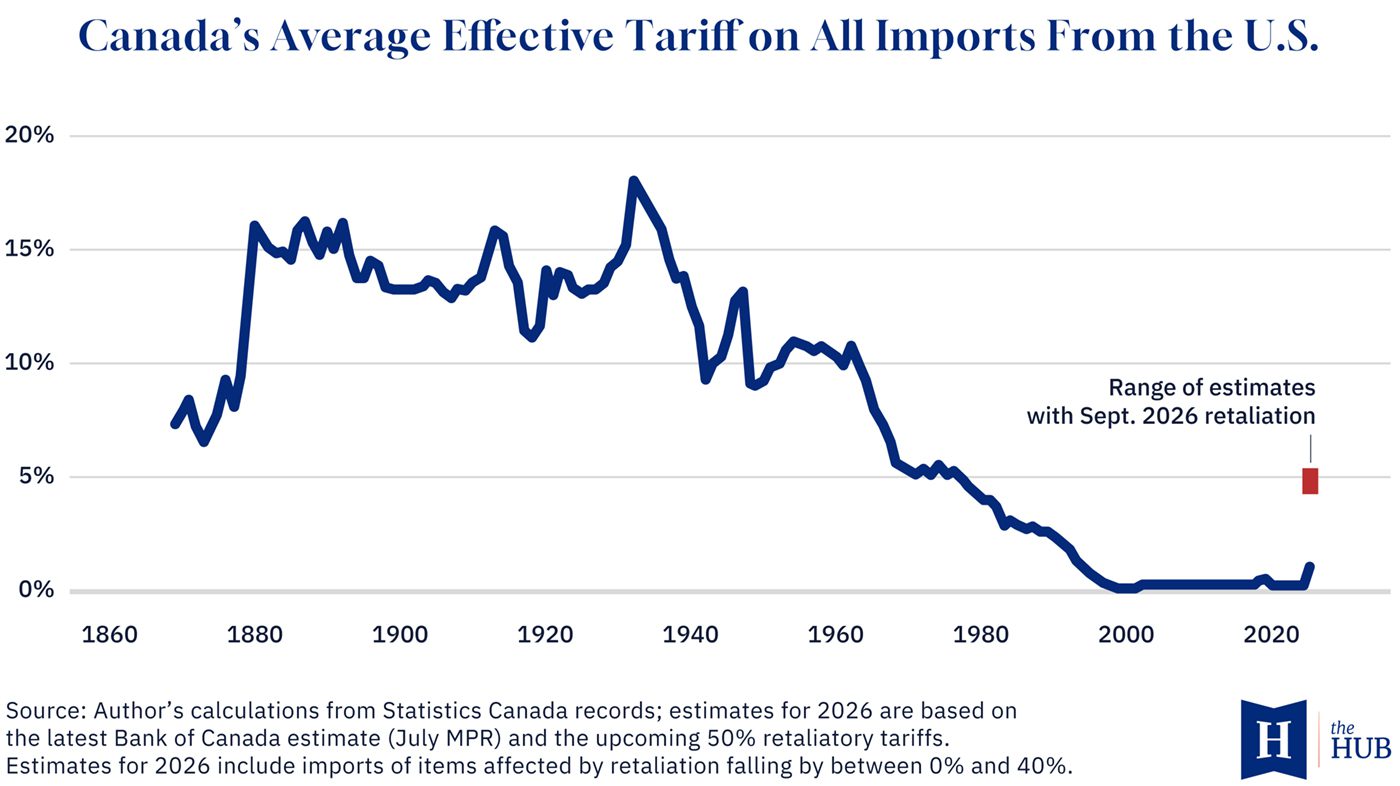
What effect these tariffs will have on Canada and the United States depends on what we choose to levy them on.

Three objectives

There are three things we might want a retaliatory package to do.

First, and most importantly, change U.S. behaviour. If not that, then what is the point? And since only a handful of states decide who becomes president, targeting swing states may be a reasonable objective. That means Wisconsin, Michigan, Pennsylvania, Georgia, Nevada, North Carolina, and Arizona, all of which went narrowly for President Trump in 2024.

Second, cause economic damage that U.S. producers will actually feel. Canada is small, so this is a hard one. If we account for only a small share of U.S. sales, tariffs put little pressure on anyone south of the border, swing state or not. But for some items, Canada might be an important destination, so we could narrow our retaliation to those.

Third, and finally, limit the damage at home. Tariffs raise prices for Canadians and disrupt businesses that rely on imported parts, materials, and machinery. That damage is smallest, though, when other countries could supply the same goods, since buyers could more easily substitute away from their U.S. purchases.

Put simply, retaliation may work best if we can easily substitute away from American goods, if Americans cannot easily substitute away from us, and if the Americans affected are electorally important.

Unfortunately, Canada is not big enough to do all three at once. At best, we can pick two.

A difficult trilemma

Let’s start with the first one. Can we tariff products where the seven swing states account for a majority of U.S. exports to Canada? I count roughly 600 such products that, together, would slightly exceed what we need for dollar-for-dollar retaliation.

Unfortunately for Canada’s economy, these items would disproportionately be accounted for by motor vehicles and transportation equipment, industrial supplies, and capital goods, with only minimal consumer goods.
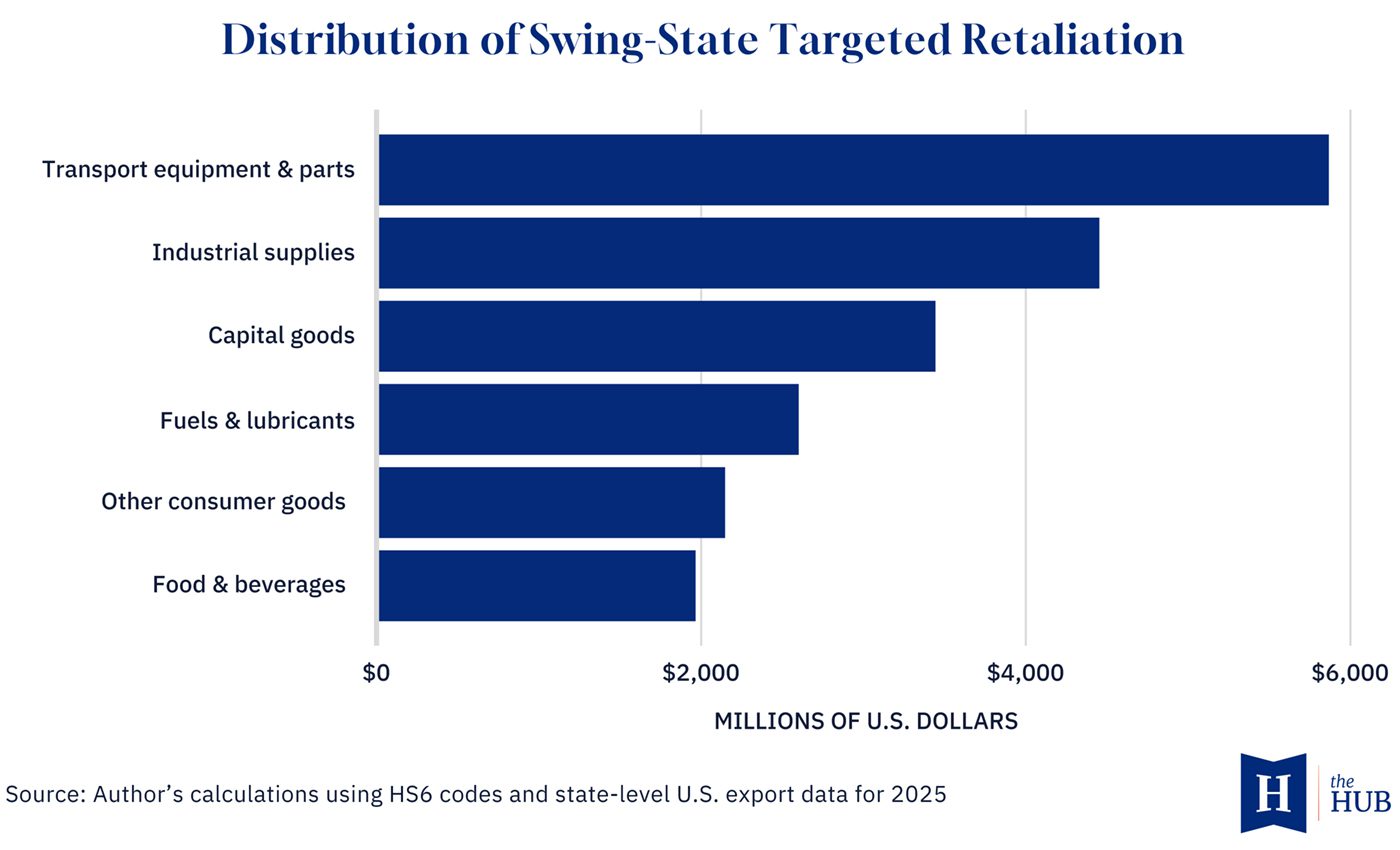
Worse, Canada is not really an important destination market for those products either. At best, we could restrict to about 330 items where Canada is only at least 15 percent of total U.S. exports (which is what I illustrate in the above graph). Restrict further to items where Canada accounts for most U.S. exports, and you’re left with a package less than half as large as needed.

Could we spare Canadian businesses by narrowing the list to food and consumer goods? Those add up to only about one-fifth of the package the government is looking for.

So, if objective one is achieved, two and three cannot be. We’d be hitting ourselves hard.

What if we abandon the requirement to be electorally important? Is there a set of consumer goods and food items where the U.S. supplies a minority of our imports, but where Canada accounts for a majority of U.S. exports? No. Not even close. So objectives two and three cannot both be simultaneously achieved in any scenario.

At best, restricted to consumer goods and food, we could target items where Canada accounts for a majority of U.S. exports, but swing states would only account for roughly one-quarter of that and for some of those items we wouldn’t have easy alternatives to turn to. Plus, such a package would still fall just slightly short of a full dollar-for-dollar response.

A compromise package is possible on looser terms. For example, we could target a set of nearly 680 items that excludes transport equipment and fuel inputs, and where swing states account for 45 percent of U.S. exports to Canada. But as before, this would be dominated by industrial supplies and capital goods. And there would be many items where the U.S. supplies over 90 percent of Canada’s imports.

No good options

We could go on and on exploring various packages, but hopefully by now the pattern is clear. Food and consumer goods are the items we could tariff with the least harm to Canada’s overall economy, and there are enough of them where Canada accounts for a majority of U.S. exports. But they are simply not well targeted at politically important states.

So we must accept disruption at home and levy tariffs on industrial inputs and capital goods too. And if not that, then accept poorly targeted tariffs in the U.S. Neither is a good option.

Picking how to retaliate is very difficult for a small country. We cannot at once target products where Canada is a large destination market, where the costs fall on key swing states, and where other countries remain meaningful suppliers for Canadians to substitute towards. A package that ticks all three boxes would, I estimate, be less than one-tenth the size that the government is looking for.

Whatever the government lands on, the economic implications for Canada cannot be ignored. Leaders will say these measures protect Canadian jobs and the economy. But in the short term, at least, they will come with significant costs of their own.


Trevor Tombe is a professor of economics at the University of Calgary, the Director of Fiscal and Economic Policy at The School of Public Policy, a Senior Fellow at the Macdonald-Laurier Institute, and a Fellow at the Public Policy Forum.

Source: The Hub

Related Posts

China is weaponizing the Canada–US trade rift to divide North America: Stephen Nagy for Inside Policy
Foreign Affairs

China is weaponizing the Canada–US trade rift to divide North America: Stephen Nagy for Inside Policy

August 25, 2026
Clarifying Canada’s role in NATO’s Arctic Sentry: Nicole J. Jackson
Arctic

Clarifying Canada’s role in NATO’s Arctic Sentry: Nicole J. Jackson

August 25, 2026
Doubling Canada’s non-U.S. exports is actually easy: Trevor Tombe in The Hub
Economic Policy

We revived a moribund economy before. We can do it again: Philip Cross in the Financial Post

August 24, 2026

Newsletter Signup

  Thank you for Signing Up
  Please correct the marked field(s) below.
Email Address  *
1,true,6,Contact Email,2
First Name *
1,true,1,First Name,2
Last Name *
1,true,1,Last Name,2
*
*Required Fields

Follow us on

Macdonald-Laurier Institute

323 Chapel Street, Suite #300
Ottawa, Ontario, K1N 7Z2 Canada

613.482.8327

info@macdonaldlaurier.ca
MLI directory

Support Us

Support the Macdonald-Laurier Institute to help ensure that Canada is one of the best governed countries in the world. Click below to learn more or become a sponsor.

Support Us

  • Inside Policy Magazine
  • Annual Reports
  • Jobs
  • Privacy Policy

© 2023 Macdonald-Laurier Institute. All Rights reserved.

No Result
View All Result
  • Home
  • About
    • Who We Are
    • Who Makes MLI Work
    • Fifteenth Anniversary
  • Experts
    • Experts Directory
    • In Memoriam
  • Issues
    • Domestic Policy
      • Economic Policy
      • Justice
      • Rights and Freedoms
      • Assisted Suicide (MAID)
      • Health Care
      • COVID-19
      • Gender Identity
      • Canada’s Political Tradition
      • AI, Technology and Innovation
      • Media and Telecoms
      • Housing
      • Immigration
      • Agriculture and Agri-Food
      • Competition Policy
    • Energy Policy
      • Energy
      • Environment
    • Foreign Policy
      • Israel-Hamas War
      • Ukraine
      • Taiwan
      • China
      • Europe and Russia
      • Indo-Pacific
      • Middle East and North Africa
      • North America
      • Foreign Interference
      • National Defence
      • National Security
      • Foreign Affairs
    • Indigenous Affairs
  • Projects
    • CNAPS (Center for North American Prosperity and Security)
    • The Promised Land
    • Dragon at the door
    • Justice Report Card
    • DisInfoWatch.org
    • Managing Indigenous Prosperity
    • Judicial Foundations
    • Landmark Cases Council
    • Closing Canada’s Border, Policing, and Legal Gaps
    • Reforming the University
    • Digital Policy & Connectivity
    • Defending The Marketplace of Ideas
    • Letter to a minister
    • Past Projects
      • The Great Energy Crisis
      • Canada on top of the world
      • Double Trouble
      • Canada and the Indo-Pacific Initiative
      • The Transatlantic Program
      • COVID Misery Index
      • Speak for Ourselves
      • The Eavesdropping Dragon: Huawei
      • Talkin’ in the Free World with Mariam Memarsadeghi
      • An Intellectual Property Strategy for Canada
      • Munk Senior Fellows
      • A Mandate for Canada
      • Confederation Series
      • Fiscal Reform
      • The Canadian Century project
      • Fixing Canadian health care
      • Internal trade
      • From a mandate for change
      • Size of government in Canada
      • Straight Talk
      • Labour Market Report
      • Leading Economic Indicator
      • Centre for Advancing Canada’s Interests Abroad
      • Indigenous Prosperity at a Crossroads
  • Events
    • Voices that Inspire: The Macdonald-Laurier Vancouver Speaker Series
    • Upcoming Events
    • Past Events
      • MLI Dinners
      • Great Canadian Debates
  • Latest News
  • Libraries
    • Columns
    • Commentary
    • Papers
    • Books
    • Video
  • Donate

© 2023 Macdonald-Laurier Institute. All Rights reserved.