
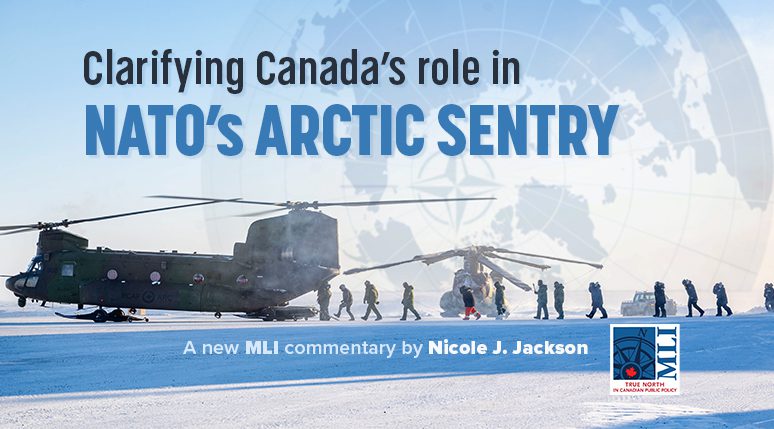
By Nicole J. Jackson
August 25. 2026
NATO launched Arctic Sentry on February 11, 2026. Led by Joint Force Command Norfolk, NATO’s operational headquarters in North America, it brings select Allied exercises, deployments and readiness measures into one High North approach. It gives NATO planners fuller visibility of national military activity and gives Allied forces more opportunities to practice together (NATO 2026a, 2026b). Arctic Sentry is not a new command; national forces and infrastructure remain under national authority. Its immediate gains are a wider regional picture, more regular Allied activity, and greater familiarity among forces operating in northern conditions. Because the activity is still developing, Canada also has an opportunity to shape which outcomes matter most and how NATO should judge progress.
Canada is not simply joining an activity centred on northern Europe. The High North links Canada’s Arctic to the North Atlantic routes used to move forces, supplies, and information between North America and Europe. NATO planning around Norway, Iceland, Greenland, and the Nordic region can affect demands on Canadian airspace, communications, ports, airfields and logistics. Canadian readiness, in turn, affects what the alliance can do. NORAD, the Canada-United States command for continental warning and defence, remains central to North American security. NATO performs a different function: collective defence, political consultation, and support for allies across the Atlantic. Arctic Sentry gives Canada a way to bring relevant national activity into that wider allied setting while NORAD and NATO retain distinct mandates.
The strategic setting explains why this co-operation matters. Russia’s Northern Fleet remains the immediate military concern in the European Arctic and North Atlantic. Russian sabotage, cyber operations and other low-visibility activity against European infrastructure also show how pressure can be applied below open conflict (Bergmann et al. 2025; Edwards and Seidenstein 2025).
China poses a different, longer-term challenge through dual-use research, infrastructure, technology, and access. Russian and Chinese capabilities could create leverage over Arctic information, logistics, and communications, although their objectives and methods differ (Schalin and Arts 2026). These risks require careful interpretation: ordinary outages, vessel movements, and foreign projects are not inherently hostile (Dalziel 2024).
Undersea infrastructure is a concrete part of this co-operation problem. Data cables, pipelines, and electricity links support communities, public administration, energy supply, and, in some cases, government or military communications. When one is damaged, investigators may know that a break occurred without yet knowing whether ice, an anchor, technical failure, negligence, or deliberate interference caused it (Bueger and Liebetrau 2021; Kavanagh, Franken, and He 2025; Sari 2025). Canadian authorities and NATO could therefore face different decisions while the facts are still developing.
An ordinary cable break remains a Canadian matter. Operators restore service, Canadian authorities investigate and exercise legal powers, and territorial, Indigenous, and local authorities address community effects. Arctic Sentry does not alter those responsibilities. NATO becomes relevant only if credible information or consequences indicate possible effects on allied warning, communications, operations, reinforcement, deterrence, or the ability of allies to act together. Canadian authorities and operators would continue the domestic response; NATO would consider any wider need for allied military planning, consultation or reassurance.
Canada can work with NATO through Arctic Sentry via three distinct avenues: by clarifying Canadian objectives, bringing lessons from existing operations and institutions into NATO planning, and deepening routine co-operation with the allies whose forces and infrastructure shape the High North. The Baltic Sea experience provides a practical lesson for all three: NATO can add allied consultation, military presence, and reassurance while national authorities and operators retain investigation, legal powers, and repair. The same principle applies beyond infrastructure incidents whenever national or NATO systems report unusual activity before governments agree on its significance or response.
From Baltic Sentry to Arctic Sentry
NATO has already faced a comparable division of responsibilities in the Baltic Sea. Explosions damaged the Nord Stream gas pipelines in 2022, and the Balticconnector gas pipeline and nearby telecommunications infrastructure were damaged in 2023. Both incidents occurred before Baltic Sentry, but they exposed problems that later NATO activity sought to address: politically sensitive attribution, limits on national legal authority, operator-led repair, and the need for allied consultation while evidence remained incomplete. NATO was involved in all three episodes, but in different ways. After Nord Stream, it issued a public alliance statement and increased protection of critical infrastructure. After Balticconnector, it stepped up patrols and surveillance (NATO 2022, 2023).
Damage to the Estlink 2 electricity link and related data cables in December 2024 prompted a more visible response from Finland, the European Union, and NATO. The following month NATO launched Baltic Sentry, a regional military activity designed to strengthen allied presence, awareness and deterrence around critical undersea infrastructure in the Baltic Sea (NATO 2025). The three cases therefore illustrate the purpose of Baltic Sentry and what NATO could add without taking over national investigation, enforcement, or repair.
Nord Stream: Restraint still requires direction
Explosions damaged Nord Stream 1 and 2 near Bornholm in September 2022. Governments had strong reasons to avoid public accusations while investigations remained incomplete, because naming a state could carry serious diplomatic and escalation consequences. Sweden later closed its investigation after concluding that Swedish jurisdiction did not apply (Swedish Prosecution Authority 2024). NATO also issued a public statement that described the available information as indicating sabotage, supported the national investigations, and warned that any deliberate attack on allied critical infrastructure would meet a united response (NATO 2022). Limited public disclosure about the evidence and possible responsibility could therefore reflect deliberate caution rather than inaction. Public sources cannot show what allies discussed privately. The bounded lesson for NATO is that public restraint still requires internal consultation and reassurance, so that it is understood as caution rather than confusion or disagreement.
Balticconnector: Technical clarity and visible repair
One year later, Balticconnector showed how technical and repair information could provide clarity without premature blame. In October 2023, the gas pipeline between Finland and Estonia was damaged alongside nearby telecommunications infrastructure. Finnish investigators found that external mechanical force caused the damage, but they did not determine intent or responsibility. They also explained that their direct enforcement powers were limited while the suspected vessel remained in Finland’s exclusive economic zone (Police of Finland 2023). Gasgrid subsequently announced that repairs were complete and recommissioning had begun (Gasgrid Finland 2024). NATO also increased Baltic Sea patrols and surveillance, including maritime patrol aircraft, AWACS aircraft, drones and four minehunters (NATO 2023). The public could therefore distinguish what the evidence showed, what the law allowed, how service would be restored, and how NATO was increasing regional vigilance.
Estlink 2: What Baltic Sentry added
Estlink 2 led to the clearest named and sustained NATO response of the three cases. Damage in December 2024 affected an electricity interconnector and related data cables. Finland acted quickly, the European Union offered support, and NATO launched Baltic Sentry in January 2025 (European Commission and High Representative 2024; NATO 2025). A Finnish court later held that Finland lacked jurisdiction over the alleged damage, and prosecutors appealed (National Prosecution Authority 2025). Baltic Sentry made NATO attention, presence, and reassurance more visible. Finnish authorities continued the investigation and took the measures available under national and maritime law. Later proceedings exposed the limits of Finnish criminal jurisdiction, and operators remained responsible for repair. NATO activity could proceed without implying that political concern had settled responsibility.
Seen together, the cases clarify both Baltic Sentry’s value and its limits. NATO could add presence, consultation, and reassurance, but national authorities still investigated and exercised legal powers, and operators still repaired the infrastructure. The evidence needed also depended on the decision being considered. Technical findings could support further investigation. Credible but incomplete information could support confidential allied consultation or temporary protective measures. Publicly accusing a state required stronger proof. For Arctic Sentry, the wider lesson is that a better regional picture is useful only when it supports proportionate NATO decisions that remain consistent with national law, technical findings, repair, and evidence-based public explanation (Jackson 2026a).
That operational lesson is now being carried north through the two Task Force X projects. Task Force X-Baltic, launched in January 2025, supported Baltic Sentry by testing more than 70 uncrewed air, surface, and underwater systems alongside allied forces. Task Force X-Arctic, launched in June 2026, is adapting that approach to the much larger North Atlantic, Arctic, and High North. It is testing how linked drones, uncrewed surface craft, and underwater vehicles can improve NATO’s regional picture (NATO 2026c; NATO Allied Command Transformation 2026). These experiments may improve detection and coverage, but national and NATO authorities still decide what the information means, who may lawfully act, and when Allied consultation is warranted.
That distinction applies beyond damaged cables. Across the High North, national or NATO systems may report unusual military, maritime, cyber, or infrastructure activity before governments agree on its significance. Arctic Sentry is most useful when it helps allies compare national information, coordinate military planning, and begin political consultation while national authorities continue their own work. This broader function is why Canada’s northern operating experience and relevant national information matter to NATO planning.
How Canada is already engaging with Arctic Sentry
At home, Operation NANOOK-NUNALIVUT tests whether Canada can deploy and sustain forces across its own North, work with allies and co-operate with northern communities. The 2026 exercise contributed to Canada’s support for Arctic Sentry (Department of National Defence 2026b, 2026c).
Farther west, Operation LATITUDE brings Canadian ships, aircraft, special operations personnel, and the Canadian Coast Guard together with United States forces in northern waters, including the Bering Sea. It improves awareness of northern approaches, supports continental defence, and is conducted in alignment with Arctic Sentry (Department of National Defence 2026a). Across the Atlantic, Canada participated in Cold Response 2026, Norway’s recurring multinational winter exercise. Held in northern Norway, Finland, and adjacent seas, it rehearsed allied reinforcement and collective defence under Arctic conditions and was included among Arctic Sentry’s initial activities (NATO 2026b; Norwegian Armed Forces 2026).
These activities serve different purposes. NANOOK-NUNALIVUT develops Canada’s ability to operate at home. LATITUDE strengthens work with the United States in North American and North Pacific approaches. Cold Response places Canadian personnel in a large European collective-defence exercise. Task Force X-Arctic is an experiment in improving regional awareness. Together, they give Canada experience at home, with its continental partner and with European Allies. They also provide settings in which Canada can examine how lessons and information from national activity inform NATO planning.
Beyond these activities, Canada can draw on existing maritime-security, emergency-management, defence, and foreign policy arrangements, together with the distinct authorities of territorial and Indigenous governments. After-action reviews and future exercises could examine how these arrangements already work when an event has both national and Allied consequences. They could confirm what functions well and identify where information-sharing, responsibilities, or links to NATO military and political channels would benefit from clarification.
Canada’s contribution also rests on capacity and legitimate authority at home. Communications, transport, energy, airfields, ports, trained personnel, maintenance, and repair access affect northern continuity and Canada’s ability to operate (Jackson 2026b, 2026c). Federal policy already links northern and Indigenous leadership, sustainable development, and security (Global Affairs Canada 2024; Department of National Defence 2024). Prime Minister Mark Carney’s March 2026 northern plan made that link more concrete by pairing operational support hubs with investments in airports, roads, ports, energy, and broadband developed with territorial and Indigenous partners (Prime Minister of Canada 2026). Operators know what failed and what repair requires. Territorial and Indigenous governments, municipalities and community institutions know which services, rights, and communities are affected. Their independent authority and knowledge make Canadian decisions more accurate, lawful, and credible. This strengthens Canada’s contribution to NATO while keeping civilian institutions outside military command.
Three ways Canada could work through Arctic Sentry
The analysis points to three ways Canada could deepen work already under way. Canada already contributes to Arctic Sentry, uses existing institutions, and works with key allies. The policy issue is how to make those efforts more deliberate, consistent, and measurable: clarifying Canada’s objectives for Arctic Sentry, bringing Canadian experience into NATO planning, and sustaining co-operation with the allies most involved in the High North.
Clarifying Canada’s objectives for Arctic Sentry
Canada could help clarify which Arctic Sentry outcomes matter most for Canada and how NATO should judge progress beyond counting exercises, forces or technologies. For Ottawa, success could include a more reliable regional picture, forces able to work together in northern conditions, and protected routes for moving forces and supplies. It could also include earlier political consultation when an event has alliance consequences, and proportionate readiness and reassurance. These objectives would help Ottawa direct its contributions and assess whether Arctic Sentry’s incremental gains support Canadian priorities. Their adoption would depend on Allied agreement.
Canada can also advocate planning criteria for when information available through Arctic Sentry warrants NATO attention. Damage to civilian infrastructure alone would not be enough. The relevant question is whether credible indicators or consequences affect allied warning, communications, operations, reinforcement, deterrence or the ability to act together. These criteria would guide assessment and consultation rather than trigger an automatic military response. Ottawa would need support from the United States, Arctic allies, the United Kingdom and other partners whose forces and infrastructure shape the region.
Using Canadian operations and institutions more deliberately in NATO planning
Canada can draw lessons from after-action reviews of its 2026 participation and from future iterations of NANOOK and LATITUDE. Future Canadian participation in Cold Response can also show which national lessons should inform Arctic Sentry. Reviews should examine what Canadian geography, logistics, communications, and northern operating experience mean for NATO exercises and plans. They could also trace how information from national operations reaches Joint Force Command Norfolk for military planning. When political consultation is needed, Canada would raise the issue through the North Atlantic Council, NATO’s political decision-making body.
Future exercises could begin with reports from operators or Canadian authorities rather than with a declared attack. They could examine how existing Canadian arrangements combine technical information, legal findings, service effects, and security implications; when an event remains national; and when it also affects allied interests. Task Force X-Arctic could be included so that information from new systems is traced to an authority able to interpret and use it. The exercise would preserve existing mandates while clarifying how relevant information reaches a decision. It would also test lawful use, human judgment, oversight, and limits on collection.
Deepening routine co-operation with the allies most involved
Canada could deepen routine co-operation with the United States, Nordic and Baltic Allies, the United Kingdom, and other European partners through ministerial consultation, NATO committees, exercises, and military planning. Canada brings Arctic geography, experience operating across long distances, and a North American perspective. European Allies bring recent experience with collective defence, undersea incidents, and regional infrastructure. Deeper co-operation would build shared expectations before a crisis while each ally retains its own authorities and procedures.
Such co-operation also has a European Union dimension. The EU is updating its 2021 Arctic policy to give greater weight to security, defence, connectivity and economic security while retaining climate, sustainable-development and scientific priorities. The European Parliament has called for deeper Arctic co-operation with Canada on early warning, hybrid threats, and critical infrastructure. This gives Canada scope to work with European partners through both NATO and the EU. NATO provides the framework for Allied defence and consultation, while the EU can contribute complementary regulation, investment, and civilian-resilience tools (European External Action Service 2026; European Parliament 2026).
During a crisis, these relationships can also help keep public explanations aligned. NATO can explain allied consultation or changes in readiness. Canadian investigators can explain what is known and unresolved; operators can explain service effects and repair; territorial, Indigenous, and local authorities can address community needs. Their accounts need not be identical, but they should fit together. A disruptive act gains less political advantage when Canadian action, operator-led restoration, and NATO consultation remain proportionate and mutually reinforcing.
Conclusion
Arctic Sentry matters to Canada because it gives Ottawa a practical way to work with NATO across the High North. Canada already contributes through operations in its own North, co-operation with the United States, exercises with European Allies, and participation in NATO experimentation. The policy question is how to turn those activities into sustained influence over NATO planning, consultation, and readiness.
The Baltic experience shows that awareness becomes strategically useful when it supports coordinated decisions. Baltic Sentry added NATO presence and attention, while national authorities retained legal powers, and operators remained responsible for repair. Task Force X-Baltic and Task Force X-Arctic show how NATO is carrying technology and awareness lessons north. The broader lesson is that NATO decisions must remain consistent with national authority, technical evidence and civilian consequences.
Canada can therefore work through Arctic Sentry in three ways. It can 1) clarify the objectives it wants the initiative to support, 2) use existing Canadian operations and institutions more deliberately in NATO planning, and 3) deepen routine co-operation with the allies most involved in the region. This approach builds on existing arrangements, uses exercises and reviews to identify gaps, and brings Canadian experience and clear proposals into the alliance. It would strengthen Canadian influence while domestic responsibilities remain with Canadian authorities.
About the author
Nicole J. Jackson is an associate professor in the School for International Studies at Simon Fraser University and was the 2025 MINDS-NATO Defense College Fellow. Her research examines how governments and alliances govern uncertainty: how they connect evidence, authority, communication, and action when challenges are ambiguous and responsibilities are divided. Her current work focuses on NATO, Canadian Arctic policy, and hybrid threats to critical infrastructure, information environments and public trust.
References
Bergmann, Max, Otto Svendsen, Marc Jacobsen, Rebekka Åsnes Sagild, Eskil Jakobsen, and Øystein Solvang. 2025. Defending the North Amid Rising Geopolitical Tensions. Center for Strategic and International Studies, January 14. Available at https://www.csis.org/analysis/defending-north-amid-rising-geopolitical-tensions.
Bueger, Christian, and Tobias Liebetrau. 2021. “Protecting Hidden Infrastructure: The Security Politics of the Global Submarine Data Cable Network.” Contemporary Security Policy 42 (3): 391-413. Available at https://doi.org/10.1080/13523260.2021.1907129.
Dalziel, Alexander. 2024. Critical Resilience: Russia, Hybrid Threats, and Subsea Fibre-Optic Cables in Canada’s Arctic. Macdonald-Laurier Institute, June 20. Available at https://macdonaldlaurier.ca/critical-resilience-russia-hybrid-threats-and-subsea-fibre-optic-cables-in-canadas-arctic/
Department of National Defence. 2024. Our North, Strong and Free: A Renewed Vision for Canada’s Defence. April 8. Available at https://www.canada.ca/en/department-national-defence/corporate/reports-publications/north-strong-free-2024.html.
Department of National Defence. 2026a. “Canadian Armed Forces Conduct Operation LATITUDE to Strengthen Allied Multi-Domain Operations in Northern Waters.” July 23. Available at https://www.canada.ca/en/department-national-defence/news/2026/07/canadian-armed-forces-conduct-operation-latitude-to-strengthen-allied-multi-domain-operations-in-northern-waters.html.
Department of National Defence. 2026b. “Operation NANOOK-NUNALIVUT 2026 Concludes with Strengthened Arctic Defence Presence.” April 16. Available at https://www.canada.ca/en/department-national-defence/news/2026/04/operation-nanook-nunalivut-2026-concludes-with-strengthened-arctic-defence-presence.html.
Department of National Defence. 2026c. “Operation NANOOK.” Updated July 24. Available at https://www.canada.ca/en/department-national-defence/services/operations/military-operations/current-operations/operation-nanook.html.
Edwards, Charlie, and Nate Seidenstein. 2025. The Scale of Russian Sabotage Operations Against Europe’s Critical Infrastructure. International Institute for Strategic Studies, August 19. Available at https://www.iiss.org/research-paper/2025/08/the-scale-of-russian–sabotage-operations–against-europes-critical–infrastructure/.
European Commission and High Representative. 2024. “Joint Statement by the European Commission and the High Representative on the Investigation into Damaged Electricity and Data Cables in the Baltic Sea.” December 26. Available at https://www.eeas.europa.eu/eeas/joint-statement-european-commission-and-high-representative-investigation-damaged-electricity-and_en.
European External Action Service. 2026. “The EU in the Arctic.” January 28. Available at: https://www.eeas.europa.eu/eeas/eu-arctic_en.
European Parliament. 2026. “Recommendation on Enhanced EU-Canada Cooperation in the Current Geopolitical Context, Including the Threats to Canada’s Economic Stability and Sovereignty.” March 11. Available at https://www.europarl.europa.eu/doceo/document/TA-10-2026-0078_EN.html.
Gasgrid Finland. 2024. “Balticconnector’s Repair Work Completed – Next on to Commissioning.” April 4. Available at https://gasgrid.fi/en/bulletins/balticconnectors-repair-work-completed-next-on-to-commissioning/.
Global Affairs Canada. 2024. Canada’s Arctic Foreign Policy. December. Available at https://international.canada.ca/en/global-affairs/corporate/reports/arctic-policy-2024?lang=eng.
Jackson, Nicole J. 2026a. “Network Signalling under Uncertainty and Undersea Critical Infrastructure Security in the Baltic Sea.” Revised manuscript under review at an academic journal.
Jackson, Nicole J. 2026b. “Network Signalling Under Uncertainty: Lessons from the Baltic Sea for a Canadian Undersea Cable Posture.” Journal of Intelligence, Conflict, and Warfare 8 (3): 1-38. Available at https://doi.org/10.21810/jicw.v8i3.7613.
Jackson, Nicole J. 2026c. “Northern Cable Security Is Becoming a Test of Canada’s Arctic Readiness.” Policy Options, May 20. Available at https://policyoptions.irpp.org/2026/05/arctic-cable-security/.
Kavanagh, Camino, Jonas Franken, and Wenting He. 2025. Achieving Depth: Subsea Telecommunications Cables as Critical Infrastructure. Geneva: United Nations Institute for Disarmament Research. Available at https://unidir.org/publication/achieving-depth-subsea-telecommunications-cables-as-critical-infrastructure/.
National Prosecution Authority. 2025. “Prosecutor Appeals Judgement in the Eagle S Case.” October 9. Available at https://www.syyttajalaitos.fi/en/news/news-archive/prosecutor-appeals-judgement-in-the-eagle-s-case/.
NATO. 2022. “Statement by the North Atlantic Council on the Damage to Gas Pipelines.” September 29. Available at https://www.nato.int/en/about-us/official-texts-and-resources/official-texts/2022/09/29/statement-by-the-north-atlantic-council-on-the-damage-to-gas-pipelines.
NATO. 2023. “NATO Steps Up Baltic Sea Patrols after Subsea Infrastructure Damage.” October 19. Available at https://www.nato.int/en/news-and-events/articles/news/2023/10/19/nato-steps-up-baltic-sea-patrols-after-subsea-infrastructure-damage.
NATO. 2025. “NATO Launches ‘Baltic Sentry’ to Increase Critical Infrastructure Security.” January 14. Available at https://www.nato.int/en/news-and-events/articles/news/2025/01/14/nato-launches-baltic-sentry-to-increase-critical-infrastructure-security.
NATO. 2026a. “Arctic Security.” Updated July 24. Available at https://www.nato.int/en/what-we-do/deterrence-and-defence/arctic-security.
NATO. 2026b. “NATO Secretary General Outlines New Activity – Arctic Sentry – Ahead of Defence Ministers Meeting.” February 11. Available at https://www.nato.int/en/news-and-events/articles/news/2026/02/11/nato-secretary-general-outlines-new-activity-arctic-sentry-ahead-of-defence-ministers-meeting.
NATO. 2026c. “NATO Allies Agree to Expedite Innovation Adoption and Integration for Baltic Sea Security.” February 12. Available at https://www.nato.int/en/news-and-events/articles/news/2026/02/12/nato-allies-agree-to-expedite-innovation-adoption-and-integration-for-baltic-sea-security.
NATO Allied Command Transformation. 2026. “NATO Launches Task Force X-Arctic to Strengthen Awareness in the Arctic and the High North.” June 6. Available at: https://www.act.nato.int/article/nato-launches-tfx-arctic/
North American Aerospace Defense Command. n.d. “NORAD Missions.” Available at https://www.norad.mil/About-NORAD/NORAD-Missions/.
Norwegian Armed Forces. 2026. “Cold Response 2026.” Updated March 25. Available at https://www.forsvaret.no/en/exercises-and-operations/exercises/cr26.
Police of Finland. 2023. “National Bureau of Investigation Has Clarified Technically the Cause of Gas Pipeline Damage.” October 24. Available at: https://poliisi.fi/en/-/national-bureau-of-investigation-has-clarified-technically-the-cause-of-gas-pipeline-damage.
Prime Minister of Canada. 2026. “Prime Minister Carney Announces Ambitious New Plan to Defend, Build, and Transform the North.” March 12. Available at https://www.pm.gc.ca/en/news/news-releases/2026/03/12/prime-minister-carney-announces-ambitious-new-plan-defend-build-and.
Schalin, Johan, and Sophie Arts. 2026. Bracing for a Cold Front: Assessing Russian and Chinese Strategic Objectives and Hybrid Threat Capabilities in the Arctic. Hybrid CoE Paper 28. Helsinki: European Centre of Excellence for Countering Hybrid Threats. Available at https://www.hybridcoe.fi/publications/bracing-for-a-cold-front-assessing-russian-and-chinese-strategic-objectives-and-hybrid-threat-capabilities-in-the-arctic/.
Sari, Aurel. 2025. Protecting Maritime Infrastructure from Hybrid Threats: Legal Options. Hybrid CoE Research Report 14. Helsinki: European Centre of Excellence for Countering Hybrid Threats. Available at https://www.hybridcoe.fi/publications/hybrid-coe-research-report-14-protecting-maritime-infrastructure-from-hybrid-threats-legal-options/.
Swedish Prosecution Authority. 2024. “The Prosecutor Closes the Swedish Investigation Concerning Gross Sabotage against Nord Stream.” February 7. Available at https://www.aklagare.se/en/for-the-media/press-releases/2024/february/the-prosecutor-closes-the-swedish-investigation-concerning-gross-sabotage-against-nord-stream/.