Tuesday, August 25, 2026
No Result
View All Result
  • Media
Macdonald-Laurier Institute
  • Home
  • About
    • Who We Are
    • Who Makes MLI Work
    • Fifteenth Anniversary
  • Experts
    • Experts Directory
    • In Memoriam
  • Issues
    • Domestic Policy
      • Economic Policy
      • Justice
      • Rights and Freedoms
      • Assisted Suicide (MAID)
      • Health Care
      • COVID-19
      • Gender Identity
      • Canada’s Political Tradition
      • AI, Technology and Innovation
      • Media and Telecoms
      • Housing
      • Immigration
      • Agriculture and Agri-Food
      • Competition Policy
    • Energy Policy
      • Energy
      • Environment
    • Foreign Policy
      • Israel-Hamas War
      • Ukraine
      • Taiwan
      • China
      • Europe and Russia
      • Indo-Pacific
      • Middle East and North Africa
      • North America
      • Foreign Interference
      • National Defence
      • National Security
      • Foreign Affairs
    • Indigenous Affairs
  • Projects
    • CNAPS (Center for North American Prosperity and Security)
    • The Promised Land
    • Dragon at the door
    • Justice Report Card
    • DisInfoWatch.org
    • Managing Indigenous Prosperity
    • Judicial Foundations
    • Landmark Cases Council
    • Closing Canada’s Border, Policing, and Legal Gaps
    • Reforming the University
    • Digital Policy & Connectivity
    • Defending The Marketplace of Ideas
    • Letter to a minister
    • Past Projects
      • The Great Energy Crisis
      • Canada on top of the world
      • Double Trouble
      • Canada and the Indo-Pacific Initiative
      • The Transatlantic Program
      • COVID Misery Index
        • Provincial COVID Misery Index
        • Beyond Lockdown
        • COVID and after: A mandate for recovery
      • Speak for Ourselves
      • The Eavesdropping Dragon: Huawei
      • Talkin’ in the Free World with Mariam Memarsadeghi
      • An Intellectual Property Strategy for Canada
      • Munk Senior Fellows
      • A Mandate for Canada
      • Confederation Series
      • Fiscal Reform
      • The Canadian Century project
      • Fixing Canadian health care
      • Internal trade
      • From a mandate for change
      • Size of government in Canada
      • Straight Talk
      • Labour Market Report
      • Leading Economic Indicator
      • Centre for Advancing Canada’s Interests Abroad
      • Indigenous Prosperity at a Crossroads
        • Aboriginal Canada and Natural Resources
  • Events
    • Voices that Inspire: The Macdonald-Laurier Vancouver Speaker Series
    • Upcoming Events
    • Past Events
      • MLI Dinners
      • Great Canadian Debates
  • Latest News
  • Libraries
    • Columns
    • Commentary
    • Papers
    • Books
    • Video
  • Donate
  • Home
  • About
    • Who We Are
    • Who Makes MLI Work
    • Fifteenth Anniversary
  • Experts
    • Experts Directory
    • In Memoriam
  • Issues
    • Domestic Policy
      • Economic Policy
      • Justice
      • Rights and Freedoms
      • Assisted Suicide (MAID)
      • Health Care
      • COVID-19
      • Gender Identity
      • Canada’s Political Tradition
      • AI, Technology and Innovation
      • Media and Telecoms
      • Housing
      • Immigration
      • Agriculture and Agri-Food
      • Competition Policy
    • Energy Policy
      • Energy
      • Environment
    • Foreign Policy
      • Israel-Hamas War
      • Ukraine
      • Taiwan
      • China
      • Europe and Russia
      • Indo-Pacific
      • Middle East and North Africa
      • North America
      • Foreign Interference
      • National Defence
      • National Security
      • Foreign Affairs
    • Indigenous Affairs
  • Projects
    • CNAPS (Center for North American Prosperity and Security)
    • The Promised Land
    • Dragon at the door
    • Justice Report Card
    • DisInfoWatch.org
    • Managing Indigenous Prosperity
    • Judicial Foundations
    • Landmark Cases Council
    • Closing Canada’s Border, Policing, and Legal Gaps
    • Reforming the University
    • Digital Policy & Connectivity
    • Defending The Marketplace of Ideas
    • Letter to a minister
    • Past Projects
      • The Great Energy Crisis
      • Canada on top of the world
      • Double Trouble
      • Canada and the Indo-Pacific Initiative
      • The Transatlantic Program
      • COVID Misery Index
        • Provincial COVID Misery Index
        • Beyond Lockdown
        • COVID and after: A mandate for recovery
      • Speak for Ourselves
      • The Eavesdropping Dragon: Huawei
      • Talkin’ in the Free World with Mariam Memarsadeghi
      • An Intellectual Property Strategy for Canada
      • Munk Senior Fellows
      • A Mandate for Canada
      • Confederation Series
      • Fiscal Reform
      • The Canadian Century project
      • Fixing Canadian health care
      • Internal trade
      • From a mandate for change
      • Size of government in Canada
      • Straight Talk
      • Labour Market Report
      • Leading Economic Indicator
      • Centre for Advancing Canada’s Interests Abroad
      • Indigenous Prosperity at a Crossroads
        • Aboriginal Canada and Natural Resources
  • Events
    • Voices that Inspire: The Macdonald-Laurier Vancouver Speaker Series
    • Upcoming Events
    • Past Events
      • MLI Dinners
      • Great Canadian Debates
  • Latest News
  • Libraries
    • Columns
    • Commentary
    • Papers
    • Books
    • Video
  • Donate
No Result
View All Result
Macdonald-Laurier Institute

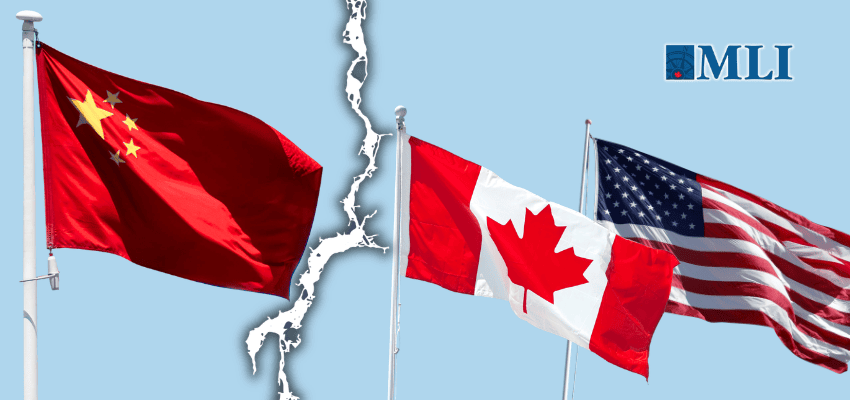
China is weaponizing the Canada–US trade rift to divide North America: Stephen Nagy for Inside Policy

In the weeks ahead, Ottawa must prepare for a targeted wave of Chinese cognitive warfare designed to exploit our domestic anxieties regarding the failed trade pact.

August 25, 2026
in Foreign Affairs, Inside Policy, Latest News, China: The dragon at the door, Foreign Policy, Stephen Nagy
Reading Time: 5 mins read
A A
China is weaponizing the Canada–US trade rift to divide North America: Stephen Nagy for Inside Policy

By Stephen Nagy, August 25, 2026

According to a Canadian Security Intelligence Service (CSIS) report released in March 2026, China views Canada as a “high priority” for foreign interference. The strategic rationale is straightforward. Our geographic, institutional, and cultural proximity to the United States means that a compromised Canada is a direct liability to Washington. If Beijing — America’s primary security challenger — can exert enough influence to misalign Canadian domestic and foreign policy from that of the US, it effectively renders North America vulnerable.

This threat is not theoretical, and the timing is critical. Following the failure of Ottawa and Washington to finalize a bilateral trade agreement on August 23, Canada–US relations have entered a period of maximum vulnerability. Beijing is already seizing this diplomatic impasse to deploy wedge politics, aiming to fracture North American cohesion.

In international relations, wedge strategies generally take four forms: realignment (pulling a target into an adversary’s camp), dealignment (pushing a target toward neutrality), disalignment (weakening alliance cohesion without a full collapse), and prealignment (preventing a coalition from forming in the first place).

While these concepts may seem academic, they are actively playing out in Canadian policymaking. During periods of heightened Canada–US friction, Beijing has adeptly lured Ottawa with the promise of a “strategic partnership” — a textbook realignment tactic. We see dealignment and disalignment in Canada’s reluctance to offer diplomatic or material support for US military operations in the Middle East, such as in the Strait of Hormuz. Furthermore, Canada’s decade-long failure to take foreign interference seriously, a track record of elite capture, and chronic underinvestment in defense all serve Beijing’s prealignment goals. By neglecting our military and intelligence capabilities, Ottawa fails to be a credible defence partner, preventing a stronger North American security coalition from materializing.

To execute these wedge strategies, Beijing relies on five well-honed tactical approaches.

First, through disinformation and propaganda, Beijing exploits the societal fault lines of Canada’s multi-ethnic democracy. By inflaming cleavages based on ethnic identity, historical grievances, and political ideology, the Chinese Communist Party (CCP) erodes trust in our democratic institutions. As documented in recent Asia-Pacific security analyses, Beijing has actively attempted to sway Canadian elections by targeting ethnic Chinese-Canadian communities with tailored disinformation regarding candidates’ platforms.

Second, Beijing deploys diaspora-targeted wedge narratives. By framing legitimate criticism of the CCP as racial discrimination, Beijing aims to weaken the diaspora’s identification with Canada and enforce homeland loyalty. The Foreign Interference Commission received stark evidence that the PRC weaponized “anti-China racism” rhetoric to instill fear among Canadians. Dissenting candidates were branded as racists, and consular officials reportedly warned Chinese-Canadians to be “prepared” ahead of the 2021 election.

Third, China utilizes geoeconomic leverage. During periods of US protectionism, Beijing opportunistically portrays itself as a reliable alternative. It uses market access — such as the well-timed reopening of its borders to Canadian agricultural products or the strategic export of heavily subsidized EVs — to keep Ottawa economically tethered and politically compliant.

Beijing also engages in clandestine diplomacy and hybrid interference. By integrating covert channels, geoeconomics, and disinformation, China creates internal divisions that paralyze intra-provincial and federal co-operation. A prime example is the blending of legitimate trade with strategic resource capture in outreach to First Nations. Chinese state firms have invested roughly $21 billion in Indigenous-held mining since 1993. Concurrently, a top-secret NSICOP report alleged clandestine, tourism-cover outreach designed to lock in long-term resource access outside federal oversight.

Finally, China applies issue-specific “damage limitation” wedging. Rather than pursuing sweeping geopolitical realignment, China increasingly focuses on preventing Western coordination on specific, high-stakes issues — such as Taiwan, Huawei, or EVs — using selective, reward-heavy pressure. When Ottawa mirrored the French playbook by placing tariffs on Chinese EVs in 2024, Beijing immediately retaliated with tariffs on Canadian canola and pork. Once Prime Minister Mark Carney rolled back the EV levy in 2026, Beijing eased the agricultural pressure.

Beijing understands the broader geopolitical trajectory. The US government is intent on recentering global manufacturing, technology, and supply chains in North America, while deepening integration with trusted partners like Japan, South Korea, Australia, and the EU. This structural shift decentres global production away from China, stripping Beijing of its primary leverage: hierarchical economic dependency.

Therefore, anchoring Canada within this new economic order of trusted trade partners is in the vital interest of both Ottawa and Washington. It is entirely logical that the US would seek to prevent Canada from signing free trade agreements with a strategic competitor. Clauses akin to those in the USMCA, which grant the US a veto over trade deals with non-market economies, reflect the necessary geoeconomic architecture of the modern era.

China’s political machine is already in hyperdrive to prevent this integration. CCP mouthpieces like the Global Times are actively amplifying Canada’s recent trade countermeasures against the US, pushing the narrative that “dependence is not the only option” and praising Canada for launching a “Chinese-styled counterattack.” Similarly, the CCP’s television mouthpiece, the Chinese Global Television Network (CGTN) has also begun emphasizing Beijing’s preferred narrative to deepen wedges between Ottawa and Washington.

At home, serial domestic academic and institutional supporters of the CCP’s policies towards Canada, will no doubt amplify Beijing’s wedge messaging for their economic interests.

To mitigate these vulnerabilities, Canada must transition from reactive damage control to a proactive, resilient policy framework. Understanding Beijing’s wedge strategies is only useful if it informs concrete policy action.

  • Ottawa must institutionalize private, bilateral dispute-resolution mechanisms with Washington. Public trade spats and political grandstanding only provide oxygen to Beijing’s disinformation networks. We must manage our inevitable bilateral frictions behind closed doors to present a united North American front.
  • Canada must aggressively harden its democratic institutions against hybrid interference. This requires fully resourcing and enforcing a robust Foreign Influence Transparency Registry, expanding CSIS’s mandate to share intelligence with provincial and municipal governments, and actively prosecuting elite capture. We cannot allow diaspora communities to be coerced by foreign consular officials on Canadian soil.
  • Canada must eliminate its “prealignment” vulnerability by taking continental defence seriously. Meeting the NATO 2 per cent GDP defence spending target and accelerating the modernization of NORAD are not merely concessions to Washington; they are baseline requirements for sovereign resilience. A Canada that cannot defend its own airspace or Arctic territory is a Canada that invites foreign leverage.
  • Ottawa must pursue aggressive trade diversification, but strictly within the bounds of “friend-shoring.” Rather than seeking economic relief in Beijing when Washington turns protectionist, Canada must deepen its geoeconomic ties with Japan, South Korea, and the Indo-Pacific democracies.

In the weeks ahead, Ottawa must prepare for a targeted wave of Chinese cognitive warfare designed to exploit our domestic anxieties regarding the failed trade pact. Beijing’s objective is to have Canadians obsess over cross-border grievances and the abrasive politics of the White House, distracting us from our core strategic interests.

If we strip away the partisan noise, the structural reality is undeniable. Canadians and Americans share a profound geographic, institutional, and cultural architecture. We live, work, and govern ourselves in fundamentally similar ways. Our policy choices must reflect this reality, and we cannot let foreign interference convince us otherwise.


Stephen R. Nagy is a professor at the International Christian University, a senior fellow and China Project lead at the Macdonald-Laurier Institute, and a JIIA CGO fellow at the Japan Institute for International Affairs.
Related Posts

Clarifying Canada’s role in NATO’s Arctic Sentry: Nicole J. Jackson
Arctic

Clarifying Canada’s role in NATO’s Arctic Sentry: Nicole J. Jackson

August 25, 2026
Doubling Canada’s non-U.S. exports is actually easy: Trevor Tombe in The Hub
Economic Policy

We revived a moribund economy before. We can do it again: Philip Cross in the Financial Post

August 24, 2026
Weak business investment frustrates Carney’s plan: Philip Cross in the Financial Post
Economic Policy

The best response to tariffs is competitive tax policy: Jack Mintz in the Financial Post

August 24, 2026

Newsletter Signup

  Thank you for Signing Up
  Please correct the marked field(s) below.
Email Address  *
1,true,6,Contact Email,2
First Name *
1,true,1,First Name,2
Last Name *
1,true,1,Last Name,2
*
*Required Fields

Follow us on

Macdonald-Laurier Institute

323 Chapel Street, Suite #300
Ottawa, Ontario, K1N 7Z2 Canada

613.482.8327

info@macdonaldlaurier.ca
MLI directory

Support Us

Support the Macdonald-Laurier Institute to help ensure that Canada is one of the best governed countries in the world. Click below to learn more or become a sponsor.

Support Us

  • Inside Policy Magazine
  • Annual Reports
  • Jobs
  • Privacy Policy

© 2023 Macdonald-Laurier Institute. All Rights reserved.

No Result
View All Result
  • Home
  • About
    • Who We Are
    • Who Makes MLI Work
    • Fifteenth Anniversary
  • Experts
    • Experts Directory
    • In Memoriam
  • Issues
    • Domestic Policy
      • Economic Policy
      • Justice
      • Rights and Freedoms
      • Assisted Suicide (MAID)
      • Health Care
      • COVID-19
      • Gender Identity
      • Canada’s Political Tradition
      • AI, Technology and Innovation
      • Media and Telecoms
      • Housing
      • Immigration
      • Agriculture and Agri-Food
      • Competition Policy
    • Energy Policy
      • Energy
      • Environment
    • Foreign Policy
      • Israel-Hamas War
      • Ukraine
      • Taiwan
      • China
      • Europe and Russia
      • Indo-Pacific
      • Middle East and North Africa
      • North America
      • Foreign Interference
      • National Defence
      • National Security
      • Foreign Affairs
    • Indigenous Affairs
  • Projects
    • CNAPS (Center for North American Prosperity and Security)
    • The Promised Land
    • Dragon at the door
    • Justice Report Card
    • DisInfoWatch.org
    • Managing Indigenous Prosperity
    • Judicial Foundations
    • Landmark Cases Council
    • Closing Canada’s Border, Policing, and Legal Gaps
    • Reforming the University
    • Digital Policy & Connectivity
    • Defending The Marketplace of Ideas
    • Letter to a minister
    • Past Projects
      • The Great Energy Crisis
      • Canada on top of the world
      • Double Trouble
      • Canada and the Indo-Pacific Initiative
      • The Transatlantic Program
      • COVID Misery Index
      • Speak for Ourselves
      • The Eavesdropping Dragon: Huawei
      • Talkin’ in the Free World with Mariam Memarsadeghi
      • An Intellectual Property Strategy for Canada
      • Munk Senior Fellows
      • A Mandate for Canada
      • Confederation Series
      • Fiscal Reform
      • The Canadian Century project
      • Fixing Canadian health care
      • Internal trade
      • From a mandate for change
      • Size of government in Canada
      • Straight Talk
      • Labour Market Report
      • Leading Economic Indicator
      • Centre for Advancing Canada’s Interests Abroad
      • Indigenous Prosperity at a Crossroads
  • Events
    • Voices that Inspire: The Macdonald-Laurier Vancouver Speaker Series
    • Upcoming Events
    • Past Events
      • MLI Dinners
      • Great Canadian Debates
  • Latest News
  • Libraries
    • Columns
    • Commentary
    • Papers
    • Books
    • Video
  • Donate

© 2023 Macdonald-Laurier Institute. All Rights reserved.