OTTAWA, ON (July 23, 2026):
Canadians are feeling the squeeze of an affordability crisis with no end in sight, but what lies at its root and how should policymakers respond?
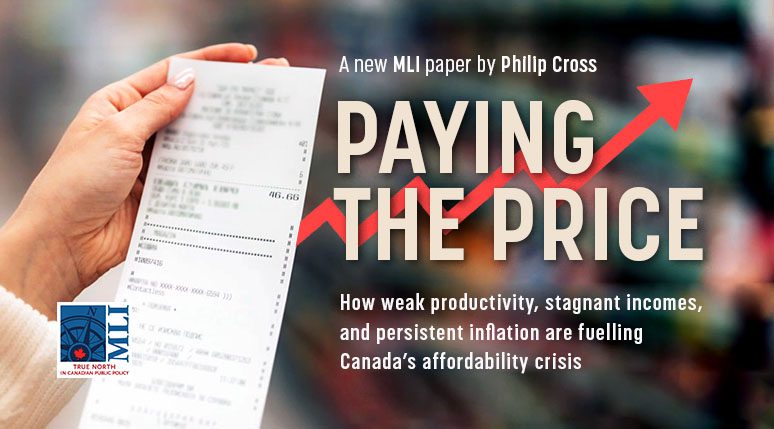
In Paying the price: How weak productivity, stagnant incomes, and persistent inflation are fuelling Canada’s affordability crisis, Senior Fellow Philip Cross argues that the crisis is driven by slow wage growth, out-of-control inflation, and ever-increasing taxes and contributions for government services.
“These challenges are symptoms of a much larger economic failure,” explains Cross. “Canada’s affordability crisis is fundamentally a problem of weak income creation, not income redistribution.”
Cross challenges the view that the crisis is driven by greedy corporations or high-income earners capturing a growing share of national income. Instead, he contends that Canada’s economy simply generates too little new income to support rising living standards.
Cross urges governments to address Canadians’ faltering income growth by focusing on four key priorities:
• Attract more business investment.
• Avoid increases in taxes and payroll contributions that reduce disposable income.
• Ensure the Bank of Canada consistently meets its 2 per cent inflation target.
• Focus economic policy on growth rather than one-time transfers or redistribution.
“Quick fixes might temporarily dull the pain of high living costs, but they won’t cure the disease,” warns Cross.
“If policymakers don’t shift their focus soon, reversing this economic slide is going to become vastly more difficult — and far more expensive.”
To learn more, read the full paper here:

Philip Cross is a senior fellow at the Macdonald-Laurier Institute. Prior to joining MLI, Cross spent 36 years at Statistics Canada specializing in macroeconomics.
For further information, media are invited to contact:
Skander Belouizdad
Senior Media Relations Officer
(613) 482-8327 x111
Skander.belouizdad@macdonaldlaurier.ca