Thursday, July 23, 2026
No Result
View All Result
  • Media
Macdonald-Laurier Institute
  • Home
  • About
    • Who We Are
    • Who Makes MLI Work
    • Fifteenth Anniversary
  • Experts
    • Experts Directory
    • In Memoriam
  • Issues
    • Domestic Policy
      • Economic Policy
      • Justice
      • Rights and Freedoms
      • Assisted Suicide (MAID)
      • Health Care
      • COVID-19
      • Gender Identity
      • Canada’s Political Tradition
      • AI, Technology and Innovation
      • Media and Telecoms
      • Housing
      • Immigration
      • Agriculture and Agri-Food
      • Competition Policy
    • Energy Policy
      • Energy
      • Environment
    • Foreign Policy
      • Israel-Hamas War
      • Ukraine
      • Taiwan
      • China
      • Europe and Russia
      • Indo-Pacific
      • Middle East and North Africa
      • North America
      • Foreign Interference
      • National Defence
      • National Security
      • Foreign Affairs
    • Indigenous Affairs
  • Projects
    • CNAPS (Center for North American Prosperity and Security)
    • The Promised Land
    • Dragon at the door
    • Justice Report Card
    • DisInfoWatch.org
    • Managing Indigenous Prosperity
    • Judicial Foundations
    • Landmark Cases Council
    • Closing Canada’s Border, Policing, and Legal Gaps
    • Reforming the University
    • Digital Policy & Connectivity
    • Defending The Marketplace of Ideas
    • Letter to a minister
    • Past Projects
      • The Great Energy Crisis
      • Canada on top of the world
      • Double Trouble
      • Canada and the Indo-Pacific Initiative
      • The Transatlantic Program
      • COVID Misery Index
        • Provincial COVID Misery Index
        • Beyond Lockdown
        • COVID and after: A mandate for recovery
      • Speak for Ourselves
      • The Eavesdropping Dragon: Huawei
      • Talkin’ in the Free World with Mariam Memarsadeghi
      • An Intellectual Property Strategy for Canada
      • Munk Senior Fellows
      • A Mandate for Canada
      • Confederation Series
      • Fiscal Reform
      • The Canadian Century project
      • Fixing Canadian health care
      • Internal trade
      • From a mandate for change
      • Size of government in Canada
      • Straight Talk
      • Labour Market Report
      • Leading Economic Indicator
      • Centre for Advancing Canada’s Interests Abroad
      • Indigenous Prosperity at a Crossroads
        • Aboriginal Canada and Natural Resources
  • Events
    • Voices that Inspire: The Macdonald-Laurier Vancouver Speaker Series
    • Upcoming Events
    • Past Events
      • MLI Dinners
      • Great Canadian Debates
  • Latest News
  • Libraries
    • Columns
    • Commentary
    • Papers
    • Books
    • Video
  • Donate
  • Home
  • About
    • Who We Are
    • Who Makes MLI Work
    • Fifteenth Anniversary
  • Experts
    • Experts Directory
    • In Memoriam
  • Issues
    • Domestic Policy
      • Economic Policy
      • Justice
      • Rights and Freedoms
      • Assisted Suicide (MAID)
      • Health Care
      • COVID-19
      • Gender Identity
      • Canada’s Political Tradition
      • AI, Technology and Innovation
      • Media and Telecoms
      • Housing
      • Immigration
      • Agriculture and Agri-Food
      • Competition Policy
    • Energy Policy
      • Energy
      • Environment
    • Foreign Policy
      • Israel-Hamas War
      • Ukraine
      • Taiwan
      • China
      • Europe and Russia
      • Indo-Pacific
      • Middle East and North Africa
      • North America
      • Foreign Interference
      • National Defence
      • National Security
      • Foreign Affairs
    • Indigenous Affairs
  • Projects
    • CNAPS (Center for North American Prosperity and Security)
    • The Promised Land
    • Dragon at the door
    • Justice Report Card
    • DisInfoWatch.org
    • Managing Indigenous Prosperity
    • Judicial Foundations
    • Landmark Cases Council
    • Closing Canada’s Border, Policing, and Legal Gaps
    • Reforming the University
    • Digital Policy & Connectivity
    • Defending The Marketplace of Ideas
    • Letter to a minister
    • Past Projects
      • The Great Energy Crisis
      • Canada on top of the world
      • Double Trouble
      • Canada and the Indo-Pacific Initiative
      • The Transatlantic Program
      • COVID Misery Index
        • Provincial COVID Misery Index
        • Beyond Lockdown
        • COVID and after: A mandate for recovery
      • Speak for Ourselves
      • The Eavesdropping Dragon: Huawei
      • Talkin’ in the Free World with Mariam Memarsadeghi
      • An Intellectual Property Strategy for Canada
      • Munk Senior Fellows
      • A Mandate for Canada
      • Confederation Series
      • Fiscal Reform
      • The Canadian Century project
      • Fixing Canadian health care
      • Internal trade
      • From a mandate for change
      • Size of government in Canada
      • Straight Talk
      • Labour Market Report
      • Leading Economic Indicator
      • Centre for Advancing Canada’s Interests Abroad
      • Indigenous Prosperity at a Crossroads
        • Aboriginal Canada and Natural Resources
  • Events
    • Voices that Inspire: The Macdonald-Laurier Vancouver Speaker Series
    • Upcoming Events
    • Past Events
      • MLI Dinners
      • Great Canadian Debates
  • Latest News
  • Libraries
    • Columns
    • Commentary
    • Papers
    • Books
    • Video
  • Donate
No Result
View All Result
Macdonald-Laurier Institute

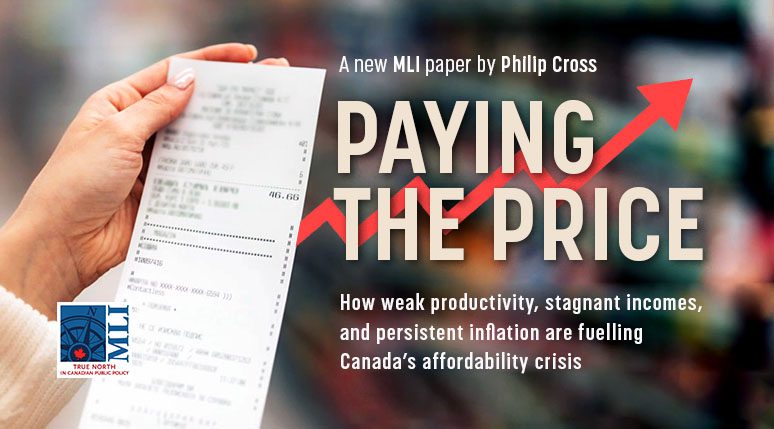
Paying the price: How weak productivity, stagnant incomes, and persistent inflation are fuelling Canada’s affordability crisis

A generation that expected to enjoy a higher standard of living than its parents instead risks inheriting slower growth, fewer opportunities, and permanently diminished prosperity.

July 23, 2026
in Domestic Policy, Latest News, Papers, Economic Policy, Philip Cross
Reading Time: 5 mins read
A A
Paying the price: How weak productivity, stagnant incomes, and persistent inflation are fuelling Canada’s affordability crisis

By Philip Cross
July 23, 2026

PDF of paper

Executive Summary | Sommaire (le français suit)

Few Canadians can precisely define affordability, but almost everyone knows what it feels like. It shows up in paycheques that no longer stretch as far, bank accounts that are harder to replenish, and the growing sense that everyday necessities are slipping out of reach.

Yet affordability is about more than rising prices or stagnant wages alone. It is the relationship between what households earn, what governments leave them to spend after taxes and transfers, and what that income can actually buy. Canada’s affordability crisis stems from a breakdown on all three fronts — and until policymakers address each of them, Canadians will continue to fall behind.

Households are being squeezed from every direction:

• Nominal wage and salary growth has slowed steadily for several years.

• Governments are taking an increasing bite out of incomes as they restrain transfers to households while raising taxes and pension contributions.

• Consumer prices have risen faster than the Bank of Canada’s 2 per cent target every year since 2021, with particularly large price hikes for essentials such as housing, food, and gasoline.

These challenges are symptoms of a much larger economic failure. Canada’s economy has generated remarkably little new income over the past decade. Real GDP per capita has grown by an average of just 0.6 per cent annually — the weakest performance since the Great Depression — while real household disposable income has risen only 0.8 per cent a year. Without stronger income growth, affordability will continue to deteriorate regardless of temporary fluctuations in inflation.

The evidence also challenges a popular narrative about the source of Canada’s affordability crisis. The problem is not that an increasing share of income has flowed to corporate profits or the top 1 per cent. Both have declined modestly over the past decade. Canada’s affordability crisis is fundamentally a problem of weak income creation, not income redistribution.

Reversing the decline in affordability requires policies that expand the economy’s capacity to generate higher incomes rather than simply reshuffling existing wealth. Governments should focus on four priorities:

• Restoring stronger productivity growth by reversing the decade-long decline in business investment.

• Protecting household incomes by avoiding further increases in taxes and mandatory payroll contributions that reduce disposable income.

• Keeping inflation under control by ensuring the Bank of Canada consistently meets its 2 per cent inflation target.

• Focusing economic policy on growth, recognizing that sustained increases in real incomes — not one-time transfers or redistribution — are the only durable solution to Canada’s affordability challenge.

The affordability crisis cannot be solved by treating its symptoms alone. Short-term relief measures may ease pressures temporarily, but only stronger productivity, investment, and income growth can restore lasting improvements in living standards. A generation that expected to enjoy a higher standard of living than its parents instead risks inheriting slower growth, fewer opportunities, and permanently diminished prosperity. The longer governments delay, the harder — and more costly — it will be to reverse the decline.


Peu de ménages canadiens peuvent définir précisément ce qu’est l’abordabilité, mais presque tous la ressentent profondément. Elle se manifeste par des salaires désormais insuffisants pour couvrir toutes les dépenses, des soldes bancaires qui s’épuisent rapidement et un sentiment croissant d’inaccessibilité des biens essentiels.

Pourtant, l’abordabilité, c’est bien plus que la progression des prix ou la stagnation des salaires. Il s’agit de la relation entre ce que les ménages gagnent, ce qui reste dans leurs poches après taxes et impôts et ce que leur revenu leur permet d’acquérir. La crise d’abordabilité au Canada se présente sous trois aspects distincts – et tant que les décideurs ne s’attaqueront pas à chacun d’eux, les ménages peineront à joindre les deux bouts.

Les ménages sont étouffés de toutes les façons :

• La croissance des rémunérations en dollars courants ralentit depuis plusieurs années.

• Les gouvernements accaparent une part toujours plus grande des revenus à travers les transferts moindres aux ménages et la hausse des impôts et des cotisations de retraite.

• Depuis 2021, la hausse des prix à la consommation dépasse chaque année la barre des 2 % établie par la Banque du Canada, compte tenu des augmentations démesurées pour les indispensables – logement, aliments et carburant.

Ces obstacles montrent la gravité de la crise économique que le Canada traverse depuis dix ans : il a généré de nouveaux revenus remarquablement bas. Par habitant, le PIB réel s’est accru de seulement 0,6  % annuellement –  la performance la plus faible depuis la crise des années 1930 – alors que le revenu disponible réel n’a augmenté que de 0,8 %. Sans une croissance forte, l’abordabilité se détériorera encore, quels que soient les sursauts de l’inflation.

Ces faits contredisent également la notion populaire sur la source de la crise. Le problème ne réside pas dans la part croissante des revenus du 1 % des ménages les plus riches ou, encore, des entreprises. Ces parts déclinent en fait quelque peu au cours de la décennie écoulée. Il y a crise en raison de la faible création de revenus, non de sa redistribution.

Renverser le recul nécessite des politiques aptes à renforcer les capacités de l’économie à générer des revenus élevés et non pas uniquement à repartager la richesse existante. Les gouvernements doivent se concentrer sur les quatre priorités que voici :

• Restaurer la forte croissance de la productivité en inversant la baisse décennale des investissements des entreprises.

• Préserver les revenus des ménages en évitant les nouvelles hausses d’impôts et de cotisations sociales obligatoires, lesquelles réduisent le revenu disponible.

• Maîtriser l’inflation en veillant à ce que la Banque du Canada adhère à son objectif de 2 %.

• Orienter la politique économique vers la croissance, en admettant que seules les augmentations durables des revenus réels — et non les transferts ponctuels ou une redistribution  —  représentent la solution pérenne au problème du Canada.

Pour remédier à une crise, il ne suffit pas de traiter les symptômes. Si les mesures à court terme peuvent temporairement atténuer les pressions, seule l’amélioration décisive de la productivité, de l’investissement et des revenus peut restaurer durablement la progression du niveau de vie. Une génération qui s’attendait à un avenir meilleur que la précédente pourrait hériter d’une croissance économique plus faible, de moins d’occasions et d’une prospérité menacée à long terme. Plus les gouvernements tardent à agir, plus il sera ardu — et onéreux — d’enrayer cette tendance à la baisse.


 

Related Posts

Canadian universities must look within and speak out on findings: Peter MacKinnon in the National Post
Reforming Universities

Canadian universities must look within and speak out on findings: Peter MacKinnon in the National Post

July 23, 2026
Canada’s energy strategy: Jamie Tronnes on the Energy Security Cubed Podcast
Energy

Canada’s energy strategy: Jamie Tronnes on the Energy Security Cubed Podcast

July 22, 2026
Gruesome beheading attempt in Belfast a warning against fast-track asylum processes: Michael Barutciski in the National Post
Immigration

Gruesome beheading attempt in Belfast a warning against fast-track asylum processes: Michael Barutciski in the National Post

July 22, 2026
Next Post
Canadian universities must look within and speak out on findings: Peter MacKinnon in the National Post

Canadian universities must look within and speak out on findings: Peter MacKinnon in the National Post

Newsletter Signup

  Thank you for Signing Up
  Please correct the marked field(s) below.
Email Address  *
1,true,6,Contact Email,2
First Name *
1,true,1,First Name,2
Last Name *
1,true,1,Last Name,2
*
*Required Fields

Follow us on

Macdonald-Laurier Institute

323 Chapel Street, Suite #300
Ottawa, Ontario, K1N 7Z2 Canada

613.482.8327

info@macdonaldlaurier.ca
MLI directory

Support Us

Support the Macdonald-Laurier Institute to help ensure that Canada is one of the best governed countries in the world. Click below to learn more or become a sponsor.

Support Us

  • Inside Policy Magazine
  • Annual Reports
  • Jobs
  • Privacy Policy

© 2023 Macdonald-Laurier Institute. All Rights reserved.

This site uses cookies. By continuing to browse the site you are agreeing to our use of cookies.

Privacy Preference Center

Consent Management

Necessary

Advertising

Analytics

Other

No Result
View All Result
  • Home
  • About
    • Who We Are
    • Who Makes MLI Work
    • Fifteenth Anniversary
  • Experts
    • Experts Directory
    • In Memoriam
  • Issues
    • Domestic Policy
      • Economic Policy
      • Justice
      • Rights and Freedoms
      • Assisted Suicide (MAID)
      • Health Care
      • COVID-19
      • Gender Identity
      • Canada’s Political Tradition
      • AI, Technology and Innovation
      • Media and Telecoms
      • Housing
      • Immigration
      • Agriculture and Agri-Food
      • Competition Policy
    • Energy Policy
      • Energy
      • Environment
    • Foreign Policy
      • Israel-Hamas War
      • Ukraine
      • Taiwan
      • China
      • Europe and Russia
      • Indo-Pacific
      • Middle East and North Africa
      • North America
      • Foreign Interference
      • National Defence
      • National Security
      • Foreign Affairs
    • Indigenous Affairs
  • Projects
    • CNAPS (Center for North American Prosperity and Security)
    • The Promised Land
    • Dragon at the door
    • Justice Report Card
    • DisInfoWatch.org
    • Managing Indigenous Prosperity
    • Judicial Foundations
    • Landmark Cases Council
    • Closing Canada’s Border, Policing, and Legal Gaps
    • Reforming the University
    • Digital Policy & Connectivity
    • Defending The Marketplace of Ideas
    • Letter to a minister
    • Past Projects
      • The Great Energy Crisis
      • Canada on top of the world
      • Double Trouble
      • Canada and the Indo-Pacific Initiative
      • The Transatlantic Program
      • COVID Misery Index
      • Speak for Ourselves
      • The Eavesdropping Dragon: Huawei
      • Talkin’ in the Free World with Mariam Memarsadeghi
      • An Intellectual Property Strategy for Canada
      • Munk Senior Fellows
      • A Mandate for Canada
      • Confederation Series
      • Fiscal Reform
      • The Canadian Century project
      • Fixing Canadian health care
      • Internal trade
      • From a mandate for change
      • Size of government in Canada
      • Straight Talk
      • Labour Market Report
      • Leading Economic Indicator
      • Centre for Advancing Canada’s Interests Abroad
      • Indigenous Prosperity at a Crossroads
  • Events
    • Voices that Inspire: The Macdonald-Laurier Vancouver Speaker Series
    • Upcoming Events
    • Past Events
      • MLI Dinners
      • Great Canadian Debates
  • Latest News
  • Libraries
    • Columns
    • Commentary
    • Papers
    • Books
    • Video
  • Donate

© 2023 Macdonald-Laurier Institute. All Rights reserved.