
Wednesday, September 2, 2026
No Result
View All Result
  • Media
Macdonald-Laurier Institute
  • Home
  • About
    • Who We Are
    • Who Makes MLI Work
    • Fifteenth Anniversary
  • Experts
    • Experts Directory
    • In Memoriam
  • Issues
    • Domestic Policy
      • Economic Policy
      • Justice
      • Rights and Freedoms
      • Assisted Suicide (MAID)
      • Health Care
      • COVID-19
      • Gender Identity
      • Canada’s Political Tradition
      • AI, Technology and Innovation
      • Media and Telecoms
      • Housing
      • Immigration
      • Agriculture and Agri-Food
      • Competition Policy
    • Energy Policy
      • Energy
      • Environment
    • Foreign Policy
      • Israel-Hamas War
      • Ukraine
      • Taiwan
      • China
      • Europe and Russia
      • Indo-Pacific
      • Middle East and North Africa
      • North America
      • Foreign Interference
      • National Defence
      • National Security
      • Foreign Affairs
    • Indigenous Affairs
  • Projects
    • CNAPS (Center for North American Prosperity and Security)
    • The Promised Land
    • Dragon at the door
    • Justice Report Card
    • DisInfoWatch.org
    • Managing Indigenous Prosperity
    • Judicial Foundations
    • Landmark Cases Council
    • Closing Canada’s Border, Policing, and Legal Gaps
    • Reforming the University
    • Digital Policy & Connectivity
    • Defending The Marketplace of Ideas
    • Letter to a minister
    • Past Projects
      • The Great Energy Crisis
      • Canada on top of the world
      • Double Trouble
      • Canada and the Indo-Pacific Initiative
      • The Transatlantic Program
      • COVID Misery Index
        • Provincial COVID Misery Index
        • Beyond Lockdown
        • COVID and after: A mandate for recovery
      • Speak for Ourselves
      • The Eavesdropping Dragon: Huawei
      • Talkin’ in the Free World with Mariam Memarsadeghi
      • An Intellectual Property Strategy for Canada
      • Munk Senior Fellows
      • A Mandate for Canada
      • Confederation Series
      • Fiscal Reform
      • The Canadian Century project
      • Fixing Canadian health care
      • Internal trade
      • From a mandate for change
      • Size of government in Canada
      • Straight Talk
      • Labour Market Report
      • Leading Economic Indicator
      • Centre for Advancing Canada’s Interests Abroad
      • Indigenous Prosperity at a Crossroads
        • Aboriginal Canada and Natural Resources
  • Events
    • Voices that Inspire: The Macdonald-Laurier Vancouver Speaker Series
    • Upcoming Events
    • Past Events
      • MLI Dinners
      • Great Canadian Debates
  • Latest News
  • Libraries
    • Columns
    • Commentary
    • Papers
    • Books
    • Video
  • Donate
  • Home
  • About
    • Who We Are
    • Who Makes MLI Work
    • Fifteenth Anniversary
  • Experts
    • Experts Directory
    • In Memoriam
  • Issues
    • Domestic Policy
      • Economic Policy
      • Justice
      • Rights and Freedoms
      • Assisted Suicide (MAID)
      • Health Care
      • COVID-19
      • Gender Identity
      • Canada’s Political Tradition
      • AI, Technology and Innovation
      • Media and Telecoms
      • Housing
      • Immigration
      • Agriculture and Agri-Food
      • Competition Policy
    • Energy Policy
      • Energy
      • Environment
    • Foreign Policy
      • Israel-Hamas War
      • Ukraine
      • Taiwan
      • China
      • Europe and Russia
      • Indo-Pacific
      • Middle East and North Africa
      • North America
      • Foreign Interference
      • National Defence
      • National Security
      • Foreign Affairs
    • Indigenous Affairs
  • Projects
    • CNAPS (Center for North American Prosperity and Security)
    • The Promised Land
    • Dragon at the door
    • Justice Report Card
    • DisInfoWatch.org
    • Managing Indigenous Prosperity
    • Judicial Foundations
    • Landmark Cases Council
    • Closing Canada’s Border, Policing, and Legal Gaps
    • Reforming the University
    • Digital Policy & Connectivity
    • Defending The Marketplace of Ideas
    • Letter to a minister
    • Past Projects
      • The Great Energy Crisis
      • Canada on top of the world
      • Double Trouble
      • Canada and the Indo-Pacific Initiative
      • The Transatlantic Program
      • COVID Misery Index
        • Provincial COVID Misery Index
        • Beyond Lockdown
        • COVID and after: A mandate for recovery
      • Speak for Ourselves
      • The Eavesdropping Dragon: Huawei
      • Talkin’ in the Free World with Mariam Memarsadeghi
      • An Intellectual Property Strategy for Canada
      • Munk Senior Fellows
      • A Mandate for Canada
      • Confederation Series
      • Fiscal Reform
      • The Canadian Century project
      • Fixing Canadian health care
      • Internal trade
      • From a mandate for change
      • Size of government in Canada
      • Straight Talk
      • Labour Market Report
      • Leading Economic Indicator
      • Centre for Advancing Canada’s Interests Abroad
      • Indigenous Prosperity at a Crossroads
        • Aboriginal Canada and Natural Resources
  • Events
    • Voices that Inspire: The Macdonald-Laurier Vancouver Speaker Series
    • Upcoming Events
    • Past Events
      • MLI Dinners
      • Great Canadian Debates
  • Latest News
  • Libraries
    • Columns
    • Commentary
    • Papers
    • Books
    • Video
  • Donate
No Result
View All Result
Macdonald-Laurier Institute

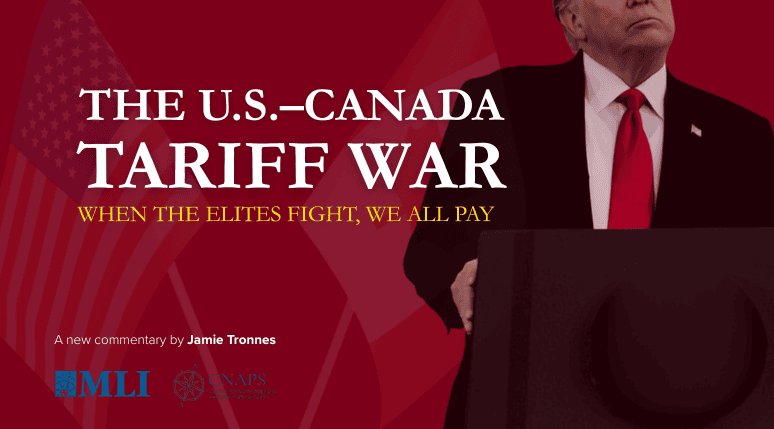
The U.S.–Canada tariff war – When the elites fight, we all pay: Jamie Tronnes

By enacting tariffs and counter-tariffs, President Trump and Prime Minister Carney have imposed the largest increases in import taxes seen in either country in living memory.

September 2, 2026
in Foreign Policy, Latest News, Commentary, North America, Jamie Tronnes
Reading Time: 7 mins read
A A
The U.S.–Canada tariff war – When the elites fight, we all pay: Jamie Tronnes

By Jamie Tronnes
September 2, 2026


There’s an African proverb — “When elephants fight, it’s the grass that suffers.” That is the case in the U.S.–Canada trade war. President Donald Trump, Secretary Howard Lutnick, Ontario Premier Doug Ford, and Prime Minister Mark Carney are stomping on the rest of us.

Americans and Canadians are struggling. The cost of living is by far the number one issue with voters in the United States and Canada alike.

Canada recently walked away from a tariff deal with the United States. The deal would have seen Canada accept some of their goods being tariffed at reduced but still historically high rates, in exchange for removing all tariffs on American products and giving up more access to its protected dairy industry.

After deciding not to take the deal, Prime Minister Mark Carney held a press conference in which he whipped up Canadian nationalism, accused the United States of asking too much, changing the terms at the last minute, and attacking Canadian sovereignty and the French language. Trump, for his part, was golfing.

But when the President did eventually respond, it was a short reply reminding Canada that if they were a state, they wouldn’t have to pay any tariffs, which only served to push Canadian elbows up higher than ever.

Premier Ford went on his typical “Captain Canada” script and told the President to kiss his large “real-estate” of a behind.

Trump announced that a full 50 percent tariff on autos and auto parts would come into effect on January 1, 2027, effectively freezing any new investment in the auto sector.  Honda immediately paused construction on a new $11 billion (C$15 billion) expansion of a Canadian plant that would have included cross-production in the United States. This is a huge lost opportunity for a sector that is already facing stiff competition globally from cheaper Chinese autos.

Meanwhile, Canadians announced details of dollar-for-dollar counter-tariffs that are aimed at a variety of American imports to Canada, from agricultural equipment to household appliances. The new tariffs are due to be enacted on September 8.

As the media frenzy over the trade talk collapse grew, U.S. Trade Representative Jamieson Greer took the opportunity on Wednesday to lower the temperature and address the talks with the seriousness they demanded. He clarified to Canadian media — in French no less — that the United States did not object to the discoverability of French content, and assured Canadians that this would not be an issue with the Canadian negotiations going forward.

After outcry from the Canadian seafood processors, the Canadians announced they were dropping tariffs on U.S. fish and seafood, a move that will allow Canadian seafood processing facilities to continue to process Maine lobsters during the busy season

But the goodwill between the two nations was brief. On Thursday afternoon, the President of the United States signed an Executive Order to unilaterally change the name of Lake Ontario to “Lake America.”  The most powerful man in the world took a sharpie to a map instead of negotiating a deal to secure investment.

And, of course, Prime Minister Carney responded in the most I-went-to-Harvard way possible: “The name Lake Ontario comes from the Wendat word Ontari’io, which means ‘the lake is beautiful, the lake is big.’ The lake is nearly 400 years old, predating both the Confederation of Canada and the Declaration of Independence.” He later worked the word “hydronyms” into a sentence because, why yes, he does have a PhD from Oxford.

While the leaders of two G7 nations bicker about the name of a lake, Canadians and Americans are worried about making ends meet.

Tariffs and counter-tariffs have real consequences. They can mean not just price hikes, but layoffs and bankruptcies.

Farmers, for example, have been hit especially hard by tariffs on their production inputs. Fertilizer and diesel cost more, largely because of the war in Iran, and steel and aluminum used in farm bins and storage sheds have skyrocketed due to tariffs. When a farmer goes under, it’s not just that the crop doesn’t get planted. A family could lose their home. Small towns continue to get smaller, the tax base shrinks, the gloom grows.

What hope for rural folks? Maybe a billionaire or a farm conglomerate can swoop in and hold onto the land at a loss for tax purposes. A data center could swing in and buy it too, but they might only get it half built before it too goes bust — copper wire and transformers and electricity turbines are all tariffed, not to mention back-ordered for years.  There are no new family farms, only old families who farm, as the saying goes.

The tariffs and counter-tariffs are also threatening home ownership for Americans and Canadians, who now pay more for lumber and building supplies like steel beams and aluminum roofing. Every house built north of the Mason-Dixon line needs to be built with hardy spruce-pine-fir lumber, and there is not enough supply in the US to meet demand. The recent tariffs spat between Canada and the United States has seen Canadian lumber tariffed at a rate higher than Russia — a country that has provided Iran with intelligence to assassinate American soldiers. Despite the American policy of an economic reckoning for countries that support Iran, Russia’s tariff and sanctions rate remains the same.

Meanwhile, Canada is doubling down on protecting the tariff-free quotas for a politically ensconced dairy cartel that dumps surplus milk to keep prices high. This cartel does not protect Canadians from American dairy. Rather, it ensures that Canadian producers don’t have to compete. Once again, politicians are placing bad policy, which keeps prices artificially high, ahead of the interests of the people they are supposed to represent.

President Trump accuses America’s allies of “ripping us off” for having the gall to sell their products to the Americans who want them.

That’s what a trade deficit is, after all. Consider a Canadian who wants oranges, but Great White North. No oranges? America will sell them to you. Does that mean Canada is getting ripped off by America? No. It means citrus states are getting money from Canada in exchange for their goods. That helps affordability and quality of life. Canadians get fresh winter produce from sunny lands, and Florida farmers have a market for their product. Everyone is happy.

Except now, Canadians are boycotting American goods. One Canadian grocery chain had to publicly backtrack its decision to pull country-of-origin labelling that is now demanded not by law, but by a motivated public who want nothing to do with their former friend.

And in the meantime, Canadians who can’t afford it have to pay more for goods from their biggest trading partner, while their biggest trading partner threatens their sovereignty.

By enacting tariffs and counter-tariffs, President Trump and Prime Minister Carney have imposed the largest increases in import taxes seen in either country in living memory.

Mr. Trump will argue, correctly, that he has cut income taxes for the middle class. But shifting tax from a predictable amount paid with each paycheck to an unsteady amount that hits businesses and consumers in their margins is an unstable way to grow the economy. There are almost no goods left that the President has not tariffed in some way or fashion.

Mr. Carney walked away from a deal that would have seen the average car tariff go from a disputed 25 percent to an agreed-upon, locked-in 15 percent. That’s still high enough to kill the Canadian auto sector, which U.S. Secretary of Commerce Howard Lutnick has said is the point.

The death of the Canadian auto sector does not mean that those jobs would come to the United States. It may mean automakers scale back the number of models to choose from, shuttering factories across North America while they wait for certainty to return. In the meantime, car prices skyrocket, sales decline, and more people lose their jobs.

The White House is making it impossible to predict what will be tariffed at what level at any given time. It may be better for manufacturing to do what some others have done — go back to the places where the labor is cheap, the healthcare costs are minimal (or nonexistent), and robotics and automation, which make up for labor margins, are not tariffed.

It’s time to get serious about the real issues. The average price of a new car in the United States is just shy of $50,000. The cost of an employer-sponsored family insurance plan is around $27,000 per year. The average cost of a new single-family home in the United States in July was $508,800. Inflation is persistently high at 3.7 percent. Tariffs, according to one study, cost the U.S. economy over 1,000,000 jobs in the past year.

Every time you hear a tariff being thrown at another country in the name of “protection,” what it really means is a tax on anything imported. We live in a world of global supply chains. Not everything can, or will, be made in America. It’s a tax that no one can escape.

Tariffs are going to continue to raise costs for both sides of the border. It will solve nothing except feeding government coffers with money that people increasingly cannot afford to spend. The elephants stomp. The grass suffers.

It’s time for the elephants to get back into the room, get over themselves, and make a deal.


About the author

Jamie Tronnes is the executive director of the Center for North American Prosperity and Security, a project of the Macdonald-Laurier Institute.
Related Posts

A trade treaty with the US isn’t much of a threat to Canada’s ‘sovereignty’: David Collins in City Law Forum
North America

A trade treaty with the US isn’t much of a threat to Canada’s ‘sovereignty’: David Collins in City Law Forum

September 2, 2026
How Trump kneecapped his own China policy with a 50% tariff on Canada: Anthony De Luca-Baratta in the Washington Examiner
North America

How Trump kneecapped his own China policy with a 50% tariff on Canada: Anthony De Luca-Baratta in the Washington Examiner

September 2, 2026
It costs Canada millions to discriminate against white male academics: Eric Kaufmann in the National Post
Education

It costs Canada millions to discriminate against white male academics: Eric Kaufmann in the National Post

September 2, 2026

Newsletter Signup

  Thank you for Signing Up
  Please correct the marked field(s) below.
Email Address *
1,true,6,Contact Email,2
First Name *
1,true,1,First Name,2
Last Name *
1,true,1,Last Name,2
*Required Fields

Follow us on

Macdonald-Laurier Institute

323 Chapel Street, Suite #300
Ottawa, Ontario, K1N 7Z2 Canada

613.482.8327

info@macdonaldlaurier.ca
MLI directory

Support Us

Support the Macdonald-Laurier Institute to help ensure that Canada is one of the best governed countries in the world. Click below to learn more or become a sponsor.

Support Us

  • Inside Policy Magazine
  • Annual Reports
  • Jobs
  • Privacy Policy

© 2023 Macdonald-Laurier Institute. All Rights reserved.

This site uses cookies. By continuing to browse the site you are agreeing to our use of cookies.

Privacy Preference Center

Consent Management

Necessary

Advertising

Analytics

Other

No Result
View All Result
  • Home
  • About
    • Who We Are
    • Who Makes MLI Work
    • Fifteenth Anniversary
  • Experts
    • Experts Directory
    • In Memoriam
  • Issues
    • Domestic Policy
      • Economic Policy
      • Justice
      • Rights and Freedoms
      • Assisted Suicide (MAID)
      • Health Care
      • COVID-19
      • Gender Identity
      • Canada’s Political Tradition
      • AI, Technology and Innovation
      • Media and Telecoms
      • Housing
      • Immigration
      • Agriculture and Agri-Food
      • Competition Policy
    • Energy Policy
      • Energy
      • Environment
    • Foreign Policy
      • Israel-Hamas War
      • Ukraine
      • Taiwan
      • China
      • Europe and Russia
      • Indo-Pacific
      • Middle East and North Africa
      • North America
      • Foreign Interference
      • National Defence
      • National Security
      • Foreign Affairs
    • Indigenous Affairs
  • Projects
    • CNAPS (Center for North American Prosperity and Security)
    • The Promised Land
    • Dragon at the door
    • Justice Report Card
    • DisInfoWatch.org
    • Managing Indigenous Prosperity
    • Judicial Foundations
    • Landmark Cases Council
    • Closing Canada’s Border, Policing, and Legal Gaps
    • Reforming the University
    • Digital Policy & Connectivity
    • Defending The Marketplace of Ideas
    • Letter to a minister
    • Past Projects
      • The Great Energy Crisis
      • Canada on top of the world
      • Double Trouble
      • Canada and the Indo-Pacific Initiative
      • The Transatlantic Program
      • COVID Misery Index
      • Speak for Ourselves
      • The Eavesdropping Dragon: Huawei
      • Talkin’ in the Free World with Mariam Memarsadeghi
      • An Intellectual Property Strategy for Canada
      • Munk Senior Fellows
      • A Mandate for Canada
      • Confederation Series
      • Fiscal Reform
      • The Canadian Century project
      • Fixing Canadian health care
      • Internal trade
      • From a mandate for change
      • Size of government in Canada
      • Straight Talk
      • Labour Market Report
      • Leading Economic Indicator
      • Centre for Advancing Canada’s Interests Abroad
      • Indigenous Prosperity at a Crossroads
  • Events
    • Voices that Inspire: The Macdonald-Laurier Vancouver Speaker Series
    • Upcoming Events
    • Past Events
      • MLI Dinners
      • Great Canadian Debates
  • Latest News
  • Libraries
    • Columns
    • Commentary
    • Papers
    • Books
    • Video
  • Donate

© 2023 Macdonald-Laurier Institute. All Rights reserved.