
This article originally appeared in The Hub.
By Trevor Tombe, September 2, 2026
On Sept. 8, roughly $30 billion in imports from the United States will face Canadian tariffs of between 15 and 50 percent. This is our response to the 50 percent U.S. tariffs now applied to approximately five percent of our exports.
Overall, I estimate Canada’s average tariff response works out to about 30 percent, on average, across affected goods. That’s roughly 60 cents of response for every dollar of U.S. tariff. While not full dollar-for-dollar retaliation, as the government frames it, it is still a large response. And it comes on top of certain retaliatory tariffs already in place from last year.
There are real costs and benefits to weigh here. The goal is to change U.S. behaviour and raise funds to cover new government support programs for workers and businesses disrupted in the trade war. But we must also be clear about the costs and consequences of these tariffs on Canadians more generally.
Consumers in particular will be hit, with tariffs increasing prices for a wide variety of goods. Not dramatically, but potentially by enough to notice—and by more for the households least able to absorb it.
I’ll explain.
Tariffs are taxes
Let’s start with the basics. Tariffs are a tax on Canadian buyers of imported goods. They raise the price of those imports, and potentially of substitutes from other countries or made here at home.
Two channels matter. The direct one is simple: households buy imported U.S. goods, and tariffs can show up in what they pay. The indirect one is trickier. Businesses import inputs too, and those inputs are now taxed. Higher input costs mean higher prices, and where those goods feed into other goods and services, the effect cascades through the supply chain. That channel matters a lot, since Canada’s tariffs fall mostly on industrial supplies and capital goods.
We have good data on both to estimate things, though there’s uncertainty here around how businesses may respond, how quickly they change prices, what fraction of tariffs are passed through to buyers, how consumers change behaviour, and more. But these caveats aside, a rough estimate of the effect is still valuable to know.
The effect on consumer prices
Overall, I estimate that the increase in overall consumer prices is roughly a quarter of a percentage point. That may sound small. But some products are affected more, including various personal items, household goods, recreation, and food.
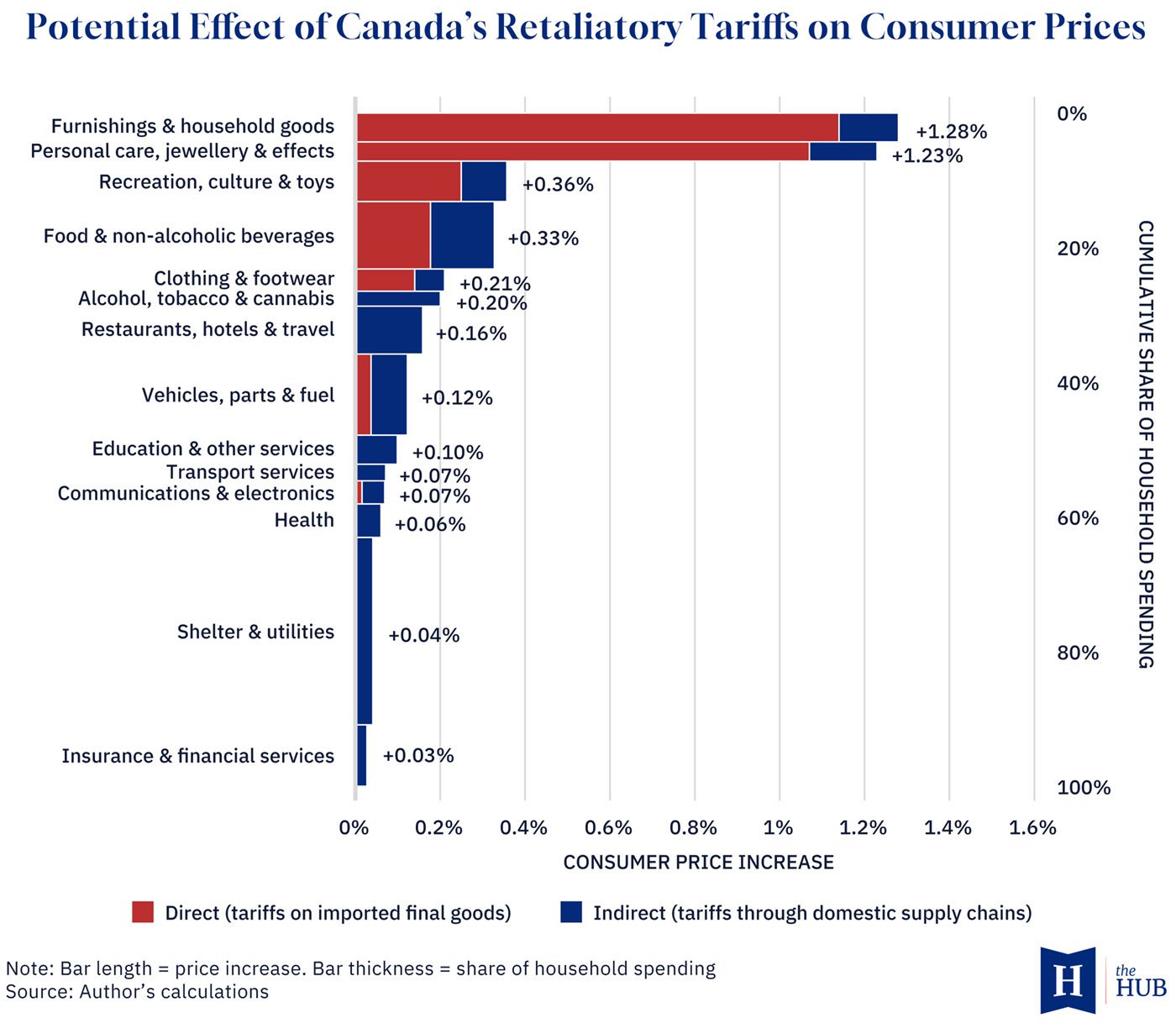
Even the overall 0.25 percent increase is not trivial. Compared against the 2 percent annual target for consumer price growth, it is a decent share of the total. It is also roughly equivalent to a $10-per-barrel increase in oil prices or—for those following the carbon tax debate—to the entire effect of a $30-per-tonne carbon tax on average consumer prices.
In total, it’s a nearly $4 billion hit to consumers. (This won’t happen immediately, to be clear. It can take a few months for the full effect to mount.) And this is an underestimate, since it doesn’t include the possible rise in the price of substitute goods.
Costs beyond consumer prices
There are also additional costs that don’t show up in consumer prices, as they are instead embedded within the price of goods and services used for investment, government spending, and even exports to other countries around the world.
I estimate the cost of Canadian exports, for example, might rise by 0.5 percent. That reduces our competitiveness abroad, with the cost of exports to Mexico specifically increasing by even more—I estimate nearly 0.8 percent.
For businesses, to take another example, I estimate the overall cost of machinery and equipment investment might rise by 0.7 percent. That could decrease investment levels, labour productivity, and overall economic growth.
These costs will eventually land on individuals in one way or another, even if not through consumer prices at first.
Hitting lower-income Canadians hardest
The overall effect is one thing. Which Canadians bear the hardest burden is another. And it’s clear that the burden won’t be shared evenly.
Households at different income levels, or with different numbers of children, buy very different things.
It’s hard to get a precise estimate, but my own work here suggests that households earning under $30,000 a year lose more than 0.5 percent of their disposable income as a result of the retaliatory tariffs. That is over three times larger than the hit to households earning above $150,000. In terms of dollars, families with kids face costs of roughly $250 per year from the tariffs while those without kids face costs of less than $170.
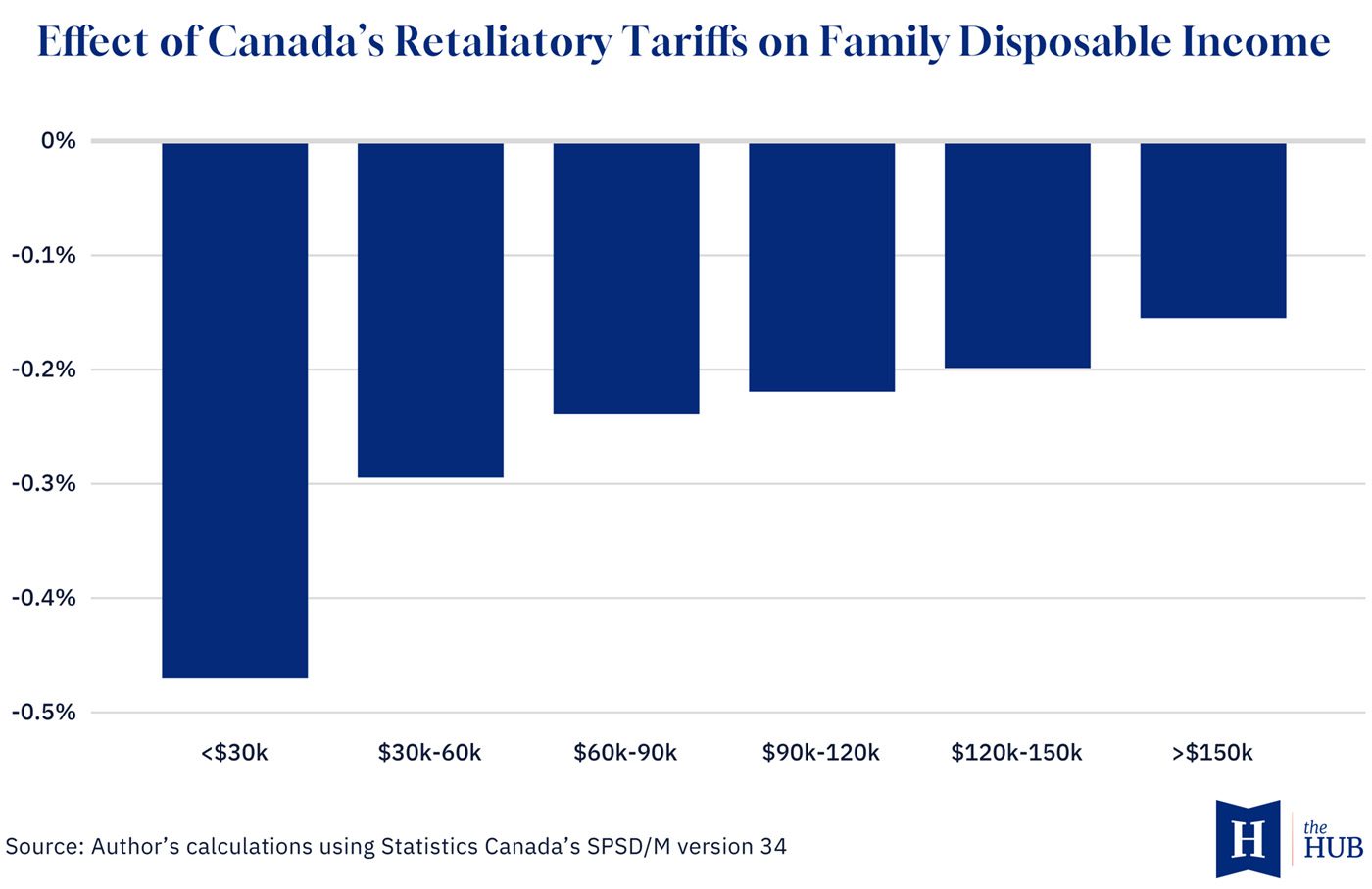
Simply put, tariffs are a regressive tax, and this is part of why they are not an ideal way to raise revenue.
A cost worth paying?
All of this is true in the U.S. as well, of course. American tariffs harm American productivity and growth, and fall heavily on low- and middle-income Americans too.
None of this means retaliation is wrong, to be clear. I tend to think it’s unwise, despite its popularity, and we could instead focus our efforts on boosting Canadian economic competitiveness and growth at home. There’s a lot to do that we aren’t.
And even if there are good (non-economic) reasons to respond, the costs must be considered. They land on Canadian consumers and businesses, and are especially challenging for those least able to bear them.
Trevor Tombe is a professor of economics at the University of Calgary, the Director of Fiscal and Economic Policy at The School of Public Policy, a Senior Fellow at the Macdonald-Laurier Institute, and a Fellow at the Public Policy Forum.