By Tim Sargent, October 27, 2025
In a departure from past practice, Prime Minister Carney has decided not to issue individual mandate letters to his ministers, leaving each to determine on their own how best to contribute to the government’s agenda and fulfill their responsibilities. In Letter to a minister, The Hub’s new series in collaboration with the Macdonald-Laurier Institute, we will provide each minister with a policy agenda that is bold enough to address the grave challenges that the country faces, but manageable enough to be implemented in a realistic time frame.
The series continues this week with a letter to the minister of justice and attorney general.
October 22, 2025
The Honourable Sean Fraser P.C., K.C., M.P.
Minister of Justice and Attorney General of Canada
House of Commons,
Ottawa, Ontario
Dear minister,
Congratulations on your appointment as the minister of justice and attorney general. Your department has a lot of work ahead of it, both to support an aggressive and important legislative and regulatory agenda and to use the tools at your disposal—primarily the Criminal Code—to make Canadians safer.
While the priority of “protecting Canadian sovereignty and safety” outlined in the prime minister’s mandate letter to ministers is the most directly aligned with your department’s mandate, in reality, as the Government of Canada’s in-house law firm, you will have an important role to play in supporting virtually all his listed priorities.
In this letter, I offer some concrete advice on how to advance meaningful change early in your mandate to allow you to fulfill this role, and policy proposals that will help ensure that Canada’s justice system is a source of national confidence and international respect.
Addressing rising crime rates
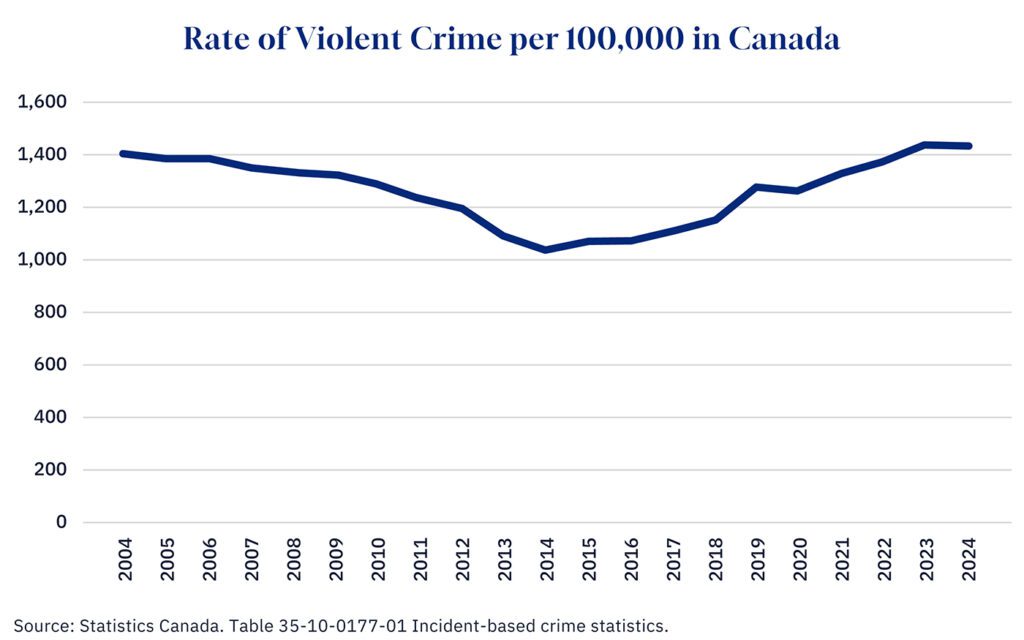
Crime has increased significantly over the last decade, with violent crime showing the most significant increase—up 37 percent since 2014, as the chart below illustrates. Canadians—particularly the most vulnerable and marginalized—are counting on you and your colleague, the minister of public safety, to tackle this challenge.
While the new bail reform legislation is a step in the right direction, the reality is that bail reform on its own will not lead to safer streets and communities. Without changes to sentencing criteria, tougher bail conditions may simply contribute to a higher proportion of offenders remanded to provincial custody while awaiting trial, without any change to conviction and sentencing outcomes.
Instead, what is required is a multifocal approach that includes more consistent sentencing, including alternatives to incarceration, and stronger measures to counter organized crime. This falls squarely within your remit, and I propose three main areas for reform:
Establish sentencing guidelines
Real change starts with smarter—not just longer—sentencing. While much of the political focus has been on mandatory minimums, the reality is that these are blunt instruments, which are very susceptible to Charter challenges. Rather, the key is consistency and predictability; there should be similar consequences for similar crimes. Introducing structured sentencing guidelines—like those used in the United States and the United Kingdom—would provide a standardized framework to ensure similar offences receive similar penalties, regardless of geography or judicial assignment. This would promote uniformity across Superior courts and reinforce public trust in the justice system. These guidelines are not rigid formulas: they offer a structured starting point while allowing judges to depart or vary from the recommended range when justified by specific criteria. This ensures that sentencing remains individualized and responsive to the unique circumstances of each case.
Expand the use of alternatives to prison
While it is tempting to deal with higher crime rates through longer sentences, the reality is that prison is expensive—more than $150,000 per inmate year—and Canada’s prisons are overcrowded and frequently disorderly. Furthermore, longer sentences served under these conditions do not reduce recidivism—indeed, prison can increase recidivism if it inducts individuals into criminal culture and makes reintegration into society harder.
To better manage individuals at high risk of reoffending—particularly those without histories of serious or violent offences—Canada should expand the use of innovative supervision tools. For example, the use of GPS-enabled ankle monitors can support the post-release monitoring of high-risk individuals, thereby enhancing public safety without resorting to expensive, prolonged incarceration. They can also be used as an alternative to pre-trial detention by allowing courts to impose conditions that protect communities while respecting the presumption of innocence.
To enable this, the Corrections and Conditional Release Act should be amended to authorize the broader use of GPS tracking and graduated sanctions. You will need to work with your provincial and territorial colleagues to harmonize legislative frameworks and operational standards, ensuring consistent and effective implementation nationwide.
Crack down on organized crime
Organized crime remains a persistent and evolving threat to public safety, economic integrity, and national security in Canada. With over 2,000 criminal groups operating across the country—many with transnational ties—these networks are deeply entrenched in illicit drug trafficking, firearms violence, money laundering, human trafficking, and cybercrime.
While the Criminal Code includes provisions targeting organized criminal activity, Canada lacks a dedicated statute comparable to the U.S. Racketeer Influenced and Corrupt Organizations (RICO) Act, which enables extended criminal penalties and civil actions against individuals engaged in criminal enterprises. Passing such an act would send a strong signal that Canada is taking organized crime seriously. I would therefore suggest that you launch a process with provincial attorneys-general to develop a Canadian equivalent of RICO. This act should contain severe mandatory minimum sentences for the most prosecutable and high-impact crimes, including large-scale fentanyl tracking and trade-based money laundering linked to transnational criminal networks.
In concert with a dedicated RICO-type act, three other areas in Canada’s broader legal framework for addressing organized criminal activity require change:
- Canada’s privacy and non-disclosure laws are frequently cited as impediments to international crime investigations. The high threshold for disclosure hinders transnational enforcement and prosecution efforts.
- Criminal trials involving organized crime are necessarily complex and lengthy; it will be essential to legislate an exemption to the Jordan framework that limits the length of trials.
- Weak safeguards for whistleblowers undermine Canada’s ability to detect and prosecute foreign bribery and other forms of white-collar crime. Robust protection mechanisms are essential to encourage disclosure and support investigative integrity.
Support the legal ecosystem
Justice Canada’s role goes well beyond criminal law. The department also plays an important role in the court system, particularly through judicial appointments, is the key drafter of legislation and regulations, and represents the Crown before the courts. Areas in which you should focus efforts include:
Help fix a slow and cumbersome court system
The judicial branch of government remains under strain due to persistent vacancies and delays in appointments. Delays not only strain judicial resources but also undermine public confidence in the system. You can play an important role in improving the system by ensuring timely judicial appointments. Since 2023, the government has made considerable progress in reducing the backlog of these appointments; however, over 44 vacancies remain, and you will need to make it a priority to fill these to ensure that current momentum is not temporary.
Review the mandate and scope of the Canadian Human Rights Commission
The Canadian Human Rights Commission (CHRC) was established to uphold equal treatment under the law and protect individual rights through fair, impartial adjudication of individual human rights complaints. However, in recent years, the CHRC has veered from this core mission by adopting frameworks that emphasize group-based outcomes rather than individual misconduct or liability, expanding liability through ambiguous standards like disparate impact, and usurping the role of lawmakers and policymakers in program design.
This drift has led to increased litigation risk, at great cost to the taxpayer. This was most evident in the decision on First Nation child and family services, which looks set to cost the taxpayer more than $23 billion in individual compensation and $47 billion over 10 years for long-term reform.
You should therefore consider requesting a parliamentary committee review of the CHRC’s enabling legislation to assess whether it continues to fulfill its intended purpose and serves the public interest. This would provide what would hopefully be a non-partisan basis for a thorough overhaul of the CHRC’s enabling legislation.
Focus spending on providing legal support for the federal government’s agenda
The generational change that the prime minister has promised will leave no area of our economy and society untouched and will require significant legislative and regulatory change. You will need to refocus resources in your department to ensure that it is drafting, repealing, and modernizing statutes to reflect the evolving legal and policy landscapes.
While spending within the justice portfolio has increased by 51.3 percent since 2015-16, this was driven primarily by a near doubling of transfer payments. When making decisions about spending reductions, you should therefore focus on reducing these transfer payments and on protecting the legal capacity (i.e., the lawyers and legal drafters) required to support the government’s ambitious agenda.
Manage legal risk proactively
Finally, it will be important to mitigate legal risk proactively while safeguarding legal integrity. You would be wise to resist legislative approaches that are based on short-term goals or strongly influenced by specific interest groups: Too often, such legislation generates legal challenges that lead to delays in the implementation of important government policies and programs. Instead, instruct your department to rigorously vet legislative proposals and to carefully evaluate the risks of prolonged spurious litigation or constitutional challenges. Maintaining Canadians’ confidence in the justice system requires you to be vigilant in ensuring that the lines between legal interpretation and policy advocacy do not become blurred, especially when the department takes public positions on constitutional matters or intervenes in politically sensitive cases.
Concluding thoughts
The rise in crime over the last 10 years, especially violent crime, is very concerning, and it is essential to reassure Canadians that the government is taking the problem seriously. However, it is also important to avoid knee-jerk reactions and political sloganeering. Consistent sentencing, efficient courts, alternatives to prison, and a focus on organized crime will do much more to reduce crime than arbitrary measures that are vulnerable to being overturned by the courts.