
Eric Kaufmann, September 3, 2026
Alex Usher, a higher education consultant, sent Macdonald-Laurier Institute (MLI) managing director Brian Lee Crowley a letter following the publication of our report, The Equity-Excellence Trade-off: A Study of EDI in the Canada Research Chairs Program. Usher’s letter, which he published online and widely circulated among academics, claims that the report is “not just gutter social science: it is a drive-by smear. Some people would call it clearly racist and sexist. You can count me among them.” Before MLI could respond, Heather Campbell repeated Usher’s claims, called our report “racist nonsense,” and republished the email to her social media.
Usher claims that our report is invalid social science because it crudely compares average h-indices across group categories without controlling for age or discipline. Both claims are manifestly false, and even a cursory read of the report would have shown this very clearly.
Usher claims that “H-index is inextricably correlated with age … Older scholars have had more time to accumulate publications than younger ones, therefore their H-index ceiling is higher. Ceteris paribus, given two scholars of identical talent and publication habits, the older one is always going to have a higher H-Index. Comparing two groups of scholars would therefore only be appropriate if a) the two groups were identical in terms of age distribution or b) age differences are explicitly controlled for. The paper provides no evidence that the latter happened … Which means the comparisons made here are utterly meaningless. Surely your authors knew this. What business would they have publishing a bibliometrics paper if they did not? But then, if they did know, why did they not mention this as a limitation in the article?”
If Alex Usher had read the report, he would have seen that we control for both career length and date of appointment, which are highly correlated with age and, more importantly, directly measure “more time to accumulate publications,” his construct of interest. More than that, we also accounted for the fact that h-indices at entry in the profession have been rising over time, and that Tier I chairs have far higher h-indices than Tier II chairs. This is a careful multivariate analysis, not the caricatured bivariate crosstabulation that Usher accuses us of.
Usher then moves on to a second charge. “There is a second massive problem with using H-index to compare individual scholars,” he adds. “Different scholarly cultures produce different patterns of scholarly publication. In the humanities, for instance, scholars are more likely to communicate via monographs (not captured by standard bibliometrics) than by articles … the mean H-index for all scholars in the humanities was 2.3, in social sciences 5.2 and in the sciences 10.6 … Using H-indices (or any citation-related measure for that matter) without taking account of field of study simply is not measuring apples-to-apples. Surely your authors knew this … Let me spell this out: if you do not control for age and field of study, comparing H-indices is completely meaningless.”
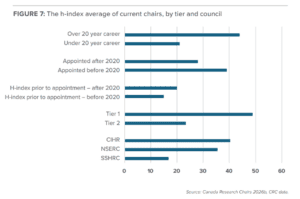
The only problem with the above is that we explicitly controlled for discipline. Not only for research council (SSHRC, NSERC, CIHR) but for 178 subdisciplines, which we modelled using fixed effects. We also use standardized h-indices to account for a non-normal pattern of distribution on the outcome measure. This was in turn compared with American data on promotions (also controlling for discipline and length of career), revealing very similar results. Some of our controls are summarized in Figure 7 of the report (below), where h-indices are given for various categories, including research council. It is astounding that any serious critic could say that we were unaware of these dynamics.
Usher leaps to confirm his priors by asserting that “female and racialized scholars who receive CRCs are a) younger and b) less likely to be in hard sciences than their white male counterparts.”
In fact, at the same stage of career, in the same discipline, female, Black, and Indigenous chairs have less research impact than male or White or Asian chairs. This kind of knee-jerk response reflects extremely poorly on an industry professional who claims to have worked with numbers.
False accusations of racism are not virtuous, but harm those they are intended to help. At numerous universities, including Cambridge, the threat of being accused of racism shut down critical scrutiny of Jason Arday’s work, setting him up for tragic failure. Have we learned nothing?
It speaks volumes about the culture of ideological conformity in this industry that someone so highly placed could make grandiose normative claims on the basis of such basic mistakes. Anyone who actually read the report and possesses even a basic grasp of multivariate statistics would never make such obvious clangers. I can only conclude that motivated reasoning accounts for these errors. As Daniel Kahneman and Amos Tversky remark, “people aren’t rational, they rationalize.”