Tuesday, June 16, 2026
No Result
View All Result
  • Media
Macdonald-Laurier Institute
  • Home
  • About
    • Who We Are
    • Who Makes MLI Work
    • Fifteenth Anniversary
  • Experts
    • Experts Directory
    • In Memoriam
  • Issues
    • Domestic Policy
      • Economic Policy
      • Justice
      • Rights and Freedoms
      • Assisted Suicide (MAID)
      • Health Care
      • COVID-19
      • Gender Identity
      • Canada’s Political Tradition
      • AI, Technology and Innovation
      • Media and Telecoms
      • Housing
      • Immigration
      • Agriculture and Agri-Food
      • Competition Policy
    • Energy Policy
      • Energy
      • Environment
    • Foreign Policy
      • Israel-Hamas War
      • Ukraine
      • Taiwan
      • China
      • Europe and Russia
      • Indo-Pacific
      • Middle East and North Africa
      • North America
      • Foreign Interference
      • National Defence
      • National Security
      • Foreign Affairs
    • Indigenous Affairs
  • Projects
    • CNAPS (Center for North American Prosperity and Security)
    • Justice Report Card
    • The Promised Land
    • Voices that Inspire: The Macdonald-Laurier Vancouver Speaker Series
    • Dragon at the door
    • Canada on top of the world
    • Letter to a minister
    • The Great Energy Crisis
    • DisInfoWatch.org
    • Managing Indigenous Prosperity
    • Judicial Foundations
    • Landmark Cases Council
    • Defending The Marketplace of Ideas
    • Reforming the University
    • Digital Policy & Connectivity
    • Past Projects
      • Double Trouble
      • Canada and the Indo-Pacific Initiative
      • The Transatlantic Program
      • COVID Misery Index
        • Provincial COVID Misery Index
        • Beyond Lockdown
        • COVID and after: A mandate for recovery
      • Speak for Ourselves
      • The Eavesdropping Dragon: Huawei
      • Talkin’ in the Free World with Mariam Memarsadeghi
      • An Intellectual Property Strategy for Canada
      • Munk Senior Fellows
      • A Mandate for Canada
      • Confederation Series
      • Fiscal Reform
      • The Canadian Century project
      • Fixing Canadian health care
      • Internal trade
      • From a mandate for change
      • Size of government in Canada
      • Straight Talk
      • Labour Market Report
      • Leading Economic Indicator
      • Centre for Advancing Canada’s Interests Abroad
      • Indigenous Prosperity at a Crossroads
        • Aboriginal Canada and Natural Resources
  • Events
    • Upcoming Events
    • Past Events
      • MLI Dinners
      • Great Canadian Debates
  • Latest News
  • Libraries
    • Columns
    • Commentary
    • Papers
    • Books
    • Video
  • Donate
  • Home
  • About
    • Who We Are
    • Who Makes MLI Work
    • Fifteenth Anniversary
  • Experts
    • Experts Directory
    • In Memoriam
  • Issues
    • Domestic Policy
      • Economic Policy
      • Justice
      • Rights and Freedoms
      • Assisted Suicide (MAID)
      • Health Care
      • COVID-19
      • Gender Identity
      • Canada’s Political Tradition
      • AI, Technology and Innovation
      • Media and Telecoms
      • Housing
      • Immigration
      • Agriculture and Agri-Food
      • Competition Policy
    • Energy Policy
      • Energy
      • Environment
    • Foreign Policy
      • Israel-Hamas War
      • Ukraine
      • Taiwan
      • China
      • Europe and Russia
      • Indo-Pacific
      • Middle East and North Africa
      • North America
      • Foreign Interference
      • National Defence
      • National Security
      • Foreign Affairs
    • Indigenous Affairs
  • Projects
    • CNAPS (Center for North American Prosperity and Security)
    • Justice Report Card
    • The Promised Land
    • Voices that Inspire: The Macdonald-Laurier Vancouver Speaker Series
    • Dragon at the door
    • Canada on top of the world
    • Letter to a minister
    • The Great Energy Crisis
    • DisInfoWatch.org
    • Managing Indigenous Prosperity
    • Judicial Foundations
    • Landmark Cases Council
    • Defending The Marketplace of Ideas
    • Reforming the University
    • Digital Policy & Connectivity
    • Past Projects
      • Double Trouble
      • Canada and the Indo-Pacific Initiative
      • The Transatlantic Program
      • COVID Misery Index
        • Provincial COVID Misery Index
        • Beyond Lockdown
        • COVID and after: A mandate for recovery
      • Speak for Ourselves
      • The Eavesdropping Dragon: Huawei
      • Talkin’ in the Free World with Mariam Memarsadeghi
      • An Intellectual Property Strategy for Canada
      • Munk Senior Fellows
      • A Mandate for Canada
      • Confederation Series
      • Fiscal Reform
      • The Canadian Century project
      • Fixing Canadian health care
      • Internal trade
      • From a mandate for change
      • Size of government in Canada
      • Straight Talk
      • Labour Market Report
      • Leading Economic Indicator
      • Centre for Advancing Canada’s Interests Abroad
      • Indigenous Prosperity at a Crossroads
        • Aboriginal Canada and Natural Resources
  • Events
    • Upcoming Events
    • Past Events
      • MLI Dinners
      • Great Canadian Debates
  • Latest News
  • Libraries
    • Columns
    • Commentary
    • Papers
    • Books
    • Video
  • Donate
No Result
View All Result
Macdonald-Laurier Institute

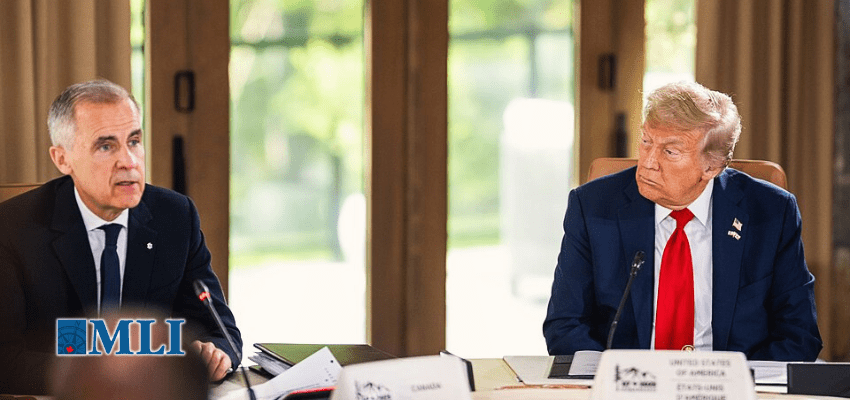
Canada’s MAGA moment doesn’t undo strategic partnership with China: Raquel Garbers in the Washington Examiner

Carney must convince the U.S. that he can and will break his party’s affinity for China.

June 16, 2026
in Foreign Affairs, National Security, Latest News, Columns, China: The dragon at the door, Foreign Policy, Indo-Pacific, North America, Raquel Garbers
Reading Time: 4 mins read
A A
Canada’s MAGA moment doesn’t undo strategic partnership with China: Raquel Garbers in the Washington Examiner

This article originally appeared in the Washington Examiner. 

By Raquel Garbers, June 16, 2026

On May 28 in New York, Canadian Prime Minister Mark Carney declared that a strong Canada “will help make America great again.” His announcement came at a high-stakes moment, with China’s foreign minister arriving in Ottawa to build out the road map for the Canada-China “strategic partnership” and Minister Dominic Leblanc heading to Washington in an attempt to salvage USMCA. It’s all interconnected.

Struck last fall against the backdrop of trade tensions with Washington, the Canada-China partnership is alarming security experts on both sides of the border. They understand Beijing is working hard to build up its coercive power over Canada and to use Canada as a back door into the United States. They also know the U.S. will use its economic power — including its ability to impose harsh trade terms on Canada — to stop Canada from getting too deeply ensnared by Beijing.

Tethered to the U.S., Canada sits on the front lines of the U.S.-China contest. Its interconnectivity with the U.S. means it is a high-value target for Beijing to co-opt and coerce, and a priority-one asset (or liability) for the U.S. to lock down. Its options for navigating this reality are few, constrained by poor choices that undercut its national unity, weakened its economy, hollowed out its military, and allowed Beijing to infiltrate its economic and political systems.

The inconvenient truth is that Carney inherited “really bad cards,” as President Donald Trump might put it, at the very moment the U.S. is demanding a new trade deal as part of its efforts to rebuild its national power and contest China. If the prime minister’s negotiation strategy includes leveraging the implicit threat of an ever deeper partnership with Beijing to wring trade concessions out of the U.S. — as seems might be the case — he’s playing a risky game.

Canada’s partnership with China has already bestowed gifts on Beijing dressed up as wins for Canada: investment opportunities that create openings for economic attacks; cheap electric vehicles that undercut Canadian industry; trade relief that perpetuates the canola sector’s vulnerability; and a new era of security cooperation that invites yet more interference in Canada’s affairs. In these ways and more, it helps Beijing nest itself inside Canada and, from there, attack interconnected U.S. systems and corrupt the North American market at the expense of U.S. and Canadian companies alike. The U.S. understands this.

After securing the partnership with Beijing, Carney moved on to deliver a speech at Davos that was widely interpreted as casting the U.S. as the irresponsible great power whose antics have caused the breakdown of the global order. He also called on middle powers to band together to push back on the great powers, effectively implying that the U.S. is no different than China. Judged only by its impact on Canada-U.S. relations, the speech overplayed his hand. Telling any American that their country is the same (or worse) than a communist dictatorship risks igniting American patriotism in opposition to Canada and squandering goodwill from domestic U.S. (anti-Trump/pro-Canada) sentiment.

There is growing evidence that Carney understands he is dancing on the edge of U.S. tolerance and may well have been warned that he has gone too far. His calls for guardrails on the partnership with China are telling. So too are his efforts to distance himself from extreme (at times, absurd) anti-U.S. rhetoric, his newfound enthusiasm for Fortress North America, and now his declaration that a strong Canada will help make America great again.

As the USMCA deadline comes into focus and both China and the U.S. dial up their Canada game, the risk of miscalculation on the prime minister’s part remains real, if only because he is holding bad cards, through no fault of his own, in a global great game. Far more serious is the risk that lies in his party’s pro-China reputation. Knowing the reasons behind that reputation, the U.S. is unlikely to trust that Canada will hold Beijing in check when it aggressively exploits the partnership.

To protect Canada from U.S. overreach stirred up by its strategic partnership with China, Carney needs to do much more than open the door to Fortress North America, offer to help make America great again, and dial down anti-U.S. rhetoric. He must also convince the U.S. that he can and will break his party’s affinity for China. Should he fail to do so, his decision to strike a strategic partnership with Beijing could well prove to be Canada’s last truly sovereign act.


Raquel Garbers is a senior fellow with the Macdonald-Laurier Institute, the Center for North American Prosperity and Security, and the Australian Strategic Policy Institute. She is a former senior official at the Department of National Defence, where she served as the principal architect of Canada’s defense policy and co-led the Canada at Economic War program at the Centre for International Governance Innovation.


Source: Washington Examiner

Related Posts

Borderless Energy: How an integrated US – Canada natural gas market keeps energy affordable, reliable, and competitive across North America
Energy Policy

Borderless Energy: How an integrated US – Canada natural gas market keeps energy affordable, reliable, and competitive across North America

June 16, 2026
Building Indigenous Advantage in Canada’s Mining Economy | Jenny-Lou Campbell
Latest News

Building indigenous advantage in Canada’s mining economy

June 15, 2026
If monopolies are un-Canadian, what about Medicare?: David Zitner in the Western Standard
Latest News

If monopolies are un-Canadian, what about Medicare?: David Zitner in the Western Standard

June 15, 2026

Newsletter Signup

  Thank you for Signing Up
  Please correct the marked field(s) below.
Email Address  *
1,true,6,Contact Email,2
First Name *
1,true,1,First Name,2
Last Name *
1,true,1,Last Name,2
*
*Required Fields

Follow us on

Macdonald-Laurier Institute

323 Chapel Street, Suite #300
Ottawa, Ontario, K1N 7Z2 Canada

613.482.8327

info@macdonaldlaurier.ca
MLI directory

Support Us

Support the Macdonald-Laurier Institute to help ensure that Canada is one of the best governed countries in the world. Click below to learn more or become a sponsor.

Support Us

  • Inside Policy Magazine
  • Annual Reports
  • Jobs
  • Privacy Policy

© 2023 Macdonald-Laurier Institute. All Rights reserved.

This site uses cookies. By continuing to browse the site you are agreeing to our use of cookies.

Privacy Preference Center

Consent Management

Necessary

Advertising

Analytics

Other

No Result
View All Result
  • Home
  • About
    • Who We Are
    • Who Makes MLI Work
    • Fifteenth Anniversary
  • Experts
    • Experts Directory
    • In Memoriam
  • Issues
    • Domestic Policy
      • Economic Policy
      • Justice
      • Rights and Freedoms
      • Assisted Suicide (MAID)
      • Health Care
      • COVID-19
      • Gender Identity
      • Canada’s Political Tradition
      • AI, Technology and Innovation
      • Media and Telecoms
      • Housing
      • Immigration
      • Agriculture and Agri-Food
      • Competition Policy
    • Energy Policy
      • Energy
      • Environment
    • Foreign Policy
      • Israel-Hamas War
      • Ukraine
      • Taiwan
      • China
      • Europe and Russia
      • Indo-Pacific
      • Middle East and North Africa
      • North America
      • Foreign Interference
      • National Defence
      • National Security
      • Foreign Affairs
    • Indigenous Affairs
  • Projects
    • CNAPS (Center for North American Prosperity and Security)
    • Justice Report Card
    • The Promised Land
    • Voices that Inspire: The Macdonald-Laurier Vancouver Speaker Series
    • Dragon at the door
    • Canada on top of the world
    • Letter to a minister
    • The Great Energy Crisis
    • DisInfoWatch.org
    • Managing Indigenous Prosperity
    • Judicial Foundations
    • Landmark Cases Council
    • Defending The Marketplace of Ideas
    • Reforming the University
    • Digital Policy & Connectivity
    • Past Projects
      • Double Trouble
      • Canada and the Indo-Pacific Initiative
      • The Transatlantic Program
      • COVID Misery Index
      • Speak for Ourselves
      • The Eavesdropping Dragon: Huawei
      • Talkin’ in the Free World with Mariam Memarsadeghi
      • An Intellectual Property Strategy for Canada
      • Munk Senior Fellows
      • A Mandate for Canada
      • Confederation Series
      • Fiscal Reform
      • The Canadian Century project
      • Fixing Canadian health care
      • Internal trade
      • From a mandate for change
      • Size of government in Canada
      • Straight Talk
      • Labour Market Report
      • Leading Economic Indicator
      • Centre for Advancing Canada’s Interests Abroad
      • Indigenous Prosperity at a Crossroads
  • Events
    • Upcoming Events
    • Past Events
      • MLI Dinners
      • Great Canadian Debates
  • Latest News
  • Libraries
    • Columns
    • Commentary
    • Papers
    • Books
    • Video
  • Donate

© 2023 Macdonald-Laurier Institute. All Rights reserved.