By John Kaye
August 8, 2025
Executive Summary | Sommaire (le français suit)
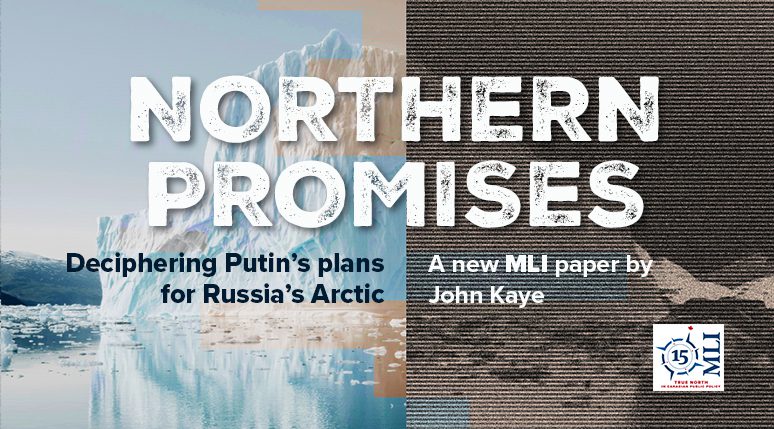
In March 2025, Russian President Vladimir Putin spoke at the International Arctic Forum in Murmansk. He presented a confused and contradictory vision for the region. On one hand, Putin claimed that the Arctic had been drawn into a “Great Power” confrontation, fuelled by NATO’s increasing polar presence and US President Donald Trump’s bold proposition for the United States to acquire Greenland. On the other, Putin envisaged the Arctic as an area brimming with endless potential – a space for pragmatic, mutually beneficial cooperation, even amidst rising international tensions.
A review of Putin’s comments between 2014 and 2024, a turbulent period for Russia, highlights the strategic importance of the Arctic Zone to the country. For Western polar nations, including Canada, grasping Putin’s evolving vision for the Arctic is crucial as they strive to assert their sovereignty and pursue their economic and security ambitions in the region.
Putin’s assertions about the Arctic are rife with contradictions: he says that ecological concerns must be balanced, while pushing for mass resource exploitation; he decries Western militarization of the far north, while bolstering Russia’s own military might in the region; he pays lip service to the unique concerns of northern and Indigenous communities, yet pushes for massive, disruptive settlement in the region.
The Arctic is now at the forefront of global politics. The collapse of relations with the West after the country’s illegal invasion of Ukraine in 2022 has seen Russia prioritize cooperation in the Arctic Zone with non-Arctic states like China and India. This complicates things further for Canada, the US, and their allies.
From the rush to exploit its reserves of critical natural resources to the human, economic, and security implications of climate change, the circumpolar region is a site of rapid change. Russia has sovereignty over half of the world’s Arctic coastline, and has ambitious plans to capitalize on the Northern Sea Route (NSR). The country’s sparsely populated Arctic Zone is home to immense reserves of natural resources and hydrocarbons, which Putin and his circle refer to as Russia’s “strategic resource base.” The region’s resources seem to offer Russia the promise of prosperity in a time of political and economic uncertainty.
Russia has excluded itself from productive partnership with Western Arctic nations to its own peril. While Putin projects the Arctic as a treasure-trove of possibilities in otherwise desperate times, Canada and its allies must remember that Russia and Russians are the main losers in the disruption of circumpolar Arctic co-operation – and must constantly remind Russia that its invasion of Ukraine is the reason for that disruption and loss. In becoming increasingly reliant on investment from countries like China and India, Russia has opened the door to non-Arctic states’ participation in regional governance and development. This will be a hard door to close. In addition, while these relationships are often described by Russia as more pragmatic than those with other Arctic states, they are based purely on extraction and exploitation, rather than mutual stewardship.
Other Arctic states are well-placed to exemplify the benefits of rulesbased co-operation in the circumpolar region. Western Arctic states have the expertise and motivation to develop the region sustainably and model leadership that takes local communities into account. It is imperative that the other Arctic states – and the world – push back on Putin’s contradictory Arctic messaging. Key policy recommendations include:
• Canada, the US, and their Arctic partners must develop strategic communications that show the benefits of a democratic approach to the Arctic – an approach that at every stage exemplifies the leadership and input of the Arctic’s inhabitants.
• At the same time, democratic Arctic nations must clearly articulate to Russian citizens what their nation is losing by allowing the Putin regime to act so belligerently on the world stage. Putin’s war in Ukraine and other aggressions have alienated Russia’s former partners in the Arctic. Putin and his regime will not tell the Russian people that – so the democratic Arctic countries should state this clearly and often.
• Canada and its Arctic allies must lead by example by engaging and collaborating with the Indigenous peoples of the polar region. Trends like Indigenous majority and co-ownership of development projects on treaty territories, as have been developed in Canada, can serve as an example of how to generate inclusive prosperity in a way that is better than dictates emanating from Moscow.
En mars 2025, le président russe Vladimir Poutine a prononcé une allocution dans le cadre du Forum international de l’Arctique tenu à Mourmansk. Sa vision de la région était floue et contradictoire. D’une part, il a affirmé que l’Arctique avait été entraîné dans un affrontement entre « grandes puissances » du fait de la présence renforcée de l’OTAN dans la région polaire et des revendications hégémoniques du président américain Donald Trump sur le Groenland. D’autre part, il a déclaré considérer l’Arctique comme une région au potentiel infini – un domaine de coopération viable et bénéfique pour tous, malgré les tensions internationales grandissantes.
L’examen des propos de Poutine de 2014 à 2024, une période mouvementée en Russie, permet de souligner l’importance stratégique de la région arctique pour ce pays. Compte tenu des efforts consentis par les pays polaires occidentaux, y compris le Canada, pour affirmer leur souveraineté et atteindre leurs objectifs en matière d’économie et de sécurité, ces derniers doivent surveiller de près les visions transformatrices de Poutine pour l’Arctique.
Les discours de Poutine sur l’Arctique sont truffés de contradictions : il prône l’équilibre écologique tout en supportant une exploitation extensive des ressources, critique la militarisation du Grand Nord par les Occidentaux tout en renforçant sa propre présence militaire dans la région, et prétend soutenir les besoins particuliers des collectivités nordiques et autochtones tout en favorisant une colonisation massive et perturbatrice.
À l’heure actuelle, l’Arctique est au cœur de l’action politique internationale. L’invasion illégale de l’Ukraine en 2022 a mis fin aux relations de la Russie avec l’Occident, de sorte que la Russie privilégie désormais la coopération en Arctique avec des pays non arctiques comme la Chine et l’Inde. Cela complique les choses pour le Canada, les ÉtatsUnis et leurs partenaires.
De l’exploitation intense de ses ressources naturelles essentielles à l’impact du réchauffement climatique sur ses habitants, l’économie et la sécurité, la région polaire est en mutation rapide. La Russie, qui exerce sa souveraineté sur plus de la moitié du littoral arctique mondial, planifie des projets d’exploitation de grande envergure pour la route maritime du Nord. Le territoire arctique russe, peu peuplé, renferme d’immenses réserves de ressources naturelles et d’hydrocarbures, qualifiées de « base stratégique des ressources » par Poutine et son entourage. Les ressources de la région semblent offrir à la Russie l’espoir d’une prospérité en temps d’incertitude politique et économique.
C’est à ses risques et périls que la Russie s’est retirée d’une coopération fructueuse avec les pays de l’Arctique occidental. Alors que Poutine voit l’Arctique comme une ressource précieuse même en temps désespéré, le Canada et ses partenaires doivent garder à l’esprit que le dérèglement de la coopération arctique lui est particulièrement préjudiciable – ainsi qu’à sa population – et persister à lui faire comprendre que c’est en tout premier lieu son attaque contre l’Ukraine qui la désorganise et l’appauvrit. En s’appuyant sur les investissements de pays comme la Chine et l’Inde, la Russie ouvre la voie à des pays non arctiques pour sa gouvernance et son développement régional. Refermer cette porte sera difficile. Par ailleurs, bien que la Russie présente souvent ces relations comme plus pratiques qu’avec certains pays arctiques, ces dernières reposent strictement sur l’extraction et l’exploitation des ressources plutôt que sur une intendance réciproque.
Pourtant, divers pays arctiques sont idéalement situés pour promouvoir les avantages d’une coopération régulée dans la région polaire. L’Arctique occidental possède les compétences et la passion nécessaires pour favoriser le développement durable et orienter le leadership en tenant compte des besoins des collectivités locales. Il est essentiel que le reste des pays arctiques, tout comme le monde, n’adhèrent pas aux signaux contradictoires de Poutine concernant l’Arctique. Voici nos principales recommandations en matière de politiques :
• Le Canada, les États-Unis et leurs partenaires arctiques doivent mettre en place des stratégies de communication qui exploitent les avantages d’une approche démocratique pour l’Arctique – une approche qui, à chaque étape, met en lumière le leadership et la contribution des populations arctiques.
• Parallèlement, les pays démocratiques de l’Arctique doivent sensibiliser les citoyens russes aux conséquences de l’agressivité du régime de Poutine sur la scène internationale. Les actions militaires de Poutine en Ukraine et diverses autres manifestations d’agression ont détérioré les liens de la Russie avec ses anciens partenaires dans la région arctique. Poutine et son gouvernement ne partageront pas ces informations avec le peuple russe – les pays démocratiques de l’Arctique doivent donc assumer cette responsabilité clairement et régulièrement.
• Il faut que le Canada et ses partenaires arctiques donnent l’exemple en collaborant étroitement avec les collectivités autochtones de la région polaire. Dans les régions visées par un traité, la présence majoritairement autochtone et la copropriété des projets de développement, typiques du Canada, peuvent démontrer comment engendrer une prospérité inclusive de manière plus aisée que les décisions de Moscou