Tis article originally appeared in The Hub.
By Dave Snow, August 4, 2026
The CBC can be forgiven for breathing a prolonged sigh of relief. After Mark Carney’s Liberals won the 2025 election, the federal government increased CBC’s budget by $150 million, in part to help “combat disinformation.” Given that the Liberals secured a majority in 2026 amid the Conservatives’ struggles in the polls, the threat of a defunded CBC now seems remote.
Aside from a few missteps—most notably an aborted CBC-funded prank show that sought to publicly humiliate retired RCMP officers—the public broadcaster has generated relatively few headlines of its own over the last year. As other newsrooms shutter, the Mother Corp lumbers on, content to rest on its laurels.
A new Senate committee report suggests that would be a mistake. Released in June after two years of study, the report found trust in CBC/Radio-Canada had declined by 14 percentage points among both anglophones and francophones since 2018. Quoting from witnesses who alleged ideological and political bias at the CBC, the committee warned that such claims “are serious and undermine trust in the public broadcaster.” It recommended that CBC/Radio-Canada periodically subject its news content to analysis by outside experts “in order to assess its fairness and balance.”
Previous statistical analyses of CBC coverage—including my own at The Hub—have generally focused on particular issues or moments in time. By contrast, the CBC’s own public record of its mistakes offers an overlooked opportunity to systematically explore patterns across a six-year period. This DeepDive focusses on that record, examining every notice published on CBC’s English-language Corrections and Clarifications page between January 2021 and July 2026.
Collectively, these corrections paint a picture that will not surprise those who have accused the CBC of progressive bias: conservative perspectives were clearly and consistently distorted by errors in the public broadcaster’s initial reporting.
This was true for subjects as varied as COVID-19, Indigenous issues, and partisan politics. But the pattern was most striking in coverage of Israel and Gaza, where the CBC had to walk back several serious allegations against Israel.
At a minimum, the correction record shows that the CBC needs the kind of independent scrutiny the Senate committee recommends.
How CBC records its mistakes
CBC’s Corrections and Clarifications page begins in January 2021. It covers written stories, radio reports, television programming, videos, and other CBC News content. According to CBC’s own Journalistic Standards and Practices (JSP), “we correct a significant error when we have been able to establish that one has occurred… When a correction is necessary, it is made promptly given the circumstances, with due regard for the reach of the published error.”
The corrections page itself notes that “Corrections and clarifications are noted directly on all digital posts,” while “updates that significantly change the audience’s understanding of a report on any platform are logged on this page.” CBC does not specify how each error is identified, though some are brought to its attention through reader reports and complaints to its ombudsman
Of course, the corrections page is not a comprehensive catalogue of everything CBC gets wrong. It is self-reported, internally policed, and subject to selection bias; CBC decides which errors are significant, which are given notices, and how much information each notice contains.
However, that limitation is revealing in and of itself: it shows which mistakes the CBC itself considers serious enough to publicly acknowledge.
With the help of ChatGPT Sol, I created a dataset of all individual notices on the CBC corrections page. I initially coded each correction notice for its date, subject matter, news format, nature of correction, and whether it involved several politically salient topics for which CBC has been subject to criticism (such as Israel/Gaza, political parties, and COVID-19). Classifications were based solely on the text of CBC’s correction notices.
For every correction discussed below, I returned to the original notices and manually checked the relevant coding to ensure the classifications were accurate. Where necessary to better understand the context (and where a web story was available), I read the updated web story, including any appended correction notice. When CBC’s notice identified the underlying story, I have linked to it below.
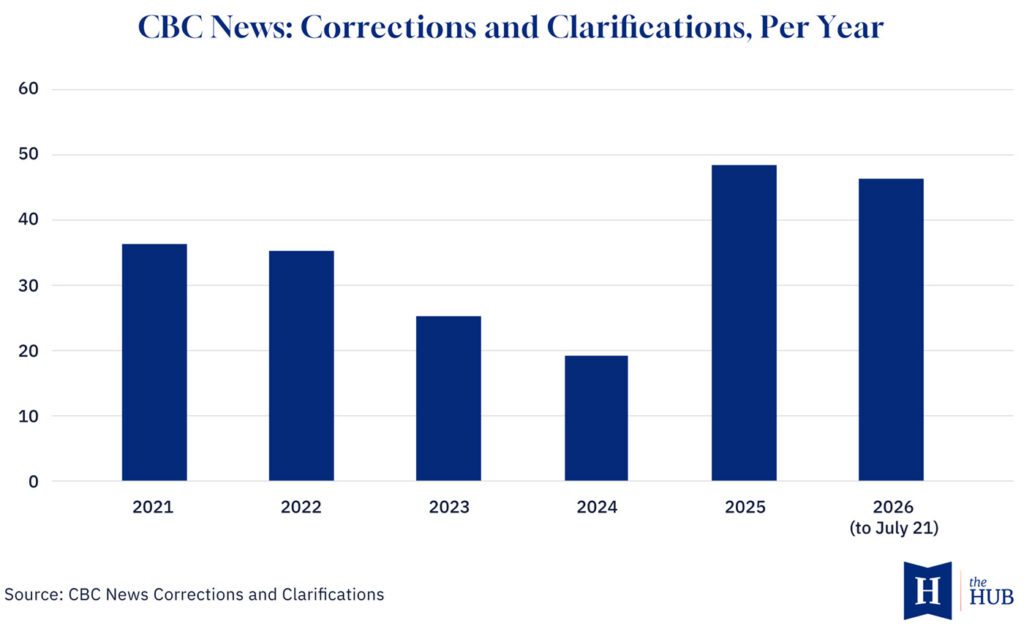
Between January 11, 2021, and July 21, 2026, the CBC published 209 individual correction or clarification notices. The annual number declined steadily between 2021 and 2024 before more than doubling to 48 in 2025. That increase has continued in 2026: by July 21, CBC had already published 46 notices. If this rate continues, there will be approximately 83 notices in 2026—more than double the annual total in every year from 2021 to 2024, and a 73 percent increase from 2025.
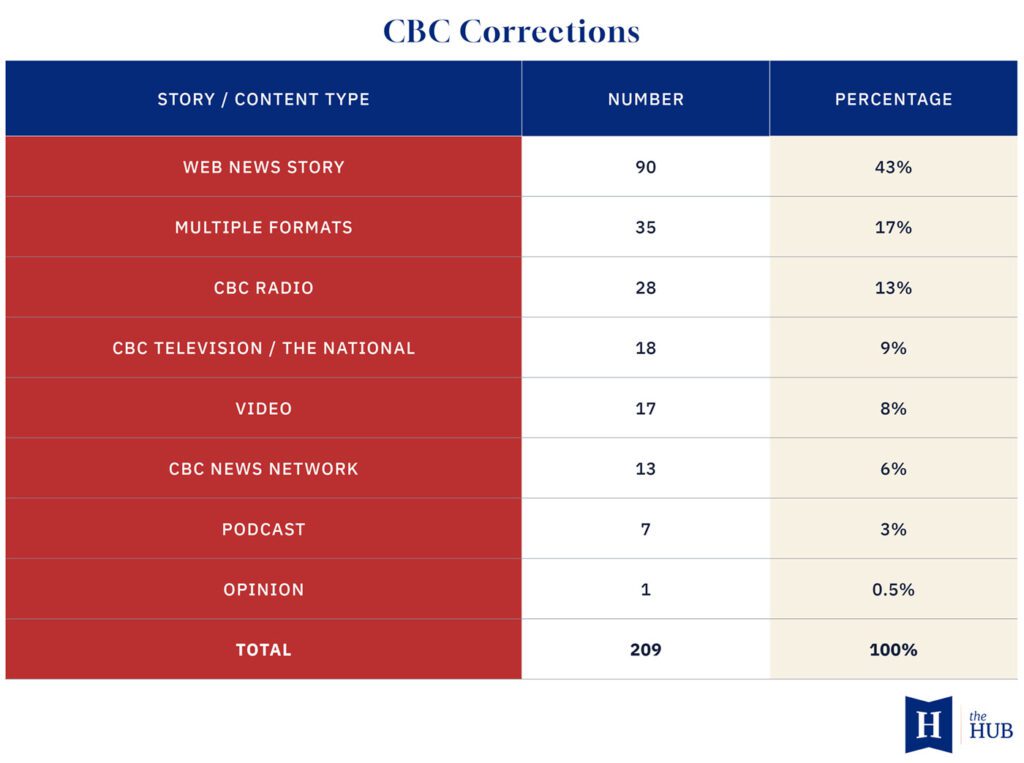
The notices spanned a wide variety of media. As the table shows, corrections to individual news stories were the most frequent (43 percent), followed by multiple formats (17 percent) and CBC Radio (13 percent). Notably, only one correction notice concerned an opinion column—a piece from a racialized Elections Canada worker who associated conservative parties and supporters with hatred. In one passage in the original piece, the author described a “pleasant interaction” with “an elderly white woman with a walker,” then wondered whether the woman “was one of the people who hate people like me.” CBC’s ombudsman described the piece as “neither fair nor precise enough to be considered accurate.” Following an editorial review, some of its language was revised, and CBC moved it from its First Person to Opinion category.
A clear ideological tilt
The data can help us understand the subjects where the CBC most frequently issues corrections, especially when it comes to the broadcaster leaning in a consistent ideological direction. CBC has often been accused of ideological bias against both the Conservative Party and conservatives more broadly. As such, I sought to determine how often partisanship or ideology appeared in CBC’s corrections.
In total, only 10 of the 209 correction notices involved Liberals or Conservatives, or liberalism or conservatism more broadly. Two were minor technical corrections for which partisanship or ideology was incidental. Of the remaining eight, two concerned Liberals and six concerned conservatives. Strikingly, all eight errors ran in the same political direction.
One of the two Liberal-related corrections involved a prematurely celebratory headline that initially declared Canada was “finally getting” a national food program when the Liberal government had merely announced one it hoped to introduce later that year. The other put words in the mouth of a prominent Conservative when a CBC fact-check video falsely said that former Conservative cabinet minister Stockwell Day and others had blamed the Liberal government for changes to Poilievre’s riding boundaries. The source material contained no such accusation. CBC’s correction omitted that context, leaving Day unnamed and admitting only that the video had wrongly said “some” blamed the Liberal government.
The remaining six corrections followed the same pattern: all involved reporting that portrayed conservatives unfavourably. The errors were as follows:
- Reporting that Conservative officials had physically pushed the assistant of floor-crossing MP Chris D’Entremont, when they had pushed open a door.
- Imprecisely linking alleged pressure by India on Conservative MP Michelle Rempel Garner to her decision to leave Patrick Brown’s leadership campaign, without initially noting that she denied being pressured.
- Challenging a Conservative housing affordability video using average mortgage costs, even though the claim was based on median income and total homeownership costs.
- Quoting a professor’s distorted characterization of Charlie Kirk’s remarks about black women and gay people, without describing what Kirk had actually said.
- Publishing quotes from a Facebook post by Conservative MP Rachael Harder in a way CBC later called “potentially misleading” with insufficient context.
- As noted above, publishing a story from an election worker that generalized hateful attitudes to conservative parties and voters more broadly.
Most of the corrections were modest, and, taken together, eight cases hardly prove systemic bias. But the political tilt of the reporting was uniform: one error favoured the Liberals, and the other seven portrayed conservatives unfavourably.
The question of ideological balance extends beyond party politics. CBC has also been accused of approaching contentious Indigenous issues from a one-sided perspective. Most recently, a Front Burner episode on “residential school denialism” was unanimously panned by The Hub’s Full Press media criticism podcast for presenting only one side of a hotly contested debate. To determine whether that criticism reflected a broader pattern, I examined CBC’s corrections involving Indigenous issues.
Thirteen notices fell into this category, eight of which involved technical or relatively minor changes. The remaining five, however, each involved reporting that overstated or prematurely assigned responsibility for wrongdoing to Canadian institutions or the Catholic Church. Somewhat remarkably, on two separate occasions more than four years apart, CBC wrongly reported that the RCMP had been responsible for fatally shooting an Indigenous person (in actuality, the officers were from local police forces in Edmundston and Nunavik). Most infamously, CBC had to correct Rosemary Barton’s defiant claim that “there have been remains of Indigenous children found in various places across the country.”
In addition, the CBC reported that the Catholic Church still owed residential school survivors $60 million, without explaining that a court held its obligations had been fulfilled. It also stated that a national Catholic fundraising campaign for residential school survivors had not begun, without noting that individual dioceses had already started raising money.
In each case, CBC’s original reporting made the Canadian state, the RCMP, or the Catholic Church appear more culpable or less responsive than the facts supported.
Israel and Gaza: An unsurprising trend
Since October 7, 2023, CBC has been subject to near–constant criticism for anti-Israel bias. Across the full dataset, 23 notices concerned Israel, Palestine, Gaza, or closely related actors or events. I reviewed all 23, consulting the original articles where available, and coded each according to the direction in which the correction attempted to add balance. Specifically:
- A correction was classified as adding Israel balance when it clearly strengthened the Israeli account or made the corrected treatment more sympathetic to the Israeli position (indicating that the original version had been too favourable to Palestine).
- A correction added Palestine balance when it clearly strengthened the Palestinian account or made the corrected treatment more sympathetic to the Palestinian position (indicating that the original version had been too favourable to Israel).
These labels describe the direction of the correction, not the overall politics of the original story or whether the correction was justified.
Of the 23 notices, eight added Israel balance, seven added Palestine balance, and eight were technical or had no clear direction. Most alarmingly, four of the eight corrections coded as “adding Israel balance” concerned stories that had initially portrayed Israel as responsible for grave abuses:
- Reporting that 14,000 Palestinian children could die from malnutrition within 48 hours, when the estimate was actually for the coming year.
- Broadcasting, without independent verification, an allegation that Israeli soldiers had buried Palestinians alive.
- Airing allegations of Israeli torture and mistreatment of Palestinian child prisoners, without including Israel’s denial.
- Referring to Palestinians detained or imprisoned by Israel as “hostages,” invoking the language used for those abducted and held captive by Hamas.
The remaining four corrections coded as “adding Israel balance” did not involve allegations of comparable seriousness. They concerned the description of a form presented to Canadian MPs denied entry to the West Bank; reports related to a criminal investigation into a killing; incorrectly describing Samidoun, the anti-Israel group Canada had just designated as a terrorist entity, as a registered charity; and referring to Gaza as “occupied” without stating Israel’s position.
By contrast, none of the seven corrections coded as “adding Palestine balance” concerned allegations as grave as those listed above. One was the mirror image of a correction noted above: initially describing Gaza as not “occupied” without noting the opposing view.
Four others also dealt principally with context or terminology: locating Al-Aqsa Mosque in Israel rather than East Jerusalem; failing to mention that, according to the Palestinian Health Ministry, three Palestinians killed in an Israeli raid on a refugee camp were children; incorrectly stating that the UN considers Hamas a terrorist organization; and incorrectly stating that CBC prohibited the use of the word “genocide” in Gaza, when the attributed use was permitted.
Of the remaining two notices adding Palestine balance, one concerned reporting that omitted violent acts by Israeli soccer supporters before subsequent attacks on them in Amsterdam. The other involved CBC’s reliance on a disputed translation saying that a Hamas militant called five captured female Israeli conscripts “women who can get pregnant.” In both cases, the underlying facts remain vigorously contested. However, even taken at face value, neither came close to the severity of the claims CBC had to correct about Israel. Instead, the gravest errors all ran in the same direction: against Israel.
CBC’s COVID-19 corrections
Somewhat surprisingly, 19 correction notices—9 percent of the entire dataset—were coded as involving COVID-19, vaccines, or pandemic reporting.
Unlike the political corrections listed above, the COVID-19 errors do not all point in a particular ideological direction. For example, CBC clarified that a hospitalized patient’s second vaccine dose had not yet become active, added previously omitted research showing that boosters substantially reduced the risk of infection, and corrected false statements made by an anti-vaccine radio caller. If anything, these mistakes cut against prevailing progressive assumptions about the pandemic.
But on the pandemic’s most contentious questions, CBC’s initial reporting frequently heightened the threat of COVID-19 or bolstered the prevailing public-health narrative: the CBC conflated clinical-trial efficacy with real-world effectiveness when describing the AstraZeneca vaccine; overstated COVID-19 death and hospitalization rates in Nova Scotia; incorrectly attributed a death to COVID-19; mischaracterized a lockdown critic as praising businesses that violated public health orders; and portrayed Ivermectin as a dangerous livestock drug without mentioning its use for treating parasitic infections in humans.
On balance, CBC’s COVID-19 errors suggest a modest progressive tilt, albeit less clearly than in other politically charged areas.
Patterns in the corrections
Looking beyond the raw numbers reveals a further problem: CBC’s correction notices are extremely brief. The average correction notice was 63 words long, with corrections ranging from 23 to 275 words. As a result, the notices often do not contain any information that would enable a retrospective understanding of what was corrected. The oldest and newest entries in the dataset make this clear:
January 11, 2021: “We updated this story, first posted in November 2019, reporting on backlash to a Facebook post from Lethbridge Conservative MP Rachael Harder. Our update was to more accurately reflect her views and to better contextualize some of the reactions to her Facebook post.”
July 21, 2026: “CBC Edmonton removed a story published on July 19, 2026 to YouTube and TikTok about automobile insurance. It was removed due to considerations in our journalistic standards and practices.”
In neither case is the correction notice sufficiently detailed to describe what, precisely, was incorrect in the first place. On occasion, the corrected story itself contains an “editor’s note” that provides a bit more information, though not much. While CBC should be commended for telling readers it has corrected the record, that is of little use when we don’t know what the record originally said.
What CBC’s corrections reveal
This DeepDive draws two broad conclusions about CBC’s self-reported correction and clarification notices. First, CBC deserves some credit for maintaining a public corrections record. While the record would benefit from longer entries and more systematic linking to previous stories, this study would not have been possible without CBC’s willingness to acknowledge its mistakes in the first place.
Second, CBC’s acknowledged errors were not ideologically random. The examples differ in subject and seriousness, but the corrections show an institution whose instincts tend to be progressive: instinctively accepting claims against Conservatives without sufficient corroboration or context; assigning wrongdoing to Canadian institutions and the Catholic Church with respect to Indigenous Peoples; over-eagerly describing COVID-19 risks in ways that reinforced prevailing public health assumptions; and, most troublingly, advancing grave allegations against Israel.
While the direction of errors is not always uniform, the evidence strongly suggests that CBC reporters’ default instincts tend to align with a progressive worldview. In such a monoculture, confirmation bias and motivated reasoning prevail.
These findings provide further support for the Senate committee’s recommendation that CBC’s news and current affairs be subject to periodic analysis by outside experts. As the federal government positions CBC as central to its efforts to “combat disinformation,” such scrutiny is essential.
CBC/Radio-Canada president Marie-Philippe Bouchard claims the broadcaster promotes “a diversity of points of view and fairness in our coverage.” Now CBC has a chance to prove it.