By Patrice Dutil, November 11, 2025
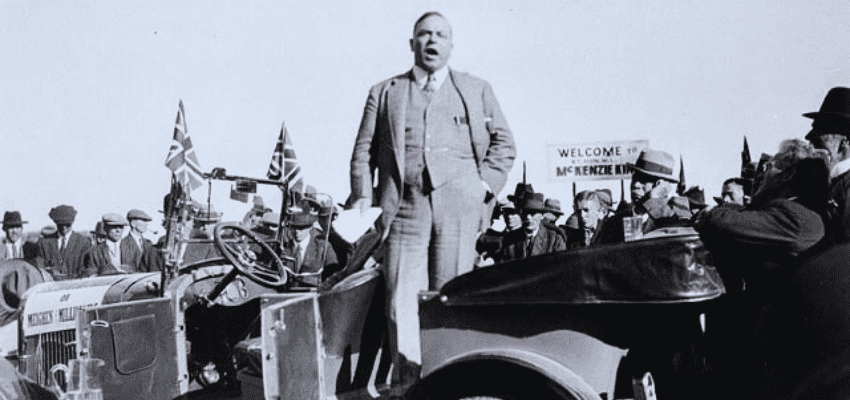
William Lyon Mackenzie King was not a natural leader. He lacked charisma, detested risk, and talked more to his diary – and the spirits of the dead – than to voters. Yet King achieved what no other Canadian has: nearly twenty-two years as prime minister, leading his country through depression, war, and social transformation.
How did this awkward, cautious man, a lifelong celibate who harboured racist views and who was obsessed with the occult, become the most successful politician in Canadian history?
King’s greatness did not lie in vision or eloquence. It lay in systematic competence – an extraordinary ability to build coalitions, manage people, organize institutions, and adapt to change without ever seeming to. In a divided, cautious, and compromise-driven country, King’s personality fit perfectly. He was average in governing, but great in surviving.
A country in pieces
When King assumed leadership of the Liberal Party in 1919, Canada was still raw from the First World War. The Winnipeg General Strike had just shaken the nation’s industrial core. The Spanish flu was killing tens of thousands. The economy had collapsed, and ethnic and regional tensions festered.
The West demanded autonomy; Quebec, scarred by the conscription crisis, distrusted Ottawa; the Maritimes felt abandoned. It was a federation held together by habit more than harmony.
King’s first task was not to lead, but to hold the country together.
In the 1921 election, the Liberals won 41 per cent of the vote but only a minority of seats in the House of Commons. Their power rested on Quebec and the Maritimes. The new Progressive Party, born of farmers’ discontent, dominated the West. King’s pragmatism – his willingness to listen and negotiate with the Progressives – kept the Liberals in office.
Over the next two decades, he repeated this feat again and again. His governments of the 1920s survived on shifting alliances with agrarian movements and with Quebecers. His response to the 1926 King-Byng Affair – a constitutional crisis over the Governor General’s refusal to dissolve Parliament – turned a political disaster into a nationalist victory. His electoral coalition and his do-nothing policies, however, were not enough to survive the wrath of the electorate in the Depression-ravaged election campaign of 1930 and the Liberals were trounced.
By 1935, as the Depression crushed R.B. Bennett’s Conservatives, King’s quiet resilience brought him back to power. His electoral coalition changed: it was now Quebec, Ontario, and parts of the Prairies, and it became the base of Liberal dominance for the next generation.
King’s politics were rarely triumphant, but they were almost never terminal. His genius lay in his ability to survive amid fragmentation.
The psychology of power
King’s success cannot be understood apart from his personality. He was an introvert in a profession of extroverts, a bureaucrat who preferred process to passion.
To his critics, he seemed weak and indecisive. Yet, it can be argued that those same traits made him the ideal leader for a country defined by caution. King’s sense of politics as “organized opinion” reflected his deepest conviction: that democracy is not a contest of wills but an exercise in equilibrium.
His diary – millions of words across five decades – reveals a man constantly measuring himself against that standard. It was his laboratory for reflection and justification. In those pages, King turned introspection into a form of governance.
He was an assiduous student of himself – and therefore a student of his country. His obsessive self-analysis kept him attuned to the boundaries of public tolerance. He led not by commanding opinion but by embodying it.
The elastic creed of Liberalism
King’s Liberalism was not an ideology but a method. It combined Victorian morality – self-help, thrift, and Christian charity – with a pragmatic acceptance of industrial modernity.
During the 1920s, this meant fiscal austerity: cutting debt, balancing budgets, and shrinking Ottawa’s footprint. It was, as economic historian Livio Di Matteo later observed, austerity so strict that it may have worsened the Depression.
Still, King saw restraint as virtue. He believed that social order depended on moral discipline and that state expansion invited instability. His early work Industry and Humanity (1918) offered a corporatist vision of co-operation between capital, labour, and the state – a call for harmony, not redistribution.
When the Depression hit, King refused to imitate US President Franklin Roosevelt’s “New Deal” or Bennett’s Canadian version of it. His 1935 campaign was deliberately vague: a promise to end “one-man government” rather than to launch a social revolution.
Only during the Second World War did necessity push him toward reform. To sustain morale and labour peace, his government introduced unemployment insurance, old-age pensions, and family allowances. The landmark Order-in-Council P.C. 1003 granted collective bargaining rights, doubling union membership.
This evolution amounted to an incremental transformation: social reform not by ideology, but by adaptation. King’s Liberalism became the architecture of Canada’s moderate welfare state – a system built for consensus, not confrontation.
Isolation abroad, competence at home
King’s foreign policy followed the same principle of cautious independence. In the 1920s, he asserted Canada’s autonomy from Britain through modest but symbolic gestures: the 1923 Halibut Treaty with the US, resistance to imperial military ventures, and eventual acceptance of the Statute of Westminster (1931).
Yet he remained a sentimental imperialist, torn between loyalty to Britain and fear of entanglement. During the 1930s, as totalitarianism spread, Canada under King stayed quiet. “Canada pulled down the blinds and hid under the bed,” the journalist Bruce Hutchison pithily noted.
When war finally came in 1939, King executed a perfect pirouette. Canada declared war on Germany in its own right, asserting independence while siding with Britain. He then built a close working relationship with Roosevelt, establishing the Permanent Joint Board on Defence and integrating North American strategy.
This subtle reorientation – from empire to continent – was one of King’s lasting legacies. He positioned Canada as an autonomous yet co-operative power, a stance that would define its postwar diplomacy.
The administrative Prime Minister
If King’s politics were cautious, his administration was modern. He brought to government the habits of a civil servant: order, hierarchy, and efficiency.
He expanded and professionalized the federal bureaucracy, strengthening the Privy Council Office and the nascent Prime Minister’s Office. He recruited highly educated advisers – Norman Robertson, O.D. Skelton, and C.D. Howe – who transformed Ottawa into a managerial state.
King demanded competence, punctuality, and loyalty. He worked late into the night, insisting that his staff do the same. He could be prickly and exacting, but he built a civil service that rivalled any in the Commonwealth.
He governed by attrition; he wore down opposition through patience and process. That persistence gave Canada a stable executive in an age of volatility.
Cabinet as an instrument of control
Nowhere was King’s managerial skill more evident than in cabinet. Having studied Liberal Prime Minister Sir Wilfrid Laurier’s methods, he built his own system of balance: region against region, ideology against ideology. He believed in strong ministers but stronger coordination.
He recruited nineteen ministers from outside Parliament – provincial premiers, professionals, and businessmen – valuing expertise over partisanship. Yet his authority was unchallenged. He listened, deferred, and decided.
The 1944 conscription crisis demonstrated his mastery of control. When Defence Minister James Ralston demanded compulsory overseas service and Quebec ministers rebelled, King replaced Ralston with General Andrew McNaughton, who opposed conscription. When McNaughton later reversed his stance, King again adjusted – approving limited conscription while preserving the authority of the government over the military. The compromise maintained national unity and Cabinet coherence.
It was not heroism but management at its most exacting, and it kept Canada from tearing itself apart.
The accidental revolution
By 1945, King’s cautious stewardship had delivered results beyond imagination. Canada’s wartime economy had doubled in size. Its armed forces numbered nearly half a million. The country had moved from debtor to donor, sending billions in aid to Britain.
More profoundly, the war catalyzed the creation of a modern welfare state. Family allowances, veterans’ benefits, and labour protections became permanent fixtures. King’s government, though reluctant, institutionalized social responsibility.
This can be called King’s “accidental revolution.” He transformed the state not through ideology, but through administrative necessity. In doing so, he created the framework of postwar Canada: activist in economics, moderate in politics, and cautious in ideology.
The final balancing act
By 1947, the architect of balance was himself unbalanced. Age and fatigue eroded his control. Younger Liberals – Louis St-Laurent, Lester Pearson, and C.D. Howe – pressed for a more assertive, internationalist policy. King resisted, fearing entanglement in global affairs.
His last battles, over Canada’s role in the nascent United Nations and Korea, exposed the limits of his caution. Realizing the tide had turned, King resigned in 1948, leaving St-Laurent to lead the next phase of Liberal dominance.
He departed quietly, having achieved what no Canadian politician has since: complete mastery of endurance.
The meaning of Mackenzie King
One-hundred-and- fifty-one years after his birth, Mackenzie King’s record should be seen as a study in governance rather than inspiration. King’s achievements were structural, not rhetorical. He built coalitions that mirrored Canada’s complexity, and institutions that could manage it.
He showed that in a country of chronic compromise, the highest political virtue is not daring but discipline. His “anatomy of success” was the anatomy of Canada itself – patient, plural, procedural, and cautious to a fault.
King did not change the country through vision; he changed it through longevity. He survived every crisis long enough to turn adaptation into legacy.
In the end, Mackenzie King was not a great man in the romantic sense – but he was a great operator. His was the genius of endurance: the capacity to balance competing forces until stability itself became an art.
King’s life was proof that in politics, survival is not the opposite of success.
Sometimes, it is success.
From King’s Canada to ours
More than seventy-five years after his departure, Mackenzie King’s approach still echoes through the corridors of Ottawa. His style of governance – careful, incremental, consensus-driven –remains the quiet constant beneath Canada’s political churn. His genius in governing through the crisis of Second World War, in holding together a divided country through caution, pragmatism, and incrementalism, remains embedded in the DNA of the Liberal Party and, arguably, in Canada’s political culture itself.
In a new age of polarization, King’s instinct for coalition-building feels newly relevant. He understood that in a country as regionally and culturally fractured as Canada, ideological purity is a liability. King built power by making room for difference and by treating politics as a system of balance, not battle. Today’s leaders, from Ottawa to the provinces, could study his patience in negotiation and his respect for process. His belief that “politics is the science of organized opinion” anticipated modern data-driven governance and the consensus politics of minority parliaments.
Yet King’s flaws are just as instructive. His aversion to risk sometimes meant paralysis. His policy paralysis during the 1930s – especially toward Jewish refugees fleeing Europe, his insensitivity to the plight of workers and his indifference to the League of Nations and building new institutions to deal with the Depression – remains a stain on his record. In a world demanding leadership on climate, security, and social inequality, King’s style of incrementalism can look like avoidance. The lesson is that prudence, if left unchecked, becomes drift. Adaptation must not substitute for vision.
King’s long tenure built a template for Liberal dominance that persisted for a long time: a big-tent party anchored in the centre, balancing progressive rhetoric with managerial competence, and governing by accommodation rather than revolution. From St-Laurent to Pearson, to Trudeau and Chrétien, Liberal leaders have thrived by embodying King’s formula – flexible, pragmatic, and rooted in the middle. Their opponents often lose not for lack of ideas but for misreading Canada’s cautious temperament.
For contemporary policymakers and political strategists, King’s legacy offers three enduring insights:
- Institutional competence matters more than charisma. Durable power comes from systems, not speeches.
- Coalition management is governance. Policy is inseparable from regional and cultural negotiation.
- Adaptation is strength – until it becomes inertia. A leader must know when to evolve and when to act decisively.
For readers wishing to understand King beyond the caricature of the mystical bureaucrat, a few books stand out (there are so many more!):
- Allan Levine’s King: William Lyon Mackenzie King – A Life Guided by the Hand of Destiny (2011). It paints a rich psychological portrait.
- J.L. Granatstein’s The Ottawa Men: The Civil Service Mandarins, 1935-1957 (1982). It’s an indispensable guide to King’s management.
- Robert Bothwell’s The Penguin History of Canada is essential for context on how King’s era built the modern state.
- The Mackenzie King Diaries, available through Library and Archives Canada is a remarkable primary source on the psychology of power.
King’s Canada was one of crisis management and careful compromise. Today’s Canada, facing its own fractures, may find that his unheroic virtues like patience, restraint, and institutional trust remain the bedrock of national endurance. But if we learn anything from his mistakes, it should be that survival is not enough. The next century of Canadian leadership must combine King’s steadiness with the courage to act creatively before events force our hand.
Patrice Dutil is a Senior Fellow at the Macdonald-Laurier Institute. He is the editor of The Enduring Riddle of Mackenzie King, published this fall by the University of British Columbia Press.