Wednesday, November 12, 2025
No Result
View All Result
  • Media
Macdonald-Laurier Institute
  • Home
  • About
    • Who We Are
    • Who Makes MLI Work
    • Fifteenth Anniversary
  • Experts
    • Experts Directory
    • In Memoriam
  • Issues
    • Domestic Policy
      • Economic Policy
      • Justice
      • Rights and Freedoms
      • Assisted Suicide (MAID)
      • Health Care
      • COVID-19
      • Gender Identity
      • Canada’s Political Tradition
      • AI, Technology and Innovation
      • Media and Telecoms
      • Housing
      • Immigration
      • Agriculture and Agri-Food
      • Competition Policy
    • Energy Policy
      • Energy
      • Environment
    • Foreign Policy
      • Israel-Hamas War
      • Ukraine
      • Taiwan
      • China
      • Europe and Russia
      • Indo-Pacific
      • Middle East and North Africa
      • North America
      • Foreign Interference
      • National Defence
      • National Security
      • Foreign Affairs
    • Indigenous Affairs
  • Projects
    • CNAPS (Center for North American Prosperity and Security)
    • The Promised Land
    • Voices that Inspire: The Macdonald-Laurier Vancouver Speaker Series
    • Dragon at the door
    • Canada on top of the world
    • Letter to a minister
    • Justice Report Card
    • The Great Energy Crisis
    • DisInfoWatch.org
    • Managing Indigenous Prosperity
    • Judicial Foundations
    • Landmark Cases Council
    • Defending The Marketplace of Ideas
    • Reforming the University
    • Past Projects
      • Digital Policy & Connectivity
      • Double Trouble
      • Canada and the Indo-Pacific Initiative
      • The Transatlantic Program
      • COVID Misery Index
        • Provincial COVID Misery Index
        • Beyond Lockdown
        • COVID and after: A mandate for recovery
      • Speak for Ourselves
      • The Eavesdropping Dragon: Huawei
      • Talkin’ in the Free World with Mariam Memarsadeghi
      • An Intellectual Property Strategy for Canada
      • Munk Senior Fellows
      • A Mandate for Canada
      • Confederation Series
      • Fiscal Reform
      • The Canadian Century project
      • Fixing Canadian health care
      • Internal trade
      • From a mandate for change
      • Size of government in Canada
      • Straight Talk
      • Labour Market Report
      • Leading Economic Indicator
      • Centre for Advancing Canada’s Interests Abroad
      • Indigenous Prosperity at a Crossroads
        • Aboriginal Canada and Natural Resources
  • Events
    • Upcoming Events
    • Past Events
      • MLI Dinners
      • Great Canadian Debates
  • Latest News
  • Libraries
    • Columns
    • Commentary
    • Papers
    • Books
    • Video
  • Donate
  • Home
  • About
    • Who We Are
    • Who Makes MLI Work
    • Fifteenth Anniversary
  • Experts
    • Experts Directory
    • In Memoriam
  • Issues
    • Domestic Policy
      • Economic Policy
      • Justice
      • Rights and Freedoms
      • Assisted Suicide (MAID)
      • Health Care
      • COVID-19
      • Gender Identity
      • Canada’s Political Tradition
      • AI, Technology and Innovation
      • Media and Telecoms
      • Housing
      • Immigration
      • Agriculture and Agri-Food
      • Competition Policy
    • Energy Policy
      • Energy
      • Environment
    • Foreign Policy
      • Israel-Hamas War
      • Ukraine
      • Taiwan
      • China
      • Europe and Russia
      • Indo-Pacific
      • Middle East and North Africa
      • North America
      • Foreign Interference
      • National Defence
      • National Security
      • Foreign Affairs
    • Indigenous Affairs
  • Projects
    • CNAPS (Center for North American Prosperity and Security)
    • The Promised Land
    • Voices that Inspire: The Macdonald-Laurier Vancouver Speaker Series
    • Dragon at the door
    • Canada on top of the world
    • Letter to a minister
    • Justice Report Card
    • The Great Energy Crisis
    • DisInfoWatch.org
    • Managing Indigenous Prosperity
    • Judicial Foundations
    • Landmark Cases Council
    • Defending The Marketplace of Ideas
    • Reforming the University
    • Past Projects
      • Digital Policy & Connectivity
      • Double Trouble
      • Canada and the Indo-Pacific Initiative
      • The Transatlantic Program
      • COVID Misery Index
        • Provincial COVID Misery Index
        • Beyond Lockdown
        • COVID and after: A mandate for recovery
      • Speak for Ourselves
      • The Eavesdropping Dragon: Huawei
      • Talkin’ in the Free World with Mariam Memarsadeghi
      • An Intellectual Property Strategy for Canada
      • Munk Senior Fellows
      • A Mandate for Canada
      • Confederation Series
      • Fiscal Reform
      • The Canadian Century project
      • Fixing Canadian health care
      • Internal trade
      • From a mandate for change
      • Size of government in Canada
      • Straight Talk
      • Labour Market Report
      • Leading Economic Indicator
      • Centre for Advancing Canada’s Interests Abroad
      • Indigenous Prosperity at a Crossroads
        • Aboriginal Canada and Natural Resources
  • Events
    • Upcoming Events
    • Past Events
      • MLI Dinners
      • Great Canadian Debates
  • Latest News
  • Libraries
    • Columns
    • Commentary
    • Papers
    • Books
    • Video
  • Donate
No Result
View All Result
Macdonald-Laurier Institute

The teachers’ strike always belonged in the political realm. Sec. 33 is justified: Kerry Sun in the National Post

Danielle Smith's use of the notwithstanding clause corrects Supreme Court overreach.

October 31, 2025
in Domestic Policy, Latest News, Columns, In the Media, Justice, Judicial Foundations
Reading Time: 9 mins read
A A
The teachers’ strike always belonged in the political realm. Sec. 33 is justified: Kerry Sun in the National Post

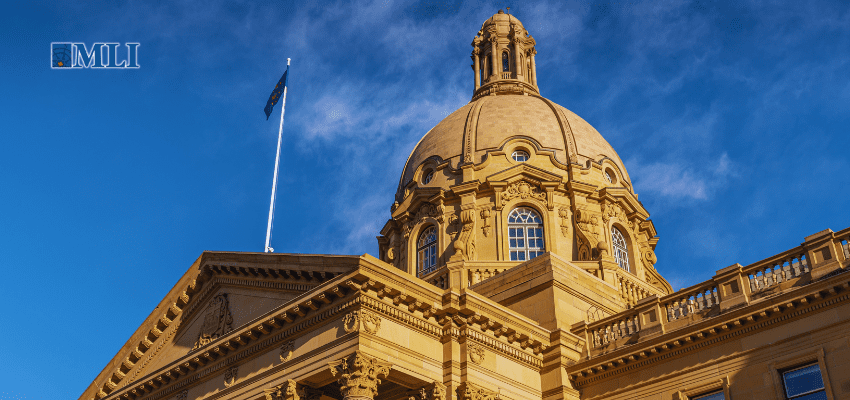
Image via Canva.

This article originally appeared in the National Post.

By Kerry Sun, October 31, 2025

After a weeks-long strike that severely tested parents’ resolve and undermined their children’s right to receive an education, Premier Danielle Smith’s government has directed Alberta teachers to return to work. Bill 2, the Back to School Act, was passed into law earlier this week. Back-to-work legislation of this kind would not have been unusual only a decade ago, before the Supreme Court of Canada constitutionalized a “right to strike.” Now, however, setting reasonable limits on strike action in the name of the broader community has required the use of Section 33 of the Charter, also known as the notwithstanding clause or parliamentary supremacy clause.

As with other recent uses of Section 33, Bill 2 has drawn the ire of activists and other commentators. The Alberta Teachers’ Association alleges that the government has embarked upon “an assault on the rights of every Albertan” and “silenced democracy itself.” The Alberta Union of Provincial Employees claims that the law sets a “dangerous precedent” and that the use of the notwithstanding clause is “reckless, authoritarian and ideological overreach.” Other commentators havecalled it a “dangerous precedent.”

This rhetoric is entirely unwarranted. The present use of Section 33, which is after all part of the Charter, is hardly an “assault” on rights. Nor can its invocation by a democratically elected legislature be characterized as an effort to “silence” democracy. While there are certainly good and bad uses of Section 33, its role in Bill 2 surely ranks among the most justifiable. This does not appear to be lost on the bill’s critics, whose pronouncements are careful to omit the reality that no constitutional right to strike existed until a decade ago, when it was conjured by judicial fiat.

Recall that Section 2(d) of the Charter, the provision said to protect the “right to strike,” states simply that everyone has the “freedom of association.” In a landmark 1987 decision, the Supreme Court had emphatically held that the Charter did not protect any constitutional right to strike. Instead, the court correctly understood that the rights to bargain collectively and to strike were creatures of legislation — labour relations were a matter of socioeconomic policy, open to calibration and compromise through the political process.

Yet over time, expansive judicial interpretations of the Charter have progressively distorted the delicate balance of labour relations in Canada. The course of rights-inflation culminated in the Supreme Court’s 2015 judgment in Saskatchewan Federation of Labour v. Saskatchewan, which overruled decades-old precedents to create a constitutional right for public-sector employees to strike. In a telling phrase, Justice Rosalie Abella, who wrote the majority judgment, announced that it “seems to me to be the time to give this conclusion constitutional benediction.”

Given the tenuous origins of this supposed right to strike, Alberta’s invocation of the notwithstanding clause is readily understood as a crucial corrective to the Supreme Court’s manifestly undisciplined interpretation of the Charter. As Justices Marshall Rothstein and Richard Wagner, dissenting in the Saskatchewan Federation of Labour case, wrote, the majority’s interpretation inflated the “right to freedom of association to such an extent that its scope is now completely divorced from the words” of Section 2(d).

More than that, the constitutional “benediction” granted to the right to strike has been profoundly destabilizing. By displacing labour relations from the domain of political contestation into the judicial realm, the Supreme Court has made regular recourse to the notwithstanding clause a practical necessity.

In one emblematic case from 2022, an Ontario trial court drew upon the Saskatchewan Federation of Labour judgment to strike down that province’s wage restraint legislation, which had limited public sector wage increases to one per cent annually. Despite the province’s fiscal pressures, the trial judge ruled that Ontario should have pursued voluntary wage restraint in collective bargaining negotiations, even if this precipitated “inconvenient” strikes and labour disruptions — a conclusion upheld by the Court of Appeal, two years later. In other words, these courts held that they had the power, and the duty, to determine how the Ontario government, responsible to the elected legislature, spent public money.

In a nation of peace, order and good government, the authority to end labour strikes must be vested in someone. The alternative is that such a power resides in no one, meaning that everyone can be subjected to unbridled industrial action of indefinite duration. Unless the Canadian judiciary is willing itself to negotiate, and terminate, labour disputes — a dubious proposition, given their lack of a democratic mandate and the institutional limitations of courts — a constitutional right to strike makes that possibility a reality.

But the framers of the 1982 Constitution recognized that a constitution is not a suicide pact. It is first and foremost a framework to enable our government to act for the common good. That is why they included Section 33 in the Charter, to ensure that the advent of American-style judicial review would not subvert the capacity of the political branches to serve the public. Without it, it will not be our elected officials, but judges, who wield the power to rebalance the cause of striking workers with the interests of the community. As Bill 2 demonstrates, the rights of parents and children are at stake. But those interests also include the right of the broader public to see the spending priorities of its democratically elected representatives given effect.

Moreover, critics of Bill 2 ignore the extent to which the constitutional balance between the political and judicial branches has been unsettled in recent years. In particular, the Alberta courts have adopted a low threshold for granting interlocutory injunctions, which stymies the legislature’s ability to act for the common good by preventing its laws from being enforced pending a constitutional challenge. Meanwhile, the Supreme Court has recently authorized Canadian courts to order governments to pay compensation for the enactment of legislation that a judge later deems to be “clearly unconstitutional.”

For better or worse, this trend of judicial adventurism should make legislators less reticent to deploy Section 33. Even if a court might eventually determine the back-to-work legislation to be a reasonable limitation on the right to strike, such an outcome is far from preordained. The Alberta legislature is acting prudently to mitigate the impact of a potentially undisciplined judicial ruling on parents, students and taxpayers.

If the Alberta government has committed a sin, it is one of political boldness: rather than remain powerless in the face of a damaging strike, it has chosen to use the tools legitimately at its disposal — thus returning this labour dispute to the realm of political deliberation, where it belongs. Ultimately, it will have to justify its actions not in a court of law, but of public opinion. That is a reasonable approach, not an “assault” on rights.


Kerry Sun is a doctoral student at the University of Oxford and a member of the Macdonald-Laurier Institute’s Judicial Foundations Project.


Source: National Post
Tags: Kerry Sun

Related Posts

In the Israel-Hamas war, international law favours the lawless: Mathew Giagnorio for Inside Policy
Israel-Hamas War

In the Israel-Hamas war, international law favours the lawless: Mathew Giagnorio for Inside Policy

November 12, 2025
Is Budget 2025 enough to reverse Canada’s economic decline?: Trevor Tombe in The Hub
Economic Policy

Is Budget 2025 enough to reverse Canada’s economic decline?: Trevor Tombe in The Hub

November 12, 2025
The CBC just got more government cash—good luck, private sector competitors: Peter Menzies in The Hub
Media and Telecoms

The CBC just got more government cash—good luck, private sector competitors: Peter Menzies in The Hub

November 12, 2025
Next Post
Is Ontario’s Ring of Fire overhyped?: Heather Exner-Pirot in The Hub

Is Ontario’s Ring of Fire overhyped?: Heather Exner-Pirot in The Hub

Newsletter Signup

  Thank you for Signing Up
  Please correct the marked field(s) below.
Email Address  *
1,true,6,Contact Email,2
First Name *
1,true,1,First Name,2
Last Name *
1,true,1,Last Name,2
*
*Required Fields

Follow us on

Macdonald-Laurier Institute

323 Chapel Street, Suite #300
Ottawa, Ontario, K1N 7Z2 Canada

613.482.8327

info@macdonaldlaurier.ca
MLI directory

Support Us

Support the Macdonald-Laurier Institute to help ensure that Canada is one of the best governed countries in the world. Click below to learn more or become a sponsor.

Support Us

  • Inside Policy Magazine
  • Annual Reports
  • Jobs
  • Privacy Policy

© 2023 Macdonald-Laurier Institute. All Rights reserved.

No Result
View All Result
  • Home
  • About
    • Who We Are
    • Who Makes MLI Work
    • Fifteenth Anniversary
  • Experts
    • Experts Directory
    • In Memoriam
  • Issues
    • Domestic Policy
      • Economic Policy
      • Justice
      • Rights and Freedoms
      • Assisted Suicide (MAID)
      • Health Care
      • COVID-19
      • Gender Identity
      • Canada’s Political Tradition
      • AI, Technology and Innovation
      • Media and Telecoms
      • Housing
      • Immigration
      • Agriculture and Agri-Food
      • Competition Policy
    • Energy Policy
      • Energy
      • Environment
    • Foreign Policy
      • Israel-Hamas War
      • Ukraine
      • Taiwan
      • China
      • Europe and Russia
      • Indo-Pacific
      • Middle East and North Africa
      • North America
      • Foreign Interference
      • National Defence
      • National Security
      • Foreign Affairs
    • Indigenous Affairs
  • Projects
    • CNAPS (Center for North American Prosperity and Security)
    • The Promised Land
    • Voices that Inspire: The Macdonald-Laurier Vancouver Speaker Series
    • Dragon at the door
    • Canada on top of the world
    • Letter to a minister
    • Justice Report Card
    • The Great Energy Crisis
    • DisInfoWatch.org
    • Managing Indigenous Prosperity
    • Judicial Foundations
    • Landmark Cases Council
    • Defending The Marketplace of Ideas
    • Reforming the University
    • Past Projects
      • Digital Policy & Connectivity
      • Double Trouble
      • Canada and the Indo-Pacific Initiative
      • The Transatlantic Program
      • COVID Misery Index
      • Speak for Ourselves
      • The Eavesdropping Dragon: Huawei
      • Talkin’ in the Free World with Mariam Memarsadeghi
      • An Intellectual Property Strategy for Canada
      • Munk Senior Fellows
      • A Mandate for Canada
      • Confederation Series
      • Fiscal Reform
      • The Canadian Century project
      • Fixing Canadian health care
      • Internal trade
      • From a mandate for change
      • Size of government in Canada
      • Straight Talk
      • Labour Market Report
      • Leading Economic Indicator
      • Centre for Advancing Canada’s Interests Abroad
      • Indigenous Prosperity at a Crossroads
  • Events
    • Upcoming Events
    • Past Events
      • MLI Dinners
      • Great Canadian Debates
  • Latest News
  • Libraries
    • Columns
    • Commentary
    • Papers
    • Books
    • Video
  • Donate

© 2023 Macdonald-Laurier Institute. All Rights reserved.