This article originally appeared in Geopolitical Monitor.
By Aurel Braun, August 27, 2026
Democratic societies invariably struggle with the allocation of finite resources. Canada is no exception. Understandably, democracies tend to opt for much needed increased spending on education, healthcare, housing and jobs. Unfortunately, all these seminal public goods are dependent on security and the protection of sovereignty.
However, in the big picture we are discovering, sometimes belatedly, that, as Walter Russell Mead wrote years ago, geopolitics has returned — though I would suggest it never left. We are also now confronting something called geoeconomics, of which China is by far the most avid and successful practitioner. Consequently, NATO countries must do much more as individual members, and collectively, to protect our security and sovereignty, specifically in the Arctic and throughout the larger European theatre. In the Arctic particularly, Russia presents a grave and growing multi-dimensional threat reflected in its massive militarization in the region, and more subtly by its Transarctic Transport Corridor (TTK), compounded at least indirectly by Moscow’s senior partner, Beijing.
Russia, of course, is not the Soviet Union but a rather miserable, though aggressive, remnant, led by a personalist dictatorship. Putin’s Russia has wreaked havoc in its war against Ukraine and continues to threaten in the Arctic with China’s support. At the end of the Cold War, many analysts and policy makers concluded that the Soviet threat may have been exaggerated, and it certainly appeared that the new Russia, under Boris Yeltsin, who expressed his wish for Russia to join the community of “civilized nations,” meaning democratic states, was no longer a threat.
This perception was understandable, particularly in Western Europe, which wanted to focus on economic growth and political stability, although the states of eastern Europe, which had emerged from Soviet control, or at least a destructive hegemony, were significantly less sanguine about Russia’s peaceful intentions. Personally, I took a more middle ground; I did not dismiss the potential Russian threat, but I did not see the urgency of enlarging NATO in the 1990s like the former Soviet-controlled eastern European states. In 1997 I testified before a parliamentary committee in Ottawa that we should not rush the enlargement of the Alliance as I worried that if it came too soon after the fall of the Soviet Union the eastern European states would join as “second-class citizens.” I was mistaken regarding the first part, expanding NATO was urgent, though not entirely about the second, concerns about the status of eastern European nations within the alliance persist.
We are now in a very different situation, but I would suggest that it is vital that we neither exaggerate nor minimize the Russian threat.
Right-Sizing the Russia Threat
I have advocated for years in articles and in my regular visits to the NATO Defense College in Rome, when I spoke to senior officers in the Russia and GFOAC seminars, that we need to right size Russia.
Prudence seems to tell us that if we mistakenly exaggerate the Russian threat and capabilities, this is less dangerous than understating the threat – with due respect to the security dilemma theory. I caution against this thinking: Overstating capabilities and threats could lead to a culture and response of deference to Russian aggression. The Collins Dictionary definition of “deference” is most relevant here: “Submission to or compliance with the will or wishes of another.”
We saw NATO give deference to Russia because of our exaggerated perception of Russian importance and strength following Moscow’s invasions of Georgia in 2008 and of Ukraine in 2014. Let us not forget that in 2009, then Secretary of State Hillary Clinton pressed what she thought was the red “reset button” with Russia to improve relations. And following the imposition of “slap-on-the-wrist” sanctions in 2014, top business leaders from Europe, including the head of the oil giant Total of France and ENI of Italy, rushed to Moscow, met with the Russian leadership and told them that it was “business as usual.” Impressed by supposed Russian might and the cost of countering the assumed vast power of Russia, Western democracies largely chose deference instead of defense and deterrence.
We cannot afford to make the same mistake in the Arctic or in Ukraine.
To be sure, we should not underestimate Russian military power, the brutal determination of Mr. Putin for external victories, including in Ukraine, or the significance of China’s support for Russia, particularly in the Arctic (with China now calling itself a “near Arctic state”). At the same time, it is essential that we understand both the limitations of Russian power, as well as the motivations, or in other words, the motor forces that drive this aggressive Russian policy.
In short, we need to find the right balance between prudence and paranoia.
We also need to be careful in our defense postures, including the rebuilding of our militaries and military industries, that we do not mistake promises for policies, or aspirations for achievements.
Understanding Russia’s Interlocking Crises
Foreign policy, and within that military strategy, are invariably connected with domestic policies everywhere. The interconnection in Russia, however, is unusually tight because of the nature of the system that Mr. Putin is running. It is not only that foreign policy starts at home as usual, but uncommonly deep, interrelated, and ongoing crises are key determinants of Russian foreign policy, including in the Arctic, and all that makes dealing with Moscow exceedingly difficult.
The four interlocking Russian crises are: a political legitimacy crisis; an economic crisis; an identity crisis; and a pending succession crisis.
The political legitimacy crisis is an especially intractable one. Mr. Putin at first tried to very cleverly manipulate the political order, not only by destroying the opposition, but also by creating an image of invincibility and near supernatural capability when he created a political version of magical realism (PMR), where he combined the occasional elements of the rational with the fantastic. More than a decade ago, we would see him participating in martial arts and always winning; finding prepositioned buried treasures under the sea; catching gigantic fish on choreographed fishing expeditions; and magically flying motorized hang gliders to guide rare cranes to their habitat. What I had called PMR might be something clever in literature, but in the case of Russia, it was Putinism kept aloft by toxic fantasies as he mortgaged the future of his country for personal power.
He increasingly needed real-world accomplishments, however, and this could be achieved by quick victories as in the case of Georgia in 2008 and Ukraine in 2014. These external attempts to build domestic political legitimacy, however, would require even greater foreign efforts, which would remain tempting, if they were not effectively countered by opponents in the world. Sadly, they were not and Mr. Putin became convinced that he could indefinitely avoid the need for fundamental domestic changes by diverting the population’s attention to external successes.
With the Ukraine war in its fifth year, however, the “magic” of external success has dissipated, and the formula has become something of a trap for the Kremlin. The Arctic, therefore, is an area where Mr. Putin appears to believe that he must win at all costs.
The Arctic Takes Center Stage
We can see the progression of Moscow’s focus on the centrality of the Arctic, from the relatively restrained 2008 policy, to the vital 2020 Arctic Policy and its ultimate seminal focus after the 2022 Russian invasion of Ukraine.
Consequently, Mr. Putin’s Russia has become a permanent threat to its neighbors and a dangerous disrupter of the international system, even though Russia has a poorly developed unidimensional economy with a nominal GDP not really larger than that of Italy.
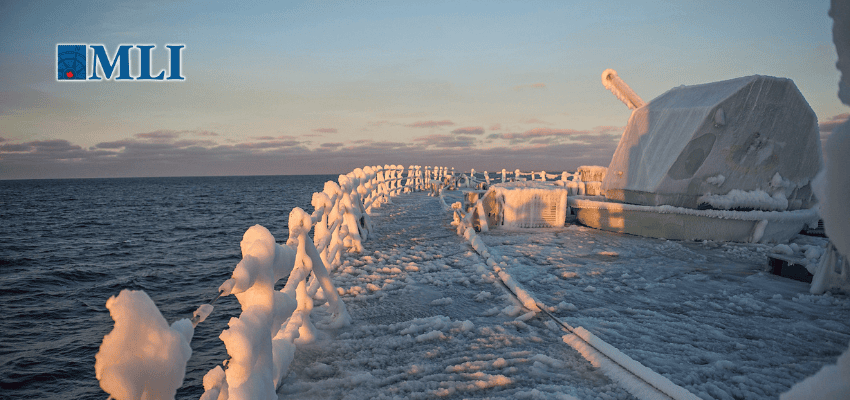
In fact, the Arctic, where Russia has long engaged in a massive military buildup, presents a five-dimensional threat: 1) political; 2) economic; 3) military; 4) legal; and 5) environmental.
Though Mr. Putin may be trapped into seeking external success (or at least the appearance of success), and conversely cannot afford to seem to fail, this is not to suggest that NATO needs to provide him with an off-ramp for his aggression in Ukraine or his dangerous ambitions in the Arctic; he has always been quite creative at finding his own, but only when he becomes convinced that he has no other choice.
It is also worth noting that Russian foreign policy ambitions do not add up to a master plan or a cohesive strategy, but rather a weltanschauung. Moreover, a Russia that is facing a huge demographic bomb, significant ethnic tensions, enormous corruption, and economic corrosion is highly vulnerable, but only if faced with NATO’s determination.
At least now we have Alliance promises of a response.
The problem is that, given Mr. Putin’s motivations and his massive military buildup in the Arctic, and his combination of arrogance and desperation, gradualism in building up defense and deterrence capabilities is insufficient. Democracies, moreover, cannot afford unrealistic alternatives. NATO is the primary instrument for countering dangerous Russian foreign policy ambitions, including in the Arctic, and the Ankara summit showed that the Alliance may be under stress, but remains resilient. Canada of course also has the benefit of NORAD.
A Path Forward
It is vital therefore to understand two crucial propositions. The first is that the Alliance needs to treat the Russian threat as an exigency. Promises to scale up by 2035 are not sufficient. Second, it is a major mistake, I would suggest, to confuse the stress caused in the Alliance (not the least by an unusual US president), with a rupture. It is in fact, far more a reset, and the difference is crucial.
A “rupture” could very well lead to futile searches for alternatives to the US playing a seminal role in the Alliance by some kind of magical collection of middle powers substituting for the American superpower, or that somehow, France and Britain would provide a sufficient extended nuclear deterrent versus Russia — something that the Kremlin finds quite risible. On the other hand, if we’re looking at a reset, and if the democracies can get beyond the bombastic, provocative, and vindictive rhetoric of the US president, then perhaps we may discern something that the New York Times has called the “Bessent doctrine.” As Treasury Secretary, Scott Bessent, put very succinctly: “America welcomes its partners, and we are stronger because of them. But our partnership now carries expectations. And, in some instances, non-negotiable obligations.”
When we look at Germany and Poland, the Baltic states, and some of our Arctic partners like Norway and Finland, we can see that they are massively and rapidly increasing their defense expenditures and capabilities, and also seem to appreciate how essential it is to keep the United States within the Alliance playing a central role. Sadly, the latter goal may not be universal within the Alliance.
Focusing back on the Arctic, if Russia is to be effectively countered, it must be done in a realistic fashion, where there is a recognition of the imperatives of geography and history in Canada, as well as that of geopolitics and geoeconomics. I come back to promises not being policies. We need to ask hard questions, and we must look for useful litmus tests. In Canada, with the second-longest Arctic coastline, the “Our North, Strong and Free” declaration has to be underpinned by effective policy.
Aurel Braun is a Professor of International Relations and Political Science at the University of Toronto, a Center Associate of the Davis Center, Harvard University and a member of the Advisory Council of the Macdonald-Laurier Institute.