Wednesday, June 17, 2026
No Result
View All Result
  • Media
Macdonald-Laurier Institute
  • Home
  • About
    • Who We Are
    • Who Makes MLI Work
    • Fifteenth Anniversary
  • Experts
    • Experts Directory
    • In Memoriam
  • Issues
    • Domestic Policy
      • Economic Policy
      • Justice
      • Rights and Freedoms
      • Assisted Suicide (MAID)
      • Health Care
      • COVID-19
      • Gender Identity
      • Canada’s Political Tradition
      • AI, Technology and Innovation
      • Media and Telecoms
      • Housing
      • Immigration
      • Agriculture and Agri-Food
      • Competition Policy
    • Energy Policy
      • Energy
      • Environment
    • Foreign Policy
      • Israel-Hamas War
      • Ukraine
      • Taiwan
      • China
      • Europe and Russia
      • Indo-Pacific
      • Middle East and North Africa
      • North America
      • Foreign Interference
      • National Defence
      • National Security
      • Foreign Affairs
    • Indigenous Affairs
  • Projects
    • CNAPS (Center for North American Prosperity and Security)
    • Justice Report Card
    • The Promised Land
    • Voices that Inspire: The Macdonald-Laurier Vancouver Speaker Series
    • Dragon at the door
    • Canada on top of the world
    • Letter to a minister
    • The Great Energy Crisis
    • DisInfoWatch.org
    • Managing Indigenous Prosperity
    • Judicial Foundations
    • Landmark Cases Council
    • Defending The Marketplace of Ideas
    • Reforming the University
    • Digital Policy & Connectivity
    • Past Projects
      • Double Trouble
      • Canada and the Indo-Pacific Initiative
      • The Transatlantic Program
      • COVID Misery Index
        • Provincial COVID Misery Index
        • Beyond Lockdown
        • COVID and after: A mandate for recovery
      • Speak for Ourselves
      • The Eavesdropping Dragon: Huawei
      • Talkin’ in the Free World with Mariam Memarsadeghi
      • An Intellectual Property Strategy for Canada
      • Munk Senior Fellows
      • A Mandate for Canada
      • Confederation Series
      • Fiscal Reform
      • The Canadian Century project
      • Fixing Canadian health care
      • Internal trade
      • From a mandate for change
      • Size of government in Canada
      • Straight Talk
      • Labour Market Report
      • Leading Economic Indicator
      • Centre for Advancing Canada’s Interests Abroad
      • Indigenous Prosperity at a Crossroads
        • Aboriginal Canada and Natural Resources
  • Events
    • Upcoming Events
    • Past Events
      • MLI Dinners
      • Great Canadian Debates
  • Latest News
  • Libraries
    • Columns
    • Commentary
    • Papers
    • Books
    • Video
  • Donate
  • Home
  • About
    • Who We Are
    • Who Makes MLI Work
    • Fifteenth Anniversary
  • Experts
    • Experts Directory
    • In Memoriam
  • Issues
    • Domestic Policy
      • Economic Policy
      • Justice
      • Rights and Freedoms
      • Assisted Suicide (MAID)
      • Health Care
      • COVID-19
      • Gender Identity
      • Canada’s Political Tradition
      • AI, Technology and Innovation
      • Media and Telecoms
      • Housing
      • Immigration
      • Agriculture and Agri-Food
      • Competition Policy
    • Energy Policy
      • Energy
      • Environment
    • Foreign Policy
      • Israel-Hamas War
      • Ukraine
      • Taiwan
      • China
      • Europe and Russia
      • Indo-Pacific
      • Middle East and North Africa
      • North America
      • Foreign Interference
      • National Defence
      • National Security
      • Foreign Affairs
    • Indigenous Affairs
  • Projects
    • CNAPS (Center for North American Prosperity and Security)
    • Justice Report Card
    • The Promised Land
    • Voices that Inspire: The Macdonald-Laurier Vancouver Speaker Series
    • Dragon at the door
    • Canada on top of the world
    • Letter to a minister
    • The Great Energy Crisis
    • DisInfoWatch.org
    • Managing Indigenous Prosperity
    • Judicial Foundations
    • Landmark Cases Council
    • Defending The Marketplace of Ideas
    • Reforming the University
    • Digital Policy & Connectivity
    • Past Projects
      • Double Trouble
      • Canada and the Indo-Pacific Initiative
      • The Transatlantic Program
      • COVID Misery Index
        • Provincial COVID Misery Index
        • Beyond Lockdown
        • COVID and after: A mandate for recovery
      • Speak for Ourselves
      • The Eavesdropping Dragon: Huawei
      • Talkin’ in the Free World with Mariam Memarsadeghi
      • An Intellectual Property Strategy for Canada
      • Munk Senior Fellows
      • A Mandate for Canada
      • Confederation Series
      • Fiscal Reform
      • The Canadian Century project
      • Fixing Canadian health care
      • Internal trade
      • From a mandate for change
      • Size of government in Canada
      • Straight Talk
      • Labour Market Report
      • Leading Economic Indicator
      • Centre for Advancing Canada’s Interests Abroad
      • Indigenous Prosperity at a Crossroads
        • Aboriginal Canada and Natural Resources
  • Events
    • Upcoming Events
    • Past Events
      • MLI Dinners
      • Great Canadian Debates
  • Latest News
  • Libraries
    • Columns
    • Commentary
    • Papers
    • Books
    • Video
  • Donate
No Result
View All Result
Macdonald-Laurier Institute

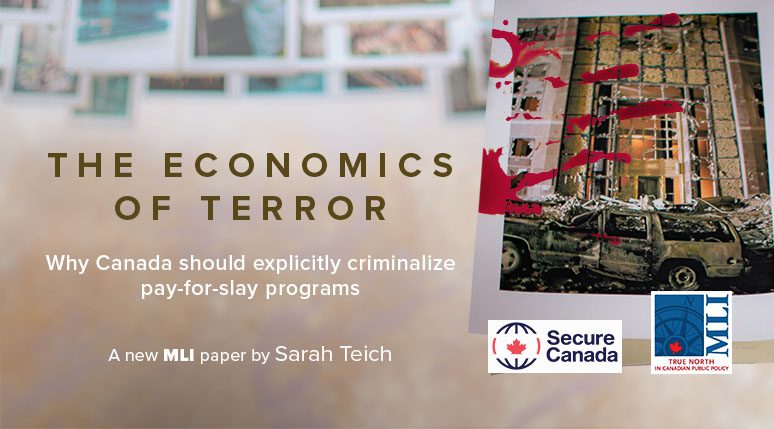
The economics of terror: Why Canada should explicitly criminalize pay-for-slay programs

Victims of terrorism deserve a legal framework that addresses the systemic structures that entrench the violence committed against them.

June 17, 2026
in Foreign Affairs, Latest News, Foreign Policy, The Promised Land, Papers, Middle East and North Africa, Israel-Hamas War, Sarah Teich
Reading Time: 6 mins read
A A
The economics of terror: Why Canada should explicitly criminalize pay-for-slay programs

By Sarah Teich
June 17, 2026

PDF of paper

Executive Summary | Sommaire (le français suit)

Canadian law prohibits the financing, facilitation, and support of terrorism. It criminalizes providing property or financial services to terrorist groups, participating in or contributing to the activity of a terrorist group, and facilitating terrorist activity.

Through the Special Economic Measures Act and the Sergei Magnitsky Law, it enables the imposition of targeted sanctions, including asset freezes and travel bans, on foreign officials responsible for gross human rights violations or significant corruption.

Yet there is a category of corrupted terrorist financing that Canadian law has never once been used to address: structured payment programs – known colloquially as “pay-for-slay” programs – that provide salaries, stipends, or other benefits to individuals who have committed terrorist attacks and to their families, calibrated to the severity of the violence.

It is time for Canada to lead by enacting legislation that explicitly criminalizes involvement in pay-for-slay programs and strengthens sanctions tools to hold those responsible to account.

• These programs are not hypothetical. Over several decades, state and state-affiliated entities across the Middle East have implemented payment structures tied directly to imprisonment for, or death resulting from, terrorist attacks.

• Saddam Hussein’s government distributed payments of $25,000 to families of Palestinian suicide bombers, compared to $10,000 provided to Palestinians killed in other manners.

• Iranian state institutions have channelled financial support through proxy organizations to families of individuals killed or imprisoned in connection with terrorist activity.

• Since 2004, the Palestinian Authority’s (PA) ongoing stipend program has legislatively mandated payments to individuals imprisoned for “participation in the struggle against the occupation,” with salaries and benefits calibrated to the severity of the offence.

Under this program, and others like it, members of groups listed as terrorist entities under Canadian law are compensated for engagement in attacks against civilians.

These programs are neither covert financing networks nor humanitarian efforts. They are institutionalized payment systems, not based on need, but structured to reward the commission of terrorist offences and scale the reward to the severity of the violence.

No individual has ever been prosecuted under Canadian law for involvement in such a program, and no foreign official has ever been sanctioned under either Canadian sanctions regime on this basis. The reason is not that the law cannot reach this conduct but that the absence of explicit statutory recognition has produced avoidable ambiguity that discourages enforcement. Prosecutors must reason by analogy from broadly worded provisions rather than applying clear statutory direction, and policymakers face uncertainty about whether the sanctions regimes were designed to capture this category of conduct.

Internationally, the dominant response has been to tie foreign aid to an end of pay-for-slay programs. It has not worked: the PA’s program, for one, has persisted for decades despite repeated measures by multiple donor states. Closing this gap requires targeted legislative action:

• A statutory definition of “pay-for-slay program” should be introduced into Part II.1 of the Criminal Code.

• A new standalone offence should criminalize knowing participation in, facilitation of, or contribution to such a program, carefully defined.

• Both the Special Economic Measures Act and the Sergei Magnitsky Law should be amended to clarify that involvement in pay-for-slay programs may constitute corruption within the meaning of each Act’s existing sanctions framework, enabling the imposition of targeted sanctions on foreign officials with responsibility for such programs.

These amendments would work within existing statutory frameworks to remove ambiguity and strengthen enforcement tools. No comparable jurisdiction has yet enacted explicit criminal or sanctions provisions addressing pay-for-slay programs. Canada has the opportunity to lead. Victims of terrorism deserve a legal framework that addresses the systemic structures that entrench the violence committed against them.


Les lois canadiennes prohibent le financement, la facilitation et le soutien du terrorisme. Il est illégal de fournir des biens ou des services financiers à des groupes terroristes, de participer à leurs activités ou de les faciliter.

La Loi sur les mesures économiques spéciales et la Loi sur la justice pour les victimes de dirigeants étrangers corrompus (Loi de Sergueï Magnitsky) autorisent les sanctions ciblées, telles que le blocage des actifs des ressortissants étrangers reconnus coupables de graves atteintes aux droits de la personne et de corruption, ainsi que l’interdiction de territoire.

Néanmoins, le droit canadien n’a jamais traité d’une forme de financement du terrorisme et de la corruption : les programmes de paiements structurés – que l’on appelle « Fonds des martyrs » – qui consistent à verser salaires, allocations ou autres indemnités aux terroristes et à leurs proches en fonction de la gravité de leurs actes.

Afin de tenir les responsables pour compte, le moment est venu pour le Canada d’agir en adoptant des lois qui criminalisent explicitement la participation à ces programmes et renforcent les mécanismes de sanction.

Ces programmes ne relèvent pas de l’hypothétique. Depuis plusieurs décennies, des entités au Moyen-Orient, étatiques ou associées à l’État, ont instauré des programmes de paiements directement liés à l’emprisonnement ou au décès résultant d’actes de terrorisme.

• Saddam Hussein versait 25 000 dollars aux familles des kamikazes palestiniens, et 10 000 dollars aux Palestiniens tués autrement.

• Les institutions d’État iraniennes ont fourni un soutien financier, par le biais d’organisations intermédiaires, aux proches des personnes décédées ou emprisonnées en lien avec des activités terroristes.

• Depuis 2004, une loi prévoit le versement par l’Autorité palestinienne d’indemnités aux personnes emprisonnées pour « participation à la lutte contre l’occupation », les salaires et avantages étant calculés en fonction de la gravité de l’acte.

Dans le cadre de ce type de programme, les membres de groupes considérés au Canada comme des entités terroristes sont rémunérés pour leur participation à des attaques contre des civils.

Ces programmes ne constituent ni des réseaux de financement clandestins ni des initiatives humanitaires, mais plutôt des systèmes de paiement institutionnalisés ayant pour seul objectif de récompenser les crimes en fonction des actes posés.

Au Canada, aucun procès n’a été intenté contre un individu, et aucun responsable étranger n’a été soumis à des sanctions pour participation à un tel programme. Ce n’est pas parce que la loi est inapplicable, mais plutôt parce qu’elle n’est pas clairement reconnue en raison de son ambiguïté, ce qui décourage son application. Les procureurs doivent donc raisonner par analogie en se fondant sur des dispositions générales, plutôt que de se conformer à des directives légales explicites. Par ailleurs, les décideurs ont des doutes quant à savoir si les sanctions ont été définies pour englober ce genre de conduite.

À l’échelle internationale, il est fréquent de conditionner l’aide étrangère à la cessation des programmes de rémunération des terroristes. Or, cela ne fonctionne pas : le Fonds des martyrs de l’Autorité palestinienne, par exemple, existe depuis des décennies malgré les efforts répétés déployés par de nombreux États donateurs.

Pour pallier cette carence, une législation ciblée s’impose :

• Il serait pertinent d’ajouter une définition juridique du programme de rémunération des terroristes dans la PARTIE II.1 du Code criminel.

• Cette définition devrait inclure une nouvelle infraction pénale pour toute participation à un tel programme, ainsi que pour toute facilitation ou contribution à celui-ci. Il est crucial d’en préciser les termes avec soin.

• La Loi sur les mesures économiques spéciales et la Loi de Sergueï Magnitski devraient toutes les deux être modifiées afin de préciser que la participation à des programmes de rémunération des terroristes peut constituer un acte de corruption au regard de leur cadre de sanctions existant, permettant ainsi l’imposition de sanctions ciblées à l’encontre des responsables étrangers chargés de tels programmes.

Ces amendements viseraient à supprimer l’ambiguïté des cadres législatifs actuels et à renforcer les mécanismes d’application de la loi. Aucune autorité similaire n’a encore adopté de dispositions pénales ou de sanctions explicites visant ces programmes. Le Canada a l’opportunité de prendre l’initiative et d’offrir un cadre juridique adapté aux besoins des victimes du terrorisme pour combattre les structures systémiques favorisant la violence à leur encontre.

Related Posts

energy
Environment

Carney wants Canada to become an energy superpower. Where will the money come from?: David Detomasi in The Hub

June 16, 2026
lng
Environment

Carney’s incoherent climate policy is hurting our European allies, helping China, and holding Canada back: Christian Leuprecht and Dimitar Lilkov in the Hub

June 16, 2026
Canada’s MAGA moment doesn’t undo strategic partnership with China: Raquel Garbers in the Washington Examiner
Foreign Affairs

Canada’s MAGA moment doesn’t undo strategic partnership with China: Raquel Garbers in the Washington Examiner

June 16, 2026

Newsletter Signup

  Thank you for Signing Up
  Please correct the marked field(s) below.
Email Address  *
1,true,6,Contact Email,2
First Name *
1,true,1,First Name,2
Last Name *
1,true,1,Last Name,2
*
*Required Fields

Follow us on

Macdonald-Laurier Institute

323 Chapel Street, Suite #300
Ottawa, Ontario, K1N 7Z2 Canada

613.482.8327

info@macdonaldlaurier.ca
MLI directory

Support Us

Support the Macdonald-Laurier Institute to help ensure that Canada is one of the best governed countries in the world. Click below to learn more or become a sponsor.

Support Us

  • Inside Policy Magazine
  • Annual Reports
  • Jobs
  • Privacy Policy

© 2023 Macdonald-Laurier Institute. All Rights reserved.

This site uses cookies. By continuing to browse the site you are agreeing to our use of cookies.

Privacy Preference Center

Consent Management

Necessary

Advertising

Analytics

Other

No Result
View All Result
  • Home
  • About
    • Who We Are
    • Who Makes MLI Work
    • Fifteenth Anniversary
  • Experts
    • Experts Directory
    • In Memoriam
  • Issues
    • Domestic Policy
      • Economic Policy
      • Justice
      • Rights and Freedoms
      • Assisted Suicide (MAID)
      • Health Care
      • COVID-19
      • Gender Identity
      • Canada’s Political Tradition
      • AI, Technology and Innovation
      • Media and Telecoms
      • Housing
      • Immigration
      • Agriculture and Agri-Food
      • Competition Policy
    • Energy Policy
      • Energy
      • Environment
    • Foreign Policy
      • Israel-Hamas War
      • Ukraine
      • Taiwan
      • China
      • Europe and Russia
      • Indo-Pacific
      • Middle East and North Africa
      • North America
      • Foreign Interference
      • National Defence
      • National Security
      • Foreign Affairs
    • Indigenous Affairs
  • Projects
    • CNAPS (Center for North American Prosperity and Security)
    • Justice Report Card
    • The Promised Land
    • Voices that Inspire: The Macdonald-Laurier Vancouver Speaker Series
    • Dragon at the door
    • Canada on top of the world
    • Letter to a minister
    • The Great Energy Crisis
    • DisInfoWatch.org
    • Managing Indigenous Prosperity
    • Judicial Foundations
    • Landmark Cases Council
    • Defending The Marketplace of Ideas
    • Reforming the University
    • Digital Policy & Connectivity
    • Past Projects
      • Double Trouble
      • Canada and the Indo-Pacific Initiative
      • The Transatlantic Program
      • COVID Misery Index
      • Speak for Ourselves
      • The Eavesdropping Dragon: Huawei
      • Talkin’ in the Free World with Mariam Memarsadeghi
      • An Intellectual Property Strategy for Canada
      • Munk Senior Fellows
      • A Mandate for Canada
      • Confederation Series
      • Fiscal Reform
      • The Canadian Century project
      • Fixing Canadian health care
      • Internal trade
      • From a mandate for change
      • Size of government in Canada
      • Straight Talk
      • Labour Market Report
      • Leading Economic Indicator
      • Centre for Advancing Canada’s Interests Abroad
      • Indigenous Prosperity at a Crossroads
  • Events
    • Upcoming Events
    • Past Events
      • MLI Dinners
      • Great Canadian Debates
  • Latest News
  • Libraries
    • Columns
    • Commentary
    • Papers
    • Books
    • Video
  • Donate

© 2023 Macdonald-Laurier Institute. All Rights reserved.