Thursday, July 16, 2026
No Result
View All Result
  • Media
Macdonald-Laurier Institute
  • Home
  • About
    • Who We Are
    • Who Makes MLI Work
    • Fifteenth Anniversary
  • Experts
    • Experts Directory
    • In Memoriam
  • Issues
    • Domestic Policy
      • Economic Policy
      • Justice
      • Rights and Freedoms
      • Assisted Suicide (MAID)
      • Health Care
      • COVID-19
      • Gender Identity
      • Canada’s Political Tradition
      • AI, Technology and Innovation
      • Media and Telecoms
      • Housing
      • Immigration
      • Agriculture and Agri-Food
      • Competition Policy
    • Energy Policy
      • Energy
      • Environment
    • Foreign Policy
      • Israel-Hamas War
      • Ukraine
      • Taiwan
      • China
      • Europe and Russia
      • Indo-Pacific
      • Middle East and North Africa
      • North America
      • Foreign Interference
      • National Defence
      • National Security
      • Foreign Affairs
    • Indigenous Affairs
  • Projects
    • CNAPS (Center for North American Prosperity and Security)
    • Justice Report Card
    • The Promised Land
    • Dragon at the door
    • Canada on top of the world
    • Letter to a minister
    • The Great Energy Crisis
    • DisInfoWatch.org
    • Managing Indigenous Prosperity
    • Judicial Foundations
    • Landmark Cases Council
    • Closing Canada’s Border, Policing, and Legal Gaps
    • Defending The Marketplace of Ideas
    • Reforming the University
    • Digital Policy & Connectivity
    • Past Projects
      • Double Trouble
      • Canada and the Indo-Pacific Initiative
      • The Transatlantic Program
      • COVID Misery Index
        • Provincial COVID Misery Index
        • Beyond Lockdown
        • COVID and after: A mandate for recovery
      • Speak for Ourselves
      • The Eavesdropping Dragon: Huawei
      • Talkin’ in the Free World with Mariam Memarsadeghi
      • An Intellectual Property Strategy for Canada
      • Munk Senior Fellows
      • A Mandate for Canada
      • Confederation Series
      • Fiscal Reform
      • The Canadian Century project
      • Fixing Canadian health care
      • Internal trade
      • From a mandate for change
      • Size of government in Canada
      • Straight Talk
      • Labour Market Report
      • Leading Economic Indicator
      • Centre for Advancing Canada’s Interests Abroad
      • Indigenous Prosperity at a Crossroads
        • Aboriginal Canada and Natural Resources
  • Events
    • Voices that Inspire: The Macdonald-Laurier Vancouver Speaker Series
    • Upcoming Events
    • Past Events
      • MLI Dinners
      • Great Canadian Debates
  • Latest News
  • Libraries
    • Columns
    • Commentary
    • Papers
    • Books
    • Video
  • Donate
  • Home
  • About
    • Who We Are
    • Who Makes MLI Work
    • Fifteenth Anniversary
  • Experts
    • Experts Directory
    • In Memoriam
  • Issues
    • Domestic Policy
      • Economic Policy
      • Justice
      • Rights and Freedoms
      • Assisted Suicide (MAID)
      • Health Care
      • COVID-19
      • Gender Identity
      • Canada’s Political Tradition
      • AI, Technology and Innovation
      • Media and Telecoms
      • Housing
      • Immigration
      • Agriculture and Agri-Food
      • Competition Policy
    • Energy Policy
      • Energy
      • Environment
    • Foreign Policy
      • Israel-Hamas War
      • Ukraine
      • Taiwan
      • China
      • Europe and Russia
      • Indo-Pacific
      • Middle East and North Africa
      • North America
      • Foreign Interference
      • National Defence
      • National Security
      • Foreign Affairs
    • Indigenous Affairs
  • Projects
    • CNAPS (Center for North American Prosperity and Security)
    • Justice Report Card
    • The Promised Land
    • Dragon at the door
    • Canada on top of the world
    • Letter to a minister
    • The Great Energy Crisis
    • DisInfoWatch.org
    • Managing Indigenous Prosperity
    • Judicial Foundations
    • Landmark Cases Council
    • Closing Canada’s Border, Policing, and Legal Gaps
    • Defending The Marketplace of Ideas
    • Reforming the University
    • Digital Policy & Connectivity
    • Past Projects
      • Double Trouble
      • Canada and the Indo-Pacific Initiative
      • The Transatlantic Program
      • COVID Misery Index
        • Provincial COVID Misery Index
        • Beyond Lockdown
        • COVID and after: A mandate for recovery
      • Speak for Ourselves
      • The Eavesdropping Dragon: Huawei
      • Talkin’ in the Free World with Mariam Memarsadeghi
      • An Intellectual Property Strategy for Canada
      • Munk Senior Fellows
      • A Mandate for Canada
      • Confederation Series
      • Fiscal Reform
      • The Canadian Century project
      • Fixing Canadian health care
      • Internal trade
      • From a mandate for change
      • Size of government in Canada
      • Straight Talk
      • Labour Market Report
      • Leading Economic Indicator
      • Centre for Advancing Canada’s Interests Abroad
      • Indigenous Prosperity at a Crossroads
        • Aboriginal Canada and Natural Resources
  • Events
    • Voices that Inspire: The Macdonald-Laurier Vancouver Speaker Series
    • Upcoming Events
    • Past Events
      • MLI Dinners
      • Great Canadian Debates
  • Latest News
  • Libraries
    • Columns
    • Commentary
    • Papers
    • Books
    • Video
  • Donate
No Result
View All Result
Macdonald-Laurier Institute

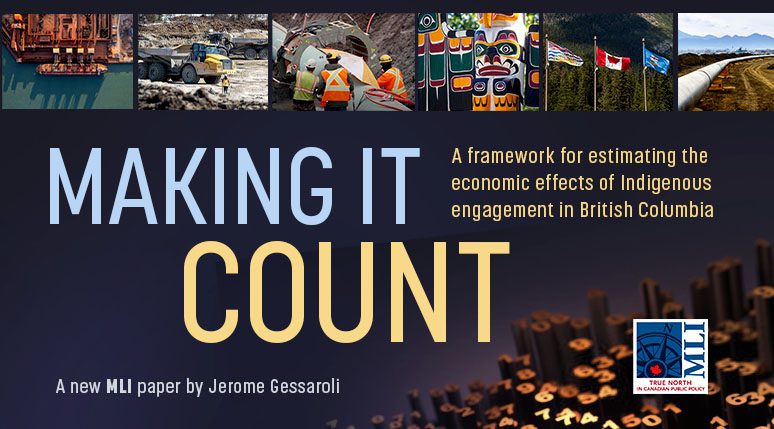
Making it count: A framework for estimating the economic effects of Indigenous engagement in British Columbia

Governments need a process that respects Indigenous rights while giving investors predictable timelines, costs, and decision rules.

July 16, 2026
in Latest News, Indigenous Affairs, Papers, Jerome Gessaroli
Reading Time: 6 mins read
A A
Making it count: A framework for estimating the economic effects of Indigenous engagement in British Columbia

By Jerome Gessaroli
July 16, 2026

PDF of paper

Executive Summary | Sommaire (le français suit)

Resource projects in Canada – including mines, pipelines, and energy infrastructure – often require engagement with affected First Nations before they can proceed.

When consultation is mishandled or ignored, the consequences extend well beyond regulatory delays: projects can face costly litigation, years of uncertainty, lost investment, or even cancellation. Billions of dollars of economic activity and thousands of jobs can hinge on these outcomes. Failures in consultation can also damage relationships with Indigenous communities for years, affecting not only individual projects but future development opportunities as well.

Better measurement of these risks is crucial for policymakers, investors, and project proponents alike. To address this, the report describes a framework to quantify how Indigenous consultation shapes project timelines, costs, legal exposure, and overall project economics.

Policy debates usually describe these effects qualitatively. This framework organizes them into economic variables that can be incorporated into an investment analysis. Analysts and policymakers can use the framework to estimate the effects of First Nations engagement on the value of projects and compare investment conditions across jurisdictions.

The framework focuses on British Columbia, currently the epicentre of national debate over Indigenous consultation following the adoption of the controversial Declaration on the Rights of Indigenous Peoples Act (DRIPA), which aligns provincial law with the United Nations Declaration on the Rights of Indigenous Peoples (UNDRIP). The BC government is currently trying to navigate a rapidly evolving legal landscape shaped by recent court decisions on Aboriginal title, and the expanding duty to consult relating to major natural resources development. These pressures are unfolding alongside renewed US trade tensions with Canada and coordinated First Nations opposition to any unilateral weakening or repeal of DRIPA.

Governments need a process that respects Indigenous rights while giving investors predictable timelines, costs, and decision rules. The framework helps policymakers and project proponents identify which parts of the process have the largest economic effects and where reform would have the most impact.

This framework:

• Uses a simplified baseline comparator that excludes Indigenous-specific consultation, delay, risk, and related obligations. The framework then measures those effects as incremental costs and risks across five channels: legal and constitutional risk, multi-party negotiation complexity, consultation and related costs, benefit-sharing obligations, and incremental Indigenous-related approval time.

• Incorporates legal and political uncertainty (Aboriginal title, court decisions, DRIPA) as a risk premium to the project discount rate and captures added negotiation time from engaging multiple First Nations, especially where territorial claims overlap.

• Includes pre-approval costs and obligations, including consultation administration, community meetings, traditional land-use studies, technical reviews, legal work, accommodation measures, redesign, and mitigation before approval.

• Allows for benefit-sharing commitments, approval delays, and post-approval risks. These may include revenue sharing, employment programs, procurement commitments, environmental monitoring, equity participation, and the possibility that formal government authorization does not guarantee project completion.

• Produces a risk-adjusted NPV and expected NPV framework that combines legal risk premiums, delays, consultation costs, benefit-sharing obligations, and approval probability. There is also a “Consultation effect” metric showing the reduction in project value relative to the baseline from approval delays and direct spending on consultation and benefit-sharing.

The framework gives policymakers, investors, and Indigenous governments a common way to assess the economic effects of consultation design. It can make consultation-related costs, risks, delays, and agreement requirements more transparent, helping users identify earlier which projects face the greatest economic or approval risk.

By making these effects more measurable, the framework can support better project screening, policy analysis, and process design. It does not eliminate uncertainty, but it helps show where legal risk, overlapping claims, consultation capacity, benefit-sharing, or agreement durability may have the greatest effect on project value.


Au Canada, la mise en œuvre de projets de ressources (mines, pipelines et infrastructures énergétiques) exige communément de consulter les Premières Nations touchées.

Les consultations mal conduites ou inexistantes peuvent engendrer des litiges coûteux, des années d’incertitude, des pertes d’investissements, voire des annulations et, donc, des dommages économiques de plusieurs milliards de dollars et la suppression de milliers d’emplois. Les échecs peuvent également nuire durablement aux relations avec les collectivités autochtones, menaçant non seulement les projets en cours, mais aussi ceux à venir.

Mieux évaluer ces risques est indispensable, tant pour les décideurs que pour les investisseurs et promoteurs. Ce rapport se penche sur cet enjeu en décrivant un cadre visant à mesurer l’impact des consultations autochtones sur les échéanciers, les coûts, les risques juridiques et la rentabilité globale des projets.

Dans les débats politiques, ces éléments sont habituellement abordés de manière qualitative. Le présent cadre les structure en variables économiques exploitables dans un rapport d’analyse pour estimer les effets de la participation des Premières Nations sur la valeur des projets et comparer les conditions d’investissement entre les administrations.

Ce cadre se focalise sur la Colombie-Britannique, qui est actuellement au centre des discussions nationales sur la consultation des peuples autochtones, suite à l’adoption de la controversée « Loi relative à la Déclaration des Nations Unies sur les droits des peuples autochtones », qui harmonise sa législation avec la Déclaration des Nations Unies. Le gouvernement britanno colombien s’efforce de s’ajuster rapidement à un paysage juridique transformé par les récentes décisions judiciaires sur les droits ancestraux et l’obligation élargie de consultation pour les grands projets de ressources. Ces pressions s’ajoutent à la recrudescence des tensions commerciales entre les États-Unis et le Canada, et à l’opposition coordonnée des Premières Nations à tout affaiblissement de cette loi.

Les gouvernements ont besoin d’un processus qui respecte les droits autochtones tout en offrant aux investisseurs des échéanciers, coûts et règles de décision prévisibles. Ce cadre aide les décideurs et promoteurs à identifier les étapes du processus comportant les conséquences économiques les plus importantes et les secteurs où une réforme aurait un impact maximal.

Voici ce cadre :

• Il utilise un comparateur de base simplifié qui fait abstraction des consultations, retards et risques spécifiquement autochtones, et des obligations connexes. Puis, il mesure ces effets en termes de coûts et de risques additionnels sur cinq axes : risque juridique et constitutionnel, complexité des négociations multipartites, coûts liés aux consultations, obligations de partage des bénéfices et temps supplémentaire pour obtenir l’approbation des peuples autochtones.

• Il intègre l’incertitude juridique et politique (droits ancestraux, décisions judiciaires, loi) dans le taux d’actualisation d’un projet (au moyen d’une prime de risque) et le temps de négociation supplémentaire lié à la participation de multiples Premières Nations, surtout lorsque les revendications territoriales se chevauchent. • Il tient compte des coûts et obligations préalables à l’approbation : administration des consultations, rencontres publiques, études sur l’usage traditionnel des terres, examens techniques, travaux juridiques, mesures d’accommodement et d’atténuation, réaménagement.

• Il prévoit les partages de bénéfices, délais d’approbation et risques postapprobation, y compris les partages de revenus, programmes d’emploi, marchés publics, contrôles environnementaux, participations au capital et possibilités qu’une approbation gouvernementale formelle ne garantisse pas la réalisation d’un projet.

• Il génère une valeur actualisée nette ajustée en fonction du risque et une valeur actualisée nette escomptée qui tient compte des primes de risque juridique, retards, coûts des consultations, obligations de partage des bénéfices et probabilité d’approbation. Un indicateur appelé « effet de consultation » illustre aussi la valeur réduite d’un projet par rapport au scénario de référence pouvant résulter des retards d’approbation et des coûts directs associés aux consultations et au partage des bénéfices.

Ce cadre offre aux décideurs, investisseurs et gouvernements autochtones un outil commun pour évaluer les effets économiques des modes de consultation. Il permet une plus grande transparence en ce qui a trait aux coûts, risques et retards, ainsi qu’aux exigences contractuelles liées aux consultations, afin de repérer rapidement les projets susceptibles d’encourir des risques économiques ou des obstacles d’approbation élevés.

En rendant ces effets plus quantifiables, ce cadre peut améliorer le choix des projets, l’analyse des politiques et la conception des processus. Il n’élimine pas l’incertitude, mais aide à relever les domaines où les risques juridiques, le chevauchement des revendications, la capacité de consultation, le partage des bénéfices et la pérennité des accords peuvent avoir l’impact le plus grand sur la valeur d’un projet.


 

Related Posts

Population aging doesn’t have to slow us down: Trevor Tombe in The Hub
Economic Policy

Population aging doesn’t have to slow us down: Trevor Tombe in The Hub

July 16, 2026
Canada’s conversation about new submarines is failing to ask the most important question: Rob Huebert in The Globe and Mail
National Defence

Canada’s conversation about new submarines is failing to ask the most important question: Rob Huebert in The Globe and Mail

July 16, 2026
Canadians’ trust in media keeps falling—and no wonder: Peter Menzies in The Hub
Media and Telecoms

Canadians’ trust in media keeps falling—and no wonder: Peter Menzies in The Hub

July 16, 2026
Next Post
Canadians’ trust in media keeps falling—and no wonder: Peter Menzies in The Hub

Canadians’ trust in media keeps falling—and no wonder: Peter Menzies in The Hub

Newsletter Signup

  Thank you for Signing Up
  Please correct the marked field(s) below.
Email Address  *
1,true,6,Contact Email,2
First Name *
1,true,1,First Name,2
Last Name *
1,true,1,Last Name,2
*
*Required Fields

Follow us on

Macdonald-Laurier Institute

323 Chapel Street, Suite #300
Ottawa, Ontario, K1N 7Z2 Canada

613.482.8327

info@macdonaldlaurier.ca
MLI directory

Support Us

Support the Macdonald-Laurier Institute to help ensure that Canada is one of the best governed countries in the world. Click below to learn more or become a sponsor.

Support Us

  • Inside Policy Magazine
  • Annual Reports
  • Jobs
  • Privacy Policy

© 2023 Macdonald-Laurier Institute. All Rights reserved.

No Result
View All Result
  • Home
  • About
    • Who We Are
    • Who Makes MLI Work
    • Fifteenth Anniversary
  • Experts
    • Experts Directory
    • In Memoriam
  • Issues
    • Domestic Policy
      • Economic Policy
      • Justice
      • Rights and Freedoms
      • Assisted Suicide (MAID)
      • Health Care
      • COVID-19
      • Gender Identity
      • Canada’s Political Tradition
      • AI, Technology and Innovation
      • Media and Telecoms
      • Housing
      • Immigration
      • Agriculture and Agri-Food
      • Competition Policy
    • Energy Policy
      • Energy
      • Environment
    • Foreign Policy
      • Israel-Hamas War
      • Ukraine
      • Taiwan
      • China
      • Europe and Russia
      • Indo-Pacific
      • Middle East and North Africa
      • North America
      • Foreign Interference
      • National Defence
      • National Security
      • Foreign Affairs
    • Indigenous Affairs
  • Projects
    • CNAPS (Center for North American Prosperity and Security)
    • Justice Report Card
    • The Promised Land
    • Dragon at the door
    • Canada on top of the world
    • Letter to a minister
    • The Great Energy Crisis
    • DisInfoWatch.org
    • Managing Indigenous Prosperity
    • Judicial Foundations
    • Landmark Cases Council
    • Closing Canada’s Border, Policing, and Legal Gaps
    • Defending The Marketplace of Ideas
    • Reforming the University
    • Digital Policy & Connectivity
    • Past Projects
      • Double Trouble
      • Canada and the Indo-Pacific Initiative
      • The Transatlantic Program
      • COVID Misery Index
      • Speak for Ourselves
      • The Eavesdropping Dragon: Huawei
      • Talkin’ in the Free World with Mariam Memarsadeghi
      • An Intellectual Property Strategy for Canada
      • Munk Senior Fellows
      • A Mandate for Canada
      • Confederation Series
      • Fiscal Reform
      • The Canadian Century project
      • Fixing Canadian health care
      • Internal trade
      • From a mandate for change
      • Size of government in Canada
      • Straight Talk
      • Labour Market Report
      • Leading Economic Indicator
      • Centre for Advancing Canada’s Interests Abroad
      • Indigenous Prosperity at a Crossroads
  • Events
    • Voices that Inspire: The Macdonald-Laurier Vancouver Speaker Series
    • Upcoming Events
    • Past Events
      • MLI Dinners
      • Great Canadian Debates
  • Latest News
  • Libraries
    • Columns
    • Commentary
    • Papers
    • Books
    • Video
  • Donate

© 2023 Macdonald-Laurier Institute. All Rights reserved.