Monday, May 4, 2026
No Result
View All Result
  • Media
Macdonald-Laurier Institute
  • Home
  • About
    • Who We Are
    • Who Makes MLI Work
    • Fifteenth Anniversary
  • Experts
    • Experts Directory
    • In Memoriam
  • Issues
    • Domestic Policy
      • Economic Policy
      • Justice
      • Rights and Freedoms
      • Assisted Suicide (MAID)
      • Health Care
      • COVID-19
      • Gender Identity
      • Canada’s Political Tradition
      • AI, Technology and Innovation
      • Media and Telecoms
      • Housing
      • Immigration
      • Agriculture and Agri-Food
      • Competition Policy
    • Energy Policy
      • Energy
      • Environment
    • Foreign Policy
      • Israel-Hamas War
      • Ukraine
      • Taiwan
      • China
      • Europe and Russia
      • Indo-Pacific
      • Middle East and North Africa
      • North America
      • Foreign Interference
      • National Defence
      • National Security
      • Foreign Affairs
    • Indigenous Affairs
  • Projects
    • CNAPS (Center for North American Prosperity and Security)
    • Justice Report Card
    • The Promised Land
    • Voices that Inspire: The Macdonald-Laurier Vancouver Speaker Series
    • Dragon at the door
    • Canada on top of the world
    • Letter to a minister
    • The Great Energy Crisis
    • DisInfoWatch.org
    • Managing Indigenous Prosperity
    • Judicial Foundations
    • Landmark Cases Council
    • Defending The Marketplace of Ideas
    • Reforming the University
    • Past Projects
      • Digital Policy & Connectivity
      • Double Trouble
      • Canada and the Indo-Pacific Initiative
      • The Transatlantic Program
      • COVID Misery Index
        • Provincial COVID Misery Index
        • Beyond Lockdown
        • COVID and after: A mandate for recovery
      • Speak for Ourselves
      • The Eavesdropping Dragon: Huawei
      • Talkin’ in the Free World with Mariam Memarsadeghi
      • An Intellectual Property Strategy for Canada
      • Munk Senior Fellows
      • A Mandate for Canada
      • Confederation Series
      • Fiscal Reform
      • The Canadian Century project
      • Fixing Canadian health care
      • Internal trade
      • From a mandate for change
      • Size of government in Canada
      • Straight Talk
      • Labour Market Report
      • Leading Economic Indicator
      • Centre for Advancing Canada’s Interests Abroad
      • Indigenous Prosperity at a Crossroads
        • Aboriginal Canada and Natural Resources
  • Events
    • Upcoming Events
    • Past Events
      • MLI Dinners
      • Great Canadian Debates
  • Latest News
  • Libraries
    • Columns
    • Commentary
    • Papers
    • Books
    • Video
  • Donate
  • Home
  • About
    • Who We Are
    • Who Makes MLI Work
    • Fifteenth Anniversary
  • Experts
    • Experts Directory
    • In Memoriam
  • Issues
    • Domestic Policy
      • Economic Policy
      • Justice
      • Rights and Freedoms
      • Assisted Suicide (MAID)
      • Health Care
      • COVID-19
      • Gender Identity
      • Canada’s Political Tradition
      • AI, Technology and Innovation
      • Media and Telecoms
      • Housing
      • Immigration
      • Agriculture and Agri-Food
      • Competition Policy
    • Energy Policy
      • Energy
      • Environment
    • Foreign Policy
      • Israel-Hamas War
      • Ukraine
      • Taiwan
      • China
      • Europe and Russia
      • Indo-Pacific
      • Middle East and North Africa
      • North America
      • Foreign Interference
      • National Defence
      • National Security
      • Foreign Affairs
    • Indigenous Affairs
  • Projects
    • CNAPS (Center for North American Prosperity and Security)
    • Justice Report Card
    • The Promised Land
    • Voices that Inspire: The Macdonald-Laurier Vancouver Speaker Series
    • Dragon at the door
    • Canada on top of the world
    • Letter to a minister
    • The Great Energy Crisis
    • DisInfoWatch.org
    • Managing Indigenous Prosperity
    • Judicial Foundations
    • Landmark Cases Council
    • Defending The Marketplace of Ideas
    • Reforming the University
    • Past Projects
      • Digital Policy & Connectivity
      • Double Trouble
      • Canada and the Indo-Pacific Initiative
      • The Transatlantic Program
      • COVID Misery Index
        • Provincial COVID Misery Index
        • Beyond Lockdown
        • COVID and after: A mandate for recovery
      • Speak for Ourselves
      • The Eavesdropping Dragon: Huawei
      • Talkin’ in the Free World with Mariam Memarsadeghi
      • An Intellectual Property Strategy for Canada
      • Munk Senior Fellows
      • A Mandate for Canada
      • Confederation Series
      • Fiscal Reform
      • The Canadian Century project
      • Fixing Canadian health care
      • Internal trade
      • From a mandate for change
      • Size of government in Canada
      • Straight Talk
      • Labour Market Report
      • Leading Economic Indicator
      • Centre for Advancing Canada’s Interests Abroad
      • Indigenous Prosperity at a Crossroads
        • Aboriginal Canada and Natural Resources
  • Events
    • Upcoming Events
    • Past Events
      • MLI Dinners
      • Great Canadian Debates
  • Latest News
  • Libraries
    • Columns
    • Commentary
    • Papers
    • Books
    • Video
  • Donate
No Result
View All Result
Macdonald-Laurier Institute

Lines, power, and trust – Inside Alberta’s electoral boundaries fight: Geoffrey Sigalet for Inside Policy

Canadians in other provinces can take note of this drama as evidence for the importance of independent commissions in ensuring effective democratic representation.

May 4, 2026
in Domestic Policy, Back Issues, Inside Policy, Latest News, Intergovernmental Affairs, Political Tradition, Geoffrey Sigalet
Reading Time: 6 mins read
A A
Lines, power, and trust – Inside Alberta’s electoral boundaries fight: Geoffrey Sigalet for Inside Policy

Image via Canva.

By Geoffrey Sigalet, May 4, 2026

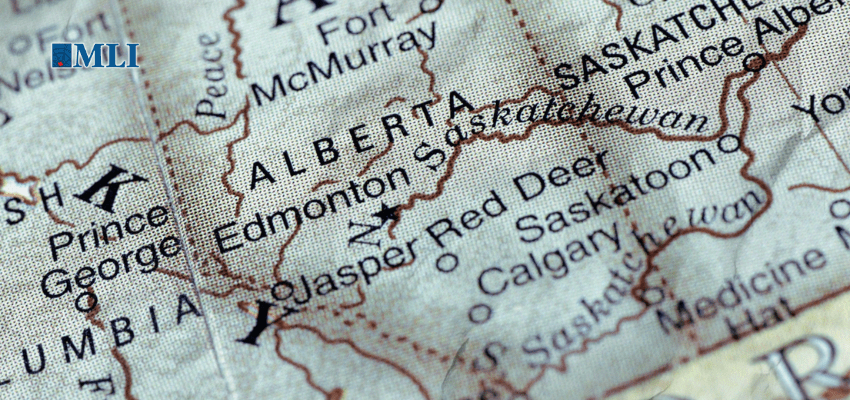
Many Canadians are following, or at least aware of, the ongoing prospect of an Alberta referendum on separatism in October 2026. But another important controversy is unfolding regarding Alberta’s electoral boundaries that has implications for democracy beyond Alberta’s borders.

The independent commission responsible for revising Alberta’s electoral boundaries issued its report on March 23, 2026, and Alberta’s United Conservative Party (UCP) Government made it clear that it would not follow a number of the commission’s recommendations.

Allegations of gerrymandering ensued, but things are a bit more complicated than many critics have let on. Alberta’s potential decision to set aside key recommendations from its electoral boundaries commission is more than a provincial controversy – it is a rare test of how far Canadian governments can depart from independent electoral redistribution processes without undermining public trust.

While such a move is unusual and raises legitimate concerns, it also forces a broader question: when, if ever, is deviation justified in the name of effective representation?

Across Canada, electoral boundaries are typically set by independent commissions rather than politicians. This system is meant to safeguard confidence in the democratic process and avoid the partisan gerrymandering that is rife in the United States.

Drawing electoral boundaries is more of a principled art than a science. While representation by population is the prime consideration, Alberta’s Electoral Boundaries Commissions Act, 2000 and the Supreme Court of Canada’s interpretation of the section 3 democratic rights of the Canadian Charter require “effective representation” – a standard that allows commissions to weigh geography, communities of interest, transportation links, and historical boundaries alongside population.

It is within this framework that Alberta undertook its most recent seat redistribution. The province expanded its legislature modestly, from 87 to 89 seats, despite rapid population growth. The independent commission – chaired by Court of King’s Bench Justice Dallas Miller and composed of government and opposition appointees – initially proposed adding seats in fast-growing urban areas: adding two seats to Calgary, one to Edmonton, and one to Airdrie/Cochrane, bedroom communities in the greater Calgary region. To balance the changes, two ridings were removed from elsewhere in the province – a consequence of the size of the legislature being increased by only two per cent despite a rise in population of twenty per cent.

The commission ultimately split in its final report. Justice Miller joined the two opposition appointed members in a majority that mostly tinkered with the interim report.

The two government-appointed commissioners, however, put forward a competing minority proposal that diverged more significantly. The majority strongly condemned that alternative for introducing completely unrequested changes, splitting communities of interest, and creating wider population variances within Calgary. This prompted strong criticism from political scientists such as Jared Wesley, Lisa Young, and Duane Bratt, the mayors of Calgary, Red Deer, and Edmonton, and from the NDP Opposition Leader Naheed Nenshi. These critics claimed the minority proposal was a blatant attempt by the ruling United Conservative Party to gerrymander the map in its favour, and called the move offensive to Canadian democratic norms.

The Alberta legislature has not moved to adopt the minority proposal, amid concerns about its constitutionality. Rather, attention has shifted to a separate proposal: a Chair’s addendum to the majority report, which was not endorsed by the NDP-appointed commissioners. It suggests that if the legislature cannot accept the 89-seat configuration due to the elimination of two rural ridings, it could instead expand to 91 seats and restore those ridings through an expedited process. On April 16, Alberta’s Government passed Motion 37 adopting the recommendation of expanding the seats to 91 and creating an all-party Special Committee to review and implement the Chair’s addendum. This is eminently reasonable.

Critics were quite right to be concerned about the minority proposal, but it is premature and arguably unjustified for groups like the Canadian Civil Liberties Union to claim that Alberta’s move to adopt Justice Miller’s addendum plan amounts to “rejecting” the first Commission’s final report. Alberta is not rejecting the Commission’s report: the legislation governing the commission states that, in the absence of a majority position, the Chair’s report prevails as the commission’s report. Proponents argue that this gap applies here, given the lack of agreement on how to resolve the impasse created by the removal of rural seats.

On that reading, the chair’s addendum can be treated as part of the operative commission recommendation where it diverges from the majority report.

References in the majority requesting adoption of the majority report “in its entirety” need to be viewed through the lens of Justice Miller caveating his views concerning the size of the legislature. As the two minority commissioners did not want any rural ridings removed, even on a map of 89, it is even more clear that a majority of commissioners would not have wanted any rural ridings removed under a map of 91 ridings.

This is consistent with Nova Scotia precedent where the commissioners rejected their legislative constraints to achieve effective representation. Nor is the notion of a legislature rejecting a population-based recommendation unprecedented: this was done to save a Quebec seat at the last federal redistribution. As such, Alberta is implementing rather than rejecting the report by creating a new Special Committee to carry out Justice Miller’s addendum. It is fair to criticize the new Commission for being majority UCP, but critics should be applauding Alberta’s decision to adopt Miller’s addendum, rather than the minority report, as a win for democracy.

Given that rural voters in Alberta tend to support the UCP, the party has a strong interest in ensuring that the number of rural seats is not reduced. However, the threshold for a majority will also be increased by one, meaning that this would only matter in an exceptionally close election. Not only that, but Justice Miller also mandated that the City of Beaumont be removed from an Edmonton riding in a map of 91 – removing the UCP’s best chance of winning a seat in Edmonton. This reduces the odds of this expansion of the legislature affecting the election winner even further, and creates more effective representation for both Edmonton and rural Alberta.

It would have been preferable to have had the Commission tasked with dividing Alberta into 91 ridings last year. But there is precedent for adding ridings to discrete areas of the province when those areas lack effective representation: this has occurred in the past decade in both Ontario and Nova Scotia, albeit for different reasons.

Donor button.

Some observers have raised concerns about the proposal to use an all-party committee for the final stage of redistricting, arguing that it risks reversing the principle that voters should choose their representatives, not the other way around. That concern is not trivial: legislator-led boundary design is generally viewed as poor practice in Canadian redistribution.

But presumably Justice Miller made this recommendation because of pragmatic constraints, including limited timelines and the expectation that any changes would have minimal impact if the conditions he imposed on the committee are followed. Most importantly, the committee will be advised by an arms-length panel and tasked with implementing the panel’s recommendations, chaired by a judge or university president, further reducing the risk of partisan interference.

Granted, the new Committee/panel has the ability to “modify” his recommendations. Albertans must be vigilant to ensure that all that occurs is the restoration of the two rural seats on the non-partisan terms Justice Miller prescribed. Any partisan tinkering or attempts to smuggle in parts of the unconstitutional minority report would be wholly inappropriate.

However, if the legislature adopts a map of 91 in the vein of his recommendations, it will not only be following the independent Commission’s recommendations – it will be achieving more effective representation for all Albertans. That would ensure, as per the majority report, that the history of Alberta’s electoral boundaries is “written by independent commissions, not by courts” and ensure trust in Alberta’s elections.

Canadians in other provinces can take note of this drama as evidence for the importance of independent commissions in ensuring effective democratic representation. Alberta’s decision to adopt Justice Miller’s addendum has helped prevent gerrymandering that erodes this trust. The honourable judge deserves some praise for that too.


Geoffrey Sigalet, a Macdonald-Laurier Institute senior fellow, is an assistant professor of Political Science at the University of British Columbia’s Okanagan Campus.

Related Posts

Healthy family life requires trade-offs: Erica Komisar and Peter Copeland for Inside Policy Talks
Domestic Policy

Healthy family life requires trade-offs: Erica Komisar and Peter Copeland for Inside Policy Talks

April 30, 2026
Rein in universities’ race-based hiring: Peter MacKinnon in the National Post
Reforming Universities

The clear and present danger to universities is not from without, but within: Peter MacKinnon in the National Post

April 30, 2026
A separate Alberta would be a poorer Alberta: Trevor Tombe in The Hub
Intergovernmental Affairs

Albertans and other Canadians are not as divided as it may seem, new survey data shows: Trevor Tombe and Brooks Decillia in The Hub

April 30, 2026

Newsletter Signup

  Thank you for Signing Up
  Please correct the marked field(s) below.
Email Address  *
1,true,6,Contact Email,2
First Name *
1,true,1,First Name,2
Last Name *
1,true,1,Last Name,2
*
*Required Fields

Follow us on

Macdonald-Laurier Institute

323 Chapel Street, Suite #300
Ottawa, Ontario, K1N 7Z2 Canada

613.482.8327

info@macdonaldlaurier.ca
MLI directory

Support Us

Support the Macdonald-Laurier Institute to help ensure that Canada is one of the best governed countries in the world. Click below to learn more or become a sponsor.

Support Us

  • Inside Policy Magazine
  • Annual Reports
  • Jobs
  • Privacy Policy

© 2023 Macdonald-Laurier Institute. All Rights reserved.

No Result
View All Result
  • Home
  • About
    • Who We Are
    • Who Makes MLI Work
    • Fifteenth Anniversary
  • Experts
    • Experts Directory
    • In Memoriam
  • Issues
    • Domestic Policy
      • Economic Policy
      • Justice
      • Rights and Freedoms
      • Assisted Suicide (MAID)
      • Health Care
      • COVID-19
      • Gender Identity
      • Canada’s Political Tradition
      • AI, Technology and Innovation
      • Media and Telecoms
      • Housing
      • Immigration
      • Agriculture and Agri-Food
      • Competition Policy
    • Energy Policy
      • Energy
      • Environment
    • Foreign Policy
      • Israel-Hamas War
      • Ukraine
      • Taiwan
      • China
      • Europe and Russia
      • Indo-Pacific
      • Middle East and North Africa
      • North America
      • Foreign Interference
      • National Defence
      • National Security
      • Foreign Affairs
    • Indigenous Affairs
  • Projects
    • CNAPS (Center for North American Prosperity and Security)
    • Justice Report Card
    • The Promised Land
    • Voices that Inspire: The Macdonald-Laurier Vancouver Speaker Series
    • Dragon at the door
    • Canada on top of the world
    • Letter to a minister
    • The Great Energy Crisis
    • DisInfoWatch.org
    • Managing Indigenous Prosperity
    • Judicial Foundations
    • Landmark Cases Council
    • Defending The Marketplace of Ideas
    • Reforming the University
    • Past Projects
      • Digital Policy & Connectivity
      • Double Trouble
      • Canada and the Indo-Pacific Initiative
      • The Transatlantic Program
      • COVID Misery Index
      • Speak for Ourselves
      • The Eavesdropping Dragon: Huawei
      • Talkin’ in the Free World with Mariam Memarsadeghi
      • An Intellectual Property Strategy for Canada
      • Munk Senior Fellows
      • A Mandate for Canada
      • Confederation Series
      • Fiscal Reform
      • The Canadian Century project
      • Fixing Canadian health care
      • Internal trade
      • From a mandate for change
      • Size of government in Canada
      • Straight Talk
      • Labour Market Report
      • Leading Economic Indicator
      • Centre for Advancing Canada’s Interests Abroad
      • Indigenous Prosperity at a Crossroads
  • Events
    • Upcoming Events
    • Past Events
      • MLI Dinners
      • Great Canadian Debates
  • Latest News
  • Libraries
    • Columns
    • Commentary
    • Papers
    • Books
    • Video
  • Donate

© 2023 Macdonald-Laurier Institute. All Rights reserved.