This article originally appeared in the National Post.
By Brian Lee Crowley and Daniel Dorman, June 19, 2026
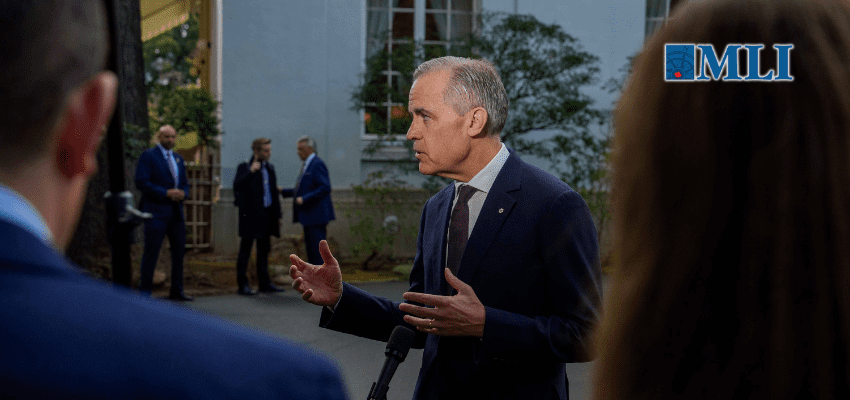
In late May, Canadian Prime Minister Mark Carney had a “maple MAGA” moment. Speaking before the Economic Club of New York, Carney claimed that “Canada Strong will help make America great again,” combining his own political slogan with U.S. President Donald Trump’s.
Painting Canada as a reliable supplier of energy and critical minerals and as a partner in an integrated North American auto market, he noted that “the examples are legion where we should work together and compete with the world together.”
It’s a fine sentiment, and Canada does have much of what America needs. Carney’s speech, however, is a stellar example of a leader wanting to have his political cake and eat it too. The indefinitely postponed opening of the Gordie Howe bridge between Detroit and Windsor last week, as mandated by the Trump administration, suggests Carney’s creative sloganeering did little to cool tensions in the relationship before the upcoming Canada-United States-Mexico Agreement (CUSMA) review.
Relying on a metaphor for aggressive play in hockey, Carney was elected last year on the idea he would keep his “elbows up” against Trump. And as U.S. Trade Representative Jamieson Greer reminded us last week when speaking of the global response to tariffs, “two countries in the world retaliated against us: the People’s Republic of China and Canada.”
Beyond those ill-advised retaliatory tariffs, Carney has spent the majority of his time in office globe-trotting in a Quixotic effort to diversify Canada’s economy away from reliance on the U.S. The prime minister apparently preferred a weaker economy to pursuing a mutually beneficial deal with the president he now courts.
Carney has antagonized the U.S., seemingly heedless of the consequences. Most famously, Carney’s January speech at the World Economic Forum in Davos bemoaned a “rupture in the world order,” widely understood as a barely veiled criticism of Trump and his policies.
In pursuit of a reduced reliance on the U.S., Carney has notably struck a new “strategic partnership” with China. Central to that deal is allowing 49,000 Chinese electric vehicles (EVs) into Canada’s market at a favourable tariff rate. This reverses Canada’s previous decision to join the U.S. in imposing 100 per cent tariffs on Chinese EVs due to unfair trade practices, overcapacity and national security concerns.
Having abruptly abandoned solidarity with the U.S. against Chinese EVs, Carney’s call to maintain an integrated North American auto market and to “compete with the rest of the world together” must ring hollow in the White House.
Another move that likely irritated Trump came just one day before the prime minister’s New York speech when Canada announced it had selected Saab of Sweden as the preferred supplier for Airborne Early Warning and Control capability. Given the almost certain impossibility of integrating the Swedish system into NORAD, this move isn’t merely short-sighted; it underlines Ottawa’s desire to make political points with Trump-skeptical Canadian voters rather than to defend and protect Canada’s (and the U.S.’s) national security. In what universe does “sticking it to the Americans” over national and continental security seem a sensible prelude to calling for broad collaboration with the United States the very next day?
While Carney’s hypocrisy is palpable, the Trump administration is far from blameless in the deterioration of Canada-U.S. relations. Section 232 tariffs against steel, aluminum, and autos have done real and needless damage to Canada’s economy. And Trump’s disruptive behaviour — the “51st state” provocations, constant barrage of tariff threats with moving goalposts — has impoverished and frightened Canadians, and rewarded our politicians for indulging in anti-American rhetoric.
In line with Carney’s u-turn in New York, Canadian Trade Minister Dominic LeBlanc asked for a 16-year extension of the CUSMA deal that has kept the majority of U.S.-Canada trade tariff free. But both the Carney speech and the request to extend CUSMA will be seen in context in the White House. Ottawa cannot and should not expect the Trump administration — which has expressed a consistent commitment to tariffs — simply to renew a free trade deal while turning a blind eye to trade-related issues like defense or cozying up to China.
The political squabbling and gamesmanship on both sides serve the interests of both countries’ politicians but no one else. Canada and the U.S. should come back to the table and strike a new deal, not over trade issues alone, but a grand bargain across a broad set of issues on matters including trade, defence, agriculture and national security that would meet the needs of both countries.
As our institutes have recently argued, re-grounding U.S.-Canada trade in a broader deal would see the stock of Canadian direct investment in the U.S. increase by $450 billion over 5 years, and more than $1 trillion over ten years, unlock major Canadian defence spending, strengthen America’s northern border, help keep China at bay and increase prosperity for both Canadians and Americans. These outcomes should command even Trump’s attention. But they require both sides to end the threats, prevarication and political posturing that have defined the relationship since his re-election.
If any adults remain, it’s time to come to the table. The future of North America’s largest trading relationship — and the security of citizens on both sides — depends on it.
Brian Lee Crowley is managing director of the Macdonald-Laurier Institute and the founder of the Center for North American Prosperity and Security (CNAPS).
Daniel Dorman is the managing editor and director of operations at the Macdonald-Laurier Institute.