By Heather Exner-Pirot
May 14, 2026
Coal is often treated as a relic of the past – dirty, declining, and politically toxic. Yet globally, it remains indispensable, the backbone of electricity systems in Asia and the primary input for global steelmaking.
For Canada, coal – especially metallurgical coal – is a major export to key Asian partners and an important contributor to economic growth. In a time when trade diversification is a priority, steelmaking is of strategic importance, and economic growth is in desperate demand, we need to rethink our support and assumptions about metallurgical coal.
Coal has played a major role in the global economy and remains important today, yet there is a growing disconnect between economic reality and political discourse. It’s time to stop treating Canadian metallurgical coal as a dirty secret, and start recognizing it as a critical mineral with the policy and political support it deserves.
Coal in historical context
Despite the widespread derision coal suffers, it is an enormously important global commodity, satisfying a vast amount of the globe’s energy and material needs.
To understand the current significance of coal, one must first look to the past. Coal’s role in the Industrial Revolution cannot be exaggerated. Its contribution came in three main forms: energy, transportation, and steel.
First, coal allowed the move from organic to mineral energy. Before the widespread use of coal, energy came from human and animal labour, wind, water, and wood. This imposed severe land constraints on energy use, which was tied to the ability to grow crops to feed workers and livestock, and cut down trees. The introduction of coal, by contrast, provided an essentially unlimited energy source.
Coal was subsequently used to power steam engines, which allowed for mechanization, and therefore industrialization; and steam ships and steam locomotives, and thus global trade.
Finally, coal enabled the smelting of iron and mass production of steel, which previously had been limited by the need for charcoal from wood. Steel also facilitated the building of bridges, railways, and steam engines themselves. This created a virtuous feedback loop that allowed for greater transportation of coal and iron and more building of railways, which opened up vast amounts of land to agriculture.
Coal’s dense energy and use for steel made heavy industry and factories viable, and the transportation of vast quantities of grains and raw materials made division of labour and greater urbanization possible. Britain led this industrial revolution, which facilitated the development of its empire and shaped world history. Coal was the most widely traded commodity of the 19th century, and undoubtedly the most important, supplying the vast majority of global commercial energy.
In the 20th century, oil eventually superseded coal in political and economic importance. Oil’s density and liquid form paved the way for a second industrial revolution, fuelling highway systems and mass car ownership, aviation, and petrochemicals.
But coal did not disappear. To this day, coal is the most mined commodity on Earth by mass and is still dominant in electricity and steel. Global coal demand continues to set new annual records, and no clear peak or decline is evident (see Figure 1).
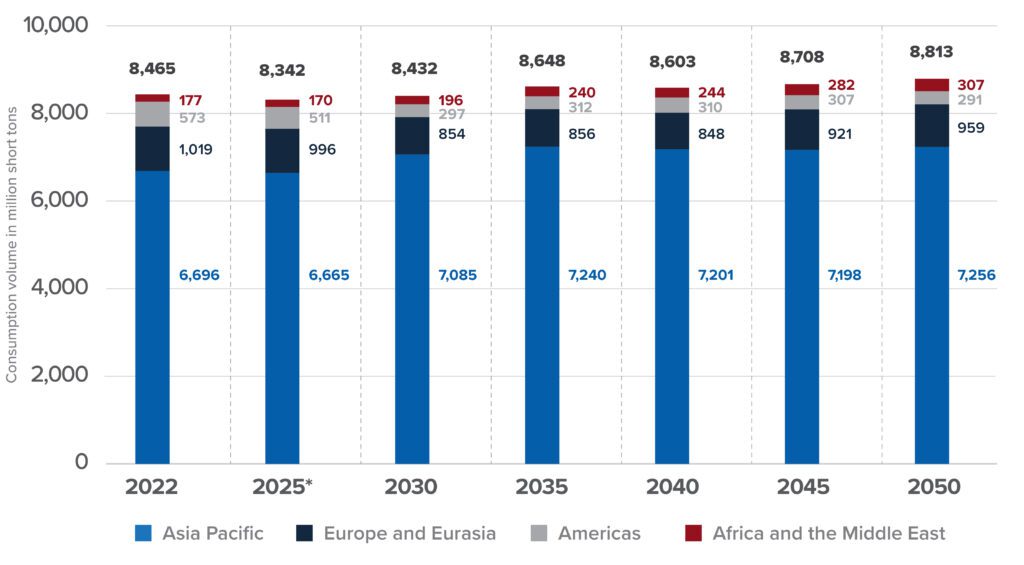
Source: Statista 2023
Electricity
Coal remains the world’s largest source of power generation, accounting for about 35 per cent of total generation. While its share in the global electricity mix has been falling, on an absolute basis it is still hitting new records.
Coal as a generation source has fallen in North America and Europe in the past 30 years, owing to fuel switching to cheaper natural gas and renewables, environmental regulations that raised the cost of operating coal plants, and the retirements of older plants.
However, coal use is still high globally due to its prevalence in Asia, where about 80 per cent of the world’s coal is consumed, playing a critical role in China and India’s economic growth. Indeed, China uses more coal than every other country combined. Coal is an essential component of energy security for the energy-scarce and population-dense Asian continent, as fuel-switching to natural gas there has economic and logistical limits.
Steel
Coal is essential in the process of making steel. Metallurgical coal is converted into coke, which produces the heat to smelt iron while also driving the chemical process to create steel by acting as a reducing agent and removing oxygen from iron ore.
Coal is typically categorized into lignite, sub-bituminous, bituminous, and anthracite categories. Metallurgical coal (also known as met coal, coking coal, or steelmaking coal) is a high-grade bituminous coal used in steelmaking, as it is high carbon, low impurity, and energy dense. Thermal coal for electricity uses lignite and sub-bituminous coal.
Roughly 770 kg of metallurgical coal is used to make a ton of steel, and globally, 214.7 kg of steel was used in new products per person in 2024. That drives significant demand for metallurgical coal.
Among common items, the amount of metallurgical coal needed is impressive. Each megawatt of solar power requires up to 45,000 kg of steel, which requires 35,000 kg of metallurgical coal; a bicycle requires 5 kg of steel and 3.9 kg of metallurgical coal; a kilometre of light rail track requires 112,000 kg of steel and 87,000 kg of metallurgical coal; and a high-voltage transmission tower requires 27,000 kg of steel and 21,000 kg of metallurgical coal.
Most, but not all, steelmaking requires metallurgical coal. The two primary steelmaking methods include a basic oxygen furnace, which draws on coke produced from metallurgical coal; and electric arc furnaces, which melt scrap steel with electricity. While electric arc furnaces are more sustainable, they are limited by the amount of scrap metal available, and basic oxygen furnaces still account for more than 70 per cent of steel production globally. In Canada, 57 per cent of steel is produced through blast furnaces and 43 per cent through electric arc furnaces.
Steelmaking with hydrogen in Direct Reduced Iron (DRI) shaft furnaces as an alternative would reduce carbon emissions, and is technically feasible, but has not reached scale and comprises less than 1 per cent of global steelmaking. That is owing to its high costs and enormous electricity needs; a global conversion to hydrogen-produced steel would require several thousand terawatt hours (TWh) of electricity, a substantial increase over today’s demand (Canada uses about 620 TWH annually). This is an unlikely scenario in a world with many competing uses for electricity including electrification of heat and transportation, data centres, and air conditioning.
Coal in Canada
As a large country, Canada has ample coal deposits in several regions. The Elk Valley in southeastern BC is Canada’s foremost coal mining district, with additional current and historic mining in the eastern slopes of Alberta, northeast of BC, central Alberta, southeast Saskatchewan, and Cape Breton Island.
Canadian mines produced 42.6 million tonnes of coal in 2024, 67 per cent of which was metallurgical coal. This is a steep decline of 31 per cent in coal production over the past decade, as thermal coal needs for domestic use decreased with coal plant phase-outs; coal accounts for less than 3 per cent of Canada’s electricity today. British Columbia (69 per cent) accounts for most of the coal tonnage mined in Canada, followed by Alberta (19 per cent) and Saskatchewan (11 per cent).
Canada exports the majority of its coal, most of which is metallurgical coal, most of which is mined in BC, and most of which goes to China, Korea, and Japan (see Figure 2). In 2024, Canadian metallurgical and thermal coal exports were valued at $8.9 billion and $800 million, respectively.
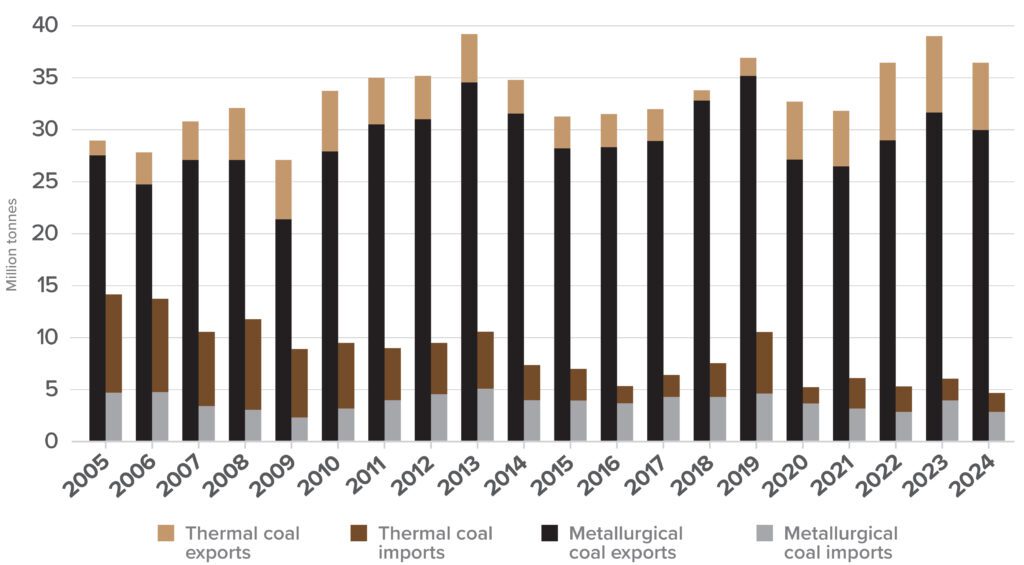
Source: Natural Resources Canada 2026
Coal is exported from ports in both Vancouver and Prince Rupert. Coal is BC’s largest mining product in both volume and price, accounting for more than half of the sector’s revenues in 2024. It was the Port of Vancouver’s largest export by volume at 41.9 million tonnes (MT) in 2024, exceeding potash, grains, and petroleum products; as well as Port of Prince Rupert’s largest export by volume, at 5.35 MT.
Politicization of coal in Canada
Coal was just another commodity for much of the 20th century, but began to be targeted as concerns about climate change and greenhouse gas emissions grew in the 1990s and 2000s. Coal emits more carbon dioxide than almost any other fuel type, and is the most emitting form of mainstream electricity generation.
Switching from coal to natural gas generation in Europe and North America delivered large, measurable climate benefits, mainly because gas emits about half the CO₂ of coal when generating electricity. Coal-to-gas switching in North America and Europe is arguably the largest single contributor to emissions reductions to date. Because it did not come at a high cost, phasing out coal generation became a palatable, mainstream solution for emissions reductions. Jurisdictions used a mix of regulatory bans and performance standards, carbon pricing, air-pollution rules, market liberalization, and fuel-switching incentives to eliminate coal-based electricity generation.
This eventually evolved into campaigns to stop coal mining altogether. Although domestic demand in Canada decreased rapidly, there were still export markets seeking both thermal and metallurgical coal. Canadian policymakers engaged in efforts to prevent this.
The federal government announced a Strategic Assessment of Thermal Coal Mining in December 2019 to guide how new thermal coal mine projects would be considered under the new Impact Assessment Act (known colloquially as Bill C-69).
On June 11, 2021, Ottawa issued a statement asserting that new thermal coal mining or expansion projects were likely to cause unacceptable environmental effects within federal jurisdiction, and were not aligned with Canada’s domestic and international climate change commitments. In other words, the Trudeau government would use federal powers to veto them.
The two highest-profile projects affected by the federal government’s new stance on coal mining were the Vista mine expansion in the Alberta foothills, for thermal coal, and the Grassy Mountain project, for metallurgical coal, on the Alberta eastern slopes. While it was not within the purview of the federal government to ban coal mining – non-renewable resource development is within the exclusive jurisdiction of the provinces – it used its environmental authority under the Impact Assessment Act, Fisheries Act, Species at Risk Act, and transboundary water impacts to delay projects and raise costs. Ultimately it rejected the Grassy Mountain metallurgical coal project in a Joint Review with the Government of Alberta, and required a full federal review of the Vista mine expansion.
After the Supreme Court of Canada ruled in 2023 that large parts of the federal Impact Assessment Act were unconstitutional, the federal government lost the legal basis it had used to designate the Vista expansion for review. As a result, Ottawa dropped the federal impact assessment, removing the main federal obstacle.
But coal mining was also under pressure from the Alberta government. The Notley NDP government’s coal-powered generation phase-out killed the market for domestic thermal coal. But in 2020, the Kenny UCP government rescinded the 1976 Coal Development Policy, removing long-standing restrictions on open-pit mining in the Rocky Mountain foothills (in what were referred to as “Category 2–3 lands”), leading to a surge of exploration applications by metallurgical coal companies. It also sparked a public backlash to more coal mining.
Under pressure, Alberta reinstated parts of the 1976 Coal Policy, announced a pause on new coal exploration on previously protected lands, and launched coal policy consultations. This created regulatory uncertainty and stalled projects, exacerbated by the rejection by the joint federal-provincial review panel of the proposed Grassy Mountain metallurgical coal mine. Compensation suits based on Alberta’s rapid policy shifts, which resulted in de facto expropriation of coal leases and investment value, followed. They’ve led to at least two settlements, with Alberta paying affected coal companies almost $240 million so far.
The Government of Alberta has more recently pursued a Coal Industry Modernization Initiative focused on new land-use categories, stronger protections for eastern slopes headwaters, and clearer rules for metallurgical coal development, but no comprehensive replacement policy has yet been finalized; as a result, Alberta remains in a transitional, case-by-case regulatory environment, with exploration limits in sensitive areas, ongoing project reviews, and continued uncertainty for proponents. They are planning to finalize proposed changes and updated legislation in Fall 2026.
The issue has become a political land mine for the governing UCP. While Alberta is generally pro-development and not opposed to fossil fuel exports, much of the opposition has arisen from rural ranchers in southern Alberta, an important conservative constituency. A country music singer, Corb Lund, has even initiated a citizen referendum, alongside the slew of others in the province, to block coal exploration and mining outright:
The Government of Alberta shall prohibit through legislation all coal exploration and mining activities within the Eastern Slopes of Alberta’s Rocky Mountains, other than mines that are in actual production as of January 1, 2026. For clarity, this prohibition includes Northback Holdings’ Grassy Mountain Project and Valory Resources’ Blackstone Project, as well as any projects to expand any producing mines.
To complicate matters, the community most affected by the Grassy Mountain project, Crowsnest Pass, held a referendum in November 2024 in which they voted overwhelmingly (72 per cent) in favour of the mine, with the straightforward question: “Do you support the development and operations of the metallurgical coal mine at Grassy Mountain?”
The project has pitted one of the wealthiest municipalities in Alberta, Ranchlands, with an economy based on ranching, against one of the poorest, Crowsnest Pass, struggling with the closures of past coal mines.
While the local dynamic is politically tricky, in general Albertans support increased coal mining. Pollster Janet Brown conducted polling in July–August 2025 that found support for new metallurgical coal mining at a ratio of about 3:1 (see Table 1).
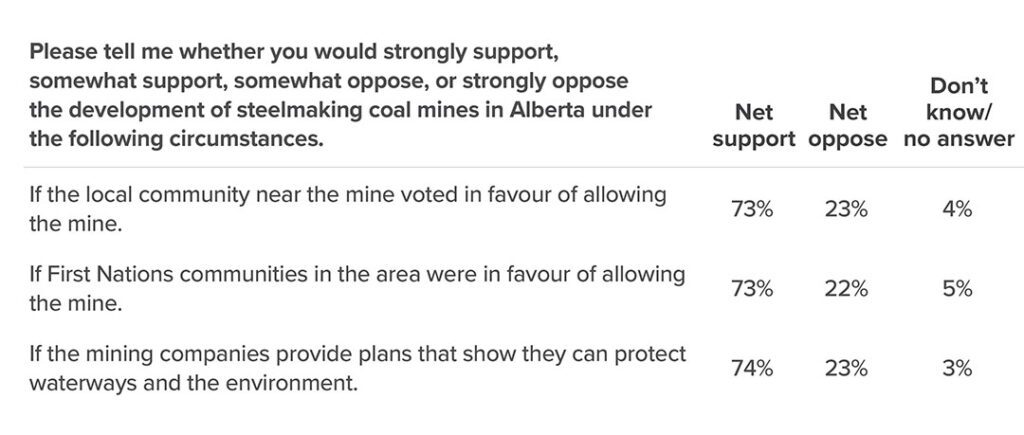
Source: Janet Brown Opinion Research, 2025
British Columbia, while environmentally progressive, is economically tied to coal mining. Its policies have therefore focused not on shutting down or preventing coal mining, but on water management, especially with regards to selenium.The coal-selenium issue in British Columbia is centred in the Elk Valley, BC’s major metallurgical coal region. Large-scale mining exposes selenium-bearing rock. When waste rock is disturbed and exposed to air and water, selenium leaches into groundwater and streams. At elevated concentrations, selenium is toxic to aquatic life, particularly fish, where it causes reproductive failure, deformities, and population impacts due to bioaccumulation.
The issue became prominent in the 2000s and 2010s as monitoring showed rising selenium concentrations in tributaries downstream of major mines operated by companies such as Teck Resources. Because the Elk Valley hosts long-lived, high-output metallurgical coal mines, the problem is cumulative and persistent, tied to extensive waste rock piles and ongoing development rather than a single site. This prompted concern from regulators about long-term watershed health and cross-border impacts into the United States Columbia River basin.
In response, the Government of British Columbia and federal regulators implemented one of Canada’s most comprehensive mine water management frameworks, centred on the Elk Valley Water Quality Plan. This introduced site-specific selenium limits, long-term monitoring, mandatory water treatment systems, and cumulative effects management across the basin. The policy outcome has not aimed to halt coal production, but to transform it into a tightly regulated activity with permanent water treatment obligations and significantly higher environmental compliance costs, effectively embedding long-term water-quality management into the region’s coal industry.
Concerns over selenium have migrated into the Alberta coal mining debate, with activists often highlighting the risks specifically from it as a reason not to mine. These seem overblown; selenium is an essential dietary mineral, and is actually given as a supplement to livestock in southern Alberta. The key issue is effective management of cumulative impacts.
The Elk Valley and other mining jurisdictions show that it can be satisfactorily managed; and mining operations across Canada are always required to manage tailings, waste rock, water, and effluent under strict environmental regulations. However, the Alberta government and mining proponents will need to communicate their water management strategies carefully to retain confidence from the general public.
Metallurgical coal as a critical mineral
While thermal coal is generally unloved, many of Canada’s allies and partners have distinguished metallurgical coal as a “critical mineral,” i.e., a raw material input of essential economic and security importance.
The first to do so was the European Union, which added coking coal to its list of critical raw minerals as far back as 2014. Recognizing the criticality of steel in industrial development, infrastructure and defence supply chains, the United States also declared metallurgical coal a critical mineral, in 2025, stating: “steel is essential to energy technologies, transportation, and defense systems, as the materials that enable steel production (including metallurgical coal and anthracite) are vital to American interests.” And just this year, India added coking coal to its list of critical minerals, a change that reinforces their commitment to increase steel production over the coming decades.
Canada has made developing critical minerals and supplying them to its allies and trading partners a key pillar of its foreign, economic, and defence strategy, and the signature of its G7 Presidency in 2025. Under the Carney government, it has also made doubling non-US exports and diversifying trade alliances a central goal.
It is hard to see Canada meeting its trade goals, and supplying the raw material needs of its allies, without also expanding production of metallurgical coal – a more valuable mineral to the Canadian economy than iron or copper, and oftentimes, potash.
However, it still seems difficult for the federal government to acknowledge coal’s existence. Despite its prominent role in Canadian exports to China, Japan, Korea, and India and growing global demand, metallurgical coal was barely mentioned in the core public messaging and official readouts of recent visits by the Prime Minister or Energy and Natural Resources Minister Tim Hodgson’s 2025 and 2026 visits to the region, which instead focused on LNG, critical minerals, and clean energy. This is despite actual MOUs signed by Elk Valley Resources of British Columbia with A-One Steels India Limited, Jindal Saw Limited, Shyam Sel & Power Limited, and Jayaswal Neco Industries Ltd. for new sales of 1.2 million tonnes of metallurgical coal worth approximately C$285M.
The tide may be turning. Public support for increasing resource development and exports is high. Recently, BC included two coal mining operations in its list of major projects to be fast-tracked (the Fording River Operations – Extension and Greenhills Operations – Cougar 8/9), an unlikely development in previous policy times.
In March, the Coal Association of Canada urged Ottawa to formally recognize metallurgical coal as a critical mineral, essential to the nation’s industrial and economic security. This would truly mark a new era for metallurgical coal in Canadian public and policy opinion. The year 2026 is proving effective for geopolitical ruptures; it is time to treat Canada’s metallurgical coal as a strategic commodity rather than an embarrassing relic.
About the author
Heather Exner-Pirot is a senior fellow and director of Energy, Natural Resources, and Environment at the Macdonald-Laurier Institute. She has twenty years of experience in Indigenous, Arctic, and resource development and governance. She has published on Indigenous economic development, resource politics and policy, energy security, Arctic human security, regional Arctic governance and the Arctic Council, Arctic innovation, First Nations equity, and own source revenues, and more. She obtained a PhD in Political Science from the University of Calgary in 2011.
Exner-Pirot sits on the boards of the Saskatchewan Indigenous Economic Development Network and the Canadian Rural Revitalization Foundation, and is a research advisor to the Indigenous Resource Network. She is a network coordinator at the North American and Arctic Defense and Security Network and managing editor of the Arctic Yearbook (an international, peer-reviewed annual volume). She has published over 45 peer-reviewed journal articles, book chapters, and edited volumes, and presented at over 100 conferences and events nationally and internationally, in addition to authoring dozens of op-eds in Canada’s top publications.