Thursday, May 14, 2026
No Result
View All Result
  • Media
Macdonald-Laurier Institute
  • Home
  • About
    • Who We Are
    • Who Makes MLI Work
    • Fifteenth Anniversary
  • Experts
    • Experts Directory
    • In Memoriam
  • Issues
    • Domestic Policy
      • Economic Policy
      • Justice
      • Rights and Freedoms
      • Assisted Suicide (MAID)
      • Health Care
      • COVID-19
      • Gender Identity
      • Canada’s Political Tradition
      • AI, Technology and Innovation
      • Media and Telecoms
      • Housing
      • Immigration
      • Agriculture and Agri-Food
      • Competition Policy
    • Energy Policy
      • Energy
      • Environment
    • Foreign Policy
      • Israel-Hamas War
      • Ukraine
      • Taiwan
      • China
      • Europe and Russia
      • Indo-Pacific
      • Middle East and North Africa
      • North America
      • Foreign Interference
      • National Defence
      • National Security
      • Foreign Affairs
    • Indigenous Affairs
  • Projects
    • CNAPS (Center for North American Prosperity and Security)
    • Justice Report Card
    • The Promised Land
    • Voices that Inspire: The Macdonald-Laurier Vancouver Speaker Series
    • Dragon at the door
    • Canada on top of the world
    • Letter to a minister
    • The Great Energy Crisis
    • DisInfoWatch.org
    • Managing Indigenous Prosperity
    • Judicial Foundations
    • Landmark Cases Council
    • Defending The Marketplace of Ideas
    • Reforming the University
    • Past Projects
      • Digital Policy & Connectivity
      • Double Trouble
      • Canada and the Indo-Pacific Initiative
      • The Transatlantic Program
      • COVID Misery Index
        • Provincial COVID Misery Index
        • Beyond Lockdown
        • COVID and after: A mandate for recovery
      • Speak for Ourselves
      • The Eavesdropping Dragon: Huawei
      • Talkin’ in the Free World with Mariam Memarsadeghi
      • An Intellectual Property Strategy for Canada
      • Munk Senior Fellows
      • A Mandate for Canada
      • Confederation Series
      • Fiscal Reform
      • The Canadian Century project
      • Fixing Canadian health care
      • Internal trade
      • From a mandate for change
      • Size of government in Canada
      • Straight Talk
      • Labour Market Report
      • Leading Economic Indicator
      • Centre for Advancing Canada’s Interests Abroad
      • Indigenous Prosperity at a Crossroads
        • Aboriginal Canada and Natural Resources
  • Events
    • Upcoming Events
    • Past Events
      • MLI Dinners
      • Great Canadian Debates
  • Latest News
  • Libraries
    • Columns
    • Commentary
    • Papers
    • Books
    • Video
  • Donate
  • Home
  • About
    • Who We Are
    • Who Makes MLI Work
    • Fifteenth Anniversary
  • Experts
    • Experts Directory
    • In Memoriam
  • Issues
    • Domestic Policy
      • Economic Policy
      • Justice
      • Rights and Freedoms
      • Assisted Suicide (MAID)
      • Health Care
      • COVID-19
      • Gender Identity
      • Canada’s Political Tradition
      • AI, Technology and Innovation
      • Media and Telecoms
      • Housing
      • Immigration
      • Agriculture and Agri-Food
      • Competition Policy
    • Energy Policy
      • Energy
      • Environment
    • Foreign Policy
      • Israel-Hamas War
      • Ukraine
      • Taiwan
      • China
      • Europe and Russia
      • Indo-Pacific
      • Middle East and North Africa
      • North America
      • Foreign Interference
      • National Defence
      • National Security
      • Foreign Affairs
    • Indigenous Affairs
  • Projects
    • CNAPS (Center for North American Prosperity and Security)
    • Justice Report Card
    • The Promised Land
    • Voices that Inspire: The Macdonald-Laurier Vancouver Speaker Series
    • Dragon at the door
    • Canada on top of the world
    • Letter to a minister
    • The Great Energy Crisis
    • DisInfoWatch.org
    • Managing Indigenous Prosperity
    • Judicial Foundations
    • Landmark Cases Council
    • Defending The Marketplace of Ideas
    • Reforming the University
    • Past Projects
      • Digital Policy & Connectivity
      • Double Trouble
      • Canada and the Indo-Pacific Initiative
      • The Transatlantic Program
      • COVID Misery Index
        • Provincial COVID Misery Index
        • Beyond Lockdown
        • COVID and after: A mandate for recovery
      • Speak for Ourselves
      • The Eavesdropping Dragon: Huawei
      • Talkin’ in the Free World with Mariam Memarsadeghi
      • An Intellectual Property Strategy for Canada
      • Munk Senior Fellows
      • A Mandate for Canada
      • Confederation Series
      • Fiscal Reform
      • The Canadian Century project
      • Fixing Canadian health care
      • Internal trade
      • From a mandate for change
      • Size of government in Canada
      • Straight Talk
      • Labour Market Report
      • Leading Economic Indicator
      • Centre for Advancing Canada’s Interests Abroad
      • Indigenous Prosperity at a Crossroads
        • Aboriginal Canada and Natural Resources
  • Events
    • Upcoming Events
    • Past Events
      • MLI Dinners
      • Great Canadian Debates
  • Latest News
  • Libraries
    • Columns
    • Commentary
    • Papers
    • Books
    • Video
  • Donate
No Result
View All Result
Macdonald-Laurier Institute

Protectionism won’t feed North America – Don’t scrap the US-Mexico-Canada Agreement: Larry Martin in The Daily Economy

Calls to weaken or abandon USMCA overlook how interconnected US, Canadian, and Mexican agriculture has become. Trade barriers hurt farmers and families in all three nations.

May 14, 2026
in Domestic Policy, Latest News, Economic Policy, North America
Reading Time: 7 mins read
A A
Protectionism won’t feed North America – Don’t scrap the US-Mexico-Canada Agreement: Larry Martin in The Daily Economy

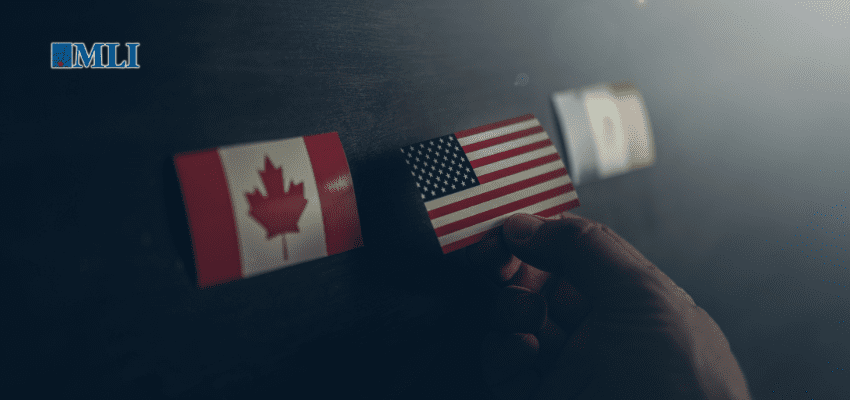
Image via Canva.

This article originally appeared in The Daily Economy.

By Larry Martin, May 14, 2026

The United States–Mexico–Canada Agreement is an established trade policy agreement among the US, Mexico and Canada, implemented in 2020 with a mandatory review after six years. As that review unfolds, its chances of being extended seem increasingly bleak.

A failure to renew USMCA will mean disrupting the highly interconnected North American food system where, for example, Canadian wheat can be ground into flour in the US, shipped back to Canada to be baked into pastries or bread, which can then be sold in either country. Many Canadian feeder cattle are finished in US feedlots, or finished in Canada, then sold to US processors, and sold back to either Canadian or US further processors or retailers.

Farmers, consumers and food companies will bear the costs. Several US agricultural organizations clearly recognize this.

A better approach is to evaluate what’s working well for all North Americans, what’s not, and needs to change.

Agrifood products currently trade with few restrictions, reducing supply shocks and price volatility. Canada’s short growing season provides demand during the prolonged seasons of southern US horticultural industries. Food and feed grains, whose prices in both countries are discovered on the Chicago Mercantile Exchange, trade back and forth as needed. Regional crop yields are often inversely related, partly owing to weather phenomena. When yields are low in Canada, and high in the US, Canada buys more, thereby relieving downward pressure on US prices. Similarly, when Canadian yields are high and US yields lag, Canadian foodstuffs are rerouted to meet that demand, reducing upward price pressure.

Relatively free trade in basic food ingredients is always good risk management, but particularly so under extreme circumstances. Beef prices are currently high. History shows the highest prices occur when ranchers keep females to build their breeding herds, reducing the number available to be processed into beef. Two recent USDA reports show that hold-back hadn’t started. When it finally occurs, we will see much higher meat prices. Canada has heaps of grassland and exports more beef and cattle than it uses for its population and it’s cheaper to import than Brazilian or Argentine beef. Stopping exports to the US with high tariffs will drive American prices even higher, while Canada looks to Asia to sell its extra beef.

Minimizing trade restrictions also helped manage risk around avian influenza, which has had greater effect in the US. Canada doesn’t normally export turkey meat to the US, but currently it is, thereby alleviating some of the upward price pressure caused by culling.

Finally, the US has a very limited natural endowment of potash, which is essential for crop growth. The US imports 90 percent of its requirements, of which more than 80 percent is from the province of Saskatchewan. The next three largest suppliers are Russia, Belarus, and China. With USMCA, American farmers got Canadian potash at the same prices as farmers in other countries. It’s working well. A threatened US tariff on it would put American farmers at the mercy of less-friendly countries.

The US, and other countries, have long complained about Canada’s supply management system for dairy (the Hub). It allows Canadian producers of dairy (and poultry) to avoid Canada’s Competition Act by colluding to control supply and prices.

Supplemented by high tariffs and tight tariff quotas on imports, the Hub works to keep foreign dairy products out of the Canadian market. It also raises prices for dairy in Canada (giving dairy and poultry producers an advantage over other farmers in buying or renting land, thereby driving up land and financing costs for everyone) and makes access to foreign markets for other Canadian products more difficult.

A major barrier to reforming Canada’s supply management is that the US dairy sector is even more protected than Canada’s. Its dairy prices and imports are “managed” by a different mechanism than Canada’s that is even more effective keeping foreign products out. The US wants more access to Canada’s dairy market; that access needs to go both ways. Lower trade barriers can be phased in over time so farms and processing companies can adjust slowly, but both countries must agree on an equitable way to do so.

The food and agricultural regulatory framework is also overdue for reworking. Both countries have constructed regulatory hoops that protect their markets while raising costs to farmers and food companies in both. Both are experiencing increased criticism of their red tape. For example, the Canadian Federation of Independent Business recently published a survey reporting 70 percent of Canadian agribusinesses discourage the next generation from staying in farming because of red tape and regulation.

Finding ways to reduce and rationalize the two food regulation systems could materially improve the competitiveness of agrifood sectors in both nations.

Focusing on the things that need to change and leaving alone the things that are working would put resources in the right places. Leaders of the two countries have a clear choice: continue to improve conditions for their farmers, consumers, and food companies, or pull the rug out from under them with short-sighted protectionism.


Larry Martin was professor and chair in the Department of Agriculture Economics and Business at the University of Guelph. He is the author of a recent paper, Growing Prosperity for the Centre for North American Prosperity and Security.

Source: The Daily Economy
Tags: Larry Martin

Related Posts

Canadian coal – From dirty secret to critical mineral: Heather Exner-Pirot
Resources

Canadian coal – From dirty secret to critical mineral: Heather Exner-Pirot

May 14, 2026
Canada backs the Philippines against Chinese coercion: Kevin Vuong and Christopher Coates for Inside Policy
Indo-Pacific

Canada backs the Philippines against Chinese coercion: Kevin Vuong and Christopher Coates for Inside Policy

May 13, 2026
Nearly 50% of all violent offences go unpunished in Canada—why police are solving fewer crimes: Dave Snow in The Hub
National Security

Canada released an ISIS recruiter. Here’s why—and how to prevent it from happening again: Ches W. Parsons and Sheryl Saperia in The Hub

May 13, 2026

Newsletter Signup

  Thank you for Signing Up
  Please correct the marked field(s) below.
Email Address  *
1,true,6,Contact Email,2
First Name *
1,true,1,First Name,2
Last Name *
1,true,1,Last Name,2
*
*Required Fields

Follow us on

Macdonald-Laurier Institute

323 Chapel Street, Suite #300
Ottawa, Ontario, K1N 7Z2 Canada

613.482.8327

info@macdonaldlaurier.ca
MLI directory

Support Us

Support the Macdonald-Laurier Institute to help ensure that Canada is one of the best governed countries in the world. Click below to learn more or become a sponsor.

Support Us

  • Inside Policy Magazine
  • Annual Reports
  • Jobs
  • Privacy Policy

© 2023 Macdonald-Laurier Institute. All Rights reserved.

No Result
View All Result
  • Home
  • About
    • Who We Are
    • Who Makes MLI Work
    • Fifteenth Anniversary
  • Experts
    • Experts Directory
    • In Memoriam
  • Issues
    • Domestic Policy
      • Economic Policy
      • Justice
      • Rights and Freedoms
      • Assisted Suicide (MAID)
      • Health Care
      • COVID-19
      • Gender Identity
      • Canada’s Political Tradition
      • AI, Technology and Innovation
      • Media and Telecoms
      • Housing
      • Immigration
      • Agriculture and Agri-Food
      • Competition Policy
    • Energy Policy
      • Energy
      • Environment
    • Foreign Policy
      • Israel-Hamas War
      • Ukraine
      • Taiwan
      • China
      • Europe and Russia
      • Indo-Pacific
      • Middle East and North Africa
      • North America
      • Foreign Interference
      • National Defence
      • National Security
      • Foreign Affairs
    • Indigenous Affairs
  • Projects
    • CNAPS (Center for North American Prosperity and Security)
    • Justice Report Card
    • The Promised Land
    • Voices that Inspire: The Macdonald-Laurier Vancouver Speaker Series
    • Dragon at the door
    • Canada on top of the world
    • Letter to a minister
    • The Great Energy Crisis
    • DisInfoWatch.org
    • Managing Indigenous Prosperity
    • Judicial Foundations
    • Landmark Cases Council
    • Defending The Marketplace of Ideas
    • Reforming the University
    • Past Projects
      • Digital Policy & Connectivity
      • Double Trouble
      • Canada and the Indo-Pacific Initiative
      • The Transatlantic Program
      • COVID Misery Index
      • Speak for Ourselves
      • The Eavesdropping Dragon: Huawei
      • Talkin’ in the Free World with Mariam Memarsadeghi
      • An Intellectual Property Strategy for Canada
      • Munk Senior Fellows
      • A Mandate for Canada
      • Confederation Series
      • Fiscal Reform
      • The Canadian Century project
      • Fixing Canadian health care
      • Internal trade
      • From a mandate for change
      • Size of government in Canada
      • Straight Talk
      • Labour Market Report
      • Leading Economic Indicator
      • Centre for Advancing Canada’s Interests Abroad
      • Indigenous Prosperity at a Crossroads
  • Events
    • Upcoming Events
    • Past Events
      • MLI Dinners
      • Great Canadian Debates
  • Latest News
  • Libraries
    • Columns
    • Commentary
    • Papers
    • Books
    • Video
  • Donate

© 2023 Macdonald-Laurier Institute. All Rights reserved.