
Wednesday, September 2, 2026
No Result
View All Result
  • Media
Macdonald-Laurier Institute
  • Home
  • About
    • Who We Are
    • Who Makes MLI Work
    • Fifteenth Anniversary
  • Experts
    • Experts Directory
    • In Memoriam
  • Issues
    • Domestic Policy
      • Economic Policy
      • Justice
      • Rights and Freedoms
      • Assisted Suicide (MAID)
      • Health Care
      • COVID-19
      • Gender Identity
      • Canada’s Political Tradition
      • AI, Technology and Innovation
      • Media and Telecoms
      • Housing
      • Immigration
      • Agriculture and Agri-Food
      • Competition Policy
    • Energy Policy
      • Energy
      • Environment
    • Foreign Policy
      • Israel-Hamas War
      • Ukraine
      • Taiwan
      • China
      • Europe and Russia
      • Indo-Pacific
      • Middle East and North Africa
      • North America
      • Foreign Interference
      • National Defence
      • National Security
      • Foreign Affairs
    • Indigenous Affairs
  • Projects
    • CNAPS (Center for North American Prosperity and Security)
    • The Promised Land
    • Dragon at the door
    • Justice Report Card
    • DisInfoWatch.org
    • Managing Indigenous Prosperity
    • Judicial Foundations
    • Landmark Cases Council
    • Closing Canada’s Border, Policing, and Legal Gaps
    • Reforming the University
    • Digital Policy & Connectivity
    • Defending The Marketplace of Ideas
    • Letter to a minister
    • Past Projects
      • The Great Energy Crisis
      • Canada on top of the world
      • Double Trouble
      • Canada and the Indo-Pacific Initiative
      • The Transatlantic Program
      • COVID Misery Index
        • Provincial COVID Misery Index
        • Beyond Lockdown
        • COVID and after: A mandate for recovery
      • Speak for Ourselves
      • The Eavesdropping Dragon: Huawei
      • Talkin’ in the Free World with Mariam Memarsadeghi
      • An Intellectual Property Strategy for Canada
      • Munk Senior Fellows
      • A Mandate for Canada
      • Confederation Series
      • Fiscal Reform
      • The Canadian Century project
      • Fixing Canadian health care
      • Internal trade
      • From a mandate for change
      • Size of government in Canada
      • Straight Talk
      • Labour Market Report
      • Leading Economic Indicator
      • Centre for Advancing Canada’s Interests Abroad
      • Indigenous Prosperity at a Crossroads
        • Aboriginal Canada and Natural Resources
  • Events
    • Voices that Inspire: The Macdonald-Laurier Vancouver Speaker Series
    • Upcoming Events
    • Past Events
      • MLI Dinners
      • Great Canadian Debates
  • Latest News
  • Libraries
    • Columns
    • Commentary
    • Papers
    • Books
    • Video
  • Donate
  • Home
  • About
    • Who We Are
    • Who Makes MLI Work
    • Fifteenth Anniversary
  • Experts
    • Experts Directory
    • In Memoriam
  • Issues
    • Domestic Policy
      • Economic Policy
      • Justice
      • Rights and Freedoms
      • Assisted Suicide (MAID)
      • Health Care
      • COVID-19
      • Gender Identity
      • Canada’s Political Tradition
      • AI, Technology and Innovation
      • Media and Telecoms
      • Housing
      • Immigration
      • Agriculture and Agri-Food
      • Competition Policy
    • Energy Policy
      • Energy
      • Environment
    • Foreign Policy
      • Israel-Hamas War
      • Ukraine
      • Taiwan
      • China
      • Europe and Russia
      • Indo-Pacific
      • Middle East and North Africa
      • North America
      • Foreign Interference
      • National Defence
      • National Security
      • Foreign Affairs
    • Indigenous Affairs
  • Projects
    • CNAPS (Center for North American Prosperity and Security)
    • The Promised Land
    • Dragon at the door
    • Justice Report Card
    • DisInfoWatch.org
    • Managing Indigenous Prosperity
    • Judicial Foundations
    • Landmark Cases Council
    • Closing Canada’s Border, Policing, and Legal Gaps
    • Reforming the University
    • Digital Policy & Connectivity
    • Defending The Marketplace of Ideas
    • Letter to a minister
    • Past Projects
      • The Great Energy Crisis
      • Canada on top of the world
      • Double Trouble
      • Canada and the Indo-Pacific Initiative
      • The Transatlantic Program
      • COVID Misery Index
        • Provincial COVID Misery Index
        • Beyond Lockdown
        • COVID and after: A mandate for recovery
      • Speak for Ourselves
      • The Eavesdropping Dragon: Huawei
      • Talkin’ in the Free World with Mariam Memarsadeghi
      • An Intellectual Property Strategy for Canada
      • Munk Senior Fellows
      • A Mandate for Canada
      • Confederation Series
      • Fiscal Reform
      • The Canadian Century project
      • Fixing Canadian health care
      • Internal trade
      • From a mandate for change
      • Size of government in Canada
      • Straight Talk
      • Labour Market Report
      • Leading Economic Indicator
      • Centre for Advancing Canada’s Interests Abroad
      • Indigenous Prosperity at a Crossroads
        • Aboriginal Canada and Natural Resources
  • Events
    • Voices that Inspire: The Macdonald-Laurier Vancouver Speaker Series
    • Upcoming Events
    • Past Events
      • MLI Dinners
      • Great Canadian Debates
  • Latest News
  • Libraries
    • Columns
    • Commentary
    • Papers
    • Books
    • Video
  • Donate
No Result
View All Result
Macdonald-Laurier Institute

A $4 billion hit – What Carney’s tariff retaliation could cost Canadian consumers: Trevor Tombe in The Hub

Families with kids face costs of roughly $250 per year from the tariffs.

September 2, 2026
in Domestic Policy, Latest News, Columns, In the Media, Economic Policy, Trevor Tombe
Reading Time: 4 mins read
A A
A $4 billion hit – What Carney’s tariff retaliation could cost Canadian consumers: Trevor Tombe in The Hub

Image via Canva.

This article originally appeared in The Hub.

By Trevor Tombe, September 2, 2026

On Sept. 8, roughly $30 billion in imports from the United States will face Canadian tariffs of between 15 and 50 percent. This is our response to the 50 percent U.S. tariffs now applied to approximately five percent of our exports.

Overall, I estimate Canada’s average tariff response works out to about 30 percent, on average, across affected goods. That’s roughly 60 cents of response for every dollar of U.S. tariff. While not full dollar-for-dollar retaliation, as the government frames it, it is still a large response. And it comes on top of certain retaliatory tariffs already in place from last year.

There are real costs and benefits to weigh here. The goal is to change U.S. behaviour and raise funds to cover new government support programs for workers and businesses disrupted in the trade war. But we must also be clear about the costs and consequences of these tariffs on Canadians more generally.

Consumers in particular will be hit, with tariffs increasing prices for a wide variety of goods. Not dramatically, but potentially by enough to notice—and by more for the households least able to absorb it.

I’ll explain.

Tariffs are taxes

Let’s start with the basics. Tariffs are a tax on Canadian buyers of imported goods. They raise the price of those imports, and potentially of substitutes from other countries or made here at home.

Two channels matter. The direct one is simple: households buy imported U.S. goods, and tariffs can show up in what they pay. The indirect one is trickier. Businesses import inputs too, and those inputs are now taxed. Higher input costs mean higher prices, and where those goods feed into other goods and services, the effect cascades through the supply chain. That channel matters a lot, since Canada’s tariffs fall mostly on industrial supplies and capital goods.

We have good data on both to estimate things, though there’s uncertainty here around how businesses may respond, how quickly they change prices, what fraction of tariffs are passed through to buyers, how consumers change behaviour, and more. But these caveats aside, a rough estimate of the effect is still valuable to know.

The effect on consumer prices

Overall, I estimate that the increase in overall consumer prices is roughly a quarter of a percentage point. That may sound small. But some products are affected more, including various personal items, household goods, recreation, and food.
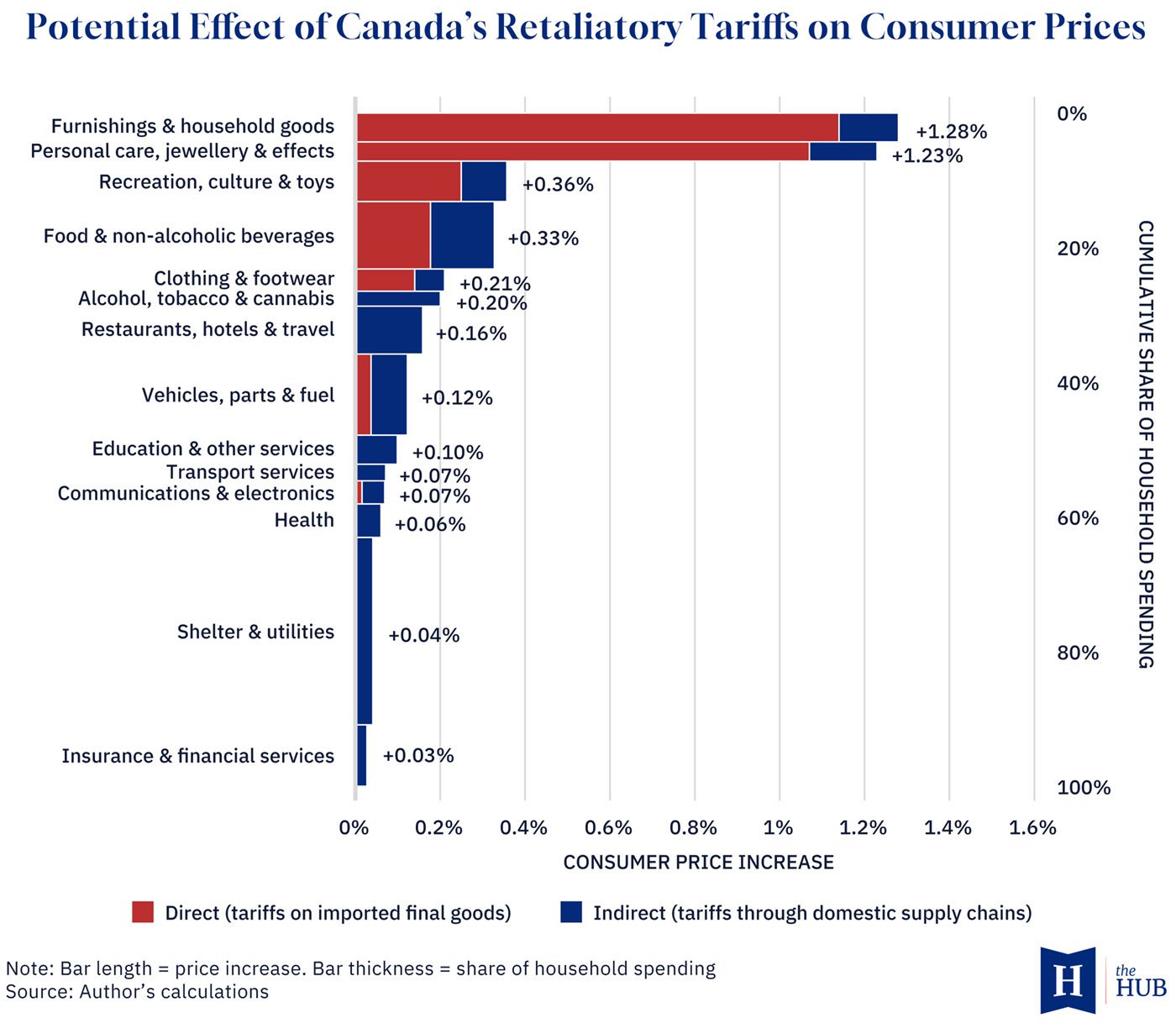
Graphic credit: Janice Nelson

Even the overall 0.25 percent increase is not trivial. Compared against the 2 percent annual target for consumer price growth, it is a decent share of the total. It is also roughly equivalent to a $10-per-barrel increase in oil prices or—for those following the carbon tax debate—to the entire effect of a $30-per-tonne carbon tax on average consumer prices.

In total, it’s a nearly $4 billion hit to consumers. (This won’t happen immediately, to be clear. It can take a few months for the full effect to mount.) And this is an underestimate, since it doesn’t include the possible rise in the price of substitute goods.

Costs beyond consumer prices

There are also additional costs that don’t show up in consumer prices, as they are instead embedded within the price of goods and services used for investment, government spending, and even exports to other countries around the world.

I estimate the cost of Canadian exports, for example, might rise by 0.5 percent. That reduces our competitiveness abroad, with the cost of exports to Mexico specifically increasing by even more—I estimate nearly 0.8 percent.

For businesses, to take another example, I estimate the overall cost of machinery and equipment investment might rise by 0.7 percent. That could decrease investment levels, labour productivity, and overall economic growth.

These costs will eventually land on individuals in one way or another, even if not through consumer prices at first.

Hitting lower-income Canadians hardest

The overall effect is one thing. Which Canadians bear the hardest burden is another. And it’s clear that the burden won’t be shared evenly.

Households at different income levels, or with different numbers of children, buy very different things.

It’s hard to get a precise estimate, but my own work here suggests that households earning under $30,000 a year lose more than 0.5 percent of their disposable income as a result of the retaliatory tariffs. That is over three times larger than the hit to households earning above $150,000. In terms of dollars, families with kids face costs of roughly $250 per year from the tariffs while those without kids face costs of less than $170.
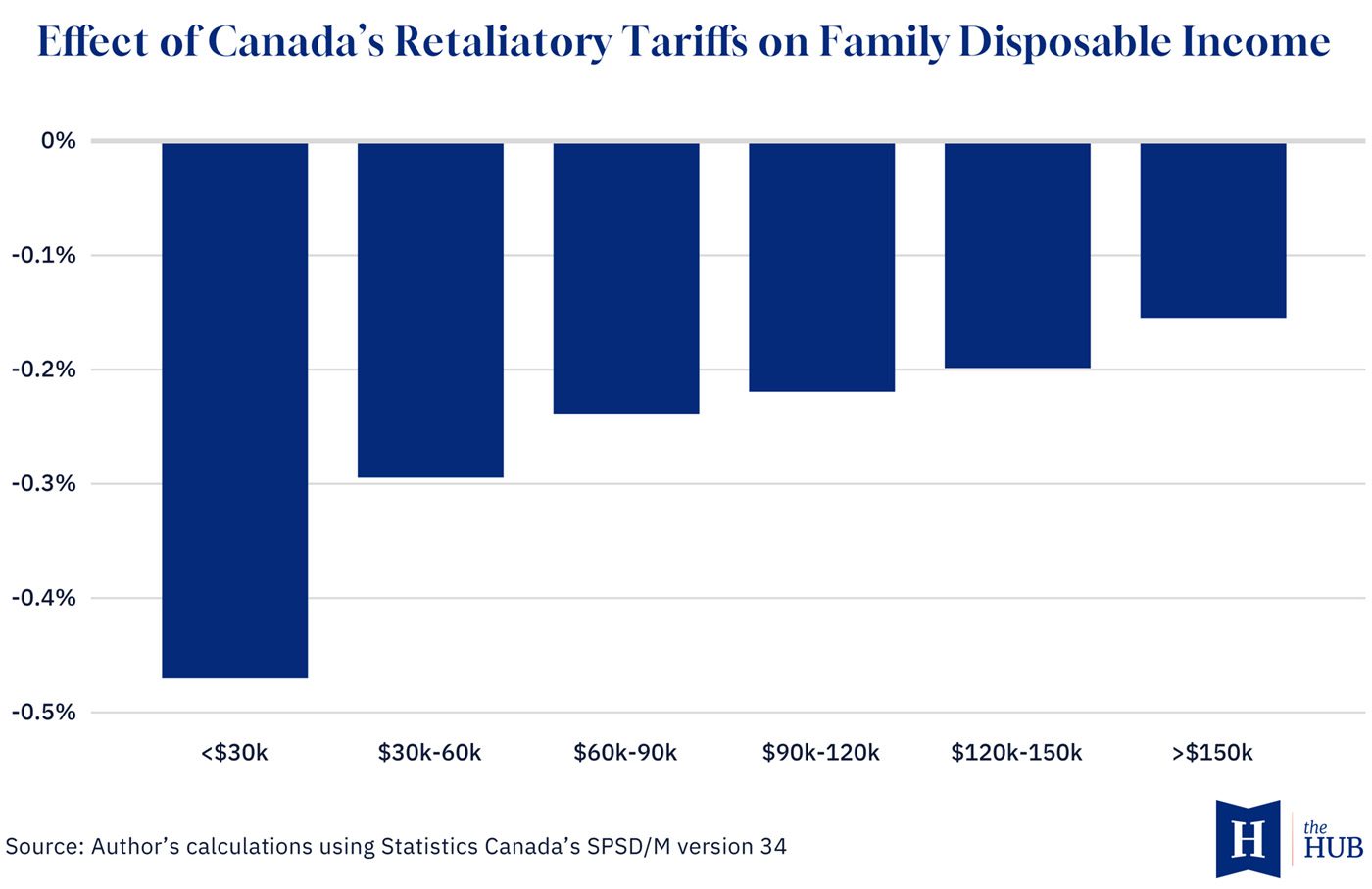
Graphic credit: Janice Nelson

Simply put, tariffs are a regressive tax, and this is part of why they are not an ideal way to raise revenue.

A cost worth paying?

All of this is true in the U.S. as well, of course. American tariffs harm American productivity and growth, and fall heavily on low- and middle-income Americans too.

None of this means retaliation is wrong, to be clear. I tend to think it’s unwise, despite its popularity, and we could instead focus our efforts on boosting Canadian economic competitiveness and growth at home. There’s a lot to do that we aren’t.

And even if there are good (non-economic) reasons to respond, the costs must be considered. They land on Canadian consumers and businesses, and are especially challenging for those least able to bear them.


Trevor Tombe is a professor of economics at the University of Calgary, the Director of Fiscal and Economic Policy at The School of Public Policy, a Senior Fellow at the Macdonald-Laurier Institute, and a Fellow at the Public Policy Forum.
Source: The Hub

Related Posts

The U.S.–Canada tariff war – When the elites fight, we all pay: Jamie Tronnes
North America

The U.S.–Canada tariff war – When the elites fight, we all pay: Jamie Tronnes

September 2, 2026
A trade treaty with the US isn’t much of a threat to Canada’s ‘sovereignty’: David Collins in City Law Forum
North America

A trade treaty with the US isn’t much of a threat to Canada’s ‘sovereignty’: David Collins in City Law Forum

September 2, 2026
How Trump kneecapped his own China policy with a 50% tariff on Canada: Anthony De Luca-Baratta in the Washington Examiner
North America

How Trump kneecapped his own China policy with a 50% tariff on Canada: Anthony De Luca-Baratta in the Washington Examiner

September 2, 2026

Newsletter Signup

  Thank you for Signing Up
  Please correct the marked field(s) below.
Email Address *
1,true,6,Contact Email,2
First Name *
1,true,1,First Name,2
Last Name *
1,true,1,Last Name,2
*Required Fields

Follow us on

Macdonald-Laurier Institute

323 Chapel Street, Suite #300
Ottawa, Ontario, K1N 7Z2 Canada

613.482.8327

info@macdonaldlaurier.ca
MLI directory

Support Us

Support the Macdonald-Laurier Institute to help ensure that Canada is one of the best governed countries in the world. Click below to learn more or become a sponsor.

Support Us

  • Inside Policy Magazine
  • Annual Reports
  • Jobs
  • Privacy Policy

© 2023 Macdonald-Laurier Institute. All Rights reserved.

This site uses cookies. By continuing to browse the site you are agreeing to our use of cookies.

Privacy Preference Center

Consent Management

Necessary

Advertising

Analytics

Other

No Result
View All Result
  • Home
  • About
    • Who We Are
    • Who Makes MLI Work
    • Fifteenth Anniversary
  • Experts
    • Experts Directory
    • In Memoriam
  • Issues
    • Domestic Policy
      • Economic Policy
      • Justice
      • Rights and Freedoms
      • Assisted Suicide (MAID)
      • Health Care
      • COVID-19
      • Gender Identity
      • Canada’s Political Tradition
      • AI, Technology and Innovation
      • Media and Telecoms
      • Housing
      • Immigration
      • Agriculture and Agri-Food
      • Competition Policy
    • Energy Policy
      • Energy
      • Environment
    • Foreign Policy
      • Israel-Hamas War
      • Ukraine
      • Taiwan
      • China
      • Europe and Russia
      • Indo-Pacific
      • Middle East and North Africa
      • North America
      • Foreign Interference
      • National Defence
      • National Security
      • Foreign Affairs
    • Indigenous Affairs
  • Projects
    • CNAPS (Center for North American Prosperity and Security)
    • The Promised Land
    • Dragon at the door
    • Justice Report Card
    • DisInfoWatch.org
    • Managing Indigenous Prosperity
    • Judicial Foundations
    • Landmark Cases Council
    • Closing Canada’s Border, Policing, and Legal Gaps
    • Reforming the University
    • Digital Policy & Connectivity
    • Defending The Marketplace of Ideas
    • Letter to a minister
    • Past Projects
      • The Great Energy Crisis
      • Canada on top of the world
      • Double Trouble
      • Canada and the Indo-Pacific Initiative
      • The Transatlantic Program
      • COVID Misery Index
      • Speak for Ourselves
      • The Eavesdropping Dragon: Huawei
      • Talkin’ in the Free World with Mariam Memarsadeghi
      • An Intellectual Property Strategy for Canada
      • Munk Senior Fellows
      • A Mandate for Canada
      • Confederation Series
      • Fiscal Reform
      • The Canadian Century project
      • Fixing Canadian health care
      • Internal trade
      • From a mandate for change
      • Size of government in Canada
      • Straight Talk
      • Labour Market Report
      • Leading Economic Indicator
      • Centre for Advancing Canada’s Interests Abroad
      • Indigenous Prosperity at a Crossroads
  • Events
    • Voices that Inspire: The Macdonald-Laurier Vancouver Speaker Series
    • Upcoming Events
    • Past Events
      • MLI Dinners
      • Great Canadian Debates
  • Latest News
  • Libraries
    • Columns
    • Commentary
    • Papers
    • Books
    • Video
  • Donate

© 2023 Macdonald-Laurier Institute. All Rights reserved.