
By Andrew Griffith, August 28, 2026
Becoming a Canadian citizen is more than completing a series of forms, tests, and administrative requirements. It is a moment of shared accomplishment and belonging — one that is diminished when the journey to citizenship increasingly happens alone, behind a screen.
In its quest to reduce costs, Immigration, Refugees and Citizenship Canada (IRCC) has increasingly shifted to online citizenship delivery, whether through online applications, citizenship ceremonies, online knowledge testing, and the proposed (but not yet implemented) online self-affirmation of the citizenship oath. In doing so, Canada risks losing something less tangible but no less important: the shared civic experience that turns legal status into a sense of belonging.
But online testing has brought another, more immediately troubling change: pass rates have risen sharply across most countries, raising questions about the integrity of the testing process.
The current knowledge test dates from the Harper government’s introduction of a new study guide, Discover Canada, in 2009 and the associated knowledge test questions. The questions were part of a larger pool, with specific questions changing from test to test.
In the wake of the new study guide, the minimum pass rate requirement rose from 60 per cent to 75 per cent. Subsequent Liberal governments largely keep the system intact, with the only substantive change being the move to online testing that started on a pilot basis during the COVID pandemic in November 2020 and became the default by 2024. (An interim measure that attempted to use videoconferencing during testing was abandoned after it was found to be “extremely resource intensive [… and it was] not sustainable to manage large volumes.”
There are a number of measures to minimize potential cheating — webcam monitoring, monitoring of other tabs, windows, or open programs, and the requirement to take the test alone. Furthermore, test questions are randomly generated from a large pool of questions.
Since neither the study guide nor the basic pass mark has changed, the move to online testing initially appeared to be the most obvious explanation for the increase in test pass rates. Online testing may simply be easier, less stressful and more convenient for applicants. It may also create new opportunities for cheating, despite measures such as webcam monitoring and restrictions on other tabs and programs.
But the timing suggests a more specific explanation. The online test was introduced during the COVID-19 pandemic, while the largest increases in pass rates occurred in 2024–25, after IRCC made the testing process more facilitative. The time available to complete the test was increased from 30 to 45 minutes, the number of attempts from two to three, and applicants were given a 30-day window to complete the test. IRCC describes these changes as measures to assist applicants who have difficulty meeting the knowledge requirements or who require additional time.
These changes may well have removed unnecessary barriers and made the test more accessible. But they also raise a question about whether the higher pass rates reflect greater accessibility, a less rigorous testing environment, or both. The question is particularly important because the largest increases occurred among family and protected-person classes, which had substantially lower pass rates than economic applicants in the preceding years.
IRCC has not publicly provided a comparative analysis showing how pass rates changed under the previous in-person system, following the introduction of online testing, and following the subsequent changes to the time and number of attempts. Nor has it disclosed a quality-assurance assessment of whether these changes have affected the reliability or integrity of the test. Without that analysis, it is impossible to know what is driving the sharp increase in pass rates.
Earlier studies indicated that lower language and education levels correlated with lower pass rates, which generally correlate with family and protected person classes.
Figure 1 examines the region of birth across four time periods:
- 2005–09, prior to the Harper government’s new study guide and other changes.
- 2010–14, when the new Harper study guide was in effect and testing was done in person.
- 2015–19 (During this period, the Harper government expanded knowledge and language proficiency testing to all applicants aged 14 to 64 years.. Previously, only applicants aged 18 to 55 took the tests. The Trudeau government later repealed the age change).
- 2020–25 (the period covering the COVID-19 pandemic, which saw testing shift online).
The high pass rates during the 2005–09 period reflect the Liberal government’s focus on facilitating citizenship. The Harper government’s created its new study guide and knowledge to correct what Prime Minister Stephen Harper considered to be overly easy citizenship requirements. The more complex content of Discover Canada and the related tougher knowledge test resulted in a sharp drop in pass rates across most regions that gradually recovered given the political fallout in many immigrant communities. The partial recovery in the 2015–19 period reflected the Harper government’s late corrections to the test to increase test pass rates, counterbalanced by increased testing of seniors (who as a group typically earned lower scores) until testing age was restored to 18 to 55 years.
The largest increases in the 2020–25 period occurred in 2024–25, the same period that IRCC provided more time and more retries for the test.
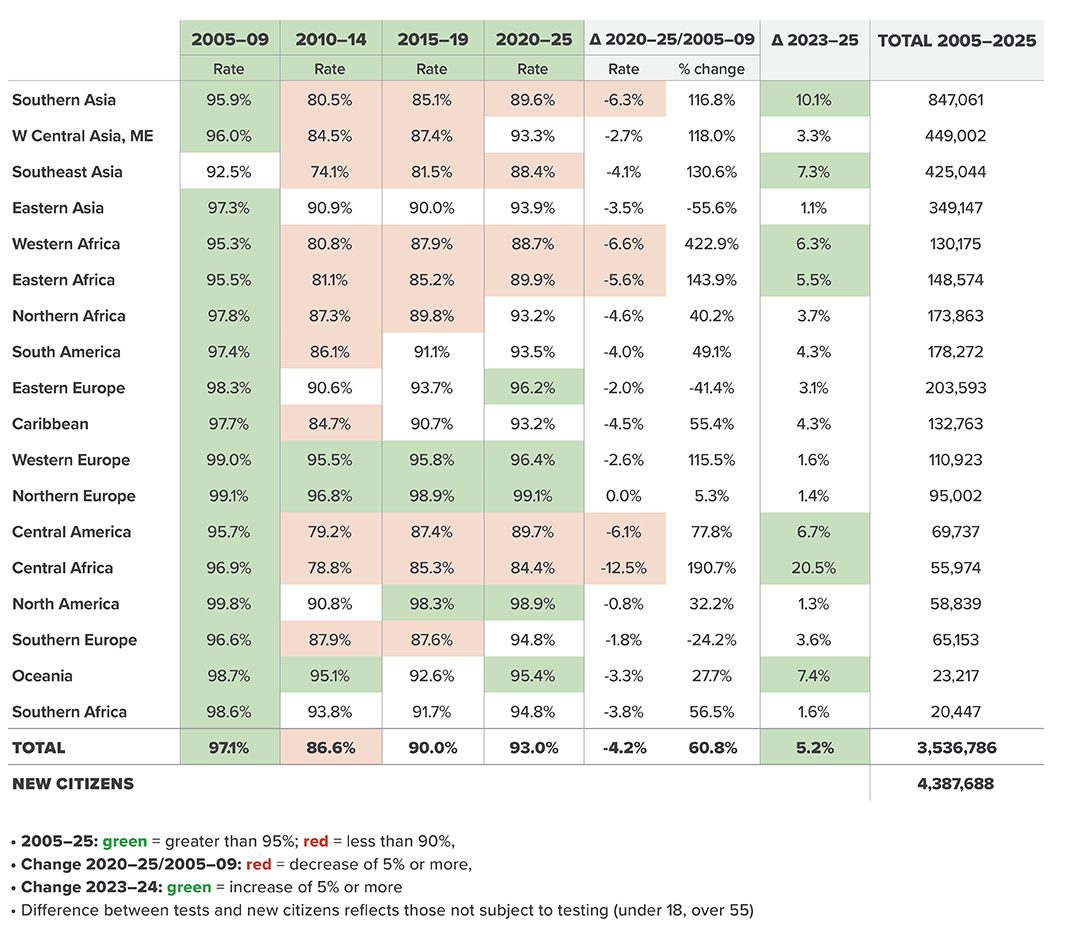
Figure 2 provides the country-level view for the same periods for the top 15 countries, showing the same general pattern. The only countries that experienced a decrease in pass rates were Syria and Iraq.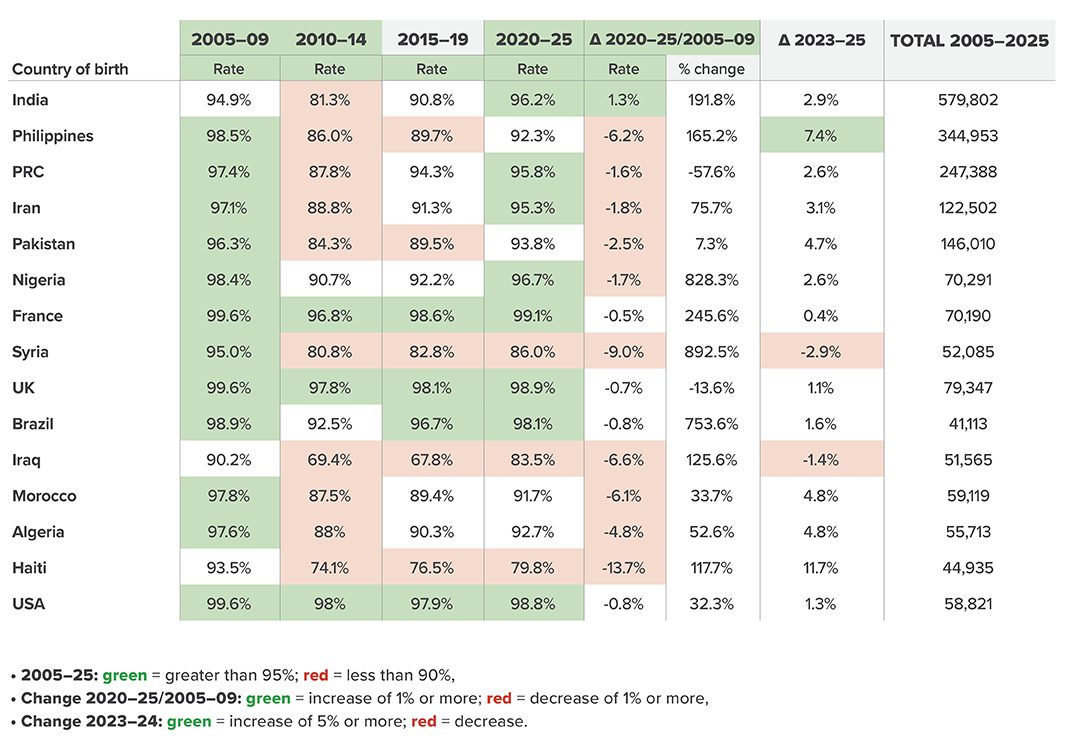
Figure 3 contrasts pass rates by immigration category and class over the past 10 years.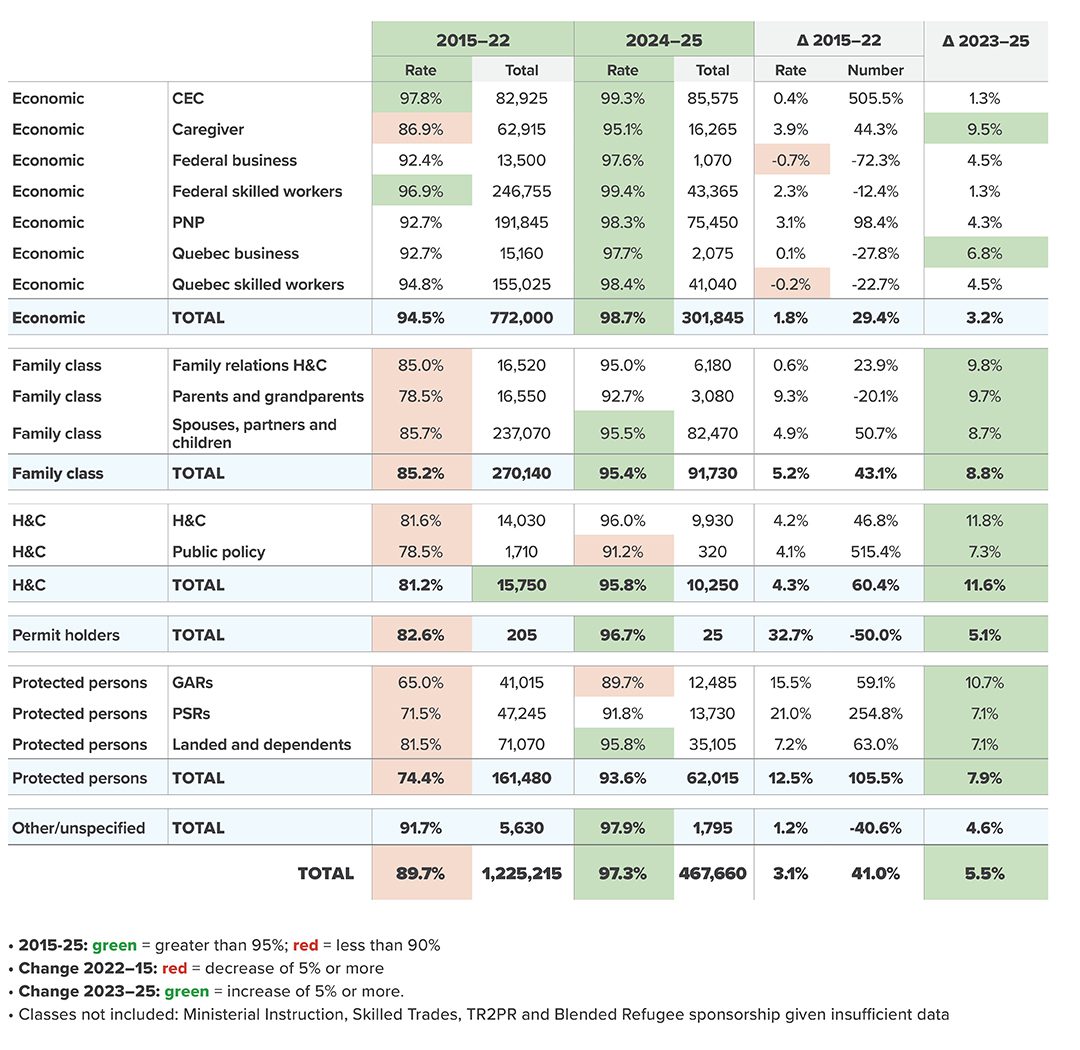
The economic category had higher test pass rates during this period compared to other categories, reflecting strong language fluency and higher education levels. The shift to online testing in 2024–25 had the greatest impact in the non-economic categories, with significant increases in virtually all classes. Only the caregivers economic class and Quebec business classes had comparatively high increases.
Conclusion
Citizenship test pass rates, and by extension, citizenship take-up, reflect policy changes at both the policy and operational levels, including the shift to online elements.
While most of the variations in test pass rates can be explained by policy changes or events, the significant increase between 2024 and 2025 coincided with a period in which online testing had become the default and IRCC had made the test more facilitative, including by increasing the time and number of attempts. The increase was particularly pronounced among family and protected-person applicants, who had lower pass rates than economic applicants in the preceding years.
However, once the pandemic was largely over and IRCC could resume in-person services, it nevertheless continued to favour online delivery. That may make sense for administrative tasks such as applications, but it is harder to justify when the change affects the integrity of a test. The sharp increase in pass rates among family and protected person applicants after online tests became the default is not, but itself, proof of cheating. But it is significant enough to demand an explanation — and IRCC has not provided one. Without comparative testing data or quality assurance assessment, there is no way to know whether the higher pass rates reflect a more accessible test, a less rigorous testing environment, or new chances to cheat.
This matters because the citizenship test is not simply another administrative hurdle. It’s meant to establish that applicants understand the country they are joining, and is an important part of the journey to becoming Canadian. IRCC needs to review its online testing system and fix any weaknesses that compromise its integrity. Canadian citizenship means more when applicants have proven that they earned it.
Andrew Griffith is a former director general of Citizenship and Multiculturalism, Immigration, Refugees and Citizenship Canada, and a fellow at the Environics Institute. The author of “Because it’s 2015…” Implementing Diversity and Inclusion, Canadian Multiculturalism: Evidence and Anecdote, and Policy Arrogance or Innocent Bias: Resetting Citizenship and Multiculturalism, Griffith blogs at Multiculturalism Meanderings.