By Avideh Motmaen-Far, July 8, 2026
US President Donald Trump signed a ceasefire with Iran in June — a bargain struck with the regime at the moment it was weakest, in exchange for promises it had every reason to break. The fact that the ceasefire has not held, and according to Trump, may now be over, is further proof of the folly of trying to negotiate with the Islamist Iranian regime.
And yet, the premise behind the earlier ceasefire deal — that engagement with Tehran costs nothing — has now surfaced in Ottawa as a suggestion that Canada reopen its embassy in Iran. On seventy years of evidence, it should not.
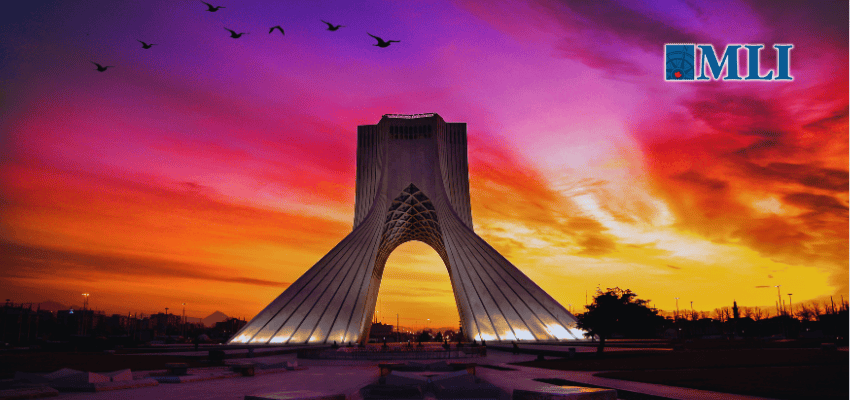
The Islamic Republic is mounting the largest exercise in manufactured legitimacy in its history — a six-day imperial funeral for Ali Khamenei, killed in the February 28 strike that opened the war, his body held in cold storage for four months until the safest, most useful week arrived — the first since the war began in which a ceasefire made such a spectacle possible to stage at all. The procession runs from Tehran through Qom, Najaf, and Karbala to burial at Mashhad on July 9, with the state projecting 15 to 20 million mourners. Scale is the message. The world is meant to look at the crowd and conclude that the regime is permanent, popular, and worth doing business with.
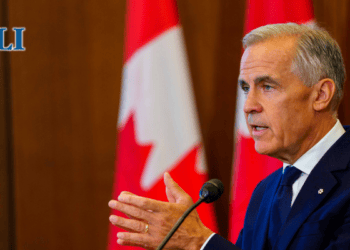
Meanwhile, in Ottawa, Prime Minister Mark Carney mused on June 25 that having no official embassy in Tehran places Canada “at a disadvantage” (the embassy closed in 2012). “Engagement is not endorsement,” he said. “Having an embassy, having consular services in a country, does not mean we endorse the policies of that country.” His own foreign ministry contradicted him within a day, and he retreated to “I’m making a general point.” He should hope the retreat holds — because the funeral is the live rebuttal to his premise, and so is the entire history of Canada’s dealings with this regime.
A coronation the heir cannot attend
Look first at what the spectacle is designed to obscure. The funeral is not a mourning; it is a coronation for a successor who cannot appear at his own father’s graveside. Mojtaba Khamenei was installed in March under pressure from the Islamic Revolutionary Guard Corps (IRGC), wounded in the same strike that killed his father, and has not been seen or heard since. An heir anointed in secret, himself wounded and unseen since, carries a legitimacy deficit that deepens with every silent week. So, the state substitutes spectacle for substance: it cannot show you the leader, so it shows you the crowd.
And the crowd is coerced. Iran International and others have documented the machinery — workplace orders driving municipal and auto workers to the route, Basij enforcers threatening to seal shops that stay open, charities warned their permits depend on producing bodies, a leaked Tehran municipality recording instructing staff to attend regardless of young children or medical conditions. The figure, engineered to beat the roughly 10 million at Khomeini’s 1989 funeral, is not a measure of grief. It is a quota filled by intimidation.
Ironically, this entire spectacle is only made possible thanks to the foolhardy ceasefire agreed to earlier by the United States. You cannot parade 20 million people through five cities while the bombs are still falling; the ceasefire is what makes it safe. And the ceasefire was purchased at a ruinous price — a reported $300-billion reconstruction plan, the removal of “all types” of sanctions, an acknowledged right to enrich uranium, and permission to keep building missiles. Iran reclosed the Strait of Hormuz on June 20, three days after signing, and now floats a permanent tolling regime on the world’s most important energy chokepoint. The regime pockets the concession and reneges on the obligation. That is the counterparty Prime Minister Carney would hand a flag and a consular section in Ottawa.
What the record shows
“Engagement is not endorsement” is a serviceable principle in ordinary diplomacy. The trouble is that our history with Tehran is neither ordinary nor ambiguous. For seventy years, nearly every time Canada has extended a hand, this regime — or the revolution that produced it — has answered with a corpse or a hostage.
Canada and Iran opened relations in the 1950s, in the era of cordial ties under the monarchy, and the Canadian mission in Tehran grew into a full embassy. That chapter ended in the revolution. When Islamist militants seized the US embassy in November 1979, Canada’s ambassador Ken Taylor and his colleague John Sheardown hid six American diplomats in their homes for weeks and spirited them out on Canadian passports in January 1980 — the celebrated “Canadian Caper.” Their very next act was to shut our own embassy and evacuate our people, for fear of the regime’s retribution. Reflect on that: the last time Canada operated freely in Tehran, our diplomats were fleeing for their lives from the same government Ottawa now muses about rejoining.
What followed only sharpened the lesson. Ties were frozen through the 1980s, restored only at a low chargé level in 1988, and never made truly normal — Ottawa had to govern them under a policy it openly called “Controlled Engagement.” The last formal attempt to upgrade to a full exchange of ambassadors, in 2007, collapsed when Canada rejected Tehran’s nominees over their suspected roles in the 1979 embassy seizure and Iran refused to accredit Canada’s in return.
Then came the proof that controlled engagement controls nothing. In 2003, Iranian-Canadian photojournalist Zahra Kazemi was arrested in Tehran, tortured and beaten to death in custody; the regime staged a sham inquiry and shielded her killers. In 2012, Foreign Minister John Baird finally closed the embassy and expelled Iran’s diplomats. In January 2020, the Revolutionary Guard shot Flight PS752 out of the sky, murdering 176 people — among them 55 Canadian citizens and 30 permanent residents — then lied for days and has never delivered accountability. Canada listed the IRGC as a terrorist entity in 2024; Tehran replied in December 2025 by designating the Royal Canadian Navy a terrorist organization.
Now weigh the prime minister’s core claim — that an embassy is needed to protect Canadians. The record refutes it twice over. When Canada did have full relations and a working mission, they did not save Zahra Kazemi. And when Canada had no embassy at all, it still brought its people home. Hamid Ghassemi-Shall, a Canadian citizen from Toronto sentenced to death on a fabricated espionage charge, was freed in 2013 and returned home — after the embassy had already closed, and even though Tehran denied him consular access throughout his ordeal. Saeed Malekpour, a Canadian permanent resident tortured in Evin and once sentenced to death, made it back to British Columbia in 2019, his status swiftly reinstated by a government that had no diplomatic presence in Iran whatsoever. What an embassy has never done is deter this regime from seizing Canadians in the first place: in late January 2018 it arrested Professor Kavous Seyed-Emami — a Canadian citizen and renowned conservationist — and roughly two weeks later announced he had hanged himself in Evin, a death no independent investigator was ever permitted to examine. Presence did not protect him. It would only have given his jailers a consulate to lie to.
And consider the sentence itself. “Having an embassy … does not mean we endorse the policies of that country” is precisely wrong about what an embassy is. An embassy is not a courtesy desk; it is a compound of accredited personnel cloaked in diplomatic immunity — shielded from search, arrest, and prosecution on the host country’s soil. That is no abstraction with this regime. Iranian-Canadians overwhelmingly oppose reopening the mission for one reason: they regard the Islamic Republic’s embassies abroad as extensions of its intelligence and influence operations, used to monitor dissidents and project the regime’s reach into the diaspora. Canada’s own spy service has warned that Iran keeps targeting its perceived enemies on Canadian soil — and in late 2025 disclosed that it had disrupted several plots to kill them. Reopening an embassy would not close that threat; it would credential it, handing immunity to the very operatives the regime would send to run it. When the two countries most recently moved toward restoring full missions, in 2016–17, it was Ottawa that walked away, shelving the plan after Professor Seyed-Emami turned up dead in Evin. That instinct was sound. It should be made permanent.
That is the ledger. It is not a record of missed diplomatic opportunities; it is a record of a regime that treats every Canadian overture as a weakness to exploit and every Canadian within its reach as a bargaining chip. An embassy in Tehran would not be a neutral listening post. It would be a propaganda trophy for a state that has just spent four months manufacturing a crowd precisely so that foreign governments will send delegations and lend it the legitimacy it cannot generate at home. The consular “advantage” Mr. Carney invokes runs the other way: a diplomatic presence expands the regime’s supply of hostages, not Canada’s leverage.
Where Canada comes in
The prudent course is the one Global Affairs reflexively defended over its own prime minister — and it deserves to be stated as principle, not walked-back gaffe. Canada should keep the embassy closed and say plainly why: any restoration of a diplomatic presence must be conditioned on concrete, verifiable steps — full accountability for Flight PS752, the release of detained dual nationals and an end to hostage-taking, and a halt to the transnational repression this regime directs against Iranian-Canadians in Toronto, Vancouver, and Montreal.
Ottawa should then go further in the direction its own instincts already point. Enforce the IRGC listing rather than treat it as a bargaining token. Expand Magnitsky-style sanctions on the very officials orchestrating this week’s coercion — the commanders and functionaries marching mourners to a graveside under threat. Refuse to lend Canada’s name, or its banks, to any Western bargain that refinances the IRGC while Iran’s prisons stay full. And amplify the voices of one of the world’s largest Iranian diasporas, who can say precisely what “engagement” with this regime has cost their families.
The funeral in Tehran and the musing in Ottawa are two versions of the same mistake — the belief that presence is neutral, that a handshake commits us to nothing. The regime knows better: it has built a six-day spectacle for the express purpose of converting the world’s engagement into its own endorsement, and it is counting on Ottawa to oblige. The last time Canada operated in Tehran, Ken Taylor locked the embassy door behind him and slipped his people out of a hostile country in disguise. Zahra Kazemi, Kavous Seyed-Emami, and the 176 souls aboard Flight PS752 are the reasons that door should stay shut. We do not need a mission in Tehran to protect Canadians from this regime. We need only remember what it has already done to them.
Avideh Motmaen-Far is president of the Council of Iranian Canadians and a writer and commentator on Iranian affairs and human rights.