By Matthew Downey, June 12, 2026
If there is a lesson to be learned from the ongoing “51st state” debacle plaguing US–Canada relations, it is that Canada needs to strengthen its identity in its own right. As the country grapples with issues of national unity and reassesses the nature and effects of its integrated relationship with the United States, titular honours could promote a distinctly Canadian meritocratic vision on the world stage. In an increasingly chaotic international environment, with Canada’s leaders speaking more fervently about the need to advance a strong image abroad, the time is right to revisit the question of Canadian titles.
Canada’s culture of honours
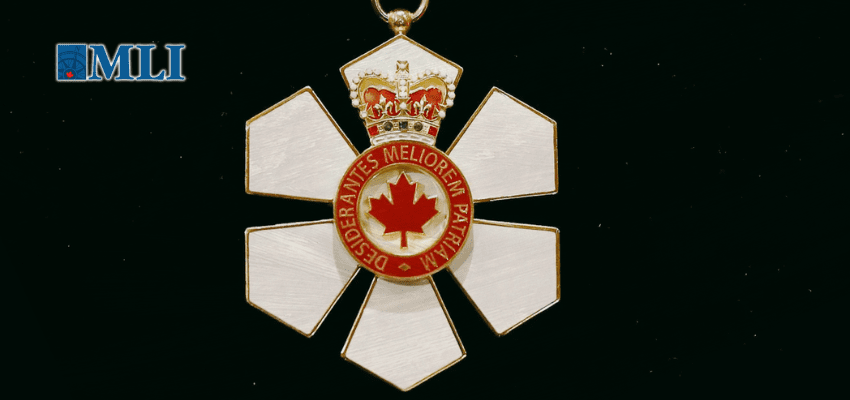
One might assume that the Order of Canada, created to mark the centenary of Confederation, has replaced the need for foreign honours. However, Canadians, in fact, continue to be awarded foreign honours (albeit none that carry titles). Government policy only disallows honours that carry titles. Rather than negating the prestige of such awards, it only makes them less visible. A Companion of the Order of Canada is not even the highest ranked civilian honour in the country’s order of precedence. That would be the British Order of Merit (OM), which is a personal gift from the British monarch. There is a limit of 24 living members of this order, and there have only been three Canadian prime ministers to have been appointed an OM. The list is incredibly ironic: William Lyon Mackenzie King, who halted the recommendation of honorific titles; Lester Pearson, who oversaw the creation of the Order of Canada (and the replacement of the Union Flag); and Jean Chrétien, who denied businessman Conrad Black the ability to maintain Canadian citizenship and accept a non-hereditary life peerage.
There is indeed a selective application of the claim that foreign honours and honorific titles have no natural place in Canada. The title “Right Honourable,” for instance, maintains a significant place in Canadian political society. This may be contrasted with the United States, with its republican insistence on the banishment of honorifics such that even the President is only allowed the prefix “Mr.” Not that this is something to be emulated. The American attitude over prenominal titles has led to some absurd public debates, such as the right of academic PhDs to the title “Dr.” Considering Canada’s image abroad, an assumed progression towards the eradication of traditional honours is not necessarily a dignified look. It was perhaps an overly casual disregard for etiquette that inspired former Prime Minister Justin Trudeau to sport over-the-top running shoes while attending King Charles’ speech from the throne in 2025. The BBC sardonically attributed the outfit to the country’s “relaxed” nature. If Canada is to be taken seriously abroad, it must exhibit its success in a way that asserts a dignified respectability.
The introduction of nonhereditary titular honours to the Order of Canada would enhance the promotion of meritocracy in Canada. This change would provide an opportunity to improve the appointment process of the Order, addressing some of the criticisms that have been levelled against it over the past decades (as discussed in the final section of this article). A revamped system of titular honours would celebrate merit, recognizing achievements in a way that uses the social visibility of prenominal titles to communicate the higher non-material value of contributing great things to the country.
Rather than representing the creation of an archaic class of elites, it would represent the extension of Canada’s existent honours system to give greater visibility to achievements in service of the country. Its independent nomination and appointment process would be a far cry from the patronage titles of the Nickle Resolution’s era. The extension of titular honours to include achievement in a variety of cultural and social spheres could prove a powerful signifier of contributions to the betterment of Canada.
This could be done so in a way that recognizes and incorporates the multiplicity of cultural identities within Canada. Far from an imposition of a Eurocentric elitist system of honours, titular honours within the context of the Order of Canada would prioritize the advancement of meritocracy regardless of class, culture, or religion. It would do away with the artificial and fallacious notion that honorifics have no place in Canadian society. This could open up the acknowledgement and incorporation of Indigenous honours within Canada’s honours system.
The Nickle Resolution and Canada’s mixed historical experience with titles
Canada used to recognize its best and brightest with titles. Scientists like Frederick Banting, composers like Ernest Macmillan, and historians like Thomas Chapais all received knighthoods in a nonpartisan recognition of their achievements in service of their country. This is no longer the case. As Canada gradually distanced itself from Britain during the 20th century, the view took hold that knighthoods and damehoods were at odds with the country’s democratic egalitarian nature. Supporters of this interpretation frequently point to the 1919 Nickle Resolution, portraying it as the beginning of a back-and-forth process that eventually saw Parliament’s rejection of archaic symbols of prestige, whether hereditary or not.
However, that’s not quite accurate. The men mentioned above each received the prefix “Sir” more than a decade after the passing of the Nickle Resolution. Indeed, the last time Parliament voted on retaining titles, in 1934, it passed with hearty support.
It’s important to note that the Nickle Resolution, introduced in Parliament in 1917 and passed in 1919, reflected its era. Context is key in understanding the historical circumstance of its passing, and its dubious role as a policy precedent.
Between 1917–19, Canada and its allies experienced the worst horrors of the Great War. Following the Armistice, the British Empire was wracked by mass unrest, turbulent nationalism, and cynical corruption throughout the Dominions and colonies. In Canada, frustration with the imperial administration began to boil over, even among conservatives; dissatisfaction exploded into violence during events like the 1918 Quebec Conscription Riots and the 1919 Winnipeg General Strike.
During this period, everyday Canadians grew frustrated by the clear class divides and corruption associated with honours and titles. The list of knighthoods and peerages given to Canadians was dominated by businessmen like Bank of Montreal president Vincent Meredith, Conservative fundraiser Hugh Graham, and London-based newspaper baron Max Aitken. Graham, made Lord Atholstan, was anti-union in a time of intense labour agitation. He, along with the pro-conscription Cabinet minister Sam Hughes, are two glaring examples of the out-of-touch nature of the honours system at the time.
As for the Nickle Resolution, it was introduced by William Nickle, a Conservative (albeit with socialist sympathies) MP who had unsuccessfully sought out a patronage title for his father-in-law, the president of Queen’s University. Whatever his particular motivations, the resolution reflected the reality at the time, which was characterized by a surge of national feeling and a prevalent cynicism toward elite corruption.
However, the Nickle Resolution itself should not be held up as a universal political/cultural precedent for the Canadian rejection of titles. Explicitly, the Nickle Resolution only stipulated that Canadians not be granted non-hereditary titles without the prime minister’s consent. Whether for ideological or pragmatic reasons, prime ministers have the ability to veto titles. For instance, during the 1930–35 government of R.B Bennett, the prime minister simply decided to unilaterally reintroduce titles.
After a committee drew up a list of nonpartisan appointees, Bennett presented the list to King George V. Outraged, Liberal MPs introduced a binding parliamentary motion that would ban the prime minister from requesting titular honours. It failed – and this was the last time the question was ever voted on by Parliament. Once Mackenzie King became prime minister, he simply defaulted to the previous practice of not requesting titles.
The comparative Commonwealth context – New Zealand and Australia
Few Canadians today realize that some of their fellow citizens actually do carry titles – they just don’t always flaunt them publicly. For instance, Canada’s richest family, the Thomsons, have been hereditary peers in the United Kingdom since the 1970s, but don’t use their titles in Canada.
Meanwhile, more than 8,700 people have been invested into the Order of Canada. While meant to be a nonpartisan honour, critics have complained that the Order of Canada’s membership has a distinctly elitist Laurentian lean, politically, socially, and culturally. As a distinct system of national honours, it has, however, served as a model for similar systems in its fellow Commonwealth countries.
In 1996, New Zealand created the New Zealand Order of Merit, which included unique knighthoods and damehoods. Around 36 titles were conferred between 1996 and 2000 before the newly elected Labour government halted the practice, calling it out of step with modern New Zealand society. That remained the status quo for around a decade, until John Key’s National government reintroduced the titles in 2009. With the change, title-less members – which included academics, athletes, and activists – were given the option of accepting knighthoods and damehoods. New Zealand has maintained titular honours ever since, even under successive Labour governments. Even former Labour Prime Minister Jacinda Ardern, a republican, accepted a Damehood herself in 2024.
In Australia, the government established the Order of Australia in 1975, with titles being granted from 1976. In 1986, titles were halted, only to be reintroduced in 2014. However, in 2015, controversy erupted after Great Britain’s Prince Philip was given an Australian knighthood. Many Australians, who were already largely hesitant about the reintroduction of titles, felt that the honours should be strictly for Australians. The backlash led to an end of the practice later that year.
Australia’s backlash was partially fuelled by the country’s widespread support for republicanism. Many Australians also connected the honours system with the Abbott government, which was highly unpopular at the time.
Tony Abbott certainly made mistakes when he reintroduced titular honours, including awarding them to the country’s elite rather than making sure they were representative of high achievers of all walks of Australian life. For many everyday Australians, awarding a knighthood to Prince Philip, the Prince Consort, smacked of imperial nostalgia. It hardly convinced anyone of its value as a way to assert Australian identity and achievement.
Abbott faced low approval during his short tenure as prime minister, which further tarnished the honours system. In contrast, New Zealand’s Prime Minister John Key was riding high in the polls when he reintroduced titular honours, and recipients seemed to better reflect all of New Zealand society.
Canada should follow New Zealand’s example. There, the reinstitution of titles was executed in a way that extended its honours to people of various classes, political leanings, and cultures. It has, as such, been embraced by republicans; it is a symbol of national identity that nevertheless tethers that identity to history. For Canada, the conversation around titular honours should not pit republicans versus monarchists. Rather, it should emphasize the uniting potential of the bold acclamation of great Canadians according to their achievements, not their demography.
Rejecting diffidence, embracing boldness
Critics will undoubtedly claim that titular honours are archaic symbols of Canada’s colonial past, and antithetical to reconciliation. However, Canada’s Indigenous peoples in fact have a long history of using various forms of honorific titles. It was colonialism that sought to stamp out the traditional titles and authority of hereditary chiefs and elders and replace it via the Indian Act with today’s current “elected chief and council” system. In the ongoing Indigenous renaissance, First Nations have reclaimed titles such as Chief and Elder. Under a new Canadian titles system, Indigenous peoples here could be honoured as New Zealand has honoured Māori leaders with knighthoods and damehoods in ceremonies adapted to their Indigenous culture and held in local communities. The expansion of the Order of Canada to include the ranks of Knight/Dame Companion and Knight/Dame Grand Companion can go hand in hand with the social embracing of Indigenous cultures of honours.
The institution of titular honours within the Order of Canada would provide the opportunity for reforming the appointment process in order to address public criticism and remove all doubt as to the meritocratic and nonpartisan nature of the honour. This could include reforming the membership of the Advisory Council, which reviews nominated individuals and recommends appointees to the Governor General.
At the very least, any optics of politicization and bias must be addressed. As things stand, the Advisory Council consists of six permanent members, including the Chief Justice of the Supreme Court, Clerk of the Privy Council, and Deputy Minister of Canadian Heritage. In addition, there are seven additional non-permanent council members appointed by the Governor General. In balancing out this membership, representatives of each provincial government could be included in the Council. Such an action would ensure the Order’s role as a uniting cultural force in a time of increased inter-regional tensions.
At a time when the United States under the Trump administration is mocking its northern neighbour as the 51st state, and calling its prime minister “governor,” reviving the use of titles would be a highly visible way of elevating and celebrating Canadian sovereignty and its belief in meritocracy. Change is possible – for instance, Canada instituted the prefix “Royal” for its Navy and Air Force after removing it between 1968 and 2011 in favour of the bland terms “Maritime Command” and “Air Command.” Bold action is needed in promoting a unifying, nonpolitical system of celebrating Canadian achievement in a way that is visible and accountable both domestically and internationally. The extension of titular honours within the Order of Canada represents an opportunity to instill cultural confidence while advancing a dignified image abroad.
Matthew Downey is an historian based in Victoria, British Columbia.