
By Jon Hartley
May 20, 2026
For those who care about the cost of living, competition and antitrust policy matters. Competition is ultimately what helps keep prices near marginal cost and prevents firms from charging exorbitant mark-ups. This applies very much to digital markets as well.
Artificial intelligence and digital platforms are quickly becoming foundational to modern economic growth, shaping everything from productivity and business formation to how consumers access information and services. These technologies are already reshaping global competition, determining where investment flows, where companies scale, and which countries emerge as innovation leaders.
For governments, this growing importance alongside rapid change has created a genuine policy dilemma. While these technologies raise legitimate concerns around market power, data control, and fairness, they also offer enormous potential to drive innovation, boost competitiveness, and unlock new industries. While overly aggressive or poorly designed regulation risks driving talent, capital, and innovation elsewhere, inaction could allow real harms around market power and accountability to grow.
In the past year, governments across advanced economies have begun experimenting with sweeping new rules for generative AI and digital platforms. In the United States, several state legislatures have proposed laws that would place heavy compliance burdens on AI developers. Meanwhile, Canada is moving forward with major reforms to the Competition Act that would significantly expand the powers of regulators to intervene in digital markets (see Macdonald-Laurier Institute publications such as Niblett 2023, Wudrick and Rinehart 2023, Wudrick 2024, and Collins 2024). This is all while Canada and much of Western Europe have experienced relatively weak GDP per capita growth since the global financial crisis, especially when compared to the United States, where productivity growth and firm dynamism have remained stronger (Cette, Fernald, and Mojon 2016; Gordon 2017; De Ridder 2024).
These progressive efforts share a common motivation: concern that large technology firms have become too powerful.
But before Canada rushes to adopt a more aggressive regulatory framework, policymakers should look carefully at Europe’s experience. Over the past several years, European governments have implemented the most ambitious technology regulation anywhere in the world. The European Union’s Digital Markets Act (DMA) (which imposes pre-emptive behavioural restrictions on large “gatekeeper” digital platforms such as app stores, search engines, and operating systems) and the United Kingdom’s Digital Markets, Competition and Consumers Act (DMCC) (which allows regulators to designate firms with “strategic market status” and impose binding conduct requirements on them in advance) represent sweeping attempts to redesign how digital markets operate (European Union 2022; United Kingdom 2024).
Their goal is to increase competition by limiting the influence of large technology firms.
Yet these policies rest on a view of competition that risks undermining innovation, discouraging investment, and weakening the very digital ecosystem they aim to improve. As Canada debates its own digital competition policy, Europe’s approach should serve less as a model than as a warning.
The rise of “ex-ante” regulation
Traditional competition policy operates after the fact. Regulators intervene when there is clear evidence that a firm has abused market power through conduct such as collusion, predatory pricing, or exclusionary practices. This approach (rooted in decades of economic analysis and experience) focuses on demonstrable harm to consumers.
Early stage technologies, particularly general-purpose technologies like artificial intelligence, tend to generate the greatest long-run benefits when experimentation is relatively unconstrained (Bresnahan and Trajtenberg 1995; Aghion et al. 2019). Ultimately, generative AI is least dangerous when it is initially developed in its infancy.
The Digital Markets Act departs sharply from that model. Rather than investigating specific anti-competitive conduct, the DMA designates certain large technology firms as “gatekeepers” based primarily on their size and market reach. Once designated, these firms must comply with an extensive list of behavioural obligations and prohibitions regardless of whether their conduct has harmed consumers.
The United Kingdom’s DMCC takes a similar approach.
This shift toward pre-emptive regulation represents a fundamental change in how competition policy works. Instead of responding to proven market failures, regulators assume that scale itself creates risks that must be managed through ongoing oversight.
A large body of economic research emphasizes that market concentration in innovation-intensive industries can reflect efficiency rather than harm, particularly in the presence of scale economies and network effects (Demsetz 1973; Peltzman 1977; Autor et al. 2020; Aghion et al. 2005). In such settings, static measures of market power can be poor guides to welfare.
Many digital markets exhibit strong network effects and economies of scale. Large platforms often emerge because they deliver significant value to users, such as integrated ecosystems, lower prices, and continuous innovation. Regulating them primarily for being large risks punishing success rather than correcting genuine market failures.
The innovation trade-off
A central weakness of the European approach is that it underestimates the dynamic nature of technology markets. Europe’s relative underperformance in digital innovation is well documented. Compared to the United States, Europe has produced fewer large-scale technology firms and attracted less venture capital in frontier sectors such as artificial intelligence and cloud computing. Some researchers attribute part of this gap to regulatory fragmentation and heavier compliance burdens.
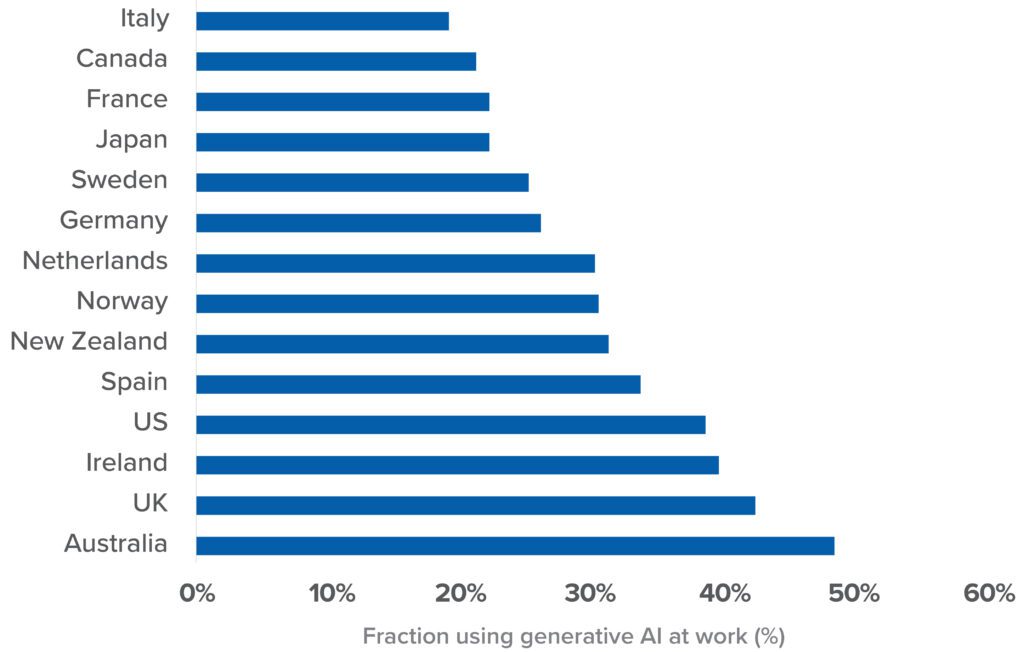
Figure 1: Share of labour force using generative AI at work across countries.Source: Hartley, Jolevski, Melo, and Moore 2025
Competition in digital industries rarely revolves around static price competition. Firms compete through innovation: developing new products, improving services, and building ecosystems that attract users and developers.
The possibility of achieving large scale and global reach is often what justifies the enormous investments required to build these technologies.
When regulation limits how platforms can integrate services, combine data, or expand into new markets, it can reduce the expected returns to innovation and deter entry. Why is it the case that most large technology companies, including all the major generative AI foundation model companies (OpenAI, Anthropic, Google), exist in the US? This likely reflects long-standing, strong property rights and low/reasonable tax regimes. To be sure, the one exception in European generative AI upstarts is Mistral AI, which is headquartered in France – though many of its employees are also located in the US, London, Palo Alto, and Singapore in addition to Paris.
To this already overburdened environment, having stringent employment protection laws certainly doesn’t help and there could be much more in the way of European tech investment if it weren’t for overbearing regulation.
Several provisions of the DMA, for example, require designated firms to open key platform infrastructure to competitors and restrict how they combine services across their ecosystems. These measures are intended to encourage competition, but they may also weaken incentives for companies to develop integrated digital services in the first place.
The result could be slower technological progress, fewer product improvements, and reduced incentives for large-scale investment.
This concern is especially relevant for artificial intelligence. AI development requires enormous capital investment, computing infrastructure, and access to large datasets. Policies that restrict integration across platforms or impose heavy compliance burdens may inadvertently discourage precisely the kinds of investments needed to push the technology forward.
Regulatory uncertainty and investment
Another consequence of Europe’s approach is increased regulatory uncertainty. Under the DMA and DMCC, regulators have broad discretion to determine what constitutes acceptable behaviour. Companies must engage in ongoing negotiations with regulators over compliance requirements, interoperability mandates, and data-sharing rules.
This creates a difficult environment for long-term investment decisions. Firms may hesitate to launch new products or business models if regulatory approval becomes unpredictable or subject to constant revision. Over time, this uncertainty risks pushing innovation elsewhere. Venture capital, start-up formation, and advanced technology development tend to cluster in regions where regulatory frameworks are stable and predictable. If Europe’s regulatory environment becomes too burdensome, investment may simply shift toward jurisdictions that offer clearer rules and greater flexibility. Canada should take care not to replicate those conditions.
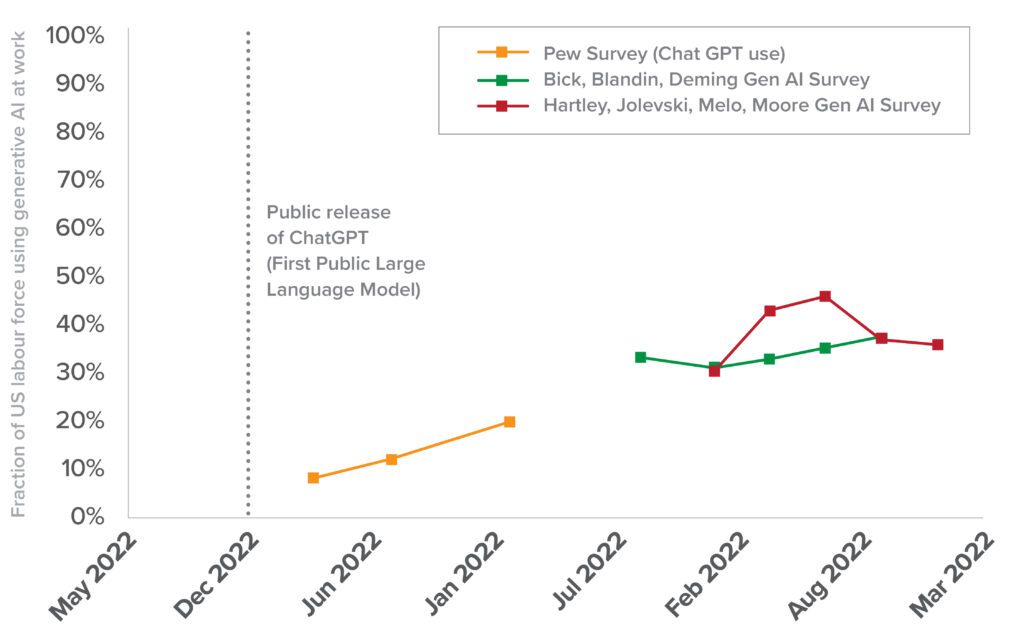
Source: Hartley, Jolevski, Melo, and Moore 2025
The risk of regulatory capture
There is also a less obvious risk: complex regulatory regimes can end up favouring the very firms they were designed to constrain (the Big Tech firms). Large companies typically have extensive legal teams and regulatory expertise. They can build a regulatory moat and they are better equipped to navigate complicated compliance regimes than smaller competitors. Start-ups and new entrants, by contrast, often lack the resources needed to deal with complex regulatory obligations (OECD 2019).
In this way, regulation intended to promote competition can unintentionally create barriers to entry. Similar dynamics have appeared in other industries where fixed compliance costs disproportionately affect smaller firms. If digital regulation becomes overly complex, it may reinforce the dominance of existing players rather than challenge it.
Canada’s policy crossroads
Canada now faces its own debate about how aggressively to regulate digital markets. Recent amendments to the Competition Act have already expanded the powers of competition authorities, and further reforms are under discussion. In that debate, European regulatory models will inevitably loom large.
But Canada’s economic circumstances differ significantly from those of the European Union. Canada relies heavily on attracting foreign investment and integrating into global technology markets. Its domestic technology sector is growing rapidly but remains smaller than those in the United States or China. Policies that discourage investment or experimentation could therefore have outsized consequences.
Historically, countries benefit from a pragmatic competition policy framework that emphasizes evidence-based enforcement rather than sweeping structural regulation. This “consumer welfare standard” has guided modern antitrust enforcement in the United States and other jurisdictions like Canada, emphasizing demonstrable harm over structural presumptions (Bork 1978; Hovenkamp 2015). Preserving that tradition would help maintain Canada’s reputation as a jurisdiction that welcomes technological innovation.
A more balanced approach
None of this suggests that digital markets should be entirely unregulated. Legitimate concerns exist around security, competition, privacy, and consumer protection. But effective policy should focus on clear evidence of harm (minors becoming addicted to screens, harms to education and so forth) rather than broad assumptions about market structure.
Several principles could guide a more balanced approach:
- Competition policy should remain grounded in economic evidence and consumer welfare. Firms should not be penalized solely for their size or success.
- Regulators should prioritize flexibility and case-by-case analysis rather than rigid behavioural mandates.
- Policymakers should recognize the importance of dynamic competition – the process through which new technologies and business models challenge incumbents.
- Canada should avoid creating regulatory frameworks that discourage investment in emerging technologies such as artificial intelligence, cloud computing, and digital infrastructure.
- Where real harms do exist, they should be addressed in a specific and targeted fashion, rather than through broad, precautionary restrictions that may unintentionally constrain innovation or competition.
Learning the right lessons
Europe’s regulatory experiment is still unfolding, and the long-term consequences of the DMA and DMCC remain uncertain.
But one lesson is already apparent: attempting to reshape rapidly evolving technology markets through sweeping regulatory mandates carries significant risks.
Canada should resist the temptation to simply replicate Europe’s approach. Instead, it should pursue a competition policy framework that encourages innovation, attracts investment, and preserves the dynamism that drives technological progress.
If Europe’s experience shows anything, it is that regulating the digital economy requires humility. Policies designed to constrain technological change can easily end up slowing it.
Canada should make sure it learns the right lessons before following Europe down the same path.
About the author
Jon Hartley is a Canadian-American economist, researcher, and business commentator. He is a research fellow at the Foundation For Research on Equal Opportunity, a research associate at the Committee on Capital Markets Regulation and a research assistant to John Cochrane at the Hoover Institution. His writing is regularly featured in national media including The Globe and Mail, and he has spent time as an economics column contributor for both Forbes and the Huffington Post. Additionally, he has consulted for The World Bank and advised the US Congress, Joint Economic Committee.
References
Aghion, Philippe, Benjamin Jones, and Charles Jones. 2019. “Artificial Intelligence and Economic Growth.” The Economics of Artificial Intelligence (NBER). Available at https://academic.oup.com/chicago-scholarship-online/book/34158/chapter-abstract/289500582?redirectedFrom=fulltext.
Aghion, Philippe, Nick Bloom, Richard Blundell, Rachel Griffith, and Peter Howitt. 2005. “Competition and Innovation: An Inverted-U Relationship.” Quarterly Journal of Economics, 120(2), 701–728. Available at https://academic.oup.com/qje/article-abstract/120/2/701/1933966.
Autor, David, David Dorn, Lawrence Katz, Christina Patterson, and John Van Reenen. 2020. “The Fall of the Labor Share and the Rise of Superstar Firms.” Quarterly Journal of Economics, 135(2), 645–709. Available at https://lkatz.scholars.harvard.edu/publications/fall-labor-share-and-rise-superstar-firms.
Bénassy-Quéré, Agnès, et al. 2026. “Addressing Europe’s Services Dependencies.” VOX EU, CEPR, January 16. Available at https://cepr.org/voxeu/columns/addressing-europes-services-dependencies?utm_source=chatgpt.com.
Bork, Robert (1978). The Antitrust Paradox. Basic Books.
Bresnahan, Timothy, and Manuel Trajtenberg. 1995. “General Purpose Technologies: Engines of Growth?” Journal of Econometrics, 65(1), 83–108. Available at https://www.sciencedirect.com/science/article/pii/030440769401598T.
Cette, Gilbert, John Fernald, and Benoît Mojon. 2016. “The Pre–Great Recession Slowdown in Productivity.” European Economic Review, 88, 3–20. Available at https://www.sciencedirect.com/science/article/abs/pii/S0014292116300654.
Collins, David. 2024. “Canada Has Tinkered With Competition Policy for Too Long: It’s Time to Fully Open Up the Market”. The Hub. Available at: https://macdonaldlaurier.ca/canada-has-tinkered-with-competition-policy-for-too-long-its-time-to-fully-open-up-the-market-david-collins-in-the-hub/.
Demsetz, Harold. 1973. “Industry Structure, Market Rivalry, and Public Policy.” Journal of Law and Economics, 16(1), 1–9. Available at https://www.jstor.org/stable/724822.
European Union. 2022. Regulation (EU) 2022/1925 on contestable and fair markets in the digital sector (Digital Markets Act, DMA). Official Journal of the European Union.
Gordon, Robert J. 2017. The Rise and Fall of American Growth. Princeton University Press. Available at https://press.princeton.edu/books/hardcover/9780691147727/the-rise-and-fall-of-american-growth.
Hartley, Jonathan S., Filip Jolevski, Vitor Melo, and Brendan Moore. 2025. The Labor Market Effects of Generative Artificial Intelligence. Working paper. Available at https://academicjournalreview.blogspot.com/2025/07/the-labor-market-effects-of-generative.html.
Hovenkamp, Herbert (2015). The Antitrust Enterprise: Principle and Execution. Harvard University Press. Available at https://www.hup.harvard.edu/books/9780674027411.
Niblett, Anthony. 2023. Stronger Enforcement of the Competition Act is Better than a Dramatic Overhaul. Macdonald-Laurier Institute. Available at https://macdonaldlaurier.ca/wp-content/uploads/2023/02/20230131_Self-preferencing_Niblett_COMMENTARY_FWeb.pdf.
OECD. 2023. OECD Digital Economy Outlook 2024. OECD Publishing. Available at https://www.oecd.org/en/publications/oecd-digital-economy-outlook_f0b5c251-en.html.
OECD. 2019. OECD SME and Entrepreneurship Outlook 2019. OECD Publishing. Available at https://www.oecd.org/en/publications/oecd-sme-and-entrepreneurship-outlook-2019_7083aa23/full-report/component-9.html.
Peltzman, Sam. 1977. “The Gains and Losses from Industrial Concentration.” Journal of Law and Economics, 20(2), 229–263. Available at https://www.jstor.org/stable/725192.
United Kingdom. 2024. Digital Markets, Competition and Consumers Act 2024 (DMCC Act).
Wudrick, Aaron. 2024. “Proposed Changes to Canada’s Competition Act Could Kneecap Our Already Faltering Economy” Inside Policy. Available at:https://macdonaldlaurier.ca/proposed-changes-to-canadas-competition-act-could-kneecap-our-already-faltering-economy-aaron-wudrick-for-inside-policy/.