Tuesday, February 10, 2026
No Result
View All Result
  • Media
Macdonald-Laurier Institute
  • Home
  • About
    • Who We Are
    • Who Makes MLI Work
    • Fifteenth Anniversary
  • Experts
    • Experts Directory
    • In Memoriam
  • Issues
    • Domestic Policy
      • Economic Policy
      • Justice
      • Rights and Freedoms
      • Assisted Suicide (MAID)
      • Health Care
      • COVID-19
      • Gender Identity
      • Canada’s Political Tradition
      • AI, Technology and Innovation
      • Media and Telecoms
      • Housing
      • Immigration
      • Agriculture and Agri-Food
      • Competition Policy
    • Energy Policy
      • Energy
      • Environment
    • Foreign Policy
      • Israel-Hamas War
      • Ukraine
      • Taiwan
      • China
      • Europe and Russia
      • Indo-Pacific
      • Middle East and North Africa
      • North America
      • Foreign Interference
      • National Defence
      • National Security
      • Foreign Affairs
    • Indigenous Affairs
  • Projects
    • CNAPS (Center for North American Prosperity and Security)
    • The Promised Land
    • Voices that Inspire: The Macdonald-Laurier Vancouver Speaker Series
    • Dragon at the door
    • Canada on top of the world
    • Letter to a minister
    • Justice Report Card
    • The Great Energy Crisis
    • DisInfoWatch.org
    • Managing Indigenous Prosperity
    • Judicial Foundations
    • Landmark Cases Council
    • Defending The Marketplace of Ideas
    • Reforming the University
    • Past Projects
      • Digital Policy & Connectivity
      • Double Trouble
      • Canada and the Indo-Pacific Initiative
      • The Transatlantic Program
      • COVID Misery Index
        • Provincial COVID Misery Index
        • Beyond Lockdown
        • COVID and after: A mandate for recovery
      • Speak for Ourselves
      • The Eavesdropping Dragon: Huawei
      • Talkin’ in the Free World with Mariam Memarsadeghi
      • An Intellectual Property Strategy for Canada
      • Munk Senior Fellows
      • A Mandate for Canada
      • Confederation Series
      • Fiscal Reform
      • The Canadian Century project
      • Fixing Canadian health care
      • Internal trade
      • From a mandate for change
      • Size of government in Canada
      • Straight Talk
      • Labour Market Report
      • Leading Economic Indicator
      • Centre for Advancing Canada’s Interests Abroad
      • Indigenous Prosperity at a Crossroads
        • Aboriginal Canada and Natural Resources
  • Events
    • Upcoming Events
    • Past Events
      • MLI Dinners
      • Great Canadian Debates
  • Latest News
  • Libraries
    • Columns
    • Commentary
    • Papers
    • Books
    • Video
  • Donate
  • Home
  • About
    • Who We Are
    • Who Makes MLI Work
    • Fifteenth Anniversary
  • Experts
    • Experts Directory
    • In Memoriam
  • Issues
    • Domestic Policy
      • Economic Policy
      • Justice
      • Rights and Freedoms
      • Assisted Suicide (MAID)
      • Health Care
      • COVID-19
      • Gender Identity
      • Canada’s Political Tradition
      • AI, Technology and Innovation
      • Media and Telecoms
      • Housing
      • Immigration
      • Agriculture and Agri-Food
      • Competition Policy
    • Energy Policy
      • Energy
      • Environment
    • Foreign Policy
      • Israel-Hamas War
      • Ukraine
      • Taiwan
      • China
      • Europe and Russia
      • Indo-Pacific
      • Middle East and North Africa
      • North America
      • Foreign Interference
      • National Defence
      • National Security
      • Foreign Affairs
    • Indigenous Affairs
  • Projects
    • CNAPS (Center for North American Prosperity and Security)
    • The Promised Land
    • Voices that Inspire: The Macdonald-Laurier Vancouver Speaker Series
    • Dragon at the door
    • Canada on top of the world
    • Letter to a minister
    • Justice Report Card
    • The Great Energy Crisis
    • DisInfoWatch.org
    • Managing Indigenous Prosperity
    • Judicial Foundations
    • Landmark Cases Council
    • Defending The Marketplace of Ideas
    • Reforming the University
    • Past Projects
      • Digital Policy & Connectivity
      • Double Trouble
      • Canada and the Indo-Pacific Initiative
      • The Transatlantic Program
      • COVID Misery Index
        • Provincial COVID Misery Index
        • Beyond Lockdown
        • COVID and after: A mandate for recovery
      • Speak for Ourselves
      • The Eavesdropping Dragon: Huawei
      • Talkin’ in the Free World with Mariam Memarsadeghi
      • An Intellectual Property Strategy for Canada
      • Munk Senior Fellows
      • A Mandate for Canada
      • Confederation Series
      • Fiscal Reform
      • The Canadian Century project
      • Fixing Canadian health care
      • Internal trade
      • From a mandate for change
      • Size of government in Canada
      • Straight Talk
      • Labour Market Report
      • Leading Economic Indicator
      • Centre for Advancing Canada’s Interests Abroad
      • Indigenous Prosperity at a Crossroads
        • Aboriginal Canada and Natural Resources
  • Events
    • Upcoming Events
    • Past Events
      • MLI Dinners
      • Great Canadian Debates
  • Latest News
  • Libraries
    • Columns
    • Commentary
    • Papers
    • Books
    • Video
  • Donate
No Result
View All Result
Macdonald-Laurier Institute

Why Canada engaged China ahead of the USMCA review: Jerome Gessaroli in the National Review

The country's trade deal with Beijing is risk-management under pressure, not a pivot away from the United States.

February 10, 2026
in Foreign Affairs, Latest News, Columns, Foreign Interference, In the Media, Economic Policy, North America, Jerome Gessaroli
Reading Time: 4 mins read
A A
As US-Canada ties unravel, Beijing pulls the threads: Stephen Nagy in Real Clear World

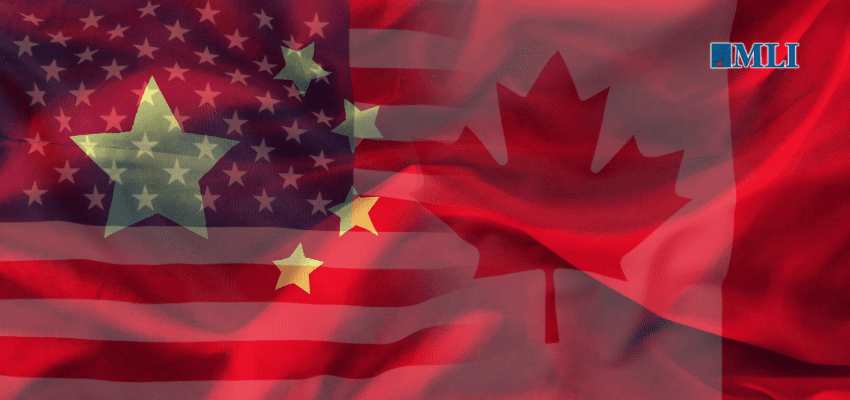
Image via Canva.

This article originally appeared in the National Review.

By Jerome Gessaroli, February 10, 2026

Commentators have described Canada’s proposed tariff-reduction agreement with China as a “gamble.” Yet doing nothing would have been the real gamble.

Ottawa’s decision to strike a limited trade deal with China — allowing a capped number of Chinese electric vehicles into Canada in exchange for lower tariffs on Canadian farm and food exports — has been framed as a geopolitical shift away from the West. A clearer-eyed reading is that it reflects a familiar response by an exposed American ally to managing risk.

Canada is being squeezed from two directions. Three-quarters of its exports go to the United States, and the first mandatory review of NAFTA’s successor, the U.S.-Mexico-Canada Agreement (USMCA) — signed during President Trump’s first term  — begins in July of this year. In Trump’s second term, the White House has signaled a far tougher stance in trade disputes, imposing a 35 percent tariff on Canadian imports not covered under the USMCA. At the same time, China has shown its willingness to use trade measures to advance broader economic and political objectives. Under those pressures, Canada chose to act.

Ottawa’s decision to move toward closer trade with China before the USMCA review was therefore predictable. Timing mattered as much as substance. Once the review began, American leverage would sharply increase. Any Canadian initiative involving China during negotiations would be easier to interpret as a provocation and fold into U.S. demands. As the review approached, the value of flexibility declined.

The deal itself is deliberately narrow and cautious, presented as an “agreement-in-principle.” Imports of Chinese electric vehicles would be capped at 49,000 units per year — about 3 percent of the Canadian market — and enter under standard tariff rates rather than preferential access. Manufacturers will face explicit review provisions rather than open-ended entry. This limited scale is precisely what makes the timing of the deal defensible: It manages trade exposure without creating a larger strategic commitment.

Taken together, these terms distinguish risk management from realignment, managing exposure without departing from the U.S.-led trade framework.

Make no mistake, Ottawa is not naïve about China’s use of trade leverage. The distinction between risk management and realignment applies beyond trade. Ottawa has indicated a willingness to cooperate with Beijing on public safety and security issues, such as narcotics trafficking, money laundering, and cybercrime, but the deal’s language reflects caution rather than a geopolitical shift. For a country whose defense and intelligence ties are so entangled with the United States, maintaining communication channels requires avoiding escalation, not closer security cooperation with America’s top adversary.

And here, too, timing comes into play. Negotiating a trade deal with China while the USMCA review was underway would open areas of potential vulnerability, making it easier for Beijing to delay concessions or harden terms.

Canada is responding to two risks at once: uncertainty in its most important trading relationship and continued exposure to Chinese trade tensions, including tariffs and import restrictions on Canadian agricultural exports. The limited deal eases pressure on one front before the other intensifies. Canada is not choosing Beijing over Washington. It is acting on the view that waiting alone does not reduce exposure.

More broadly, the deal modestly improves Canada’s position ahead of the USMCA review by securing agricultural export relief, most notably for canola seed. That lowers U.S. economic leverage as Canada’s chief buyer and eases domestic political strain, particularly in the Prairies. Yet more agricultural products sold to China do not necessarily mean fewer will be sold to America. Nor does that relief reduce Canada’s dependence on the United States or signal a shift in alignment, but it does help ensure Ottawa does not enter the USMCA review without any cushion.

The mixed reaction in Washington fits this pattern. President Trump has waffled between indifference and chest-thumping, while his trade officials have warned that Canada may come to regret the decision. Trade, security, and regulatory agencies — not just the White House — will shape the U.S. response, most likely through the USMCA review process.

Washington’s focus will extend beyond mere optics. It will include whether Chinese vehicles or components could indirectly enter U.S. supply chains through Canada, the issue of who can access vehicle data, and where it is routed, all for security reasons. The risk of trade-war escalation would rise if U.S. officials concluded that Canada’s arrangement with China enables indirect market access to the United States.

Rather than retaliating immediately, Washington is more likely to apply pressure through the treaty review process already scheduled, tightening rules on Chinese products that may come through Canada. That push may be tempered by U.S. industries outside the auto sector that rely on integrated North American supply chains and value stability. For them, tightening rules through established processes is less costly than disruption driven by escalation.

The real test of the agreement will come in how Washington factors it into USMCA demands, rather than in retaliatory measures against Beijing. Canada is acting on the assumption that the review may not yield a satisfactory outcome and has moved to secure limited relief in advance.

For the United States, the issue goes beyond approving or rejecting Canada’s choice to negotiate with China. It is really about whether the USMCA review this year can accommodate the realities allies face when trade pressure hits them from multiple directions at once.


Jerome Gessaroli is a senior fellow at the Macdonald-Laurier Institute and the Center for North American Prosperity and Security, and leads the Sound Economic Policy Project.

Source: National Review

Related Posts

Memo to PM Carney – Japan’s Iron Lady has chosen realism over culture wars, and so must you: Stephen Nagy in National Newswatch
Indo-Pacific

Memo to PM Carney – Japan’s Iron Lady has chosen realism over culture wars, and so must you: Stephen Nagy in National Newswatch

February 10, 2026
Canadian universities have an Islamist problem: Casey Babb and Joe Adam George in the National Post
Education

University censorship is out of control: Peter MacKinnon in the National Post

February 10, 2026
Geoffrey S. Moyse and Warren Mirko on Land Claims, Unceded Territory, and Transparency
Latest News

Breakthrough Nation with Karen Restoule: Geoffrey S. Moyse and Warren Mirko Series 3, Ep. 2

February 9, 2026

Newsletter Signup

  Thank you for Signing Up
  Please correct the marked field(s) below.
Email Address  *
1,true,6,Contact Email,2
First Name *
1,true,1,First Name,2
Last Name *
1,true,1,Last Name,2
*
*Required Fields

Follow us on

Macdonald-Laurier Institute

323 Chapel Street, Suite #300
Ottawa, Ontario, K1N 7Z2 Canada

613.482.8327

info@macdonaldlaurier.ca
MLI directory

Support Us

Support the Macdonald-Laurier Institute to help ensure that Canada is one of the best governed countries in the world. Click below to learn more or become a sponsor.

Support Us

  • Inside Policy Magazine
  • Annual Reports
  • Jobs
  • Privacy Policy

© 2023 Macdonald-Laurier Institute. All Rights reserved.

This site uses cookies. By continuing to browse the site you are agreeing to our use of cookies.

Privacy Preference Center

Consent Management

Necessary

Advertising

Analytics

Other

No Result
View All Result
  • Home
  • About
    • Who We Are
    • Who Makes MLI Work
    • Fifteenth Anniversary
  • Experts
    • Experts Directory
    • In Memoriam
  • Issues
    • Domestic Policy
      • Economic Policy
      • Justice
      • Rights and Freedoms
      • Assisted Suicide (MAID)
      • Health Care
      • COVID-19
      • Gender Identity
      • Canada’s Political Tradition
      • AI, Technology and Innovation
      • Media and Telecoms
      • Housing
      • Immigration
      • Agriculture and Agri-Food
      • Competition Policy
    • Energy Policy
      • Energy
      • Environment
    • Foreign Policy
      • Israel-Hamas War
      • Ukraine
      • Taiwan
      • China
      • Europe and Russia
      • Indo-Pacific
      • Middle East and North Africa
      • North America
      • Foreign Interference
      • National Defence
      • National Security
      • Foreign Affairs
    • Indigenous Affairs
  • Projects
    • CNAPS (Center for North American Prosperity and Security)
    • The Promised Land
    • Voices that Inspire: The Macdonald-Laurier Vancouver Speaker Series
    • Dragon at the door
    • Canada on top of the world
    • Letter to a minister
    • Justice Report Card
    • The Great Energy Crisis
    • DisInfoWatch.org
    • Managing Indigenous Prosperity
    • Judicial Foundations
    • Landmark Cases Council
    • Defending The Marketplace of Ideas
    • Reforming the University
    • Past Projects
      • Digital Policy & Connectivity
      • Double Trouble
      • Canada and the Indo-Pacific Initiative
      • The Transatlantic Program
      • COVID Misery Index
      • Speak for Ourselves
      • The Eavesdropping Dragon: Huawei
      • Talkin’ in the Free World with Mariam Memarsadeghi
      • An Intellectual Property Strategy for Canada
      • Munk Senior Fellows
      • A Mandate for Canada
      • Confederation Series
      • Fiscal Reform
      • The Canadian Century project
      • Fixing Canadian health care
      • Internal trade
      • From a mandate for change
      • Size of government in Canada
      • Straight Talk
      • Labour Market Report
      • Leading Economic Indicator
      • Centre for Advancing Canada’s Interests Abroad
      • Indigenous Prosperity at a Crossroads
  • Events
    • Upcoming Events
    • Past Events
      • MLI Dinners
      • Great Canadian Debates
  • Latest News
  • Libraries
    • Columns
    • Commentary
    • Papers
    • Books
    • Video
  • Donate

© 2023 Macdonald-Laurier Institute. All Rights reserved.