By Richard Shimooka
January 16, 2025
Over the past year, in light of upcoming procurements and new investments in the Royal Canadian Air Force (RCAF) and the defence industrial base supporting it, the Government of Canada has reopened the debate on how best to cultivate its defence aerospace industry. The ongoing rupture in Canada-US relations, and the stalled review of the existing Lockheed Martin F-35 acquisition, has attracted attention. Into this breach Saab, with its JAS-39E Gripen fighter, has appeared, promising 10,000 jobs as well as a scheme to produce them in Canada (Reguly 2025a; 2025b). While the veracity of Saab’s claims have been questioned by many individuals (Duggan 2025), the situation has sparked broader questions about what approach the Government of Canada should take to develop the RCAF’s airpower capabilities as well as the industrial system to support those objectives.
Equipping the RCAF effectively requires a clear understanding of how Canada’s aerospace industry translates into military capability. Rather than repeat ineffective policies from the past – such as licensed production, where a foreign government or firm is granted rights and the technical know-how to manufacture a specific weapons system – Ottawa can build on the strengths of the Canadian industry and join allies’ military projects early in their development cycles.
This approach would give the RCAF access to cutting-edge capabilities while embedding domestic firms in far larger and more resilient supply chains. This model was employed to great success with the Joint Strike Fighter program, and new opportunities with similarly large-scale benefits are emerging – if the Government of Canada is nimble and risk tolerant enough to act.
The focus here is on tactical fighters and their relationship to Canada’s defence aerospace industry. This is not meant to diminish the importance of other airpower capabilities; many of the trends seen with tactical fighters also appear in other domains and more broadly across services such as land and naval systems.
Canadian Defence Aerospace Industry Development from 1939 to 1980
Canada’s defence aviation industry, like many other sectors, can trace its roots back to the Second World War. Prior to the conflict, the industry was relatively small and largely focused on small single-engine aircraft for local use. The Second World War saw a major expansion of the aviation industry to fill the needs of the war effort – from less than 50 aircraft being produced per year in 1938, it would produce over 16,000 in 1944 (Stacey 1970). However, Canada’s dramatic wartime industrial expansion was uneven and masked several deficiencies.
In the 1940s, aerospace manufacturing tended to be concentrated within highly integrated verticals inside two categories of firms (Holley 1989) – engine companies and the airframe manufacturers; the latter would now be described as system integrators. Subcontractors existed but were limited in their presence and mostly focused on specialist areas, including propellers, tires, and certain electronics.
Because the Canadian defence sector was non-existent before 1940, the government attempted to harness as much industrial power to increase war production as possible. In particular, it encouraged the use and growth of independent subcontractors to supply manufacturers with subassemblies (Holley 1989). This was extremely successful, stimulating the growth of smaller firms that developed specialized niches. An example of this would be Héroux Machine Parts Limited, which started in 1942 as an aviation machine tooling company, and later became a world leader in landing gears (Heroux-Devtek 2026).
US and British firms established subsidiaries in Canada to undertake full production and developed supply chains to support their operations (CBC 1945). Yet this also meant Canada became wholly dependent on foreign manufacturers to undertake the research, engineering, and development of aircraft designs. With a few insignificant exceptions, Canada’s production was completely dominated by UK- or US-designed aircraft under license – such as the Avro Lancaster, Hawker Hurricane, and the North American Texan (renamed the Harvard).
This left Canada as essentially a giant branch plant, with little domestic design capability and incomplete supply chain for aircraft production. A particularly acute limitation was the lack of a major engine manufacturer: of the 16,000 aircraft Canada produced during the war, not one mounted an engine that was built domestically (Wakelam 2011). This was a deliberate choice by the government for wartime expediency: it focused economic mobilization on specific sectors while avoiding overextending itself on others. The establishment of a production line to produce 400 engines would take $50 million and 8,000 workers, and Canada would still be reliant on a large number of subcomponents from British or American industries (Sullivan and Milberry 1989). By comparison, Canada’s entire defence expenditure in 1939 was $35 million.
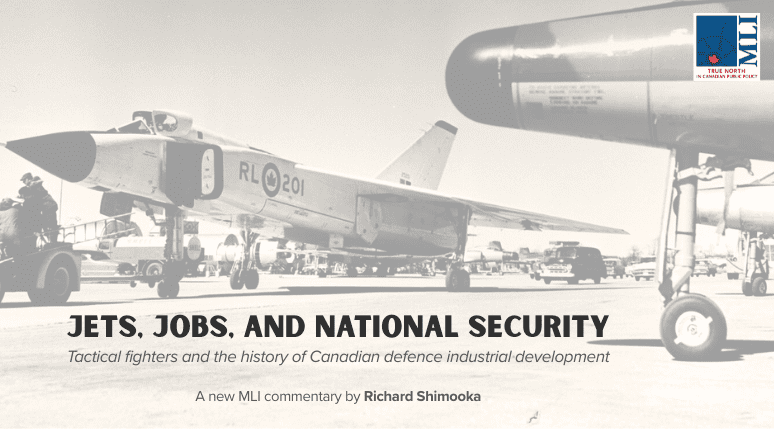
However, as the end of the war loomed, the Mackenzie King government sought to sustain the existing industry by developing a domestic fighter strategy (Wakelam 2011). Ottawa’s objectives were twofold: to ensure a wartime supply of fighters for the RCAF and to preserve the industrial infrastructure and skilled workforce developed during the conflict. In 1947, it launched its first fighter program: the CF-100 Canuck, which would be undertaken by A.V. Roe, or Avro, a Canadian subsidiary of the British Hawker Siddeley firm.
The CF-100 was intended to be an all-weather, long-range interceptor primarily tasked with defending Canada. However, officials realized that the Canuck would not fulfil the military’s need for a shorter-range day fighter appropriate for front line operations in Europe or elsewhere. As a result, Ottawa eventually started the licensed production of the North American F-86 Sabre, a highly capable jet fighter that operated with relative success during the Korean War. It was representative of a new generation of highly capable fighter aircraft that combined aerodynamic features such as a swept wing with a reliable and powerful jet engine.
The firm Canadair, originally a spun-off division of Canadian Vickers that emerged from government receivership, ended up with the contract. It was a lucrative one, with Canadair delivering 1,815 aircraft – the most produced jet in Canadian history. The aircraft became the RCAF’s primary fighter for the next decade and served with twelve other nations as they expanded their air forces at the onset of the Cold War.
The use of licensed production for the F-86 Sabre was expedient and appropriate for the situation. It maximized benefits for both countries by increasing the production capacity for the fighter and helping to sustain the Canadian defence industry. However, since Canadair was not involved in the original design and integration work (though they did undertake several successful modifications), it provided little knowledge or capacity on how to indigenously develop a design. This would have required a much more substantial investment and aerospace capacity, including dedicated testing facilities such as wind tunnels and radar ranges.
This curtailing of design capacity was a major limitation of licensed production – a limitation reflected in the experience of many countries. Japan for example, employed it on four separate designs extensively from the 1950s until the1990s. This strategy compensated for a decade of post-war inactivity, during which the country was banned from engaging in military activity (Samuels 1994).
Like Canada, Japan also successfully adapted licensed designs for local defence requirements and industrial specialties. However, it also found the approach limiting in its ability to develop a sustainable defence aerospace industry, especially concerning areas of aircraft design and manufacturing. As Richard Samuels succinctly noted about Japan’s experience: “Licensing established knowledge is a good way to keep up; it is not a good way to get ahead” (Samuels 1994). Thus, if Canada wanted to develop a sovereign fighter capability it would require a much larger domestic program to sustain it.
In addition to increasing domestic production, the federal government sought to address key supply chain deficiencies, the most obvious being engine production. The timing was right: The jet engine was a revolutionary technology that was early in its development cycle and investment could yield immediate dividends in production-ready applications. The emerging field of digital electronics as well as new, exotic alloys and materials also provided shortcuts for Canada’s onramp into the mainstream aviation industry.
Ottawa experienced some initial success in developing a domestically designed fighter. The first aircraft from this program, the CF-100 Canuck, filled a critical niche for the RCAF in continental defence and was produced in large numbers: nearly 700 were built and 53 exported to Belgium. Nonetheless, the CF-100 program – initiated in 1946 – only delivered its first operational aircraft in 1953 (Wakelam 2011). It was an unusually long gestation for an aircraft of that era that often only lasted in service for less than ten years due to rapid obsolescence.
Avro’s inexperience with fighter production exacerbated these delays, highlighting the formidable technical leap between licensed production and full design and manufacturing. As Randall Wakelam (2011) noted:
The underlying problem was that the company had a strong design team but lacked the expertise and experience to effectively turn the design into production capability and on-time deliveries.
The RCAF also slowed production by frequently requesting design changes. The CF-100’s issues would manifest to a greater degree in AVRO’s next major project, the CF-105 Arrow. Effectively a supersonic replacement for the Canuck, the aircraft was plagued with extreme cost overruns and delays during its development (Story and Isinger 2007). The death knell for the project was the changing strategic environment and reduced need for the Arrow’s capability.
The cancellation of the Arrow in 1959 profoundly impacted Canadian industry; within a few years, both the RCAF’s domestic fighter development program and Avro itself had been dissolved. However, the wider aviation industry survived. The program was successful in developing a broad and highly competitive domestic aerospace supply chain, which was now in search of new opportunities (Dominion Bureau of Statistics 1957). Significant portions of the industry moved towards subcomponent manufacturing, facilitated by various bilateral agreements signed in the 1950s with the United States. One such deal was the 1956 Defence Production Sharing Act (DPSA), which provided Canadian firms unfettered access to the American market. Instead of sustaining Canadian prime contractors like Avro or Canadair, smaller firms would start support major US ones, like McDonnell Douglas, General Dynamics, or Boeing.
While the Arrow’s cancellation resulted directly from severe cost overruns, developmental difficulties, and a shifting strategic landscape. However, these immediate factors often obscure the broader technological and economic trends that were shaping aircraft production at the time.
In short, the cost of developing and producing cutting-edge fighter aircraft was rapidly increasing and starting to exceed the financial capacity of most states other than the superpowers. A 2008 Rand study found that fighter costs increased by 9.3 per cent on average each year from 1950 to 2010, far exceeding the average inflation rate of 4.3 per cent during that period (Arena et al. 2008). Like Canada, many states ended their domestic fighter development programs. For instance, the United Kingdom cancelled a whole slew of manned programs in 1957 and the years afterwards due to rising costs and the belief that guided missiles could do the same roles more cost-effectively (Buttler 2018).
Aircraft performance during this post-war period increased dramatically, significantly increasing speed, range, and maneuverability, requiring exotic materials and configurations that were costly to fabricate. Inflation surrounding airframe costs would taper off somewhat into the 1960s and onwards, in part due to less emphasis on top speed and altitude while the avionics, or electronics in the aircraft, became an increasingly important enabler for improving the flight performance of aircraft as well as their mission capabilities.
This trend accelerated in the late 1970s and 1980s with the increasingly widespread adoption of reprogrammable digital avionics – a profound development for all military aircraft, which continues to revolutionize fighter design today. Electronic hardware and the software loaded on it increasingly determined all aspects of an aircraft’s capabilities, introducing the need for a continuous modernization and sustainment programs dedicated solely for aircraft programming.
The Canadian Air Force found this particularly challenging for its CF-18 program, as policy decisions prevented the air force from operating avionics versions common to other allies. The government-established sustainment system could not keep the aircraft abreast of developments in airpower, such as precision-guided munitions or secure communication systems. The CF-18 became increasingly less capable than other Hornet users. The acceleration of modernization cycles for digital avionics systems has increased steadily since the 1980s. Consequently, aircraft have become more reliant on programming to enable advanced capabilities, such as sensor fusion and cyber warfare.
Defence aerospace capabilities have become highly complex activities, eventually incorporating tens of thousands of firms that operate niche areas of development. As with other economic sectors, supply chains have become vast industrial efforts that can extend deep into a number of countries. National security and defence considerations can significantly increase complexity and cost.
Countries responded to these changes in several ways. Many nations’ militaries – other than the United States force structure for fighters – have had difficulties making domestic production economically viable. The states that persevered, like France and Sweden, did so though several different approaches. The French government made an aggressive effort to export its designs (Béraud-Sudreau 2020), while Saab increasingly farmed out specific subsystem work for their fighters to foreign manufacturers, beginning with engines and then later, avionics and radar. Similarly, when Israel attempted to build its own fighter in the 1980s, the Lavi, it turned to American firms like Northrop for large portions of the design (Golan 2016).
Another common model, especially for European states, was to undertake joint development projects. Examples included the Franco-UK SEPECAT Jaguar, the West German-Italian-UK Panavia Tornado, and the German-Italian-Spanish-UK Eurofighter. Joint production held several potential advantages, such as shared development costs and increasing a program’s total production quantities (thereby reducing per unit cost). In addition, it could theoretically mobilize each states’ industries comparative advantages to improve outcomes. However, these programs tended to fall far short from this ideal and operated in a highly inflexible manner. Consortium partners usually negotiated a “workshare” arrangement, which divided the available production between the participating countries industries – even including the duplication of activities that would increase costs (Hartley 2006).
Canada’s response differed somewhat from other states. While the country continued licensed production of some tactical fighters for the next decade and a half, the attractiveness of the approach waned. Canadair would assemble the CF-104 Star Fighter procured from Lockheed, and then the CF-5 freedom fighter from Northrop for the Canadian Forces. However, that ended in 1975, and with it, the last embers of Canada’s Cold War-fuelled domestic fighter industrial policy were snuffed out. Nevertheless, the Canadian aviation industry continued to grow, buoyed by increasing cross-border co-operation through the DPSA. Many Canadian firms started producing components for aircraft in the United States and abroad. By the 2000s, the Canadian aviation industry was the fifth-largest in the world, but over 60 per cent of its sales were exported abroad (Stone 2019).
The industrial base’s limited capabilities and the increasingly complex nature of fighter designs made licensed production less economically beneficial in the long run. Without the capacity to design and integrate technologies, Canada became increasingly confined to just assembling completed subassemblies from abroad. This did not substantially advance the Canadian industry’s technical knowledge; however, it did increase the per-unit cost of aircraft, thereby decreasing the purchasing power of military spending. As production ended, Canadian plants shut down. As a result of these factors, the economic case for licensed production evaporated.
The 1980s to Present: Changing industry structure and the challenge of investment.
In the 1980s, Canada replaced its aging CF-101 and CF-104 aircraft with the McDonnell Douglas CF-18. While this represented a massive jump in military capability, it also signalled a significant change in industrial policy when Canada did not request licensed production in its request for proposals to prospective manufacturers. A key objective of the program was to obtain as many aircraft as possible within the financial constraints outlined by the government (Manson 2013). Licensed production meant increased acquisition costs with little lasting economic or industrial benefit. Instead, the government sought to use a new approach, securing reciprocal industrial and commercial contracts from the winning bidder. Known as “offsets,” they reflected a significant shift in Ottawa’s defence industrial policy as well as defence production overall.
As with fighter production, the domestic capacity to produce many complex defence systems had become extant, or in some cases never developed. Yet considering domestic firms’ burgeoning strength in subcontract production, a new model for industrial development was required.
In the 1970s and 1980s, the Government of Canada launched a policy of offsets for major defence purchases. This required any firm “to undertake economic activity in Canada equal to at least 100 per cent of the value of the contract,” (Penney and Kho 2022) which could involve reciprocal foreign investments into domestic industries.
This would be codified in the 1986 Industrial Regional Benefits policy (known as IRBs and the predecessor to the current Industrial Technical Benefits policy) (Auger 2020). IRBs, however, were not seen as the primary means to implement defence industrial policy. The two pillars of defence production would be domestic production and joint programs with other states. Rather, officials expected IRBs to fill the gap between the two approaches where neither option was available.
Ottawa was particularly focused on improving its ability to conduct joint programs with the United States, which followed its broader efforts to stimulate free trade between the two countries (Reagan and Mulroney 1985). This was seen as mutually beneficial, as Canadian industries were considered highly competitive and potentially able to further improve the United States’ defence outputs.
The move to promote joint programs culminated in a 1987 White Paper, Challenge and Commitment, which set forth a comprehensive industrial policy for Canada (Department of National Defence 1987). This policy aimed to strengthen R&D by producing defence systems either domestically or through joint programs with allied nations: the latter was viewed as the most advantageous path for industrialized growth. However, because Canada selected the CF-18 after it was finalized, opportunities for high-level sub-component manufacturing were scarce. Consequently, the offsets Ottawa received were largely indirect and unrelated to the aircraft’s actual production – a “lost opportunity” that became a key lesson for future programs.
Many Western allies also delayed their fighter modernization programs during the 1990s due to the peace dividend that emerged with the collapse of the Soviet Union and large inventories of relatively modern jet fighters acquired during the 1980s. Although Japan had aspired to manufacture an indigenous fighter design, it settled on a jointly developed enlarged variant of the General Dynamics F-16, the Mitsubishi F-2 (Lorell 1995). While Tokyo funded several development projects during this period, such as the X-2 Shinshin demonstrator in the 2000, and then the F-X stealth fighter in 2010s, it decided to shelve a domestic design and join a UK-led fighter program in 2022.
The market consolidated around several programs. In Europe, several Cold War-era designs continued development – the Rafale, the Eurofighter, and the Gripen. The US focused on the F-22 and F/A-18E. However, technological shifts and a changing threat environment – as well as the need to eventually replace the aircraft purchased in the 1980s – resulted in a new approach for aircraft and industrial development. This was the genesis of the Joint Strike Fighter (JSF) program. The F-35 that it produced would replace a number of major fighter types, including the F/A-18C, F-16, AV-8, and the A-10 (Kapstein 2004).
In addition to its advanced design, the program featured a novel paradigm for joint production. In this approach, the US government would eschew the inflexible workshare arrangements that had typified European programs and identify several partner states to collaborate with on production. Taking a page from the civil aircraft industry, it would harness its partner countries’ most productive industries as part of an industrial team to produce fighters. Companies would win contracts based on best-value competitions that could be reopened in case of non-performance on cost or output. In return, they would be incorporated into the program’s supply chain, potentially delivering components or services that sustained the entire production run, projected to be over 2,500 aircraft.
In Canada’s case, the domestic aerospace industry was well configured to support and even prosper under the JSF program structure, a reality that was understood early on by US government analysts (Department of Defence 2003). In the two decades since, the Canadian industries have largely realized those benefits, accruing US$3.3 billion in contracts over the past twenty years (Government of Canada 2025). Many firms utilized the opportunity presented by the program’s high technology environment to modernize their own technical and production knowledge.
Finally, the JSF program also addressed a core challenge facing fighter development – avionics interoperability. This had become an increasingly critical area of fighter design, particularly as new doctrinal concepts call for capabilities that can seamlessly integrate within a “system of systems.” However, as noted earlier, the cost of maintaining integration is high, especially as allied forces adopt rapidly evolving software-centric approaches to war fighting. The JSF program’s structure proportionally divided these costs among the partnership, which vastly decreased the financial cost and resourcing requirements for Canada. With four of the Five-Eyes partners (the elite intelligence sharing alliance comprising the US, UK, Canada, Australia, and New Zealand) participating in the program, avionics fit closely with the RCAF’s overriding data-management perspectives, a significant advantage in maintaining the interoperability with key allies.

Towards the future: Potential avenues for Canadian Industry
Canada’s recent fighter jet review has reopened the debate on how best to support the domestic aviation industry with respect to fighter development. Since Saab reportedly made an unsolicited offer of 72 Gripens and GlobalEye Airborne Early Warning and Control aircraft, significant debate has emerged as to whether this would better serve broader defence industrial objectives. Saab’s representatives have frequently proposed some sort of licensed production scheme, claiming that it could create 10,000 aircraft within Canada through licensed production (Reguly 2025a).
This alone is a highly dubious claim because the direct work required for the Gripen – or France’s Rafale, for that matter – is significantly lower. However, it is important to have a debate on the most appropriate model for Canada.
As noted earlier, licensed production schemes have become rare internationally for fighter production. Certainly, in Canada’s case, the structure of the country’s aerospace industry, the limited number of aircraft acquired by the country, and the requirement to maintain high levels of interoperability with allied countries’ air forces severely limits any potential advantages of this approach.
Perhaps most critically, it will not provide a means to develop and sustain a modern aircraft design capability, which is the essential element in sustaining that program.
Canada would be completely responsible for the avionics development for interoperability, a costly and technologically fraught proposition, as the CF-18’s history illustrates. It is most likely that Canada would open a factory, produce a limited number of aircraft – perhaps only those for the RCAF – and then shutter the factory due to low demand, a crowded marketplace, and higher costs involved with a secondary licensed production lines.
Instead, Canada should look to the JSF’s approach as inspiration for future aerospace industrial development. Certainly, the joint development approach has become extremely popular among Western states thanks to the ability to share development costs and increase production size. To maximize the potential benefits of joint development, Ottawa will need to shift its procurement practices to eschew competition and take the risk of joining a program early in its development.
If Canada chooses an aircraft after the design is selected and engineering and production development has started, it is already too late. Industrial supply chains are established early in an airframe’s design, as the prime contractor works with subcomponent manufacturers to refine its engineering. The government has already laid the potential groundwork for this approach through the expansion of the national security exemption in the spring of 2025 (Mills 2025), which limits firms’ ability to protest procurement decisions.
Preserving sovereign capabilities remains a primary objective – but becoming a major industrial contributor within a joint program secures substantial strategic leverage. Furthermore, the modest airframe quantities that Ottawa requires ensure that independent manufacturing efforts would prove impossibly expensive.
Joint procurement programs also provide leverage to participating states for their foreign policy aims. Partner countries could, for example, hold up production, causing delays and increasing costs, which can be used to deter undesirable outcomes. Certainly, leverage increases the more one invests – that is apparent with the current Franco-German-Spanish Future Combat Air System project, where French intransigence over workshare has halted momentum on the project (Franke 2025). Joint production programs can have many limitations, including inflexible workshare arrangements that can sap efficiency and cost effectiveness. But these arrangements can also be leveraged for Canadian interests.
On the other hand, licensed production does not provide nearly the same leverage, as a purchasing state remains nearly completely reliant on a foreign industrial supply chain until the last steps of production. Lacking a countervailing response, the purchasing state can end up at the mercy of foreign government’s decision-making.
Getting the right model for developing the defence aerospace sector is critical given the strategic situation Canada finds itself in. The federal government has committed to immediately meeting the NATO 2 per cent of GDP spending guideline, and reaching the 5 per cent objective by 2035. Considering Canada’s vast geography, as well its need to deploy capabilities abroad to support its allies, the RCAF is primed to receive a large portion of the new defence spending increase. At the same time, Canada has made domestic industrial development a significant priority for the committed defence spending, which emphasizes the need for an effective organizational and policy structure. Finally, there is also a pressing need to ensure that the entire Canadian Armed Forces has a secure and sustainable supply of defence material that can be mobilized during a potential war. The defence industrial policies established today will form the foundation for a massive expansion if required.
Canada already has several available options. Even though it is currently seeking to replace the CF-18, the RCAF will need to look even further ahead, at the next generation of fighter aircraft either to augment the F-35 or replace it outright. Rapid advancements in airpower technologies and doctrine are necessitating new manned and unmanned platforms, operating in networked systems, to achieve aerial superiority.
There are several “sixth generation” aircraft programs ongoing; the US is developing the F/A-XX and the F-47, while Europe has the UK-led Global Combat Air Programme (GCAP) and the Franco-German Future Combat Air Capability (FCAS). During the last federal election, the Carney Liberals promised to join one of these programs (Chase 2025).
Of these, potentially only GCAP or F/A-XX offer the right mix of interoperability, military capabilities, and industrial opportunities for Canadian firms. With the federal government looking to expand Canada’s supplier base beyond the US, that makes the GCAP the most likely winner. However, if Ottawa hopes to extract maximum benefit from selecting the GCAP for the RCAF, its window of opportunity to join and invest in the program is closing quickly.
Beyond sixth generation fighters, Canada must exploit emerging opportunities in the broader defence aerospace sector. Much as the 1940s and1950s introduced jet engines, electronics, and exotic materials, today’s shifting technological and doctrinal landscape offers a new frontier for Canadian industrial growth.
Leading the way are a new class of unmanned vehicles that will operate beside manned capabilities – commonly known as Collaborative Combat Aircraft (CCAs). These vary in size and cost from a thousand-pound disposable delivery system that could cost a few million dollars, to a fighter-sized “loyal wingman” that may cost between $40 million to $60 million per unit. Canadian firms, especially at the lower end of the spectrum, have plenty of opportunities to capitalize – since many of these systems may be considered “munitions” in their rate of use and cost, the market demand will be strong.
Canada could also invest in larger capabilities that would be useful patrolling in the arctic or off the country’s coastlines. This may involve developing aircraft like the Bombardier Global 6500 into an unmanned sensor platform that can loiter for long periods with a large radar array that works in conjunction with manned platforms.
However, the only way to achieve these more forward-looking capabilities is to develop a nimble defence industrial strategy that is closely married to the RCAF’s requirements and the technological environment. This is not a new suggestion: a 2013 report on defence procurement led by industry executive Tom Jenkins made that one of its primary recommendations (Jenkins et al. 2013). A return to licensed production as opposed to participation in joint programs (like the JSF and beyond) would severely undermine Canada’s defence industrial strategy and our capacity to properly equip the RCAF in both the long- and short-term.
About the Author
Richard Shimooka is a senior fellow at the Macdonald-Laurier Institute. He was a senior fellow at the Defence Management Studies Programme at Queen’s University from 2007 to 2012, and a research fellow at the Conference of Defence Associations Institute from 2012–17. Shimooka’s work covers a diverse array of topics, including Canadian and American foreign and defence policy, modern airpower, and defence procurement.
He is a frequent commentator in the media on security and defence issues and has published articles in the National Post, Ottawa Citizen, the Hill Times, War on the Rocks, On Track, and the Canadian Military Journal. He is the co-author (along with Douglas Bland) of Let Sleeping Dogs Lie: The Influence of External Studies and Reports on National Defence Policy – (Queens’ School of Policy Studies) and the author of Vimy Paper 33: The Fourth Dimension: The F-35 Program, Defence Procurement, and the Conservative Government, 2006–2015 (CDA Institute). His forthcoming book is titled No Nobler Purpose: Canada, The United States and 1996 Rwandan Refugee Crisis (UBC Press).
Shimooka holds a Master’s in Strategic Studies from the University of Wales Aberystwyth and a Bachelor’s with Honours in Political Studies from Queen’s University.
References
Arena, Mark, et al. 2008. Why Has the Cost of Fixed-Wing Aircraft Risen?: A Macroscopic Examination of the Trends in U.S. Military Aircraft Costs Over the Past Several Decades. RAND Corporation. Available at https://www.rand.org/content/dam/rand/pubs/monographs/2008/RAND_MG696.sum.pdf
Auger, Martin. 2020. The Evolution of Defence Procurement in Canada: A Hundred-Year History. Library of Parliament of Canada. Available at https://lop.parl.ca/sites/PublicWebsite/default/en_CA/ResearchPublications/202054E
Béraud-Sudreau, Lucie. 2020. French Arms Exports: The Business of Sovereignty. International Institute for Strategic Studies. Available at https://www.iiss.org/publications/adelphi/2020/french-arms-exports/.
Buttler, Tony. 2018. The 1957 Defence White Paper: Cancelled Projects. Journal of Aeronautical History. Available at https://www.aerosociety.com/media/8134/the-1957-defence-white-paper-cancelled-projects.pdf.
CBC. 1945. Women Build Warplanes at Boeing Vancouver Plant. Available at https://www.cbc.ca/player/play/video/1.4685714.
Chase, Steven. 2025. Mark Carney Promises New Submarines, More Icebreakers, Pay Raises for Armed Forces. Globe and Mail, March 25. Available at https://www.theglobeandmail.com/politics/article-mark-carney-liberals-election-defence-spending/.
Department of National Defence. 1987. Challenge and Commitment: A Defence Policy for Canada. Available at https://publications.gc.ca/pub?id=9.696698&sl=0.
Department of Defence. 2003. JSF International Industrial Participation: A Study of Country Approaches and Financial Impacts on Foreign Suppliers. Available at https://www.govinfo.gov/app/details/GOVPUB-D-PURL-LPS61713.
Department of National Defence. 2026. Future Fighter Capability Project. Available at https://www.canada.ca/en/department-national-defence/services/procurement/fighter-jets/future-fighter-capability-project.html.
Dominion Bureau of Statistics. 1957. The Aircraft and Parts Industry: 1955. Available at https://publications.gc.ca/collections/collection_2017/statcan/42-203/CS42-203-1955-eng.pdf.
Duggan, Kyle. 2025. “‘Completely Unrealistic:’ Critics Question Saab’s Offer to Bring 10,000 Aerospace Jobs to Canada.” Canadian Press. Available at https://www.ctvnews.ca/business/article/critics-question-saabs-offer-to-bring-10000-aerospace-jobs-to-canada/.
Franke, Ulrike. 2025. The Trouble with FCAS: Why Europe’s Fighter Jet Project Is Not Taking Off. European Council on Foreign Relations. Available at https://ecfr.eu/article/the-trouble-with-fcas-why-europes-fighter-jet-project-is-not-taking-off/.
Golan, John. 2016. Lavi: The United States, Israel, and a Controversial Fighter Jet. Potomac Books.
Hartley, Keith. 2006. The Industrial and Economic Benefits of Eurofighter Typhoon. Updated report.
Heroux-Devtek. 2025. Our History. Available at https://www.herouxdevtek.com/en/historique.
Holley Jr., Irving Brinton. 1989. Buying Aircraft: Materiel Procurement for the US Army Air Forces. Center of Military History, US Army.
Jenkins, et al. 2013. Canada First: Leveraging Defence Procurement Through Key Industrial Capabilities. Public Works and Government Services Canada. Available at https://www.tpsgc-pwgsc.gc.ca/app-acq/documents/eam-lmp-eng.pdf.
Kapstein, Ethan. 2004. Capturing Fortress Europe: International Collaboration and the Joint Strike Fighter Survival. International Institute for Strategic Studies. Available at https://www.tandfonline.com/doi/pdf/10.1080/00396330412331343773.
Lorell, Mark. 1995. Troubled Partnership: An Assessment of U.S.-Japan Collaboration on the FS-X Fighter. RAND. Available at https://www.rand.org/pubs/monograph_reports/MR612z1.html.
Manson, Paul. 2013. Personal interview.
Mills, Marcia. 2025. New Federal Regulations May Significantly Impact Competitive Procurement Processes. Fasken. Available at https://www.fasken.com/en/knowledge/2025/02/new-federal-regulations-may-significantly-impact-competitive-procurement-processes.
Penney, Chris, and Albert Kho. 2022. The Industrial and Technological Benefits Policy: An Analysis of Contractor Obligations and Fulfillment. Parliamentary Budget Officer, Ottawa. Available at https://distribution-a617274656661637473.pbo-dpb.ca/cdae8df20c63dd08820ba553a37151863d4e5112ae56def60eb2ca27fba302f0.
Reagan, Ronald, and Brian Mulroney. 1985. Joint Canada–United States Declarations on Trade and International Security. Ronald Reagan Library and Archive. Available at https://www.reaganlibrary.gov/archives/speech/joint-canada-united-states-declarations-trade-and-international-security.
Reguly, Eric. 2025a. Bombardier, Sweden’s Saab in Talks to Build Gripen Fighter Jet in Canada. Globe and Mail. Available at https://www.theglobeandmail.com/business/article-bombardier-swedens-saab-in-talks-to-build-gripen-fighter-jet-in-canada/.
Reguly, Eric. 2025b. Building Military Aircraft in Canada Would Create More Than 12,000 Jobs, Saab Tells Ottawa. Globe and Mail. Available at https://www.theglobeandmail.com/business/article-saab-gripen-fighter-yet-globaleye-surveillance-plane-melanie-joly/.
Samuels, Richard. 1994. “Rich Nation, Strong Army”: National Security and the Technological Transformation of Japan. Cornell University Press.
Stacey, C.P. 1970. Arms, Men and Governments: The War Policies of Canada, 1939–1945. Ottawa: Department of National Defence. Available at https://www.canada.ca/content/dam/themes/defence/caf/militaryhistory/dhh/official/book-1970-policies-ww2-en.pdf.
Stone, Craig. 2019. The Canadian Aerospace Industry: An Important Segment of the Defence Industrial Base. In Fetterly and Solomon (eds.), RCAF Defence Economics. Canadian Forces Air Warfare Centre.
Story, Donald, and Russell Isinger. 2007. “The Origins of the Cancellation of Canada’s Avro CF-105 Arrow Fighter Program: A Failure of Strategy.” Journal of Strategic Studies. Available at https://doi.org/10.1080/01402390701676535.
Sullivan, Kenneth, and Larry Milberry. Power: The Pratt and Whitney Canada Story. Canav Books.
Wakelam, Randall. 2011. Cold War Fighters: Canadian Aircraft Procurement, 1945–54. UBC Press.