By J.L. Granatstein, November 21, 2025
Canada faces an increasingly dangerous world, yet decades of neglect have left its armed forces perilously weak. As new mobilization plans finally emerge in Ottawa, it’s worth recalling how earlier efforts failed – and what must change now.
In 1995, I was appointed to a Special Commission on the Restructuring of the Canadian Forces Reserves, a Department of National Defence committee established to try to fix the fraught relations between the Army Regular force and the unhappy, understrength, and underfunded Reserves (or Militia).
The three-person commission was led by former Chief Justice of Canada Brian Dickson, with Lieutenant-General Charles Belzile, the former commander of the Canadian Army, as the third member. Together, we brought our combined legal, military, and institutional expertise to bear on the deep structural and cultural challenges facing Canada’s Reserves.
After we had been working for several months, we met with Chief of the Defence Staff General John de Chastelain. I had been at the Royal Military College of Canada two years behind De Chastelain and knew him slightly – and I had some questions. My first was why the Army had killed the Canadian Officers Training Corps three decades ago and whether it might be restored. The COTC had connected the Army to the universities and had been very valuable in the past. There was no need for more officers, De Chastelain replied, pointing to the across-the-board cuts Prime Minister Jean Chrétien’s government was imposing as it wrestled with the deficit and the end of the Cold War a few years before.
Then I asked if Canada had a mobilization plan in case of a major conflict, something the Militia believed necessary. De Chastelain answered that there was a 1994 plan, but it was not one that used the Militia as the basis for creating a large army, presumably because there was no war on the horizon. I followed this by asking about the tiny numbers in the Supplementary Reserve, a list of retired senior NCOs and officers who had left the forces but indicated a willingness to rejoin if needed. The General indicated that there was no way to force those who left the Canadian Armed Forces to join the Supplementary Reserve, nor were greater numbers necessary.
The meeting had not been very satisfactory from the Commission’s point of view, but I think we understood the budgetary and personnel problems De Chastelain faced. But to my pleasure, the Commission’s report, released on October 30, 1995, did call for a mobilization plan that gave a major role to the Army Reserve and for all retiring personnel to be transferred to the Supplementary Reserve.
Unsurprisingly, nothing came of these recommendations.
Thirty years later, Canada lives in a very different world with aggressor powers building large, well-armed military forces and threatening the democracies. The United States seems increasingly unconcerned with its NATO partners, including Canada, and eager to strike new arrangements with Russia. For Canada, long accustomed to sheltering under the American umbrella, this shift is deeply worrisome.
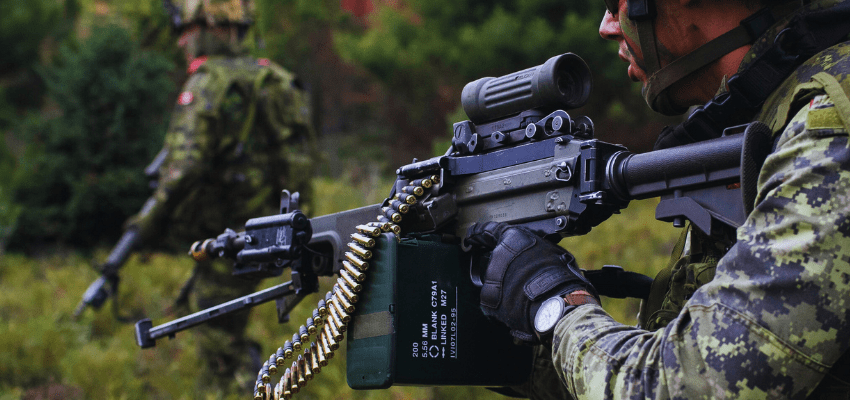
And in this dangerous world, the Canadian Armed Forces has a paper strength of 65,000, featuring understrength Regular Army units that lack modern equipment, and ill-equipped Army Reserve units with a total strength under 17,000 that struggle to put one or two hundred men on parade on their training nights. The Army – along with the Navy and the Air Force – is as weak as it has ever been after decades of underfunding and cutbacks.
Indeed, the gap between Canada’s commitments and its actual capabilities has rarely been wider.
But for the first time in years, there is now planning at National Defence Headquarters for a mobilization scheme, and Chief of the Defence Staff General Jennie Carignan is talking of creating a Primary Reserve of 100,000 and a Supplementary Reserve of 300,000. Most of the Primary Reserve is intended for the Army, but some of the increased strength would go to the Air and Navy Reserve units. Carignan has said that the Supplementary Reserve, at present only 4,300 strong, would continue to have retired personnel (though whether this would include all retiring personnel remains unclear) and tens of thousands of others, including public servants.
These men and women, intended to be the vast majority, would be given some rudimentary training in shooting, communications, truck driving and drone operation, and would do a maximum of five days training a year in peacetime. Their role, the CDS stated, would be to become available in civil or military crises ranging from “low-intensity natural disasters to high-intensity large scale combat operations.”
How such lightly trained people would fare in combat is unfortunately all too clear. But if there are regularly updated lists of skill sets and if contact is maintained with those men and women, they could be very useful, for example, in mobilizing firefighters and evacuations in civil emergencies. As General Carignan said, she could contemplate dump truck operators, heavy equipment operators, cooks, and electricians being helpful in many circumstances. So could doctors, engineers, and police.
Used appropriately, such a pool could greatly expand Canada’s ability to respond to non-combat crises. Even more useful, I expect, would be retired and retiring Regular Force personnel. If, for example, they could be encouraged to join the Supplementary Reserve (as they now are not) by being told they would be paid to attend briefings a few days a year, to keep their uniforms and ranks, and be available to be called up in a crisis, many would likely sign on.

And if the Primary Reserve is expanded to 100,000, as the CDS has said, then many Supplementary Reserve NCOs and officers could be called on to assist in training new recruits, a task that most Reserve units might find very difficult given their present numbers. At the same time retired personnel could handle the influx of 300,000 civilians and provide the very basic training they would receive. The Regular force is short of training capacity at present and would simply be incapable of doing the job; indeed, the Regulars are unable to train their own new recruits beyond a limited number each year.
Without leveraging retired personnel, any large-scale mobilization would be almost impossible.
There is much still to be fleshed out, and as yet, the CDS has made clear that there is no funding allocated to her plans. But the Carney government seems serious about defence, the first Canadian government in decades to do so. There is a real effort underway to think about mobilization and the strength of the Primary Reserve. Already senior Army reservists are reporting that money is flowing to them in ways that are markedly increased from the recent past.
The Supplementary Reserve intentions may seem fanciful – Will public servants want to join? Where will equipment for them be found? Will they be paid? etc. – but there can be no doubt that this is fresh thinking about defence of a kind that has long been missing in this country.
Historian J.L. Granatstein is a member of the Macdonald-Laurier Institute’s Research Advisory Board. He taught history at the postsecondary level for 30 years. A bestselling author, Granatstein was the director and CEO of the Canadian War Museum. He writes on Canadian military history, foreign and defence policy, and politics. Among his publications are Canada’s War, The Generals, Canada’s Army, and Who Killed the Canadian Military? He is an officer in the Order of Canada.