Monday, December 15, 2025
No Result
View All Result
  • Media
Macdonald-Laurier Institute
  • Home
  • About
    • Who We Are
    • Who Makes MLI Work
    • Fifteenth Anniversary
  • Experts
    • Experts Directory
    • In Memoriam
  • Issues
    • Domestic Policy
      • Economic Policy
      • Justice
      • Rights and Freedoms
      • Assisted Suicide (MAID)
      • Health Care
      • COVID-19
      • Gender Identity
      • Canada’s Political Tradition
      • AI, Technology and Innovation
      • Media and Telecoms
      • Housing
      • Immigration
      • Agriculture and Agri-Food
      • Competition Policy
    • Energy Policy
      • Energy
      • Environment
    • Foreign Policy
      • Israel-Hamas War
      • Ukraine
      • Taiwan
      • China
      • Europe and Russia
      • Indo-Pacific
      • Middle East and North Africa
      • North America
      • Foreign Interference
      • National Defence
      • National Security
      • Foreign Affairs
    • Indigenous Affairs
  • Projects
    • CNAPS (Center for North American Prosperity and Security)
    • The Promised Land
    • Voices that Inspire: The Macdonald-Laurier Vancouver Speaker Series
    • Dragon at the door
    • Canada on top of the world
    • Letter to a minister
    • Justice Report Card
    • The Great Energy Crisis
    • DisInfoWatch.org
    • Managing Indigenous Prosperity
    • Judicial Foundations
    • Landmark Cases Council
    • Defending The Marketplace of Ideas
    • Reforming the University
    • Past Projects
      • Digital Policy & Connectivity
      • Double Trouble
      • Canada and the Indo-Pacific Initiative
      • The Transatlantic Program
      • COVID Misery Index
        • Provincial COVID Misery Index
        • Beyond Lockdown
        • COVID and after: A mandate for recovery
      • Speak for Ourselves
      • The Eavesdropping Dragon: Huawei
      • Talkin’ in the Free World with Mariam Memarsadeghi
      • An Intellectual Property Strategy for Canada
      • Munk Senior Fellows
      • A Mandate for Canada
      • Confederation Series
      • Fiscal Reform
      • The Canadian Century project
      • Fixing Canadian health care
      • Internal trade
      • From a mandate for change
      • Size of government in Canada
      • Straight Talk
      • Labour Market Report
      • Leading Economic Indicator
      • Centre for Advancing Canada’s Interests Abroad
      • Indigenous Prosperity at a Crossroads
        • Aboriginal Canada and Natural Resources
  • Events
    • Upcoming Events
    • Past Events
      • MLI Dinners
      • Great Canadian Debates
  • Latest News
  • Libraries
    • Columns
    • Commentary
    • Papers
    • Books
    • Video
  • Donate
  • Home
  • About
    • Who We Are
    • Who Makes MLI Work
    • Fifteenth Anniversary
  • Experts
    • Experts Directory
    • In Memoriam
  • Issues
    • Domestic Policy
      • Economic Policy
      • Justice
      • Rights and Freedoms
      • Assisted Suicide (MAID)
      • Health Care
      • COVID-19
      • Gender Identity
      • Canada’s Political Tradition
      • AI, Technology and Innovation
      • Media and Telecoms
      • Housing
      • Immigration
      • Agriculture and Agri-Food
      • Competition Policy
    • Energy Policy
      • Energy
      • Environment
    • Foreign Policy
      • Israel-Hamas War
      • Ukraine
      • Taiwan
      • China
      • Europe and Russia
      • Indo-Pacific
      • Middle East and North Africa
      • North America
      • Foreign Interference
      • National Defence
      • National Security
      • Foreign Affairs
    • Indigenous Affairs
  • Projects
    • CNAPS (Center for North American Prosperity and Security)
    • The Promised Land
    • Voices that Inspire: The Macdonald-Laurier Vancouver Speaker Series
    • Dragon at the door
    • Canada on top of the world
    • Letter to a minister
    • Justice Report Card
    • The Great Energy Crisis
    • DisInfoWatch.org
    • Managing Indigenous Prosperity
    • Judicial Foundations
    • Landmark Cases Council
    • Defending The Marketplace of Ideas
    • Reforming the University
    • Past Projects
      • Digital Policy & Connectivity
      • Double Trouble
      • Canada and the Indo-Pacific Initiative
      • The Transatlantic Program
      • COVID Misery Index
        • Provincial COVID Misery Index
        • Beyond Lockdown
        • COVID and after: A mandate for recovery
      • Speak for Ourselves
      • The Eavesdropping Dragon: Huawei
      • Talkin’ in the Free World with Mariam Memarsadeghi
      • An Intellectual Property Strategy for Canada
      • Munk Senior Fellows
      • A Mandate for Canada
      • Confederation Series
      • Fiscal Reform
      • The Canadian Century project
      • Fixing Canadian health care
      • Internal trade
      • From a mandate for change
      • Size of government in Canada
      • Straight Talk
      • Labour Market Report
      • Leading Economic Indicator
      • Centre for Advancing Canada’s Interests Abroad
      • Indigenous Prosperity at a Crossroads
        • Aboriginal Canada and Natural Resources
  • Events
    • Upcoming Events
    • Past Events
      • MLI Dinners
      • Great Canadian Debates
  • Latest News
  • Libraries
    • Columns
    • Commentary
    • Papers
    • Books
    • Video
  • Donate
No Result
View All Result
Macdonald-Laurier Institute

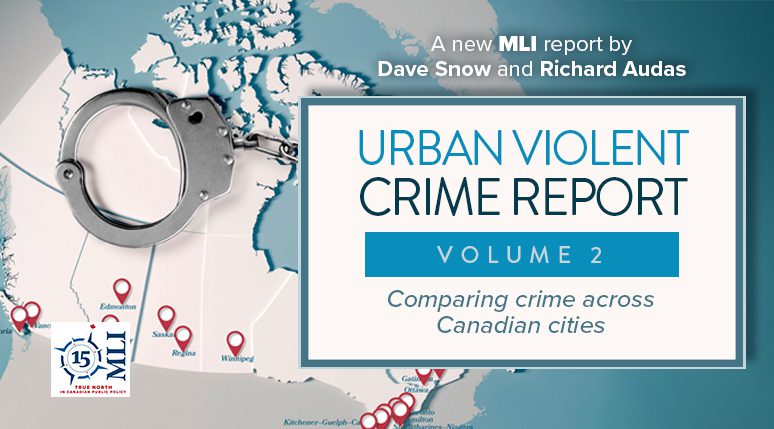
Urban Violent Crime Report, Volume 2: Comparing crime across Canadian cities

Canada is not immune to rising urban violence, and the latest evidence suggests that the problem is broader and more entrenched than many realize.

November 12, 2025
in Domestic Policy, Latest News, Papers, Justice, Dave Snow, Richard Audas
Reading Time: 6 mins read
A A
Urban Violent Crime Report, Volume 2: Comparing crime across Canadian cities

By Dave Snow and Richard Audas
November 12, 2025

PDF of paper

Executive Summary | Summary (French follows)

Violent crime in Canada’s cities has not only risen – it has become a growing threat affecting urban communities across the country.

While headlines often focus on year-to-year fluctuations in crime, the Urban Violent Crime Report, Volume 2 reveals a deeper and more troubling reality: over the past decade, violent crime has increased significantly across Canadian cities, spreading beyond Toronto, Vancouver, and Montreal to smaller urban centers once considered relatively safe.

This second volume in the Macdonald-Laurier Institute’s Urban Violent Crime series expands on our 2024 landmark study, Urban Violent Crime Report, Volume 1: A Look at Canada’s Major Cities, to include new comparative data from cities across nine provinces. It goes beyond last year’s analysis of nine major cities to now include 20 census metropolitan areas (CMAs) covering more than 65 per cent of the Canadian population. Combined with other recent studies showing a growth in Canadian property crime and a narrowing of Canada’s crime gap with the United States, our results reveal that the erosion of public safety in Canada is not a temporary urban anomaly, but part of a larger nationwide trend.

Our major findings include:

• Violent crime has increased across nearly all major urban centers over the past decade, confirming that the trend in Canada’s largest cities is part of a broader, nationwide shift.

• The sexual assault rate has substantially increased over the last decade: it is up across all 20 CMAs, with some CMAs experiencing a doubling of sexual assault rates in ten years.

• No city is immune. While Prairie CMAs and Atlantic centers recorded the highest violent-crime rates and severity indices, even regions with lower crime rates, such as Windsor, Quebec City, and Gatineau, have experienced substantial increases since 2015.

• There is a deep regional crisis: Prairie cities – Winnipeg, Regina, Saskatoon, and Edmonton – often record violent crime rates that are twice as high as other large CMAs (and in the case of Winnipeg, even higher).

• The geography of violent crime has shifted. Smaller and mid-sized CMAs – Halifax, Kitchener, Moncton, and St. John’s – are increasingly matching or even surpassing larger urban centers in violent-crime growth, indicating that the trend has diffused beyond the traditional hotspots.

The message is stark: Canada’s decade-long rise in violent crime is broad-based, sustained, and no longer confined to its largest cities. Canadians’ growing concerns about public safety are justified. The data confirm that media reports of urban violent crime are not isolated incidents, but part of a national pattern.

At a time when governments and police services face resource constraints, uneven enforcement capacity, and shifting lease and prosecution frameworks, our report offers an evidence-based picture of where and how violence is intensifying. By extending our analysis to 20 urban areas and distinguishing short-, medium-, and long-term trajectories, we provide policymakers with a reliable benchmark for understanding the scale of the problem – and for designing the next generation of public-safety and crime-reduction strategies.

Canada is not immune to rising urban violence, and the latest evidence suggests that the problem is broader and more entrenched than many realize. Policymakers can no longer rely on temporary explanations or regional anomalies. The challenge now is to restore public confidence and measurable accountability in how we protect our cities.


Les crimes violents dans les villes canadiennes n’ont pas seulement augmenté, ils sont devenus une menace croissante pour les communautés urbaines à travers le pays.

Si les manchettes des médias attirent souvent l’attention sur les variations d’année en année, ce deuxième tome de la série Urban Violent Crime révèle une réalité bien plus complexe et préoccupante  :  au cours de la décennie écoulée, la criminalité violente a beaucoup augmenté dans les villes canadiennes et s’étend désormais au-delà de Toronto, Vancouver et Montréal vers de petits centres urbains autrefois sûrs.

Le deuxième tome de cette série de l’Institut  Macdonald-Laurier  élargit l’étude historique de 2024 sur la criminalité urbaine au Canada grâce à de nouvelles données comparatives provenant de neuf provinces. Il va au-delà des neuf  principales villes canadiennes de l’an dernier en ajoutant 20  régions métropolitaines de recensement (RMR), soit plus de 65  % de la population canadienne. Conjointement avec d’autres études récentes montrant une hausse des infractions liées aux biens et une convergence des tendances canado-américaines en matière de criminalité, nos résultats indiquent que l’insécurité publique au Canada n’est pas seulement un problème urbain temporaire – il reflète une tendance nationale plus large.

Voici nos principales conclusions :

• L’augmentation des crimes violents dans la plupart des grands centres urbains au cours de la décennie écoulée vient confirmer un important virage à l›échelle nationale.

• Les taux d’agressions sexuelles ont fortement augmenté ces dix dernières années dans les 20 RMR, de plus du double dans certaines.

• Aucune ville n’est épargnée. Tandis que les RMR des Prairies et les centres de la région de l’Atlantique affichent les taux de criminalité et les indices de gravité les plus élevés, même les régions à taux de criminalité moindre comme Windsor, Québec et Gatineau ont connu de fortes hausses du nombre de crimes violents depuis 2015.

• Une crise régionale profonde sévit : les villes des Prairies – Winnipeg, Regina, Saskatoon et Edmonton – enregistrent fréquemment des taux de criminalité violente deux fois plus élevés que d’autres grandes RMR (et plus encore à Winnipeg).

• La criminalité violente a évolué géographiquement. Les petites et moyennes régions métropolitaines – Halifax, Kitchener, Moncton et St. John’s – rivalisent de plus en plus avec les grands centres urbains, voire affichent une croissance supérieure. Cela montre une extension de la tendance au-delà des « points chauds » habituels.

Le constat est clair : la hausse des crimes violents au Canada depuis dix ans est générale, soutenue et  désormais étendue à  tout le territoire. Les craintes croissantes concernant la sécurité publique sont justifiées. Les données confirment que les crimes violents médiatisés ne sont pas des incidents urbains isolés, mais s’inscrivent dans une tendance nationale.

À l’heure où les gouvernements et les services de police doivent composer avec  des contraintes budgétaires, des capacités  inégales et des cadres mouvants en matière de mise en liberté sous caution et de poursuites judiciaires,  notre étude offre une vision fondée de l’intensification de la violence, tant géographiquement que dans sa forme. En analysant 20 régions métropolitaines sur le court, moyen et long terme, nous fournissons aux décideurs des repères fiables pour comprendre l’importance du problème – et concevoir de nouvelles stratégies de sécurité publique et de réduction de la criminalité.

Le Canada n’est pas à l’abri de la montée de la violence urbaine, un problème plus vaste et plus  profond que beaucoup ne l’imaginent, mais bien documenté. Les politiciens ne peuvent plus s’en remettre à des explications rapides ou des anomalies régionales. Le défi est maintenant de regagner la confiance du public et de restaurer une responsabilisation prévisible pour protéger nos villes.

Read the full paper here:

Related Posts

Breakthrough Nation with Karen Restoule: Crystal Smith, Ep. 1
Energy

Breakthrough Nation with Karen Restoule: Crystal Smith, Ep. 1

December 12, 2025
Asia Map
Latest News

Survival in Trump, Xi and Putin’s ‘great power’ world: Stephen Nagy in the Japan Times

December 12, 2025
Westminster parliament
Domestic Policy

Dec. 11 is the day Canada gained autonomy. Progressives want us to forget: Christopher Dummitt in the National Post

December 11, 2025
Next Post
The CBC just got more government cash—good luck, private sector competitors: Peter Menzies in The Hub

The CBC just got more government cash—good luck, private sector competitors: Peter Menzies in The Hub

Newsletter Signup

  Thank you for Signing Up
  Please correct the marked field(s) below.
Email Address  *
1,true,6,Contact Email,2
First Name *
1,true,1,First Name,2
Last Name *
1,true,1,Last Name,2
*
*Required Fields

Follow us on

Macdonald-Laurier Institute

323 Chapel Street, Suite #300
Ottawa, Ontario, K1N 7Z2 Canada

613.482.8327

info@macdonaldlaurier.ca
MLI directory

Support Us

Support the Macdonald-Laurier Institute to help ensure that Canada is one of the best governed countries in the world. Click below to learn more or become a sponsor.

Support Us

  • Inside Policy Magazine
  • Annual Reports
  • Jobs
  • Privacy Policy

© 2023 Macdonald-Laurier Institute. All Rights reserved.

No Result
View All Result
  • Home
  • About
    • Who We Are
    • Who Makes MLI Work
    • Fifteenth Anniversary
  • Experts
    • Experts Directory
    • In Memoriam
  • Issues
    • Domestic Policy
      • Economic Policy
      • Justice
      • Rights and Freedoms
      • Assisted Suicide (MAID)
      • Health Care
      • COVID-19
      • Gender Identity
      • Canada’s Political Tradition
      • AI, Technology and Innovation
      • Media and Telecoms
      • Housing
      • Immigration
      • Agriculture and Agri-Food
      • Competition Policy
    • Energy Policy
      • Energy
      • Environment
    • Foreign Policy
      • Israel-Hamas War
      • Ukraine
      • Taiwan
      • China
      • Europe and Russia
      • Indo-Pacific
      • Middle East and North Africa
      • North America
      • Foreign Interference
      • National Defence
      • National Security
      • Foreign Affairs
    • Indigenous Affairs
  • Projects
    • CNAPS (Center for North American Prosperity and Security)
    • The Promised Land
    • Voices that Inspire: The Macdonald-Laurier Vancouver Speaker Series
    • Dragon at the door
    • Canada on top of the world
    • Letter to a minister
    • Justice Report Card
    • The Great Energy Crisis
    • DisInfoWatch.org
    • Managing Indigenous Prosperity
    • Judicial Foundations
    • Landmark Cases Council
    • Defending The Marketplace of Ideas
    • Reforming the University
    • Past Projects
      • Digital Policy & Connectivity
      • Double Trouble
      • Canada and the Indo-Pacific Initiative
      • The Transatlantic Program
      • COVID Misery Index
      • Speak for Ourselves
      • The Eavesdropping Dragon: Huawei
      • Talkin’ in the Free World with Mariam Memarsadeghi
      • An Intellectual Property Strategy for Canada
      • Munk Senior Fellows
      • A Mandate for Canada
      • Confederation Series
      • Fiscal Reform
      • The Canadian Century project
      • Fixing Canadian health care
      • Internal trade
      • From a mandate for change
      • Size of government in Canada
      • Straight Talk
      • Labour Market Report
      • Leading Economic Indicator
      • Centre for Advancing Canada’s Interests Abroad
      • Indigenous Prosperity at a Crossroads
  • Events
    • Upcoming Events
    • Past Events
      • MLI Dinners
      • Great Canadian Debates
  • Latest News
  • Libraries
    • Columns
    • Commentary
    • Papers
    • Books
    • Video
  • Donate

© 2023 Macdonald-Laurier Institute. All Rights reserved.