
This article originally appeared in The Hub.
By Paul W. Bennett, August 27, 2025
Grit—a term once synonymous with the work ethic—made a comeback nearly a decade ago thanks to Angela Duckworth’s best seller Grit: The Power of Passion and Perseverance. For a brief moment, it captured public attention with its focus on perseverance, tenacity, and ambition—all traits closely tied to conscientiousness. It was the psychologist’s “Grit Scale” which posited that adolescents and young adults who were high in grit were primed for life success.
Today, grit is back in the spotlight following a striking recent Financial Times column by journalist John Burn-Murdoch, highlighting the sharp decline in conscientiousness among Americans aged 16 to 39. A chart accompanying the piece—based on updated findings from the 2022 Understanding America Study (UAS)—revealed a marked drop in this personality trait among younger adults. It reinforced what many already suspected: the next generation appears less focused, more distracted, and increasingly less likely to follow through.
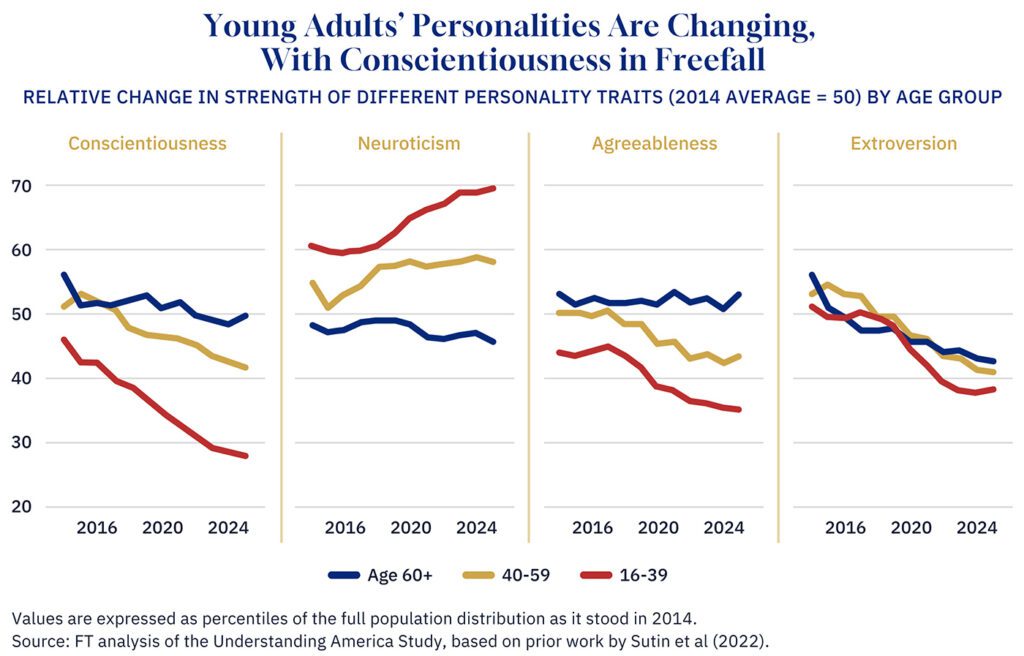
The age bracket in question actually spans two generations—Millennials (born 1980-1994) and Generation Z (born 1995-2012)—and the numbers are cause for worry. Young adults reported being less diligent, more careless, and far more prone to abandoning commitments. Yet before diving headlong into the usual generational blame game, it’s worth stepping back and unpacking the data to examine the deeper forces at play.
The rush to judgment
Predictably, instant analysts and social commentators pointed fingers at smartphones and digital media. Burn-Murdoch echoed the rising chorus shaped by Jonathan Haidt’s The Anxious Generation and other critiques of social media addiction, including my own Weapons of Mass Distraction. “Ubiquitous and hyper-engaging digital media,” Burn-Murdoch wrote, are encouraging distraction and making it easier than ever to abandon plans or avoid commitments altogether.
Indeed, the architecture of the online world undermines persistence. Instant access to information, entertainment, and social validation shortens attention spans and discourages sustained effort. Face-to-face interactions have been supplanted by ghosting, flaking, and fleeting digital ties—substitutes that diminish the value of consistency, follow-through, and grit.
The bigger picture
The decline in conscientiousness is not occurring in isolation. Psychographic researchers studying the “Big Five” personality traits—openness, conscientiousness, extroversion, agreeableness, and neuroticism (OCEAN)—have documented a range of shifts. Notably, neuroticism has risen sharply, likely fueled by the pandemic and the digital era’s mental health toll. Openness and extroversion have dipped, and young adults—once the most gregarious cohort—now report lower sociability than their elders.
Pandemic fallout is a factor. Extended school closures and prolonged social isolation during COVID-19 left a deep psychological imprint on those in their teens and twenties. The aftereffects are showing up in the data and can no longer be swept aside by policymakers.
It’s not so new
While the latest numbers appear startling, this trend has been building for years. Psychologist Jean Twenge’s 2006 book Generation Me flagged the early signs, documenting rising narcissism, entitlement, and discontent among younger cohorts. Twenge tied these patterns to a school system that, since the 1970s, emphasized self-esteem over effort, rewarded participation more than performance, and fostered a culture of entitlement.
Today’s dip in conscientiousness is just the latest chapter in a longer generational story—one shaped by changes in schooling, parenting, technology, and culture.
Reading into the data
The Financial Times chart, while visually compelling, paints a more dramatic picture than the underlying data may warrant. Data analysts like Ben Jourdan point out that it didn’t show absolute scores, but rather percentile rankings compared to a 2014 baseline. So, what looks like a steep drop reflects shifts relative to past norms—not an absolute collapse.
Further complicating matters is how conscientiousness is measured in the Understanding America Study (UAS). It’s based upon just nine self-reported items like “I see myself as someone who does a thorough job.” That kind of self-assessment is rife with biases. Older adults, with more life experience and confidence, may rate themselves higher—not because they’re objectively more conscientious, but because they have more experience than young adults.
Not all is lost. The UAS survey, based upon the OCEAN framework, tends to devalue traits found in more abundance among young adults. More open-ended analyses have highlighted other, more positive traits, depicting Millennials and Gen Z as more socially conscious and collaborative, tech-savvy, more purpose-driven, and flexible and attuned to work-life balance. In short, the forecast may not be as gloomy as that offered up in the Financial Times.
There’s also the economic context. As Jourdan noted, conscientiousness scores in the UAS study vary by income. Those facing financial hardship may not have the luxury of time to be meticulous or forward-thinking when survival is the priority.
The broader takeaway? Age alone doesn’t explain the decline. Factors like socio-economic status, education, job security, and mental health play critical roles in shaping survey responses.
A few lessons and a path forward
Yes, the data is troubling. An increasingly distracted, anxious, and commitment-averse generation is a poor match for the world’s current challenges—from economic crises and climate change to the erosion of democracy. But personality is not destiny. Traits like grit and conscientiousness are malleable. They can grow, given the right conditions.
Digital convenience and dopamine hits are hard to escape. Yet there’s always hope because attitudes and values can change. It may take a social transformation, accompanied and a new rewards system, if we are to set the next generation on a better, more purposeful, and satisfying future. That would help ensure that the truly conscientious do inherit the earth in the 21st century.
Paul W. Bennett, Ed.D., is director of the Schoolhouse Institute, a senior fellow at the Macdonald-Laurier Institute, and author of Weapons of Mass Distraction: Curbing Social Media Addiction and Reclaiming the Smartphone Generation.