On October 22, 2025, MLI’s director of energy, natural resources and environment testified before the House of Commons Standing Committee on Natural Resources. The following article is a lightly edited transcript of her opening statement.
By Heather Exner-Pirot
Although everyone depends on mining products in their daily lives, critical minerals have only become a hot topic in the past five years or so.
That is largely owing to, first, supply chain concerns raised by the COVID pandemic and later the Russian invasion of Ukraine; second, the desire to electrify transportation, and therefore develop more battery minerals; and most recently concerns about our overreliance on adversaries, particularly China, even in the basic materials needed for our defence industrial supply chain.
While our attention has become focused, our policy discourses, and thus responses, are still not at an appropriate level of sophistication.
The greatest demonstration of this is our bundling of 34 minerals and metals, half of the periodic table, into one broad category. The umbrella term ‘critical minerals’, sometimes even conflated with rare earths, is good for messaging but it is bad for policy nuance.
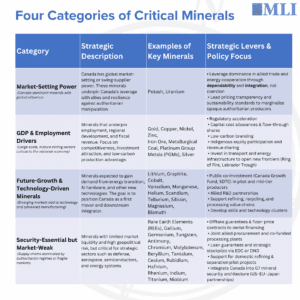
There are at least four categories of minerals that call for different strategic and policy responses.
The first is minerals in which Canada is dominant and has global market-setting power, in which I would include potash and uranium. How can we gain leverage with our allies or disrupt authoritarian manipulation in this category?
The second is minerals which are major GDP drivers for Canada. How can we enhance competitiveness, attract investment, and drive-up global market share in minerals such as gold, metallurgical coal, copper, and nickel?
The third is minerals for which technologies or market structures favour future growth, such as lithium, graphite, cobalt, helium, and silver. How can we ensure Canadian projects and companies are best positioned to take advantage of changes to the market cycle, and be first movers?
The fourth are minerals for which market structures are weak but security of supply is essential, such as gallium, germanium, tungsten, antimony and rare earths. What are the financial tools the state can use to develop supply in these commodities, by ourselves and with our allies?
In general, Canada has taken a disinterested and laissez faire approach to our minerals sector in the past decade, rather than treating it as a strategic industry to be cultivated and fortified.
Despite that, Canada retains many strengths that we can and should leverage going forward.
The first is endowment. As the second largest country in the world, we have a lot of geology and a lot of untapped reserves. We are the world’s top destination for exploration dollars. We need policies that make it as easy as possible to translate that mineral potential into economically competitive, and thus, producing projects. We don’t have that today.
The second is our strong mining business. The TSX and TSXV are home to about 40% of the world’s publicly listed mining companies, more than any other exchange in the world. This is leverage that we need to maintain and support through policies that attract anchor listings, ensure access to the biggest possible pool of foreign capital investment, and promote tax and regulatory competitiveness. Canada should want to be the first choice for mining companies to list and headquarter, but we have been losing that advantage.
The third is our geopolitical reputation. The world is obviously a more complicated place these days. Global superpowers are acting in a predatory manner. We are amongst wolves, but Canada does not need to be a sheep. In my opinion, our highest and best purpose is to use our mineral, energy, and agricultural potential to ensure our friends and allies have access to the materials they need to thrive and prosper, and fend off authoritarian manipulation and volatility.
To be that reliable supplier, Canada needs to produce more products competitively and get it to global markets more reliably.
Heather Exner-Pirot is director of energy, natural resources, and environment at the Macdonald-Laurier Institute.