Saturday, December 13, 2025
No Result
View All Result
  • Media
Macdonald-Laurier Institute
  • Home
  • About
    • Who We Are
    • Who Makes MLI Work
    • Fifteenth Anniversary
  • Experts
    • Experts Directory
    • In Memoriam
  • Issues
    • Domestic Policy
      • Economic Policy
      • Justice
      • Rights and Freedoms
      • Assisted Suicide (MAID)
      • Health Care
      • COVID-19
      • Gender Identity
      • Canada’s Political Tradition
      • AI, Technology and Innovation
      • Media and Telecoms
      • Housing
      • Immigration
      • Agriculture and Agri-Food
      • Competition Policy
    • Energy Policy
      • Energy
      • Environment
    • Foreign Policy
      • Israel-Hamas War
      • Ukraine
      • Taiwan
      • China
      • Europe and Russia
      • Indo-Pacific
      • Middle East and North Africa
      • North America
      • Foreign Interference
      • National Defence
      • National Security
      • Foreign Affairs
    • Indigenous Affairs
  • Projects
    • CNAPS (Center for North American Prosperity and Security)
    • The Promised Land
    • Voices that Inspire: The Macdonald-Laurier Vancouver Speaker Series
    • Dragon at the door
    • Canada on top of the world
    • Letter to a minister
    • Justice Report Card
    • The Great Energy Crisis
    • DisInfoWatch.org
    • Managing Indigenous Prosperity
    • Judicial Foundations
    • Landmark Cases Council
    • Defending The Marketplace of Ideas
    • Reforming the University
    • Past Projects
      • Digital Policy & Connectivity
      • Double Trouble
      • Canada and the Indo-Pacific Initiative
      • The Transatlantic Program
      • COVID Misery Index
        • Provincial COVID Misery Index
        • Beyond Lockdown
        • COVID and after: A mandate for recovery
      • Speak for Ourselves
      • The Eavesdropping Dragon: Huawei
      • Talkin’ in the Free World with Mariam Memarsadeghi
      • An Intellectual Property Strategy for Canada
      • Munk Senior Fellows
      • A Mandate for Canada
      • Confederation Series
      • Fiscal Reform
      • The Canadian Century project
      • Fixing Canadian health care
      • Internal trade
      • From a mandate for change
      • Size of government in Canada
      • Straight Talk
      • Labour Market Report
      • Leading Economic Indicator
      • Centre for Advancing Canada’s Interests Abroad
      • Indigenous Prosperity at a Crossroads
        • Aboriginal Canada and Natural Resources
  • Events
    • Upcoming Events
    • Past Events
      • MLI Dinners
      • Great Canadian Debates
  • Latest News
  • Libraries
    • Columns
    • Commentary
    • Papers
    • Books
    • Video
  • Donate
  • Home
  • About
    • Who We Are
    • Who Makes MLI Work
    • Fifteenth Anniversary
  • Experts
    • Experts Directory
    • In Memoriam
  • Issues
    • Domestic Policy
      • Economic Policy
      • Justice
      • Rights and Freedoms
      • Assisted Suicide (MAID)
      • Health Care
      • COVID-19
      • Gender Identity
      • Canada’s Political Tradition
      • AI, Technology and Innovation
      • Media and Telecoms
      • Housing
      • Immigration
      • Agriculture and Agri-Food
      • Competition Policy
    • Energy Policy
      • Energy
      • Environment
    • Foreign Policy
      • Israel-Hamas War
      • Ukraine
      • Taiwan
      • China
      • Europe and Russia
      • Indo-Pacific
      • Middle East and North Africa
      • North America
      • Foreign Interference
      • National Defence
      • National Security
      • Foreign Affairs
    • Indigenous Affairs
  • Projects
    • CNAPS (Center for North American Prosperity and Security)
    • The Promised Land
    • Voices that Inspire: The Macdonald-Laurier Vancouver Speaker Series
    • Dragon at the door
    • Canada on top of the world
    • Letter to a minister
    • Justice Report Card
    • The Great Energy Crisis
    • DisInfoWatch.org
    • Managing Indigenous Prosperity
    • Judicial Foundations
    • Landmark Cases Council
    • Defending The Marketplace of Ideas
    • Reforming the University
    • Past Projects
      • Digital Policy & Connectivity
      • Double Trouble
      • Canada and the Indo-Pacific Initiative
      • The Transatlantic Program
      • COVID Misery Index
        • Provincial COVID Misery Index
        • Beyond Lockdown
        • COVID and after: A mandate for recovery
      • Speak for Ourselves
      • The Eavesdropping Dragon: Huawei
      • Talkin’ in the Free World with Mariam Memarsadeghi
      • An Intellectual Property Strategy for Canada
      • Munk Senior Fellows
      • A Mandate for Canada
      • Confederation Series
      • Fiscal Reform
      • The Canadian Century project
      • Fixing Canadian health care
      • Internal trade
      • From a mandate for change
      • Size of government in Canada
      • Straight Talk
      • Labour Market Report
      • Leading Economic Indicator
      • Centre for Advancing Canada’s Interests Abroad
      • Indigenous Prosperity at a Crossroads
        • Aboriginal Canada and Natural Resources
  • Events
    • Upcoming Events
    • Past Events
      • MLI Dinners
      • Great Canadian Debates
  • Latest News
  • Libraries
    • Columns
    • Commentary
    • Papers
    • Books
    • Video
  • Donate
No Result
View All Result
Macdonald-Laurier Institute

The courts have delegitimized the Charter — it’s time to reclaim it: Mark Mancini in the National Post

The more the public perceives that judging is finger-in-the-wind preaching, the less legitimate the Charter will appear.

October 3, 2025
in Domestic Policy, Latest News, Columns, In the Media, Justice, Landmark Cases Council, Mark Mancini
Reading Time: 10 mins read
A A
The courts have delegitimized the Charter — it’s time to reclaim it: Mark Mancini in the National Post

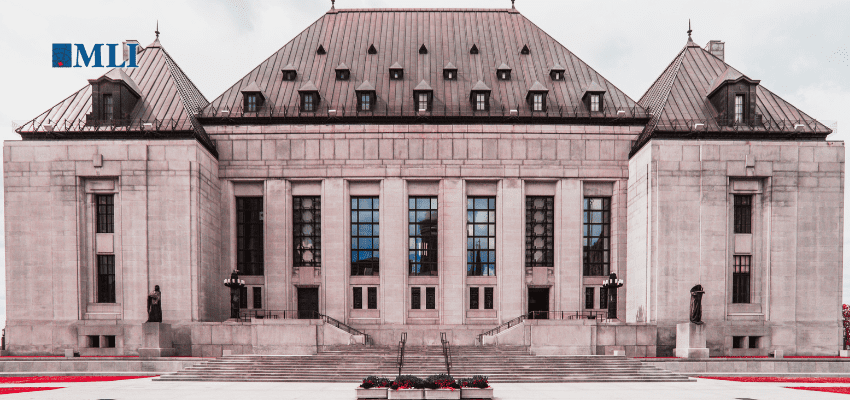
Image via Canva.

This article originally appeared in the National Post.

By Mark Mancini, October 3, 2025

Was the Charter of Rights and Freedoms a mistake? National Post columnist Carson Jerema thinks so. Writing in these pages last week, he argued that the Charter was a massive gift of power to the judiciary that allowed the august benches of the Supreme Court to replace our emasculated political chambers. Why bother with Parliament, when the real power is just a short walk down Wellington Street?

The theory behind an entrenched Charter of Rights — that the law should restrain majorities from violating fixed and judicially enforceable rights — is not imprudent, nor does it necessarily lead to absurd results like constitutionalizing bike lane policy. But the more that the public perceives that judging is finger-in-the-wind preaching, the less legitimate the Charter will appear.

So, it is worthwhile to think: how would judges have to behave for the Charter not to be a mistake? Consider two virtues that judges should cultivate under an entrenched constitution.

The first: judicial humility. Judges acting under an entrenched constitution carry great power. But their power is not measured by their own view of what is “best for Canadians.” Rather, the invalidation of democratically adopted laws is an extraordinary power that’s fraught with risk. Judges who do so should be disciplined by second thoughts and caution.

This should manifest, for example, in a sufficiently deferential attitude when courts are faced with balancing complex and incommensurate goods. This was something the Supreme Court of the early Charter era seemed to understand.

In the 1989 case, Irwin Toy Ltd. v. Quebec, the Supreme Court distinguished between cases where the rights of many groups must be balanced and cases where the state acts as a “singular antagonist of the individual,” such as in criminal law. There, the Charter has bite.

Humility, however, is not abdication. An entrenched constitution means that the majority will not always get what it wants, and judges will be in the unpopular position of enforcing rights for disfavoured groups. But where this occurs, the Supreme Court of an earlier generation understood that Charter review must be rigorous.

Consider the early case of Hunter v. Southam, the Supreme Court’s first foray into Sec. 8 of the Charter, which protects against unreasonable search and seizure. Then-justice Brian Dickson rejected the government’s argument that the Constitution permitted it to determine whether a search is “reasonable.”

The ancient common law protected a requirement that searches of property be legally authorized. The Charter expanded on this, guaranteeing a broad expectation of privacy. Dickson concluded that this expectation can only be measured by an independent judge — not the state.

It is no wonder that Dickson’s historically grounded approach to Sec. 8 continues to be used. It was applied recently to find that the federal government’s freezing of bank accounts under the Emergencies Act was unconstitutional. Even though the government evidently thought that this move was in the public good, rote recitations of that spell should not survive under an entrenched constitution.

The second virtue: judges should re-articulate what judicial decision-making means under a legally entrenched constitution.

The trade-off under the Charter was simple: the framers gave judges the power to review the substance of legislative action for conformity with the Charter, but judges, in turn, were given this power because they are experts in the law.

It is true that our constitutional law is, in part, unwritten, including principles like the rule of law, parliamentary sovereignty, federalism and the separation of powers. These are principles that we can trace throughout our legal history.

There is no escaping the fact that constitutional law involves the resolution of cases relying on these principles, and that is not easy or mechanical stuff. But as Supreme Court Justice Malcolm Rowe has emphasized, this judicial task is still guided by a “structured and deliberate methodology” that should be measurable by the bar and the public.

When cases inexplicably diverge from this methodology, the public is right to be alarmed. Public scrutiny and criticism of judicial decisions is — as one of Canada’s former chief justices once said — a “source of happiness.”

This virtue also entails respect for precedent and doctrine. Legal decision-making does not usually permit judges to take a fresh view of every case. Yet the Supreme Court has taken a rather generous approach to its own precedents, granting “benediction” to new rights as the mood strikes.

Courts operating under the Charter should be more circumspect. In the span of the common law, precedents rendered after 1982 are not old. Charter cases are not like milk — they do not have fixed expiry dates.

Some people think that the Charter is too far gone to be saved — that judges are so beholden to “Charteritis,” the view that constitutional law and civil rights began in 1982, that any attempt to dissuade them of these ideas would be foolish.

But encouraging judicial rigour is no more foolish than pursuing an ill-conceived process of constitutional amendment. The Charter itself is an achievement because it is hard to imagine, today, the possibility of a constitutional compromise of any kind.

But that alone will not sustain the Charter. The long road to more consistent adjudication must begin with law schools and the public. Law schools must get better at teaching that, as Asher Honickman points out, “Charter supremacy” is not our law.

Schools should focus on cultivating an understanding of the Charter as one aspect of the broader constitutional ecosystem. As Judge David Stratas recently argued in an important speech, this will create “headwinds” against judicial decisions that might distort the Charter.

As for the public, a constitution can degenerate to the point where it loses its substance, even if the outward appearance of it remains the same. When that occurs, no law or court can save it. Abraham Lincoln was right: to keep our Constitution, we must endeavour to create a “political religion” of “reverence for the laws.”

If politicians leave the impression that the Constitution is only legitimate when it accomplishes things they consider just, the law becomes a skin-suit for politics. If judges do not appeal to broadly accepted modes of reasoning, the Charter will rightly be perceived as an elite affectation.

If the Charter is to survive in hearts and minds, it will take a significant effort from those tasked with its application, and those subject to it. Respect for the law is not created overnight, but it can easily be lost in a generation. Those who believe in the value of an entrenched Charter should take heed.


Mark Mancini is an assistant professor in the faculty of law at Thompson Rivers University and a senior fellow at the Macdonald-Laurier Institute.


Source: National Post

Related Posts

Breakthrough Nation with Karen Restoule: Crystal Smith, Ep. 1
Energy

Breakthrough Nation with Karen Restoule: Crystal Smith, Ep. 1

December 12, 2025
Asia Map
Latest News

Survival in Trump, Xi and Putin’s ‘great power’ world: Stephen Nagy in the Japan Times

December 12, 2025
Westminster parliament
Domestic Policy

Dec. 11 is the day Canada gained autonomy. Progressives want us to forget: Christopher Dummitt in the National Post

December 11, 2025
Next Post
Canada’s whistleblower laws protect the corrupt, not the courageous: Garry Clement for Inside Policy

Canada’s whistleblower laws protect the corrupt, not the courageous: Garry Clement for Inside Policy

Newsletter Signup

  Thank you for Signing Up
  Please correct the marked field(s) below.
Email Address  *
1,true,6,Contact Email,2
First Name *
1,true,1,First Name,2
Last Name *
1,true,1,Last Name,2
*
*Required Fields

Follow us on

Macdonald-Laurier Institute

323 Chapel Street, Suite #300
Ottawa, Ontario, K1N 7Z2 Canada

613.482.8327

info@macdonaldlaurier.ca
MLI directory

Support Us

Support the Macdonald-Laurier Institute to help ensure that Canada is one of the best governed countries in the world. Click below to learn more or become a sponsor.

Support Us

  • Inside Policy Magazine
  • Annual Reports
  • Jobs
  • Privacy Policy

© 2023 Macdonald-Laurier Institute. All Rights reserved.

No Result
View All Result
  • Home
  • About
    • Who We Are
    • Who Makes MLI Work
    • Fifteenth Anniversary
  • Experts
    • Experts Directory
    • In Memoriam
  • Issues
    • Domestic Policy
      • Economic Policy
      • Justice
      • Rights and Freedoms
      • Assisted Suicide (MAID)
      • Health Care
      • COVID-19
      • Gender Identity
      • Canada’s Political Tradition
      • AI, Technology and Innovation
      • Media and Telecoms
      • Housing
      • Immigration
      • Agriculture and Agri-Food
      • Competition Policy
    • Energy Policy
      • Energy
      • Environment
    • Foreign Policy
      • Israel-Hamas War
      • Ukraine
      • Taiwan
      • China
      • Europe and Russia
      • Indo-Pacific
      • Middle East and North Africa
      • North America
      • Foreign Interference
      • National Defence
      • National Security
      • Foreign Affairs
    • Indigenous Affairs
  • Projects
    • CNAPS (Center for North American Prosperity and Security)
    • The Promised Land
    • Voices that Inspire: The Macdonald-Laurier Vancouver Speaker Series
    • Dragon at the door
    • Canada on top of the world
    • Letter to a minister
    • Justice Report Card
    • The Great Energy Crisis
    • DisInfoWatch.org
    • Managing Indigenous Prosperity
    • Judicial Foundations
    • Landmark Cases Council
    • Defending The Marketplace of Ideas
    • Reforming the University
    • Past Projects
      • Digital Policy & Connectivity
      • Double Trouble
      • Canada and the Indo-Pacific Initiative
      • The Transatlantic Program
      • COVID Misery Index
      • Speak for Ourselves
      • The Eavesdropping Dragon: Huawei
      • Talkin’ in the Free World with Mariam Memarsadeghi
      • An Intellectual Property Strategy for Canada
      • Munk Senior Fellows
      • A Mandate for Canada
      • Confederation Series
      • Fiscal Reform
      • The Canadian Century project
      • Fixing Canadian health care
      • Internal trade
      • From a mandate for change
      • Size of government in Canada
      • Straight Talk
      • Labour Market Report
      • Leading Economic Indicator
      • Centre for Advancing Canada’s Interests Abroad
      • Indigenous Prosperity at a Crossroads
  • Events
    • Upcoming Events
    • Past Events
      • MLI Dinners
      • Great Canadian Debates
  • Latest News
  • Libraries
    • Columns
    • Commentary
    • Papers
    • Books
    • Video
  • Donate

© 2023 Macdonald-Laurier Institute. All Rights reserved.