By Geoff Russ, April 15, 2026
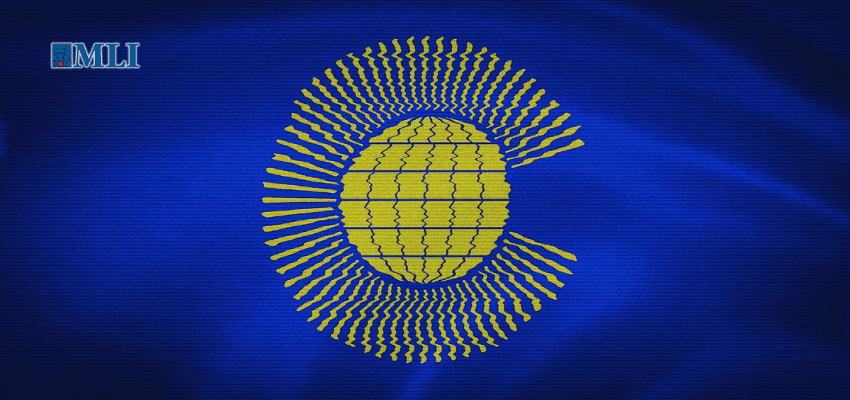
Canada has no business being part of the Commonwealth of Nations.
Its most redeeming feature is the Commonwealth Games, first held in Hamilton, Ontario, in 1930 when they were referred to as the British Empire Games. The Commonwealth touts the games as “world-class,” and this is fairly accurate, drawing in athletes from more than 70 nations and territories to compete against each other.
Beyond that, the Commonwealth is not a real political community. It has no business existing outside of padding the stats of track-and-field runners.
The Commonwealth has no common purpose, unless one counts the collective calls for reparations from its sizable contingent of members from the Global South. At the 2024 Summit, Commonwealth leaders opened talks on so-called “reparatory justice” for the transatlantic slave trade, which the British Royal Navy ended in the 1860s, at great cost.
The climate is certainly ripe for such shakedowns. On March 25, Ghana led a push at the UN General Assembly for another set of reparations. Ghana introduced a vote at the General Assembly that called the transatlantic slave trade “the gravest crime against humanity.” In that regard, the Mongol warlord Genghis Khan might have given the slave trade some competition. He is estimated to have killed more than 40 million people across Eurasia between 1205 and his death in 1227.
However, historical literacy is not in the mandate of either the UN or the Commonwealth, and resentment is a shoddy basis for multilateralism. It is not in Canada’s national interest to treat either organization as a meaningful forum for political action.
If using moral blackmail to bilk the British for billions of pounds is to be the modern Commonwealth’s defining theme, Canada had best leave it. Ideally, this would start the organization’s formal disintegration.
When it began in its modern form in 1949, a basic assumption of the Commonwealth was that, on balance, the British Empire espoused good principles that were worth upholding.
At the time, a generation of postcolonial leaders like India’s Jawaharlal Nehru, Pakistan’s Muhammad Ali Jinnah, and Singapore’s Lee Kuan Yew, had lived or been educated in England. They were decidedly Anglophilic to varying degrees, even as they sought independence for their homelands.
One of the Commonwealth’s greatest champions was the South African leader Jan Smuts, an Afrikaner who had actually fought the British in the Boer War from 1899 to 1902.
Smuts imagined the Commonwealth as a harmonious successor of the Empire, and a partnership of self-governing, liberal nations. He died in 1950, never living to see Commonwealth co-members like India and Pakistan go to war multiple times. Neither did he see the modern drift of so many Commonwealth member states towards authoritarian governance, or into the orbit of Russia or China.
Pakistan is not shy about cozying up to Russian President Vladimir Putin, with Moscow openly praising Russian ties to Pakistan as “genuinely mutually beneficial.” Both are now negotiating a deepening partnership regarding energy, which goes directly against Western interests.
Smuts’ own South Africa is another offender in this regard. Since 1994, the country has been governed by the African National Congress (ANC), a historically communist party that was allied with the Soviet Union. It has sought to retain the benefits of Western economic ties while deepening its relations with Russia, and it does so publicly. Also among South Africa’s list of friends are Iran and China.
What sort of political family is this? Canada, Britain, Australia, and others are firmly behind Ukraine in its war with Russia, oppose the Iranian regime, and are, hopefully, wary of China’s growing influence and what it means for them. The solution to such dysfunctional families is a divorce.
The Canada-Australia-New Zealand-United Kingdom (CANZUK) proposal is an imperfect concept, but it is far superior. It would not be nearly as unwieldy and morally corrupt as the Commonwealth, and it shares far more in terms of culture, history, and alignment.
All the countries are of British heritage, and share language, political, and legal structures. CANZUK International’s official website touts the common law, the monarchy, and parliamentary government as ties that bind the prospective states.
The CANZUK four were the imperial core of the old Empire, growing as settler colonies rather than as garrisoned outposts of resource extraction. Why not add “Anglo” or “British” culture to the list of benefits?
We certainly have benefited from that, and most people, including CANZUK’s left-wing critics, can see the clear cultural and historical similarities among the four prospective member countries. CANZUK’s proponents should simply own the obvious. A purely propositional union lacks a certain appeal to the heart and cultural memory of the populations of its prospective members.
Furthermore, CANZUK’s procedural appeals, like freedom of movement and trade, as well as a more deeply aligned foreign policy, run the risk of sounding redundant. Given the fraught state of immigration across the English-speaking world, promising freedom of movement is more a detriment than a selling point.
The proposed CANZUK states are also already well integrated on trade and intelligence-sharing.
In 2024, Britain joined the Comprehensive and Progressive Agreement for Trans-Pacific Partnership (CPTPP). Formerly the Trans-Pacific Partnership, it also contains Australia, New Zealand, and Canada alongside a number of friendly nations in the Pacific.
On intelligence, the CANZUK four are also part of the Five Eyes alignment alongside the United States, and both Australia and New Zealand are regional partners of NATO.
However, despite its flaws as a proposition, CANZUK is worth pursuing.
Canada and Britain signed the Trade Continuity Agreement (TCA) in 2020. CANZUK itself has dangled the possibility of “a more integrated marketplace of over 136 million people with a combined nominal GDP exceeding US$8.3 trillion,” which is nothing to sneeze at, even if only partially realized.
The Five Eyes itself is not an actual alliance, despite often being described as such, and does not extend beyond sharing intelligence. Australia and New Zealand’s place as mere regional partners of NATO is worth reconsidering in light of rising Chinese aggression.
There is unoccupied space for deepened defence and security co-operation among the CANZUK four, so long as it is realistic and does not become another bloated, supranational bureaucracy. Fusing and combining our existing commitments to each other into a single organization could be a welcome change, so long as we drop the ones that make no sense anymore.
From that place of strength, CANZUK can reestablish partnerships with former imperial possessions of its choosing. Ideally these include those who are not genuine or aspirational basket cases, like Singapore, Kenya, and the United States.
However, CANZUK’s strongest justification right now is a civilizational one, not a tidier, tighter version of the stagnant Commonwealth.
It is strange that no official international organization exists for a deeper partnership between culturally Anglo countries. That only extends to the ones that never felt the need to undergo revolutionary “decolonization,” or aggressively cast off their heritage, even if some radical activists are today making headway in that regard.
For those who value this heritage, be it philosophical, literary, or cultural, CANZUK should foster these ties. Without proposing a schedule of programming, the first and essential goal is establishing robust and compelling justifications for the existence of Anglo civilization, even if that means running against powerful forces that want it to disappear.
For example, Dennis Danielson, an emeritus professor of English at the University of British Columbia who was born in Victoria, penned a letter to Victoria’s Times Colonist newspaper in 2023.
“I’ve always been a colonial … and I’m proud of my identity,” he wrote. “Many people whose first language was something else have gone to the trouble of learning English for themselves – so many, in fact, that it’s now spoken and understood all around the world. You could call it the Common Tongue. (Which is not to diminish the riches of all those other languages that people speak. Diversity’s good, eh?)”
Danielson mentioned his pride in both the Union Jack he waved as a child in a city named for Queen Victoria, and his equal pride in the modern Maple Leaf flag. In response, his fellow readers raked Danielson over the coals – they found his personal affirmation to be heinous, and demanded that he “decolonize” his mind.
Far from being the great villain of “colonial” history, this civilization produced some of the best governed and most prosperous societies on the planet. The norms of trust, good neighbourly relations, and a spirit of adventure were as crucial to the CANZUK four’s flourishing as parliamentary government, liberal economics, and the rule of law. Leafy green neighbourhoods that do not require security fences around houses, or compel families to supply themselves with firearms for self-defence, are as much about culture as they are about material prosperity.
Another goal could be the rehabilitation of explorers like James Cook, a man who charted the shores of Canada, Australia, and New Zealand.
It must be said that such a project should not be based on crude biology. People can think and embrace cultures and civilizations honestly, while those that belong to those same cultures and civilizations often reject them. The elected leaders who helped pave the way for the sidelining, or outright denigration, of Anglo and traditional civilization were Anglos themselves. They include names like Paul Keating, Lester Pearson, and Jacinda Ardern, whose families have deep colonial roots in Australia, Canada, and New Zealand, respectively.
People who have little or no physical Anglo ancestry are among the foremost proponents of CANZUK, and fiercely oppose the ideologies of “decolonization,” post-nationalism, and Third-Worldism. Pushing back against those ideologies will require a coalition of the willing, and attempting to exclude people on the basis of their parentage is intellectually bankrupt and strategically wrong.
The first step towards recovering a healthy sense of our history and national cultures is to admit that our forebears bear the responsibility for its decline. From there, those mistakes can be corrected.
It is still far easier for Canada to trust Australia, New Zealand, and Britain than it is to trust other members of the Commonwealth. We can understand each other on a legal, political, and cultural basis that is not shared with South Africa, Pakistan, or even republican Ireland. Nonetheless, propositional ideals only go so far in rallying a common heritage across continents. The question is whether or not Anglo civilization and identity will endure, and have champions to lead the way?
CANZUK should embrace our shared, non-propositional roots more forcefully, lest it come to be solely remembered as an acronym for an idea without a soul that never came to fruition.
Prime Minister Mark Carney has repeatedly praised Canada’s “proud British heritage” as part of the “bedrock” of our Founding Peoples. Opposition leader Pierre Poilievre recently travelled to England to praise the legacy of Magna Carta and the tradition of liberty. Both are welcome developments, but words are just that without action.
If the Commonwealth has become a soapbox for hostile grievances and moral blackmail from dubious fellow members, CANZUK can do better. It could restore the sense of common purpose among an extended civilization, one that men like Jan Smuts once championed
As imperfect as the CANZUK idea is today, it is worth pursuing. The world is realigning and the latest crisis in the Middle-East has made it clear that Canada cannot afford to sit on its hands. At the domestic level, wanting Canada to actually mean something makes CANZUK even more appealing.
Geoff Russ is a writer, policy analyst, and contributor for the Macdonald-Laurier Institute.