Thursday, July 2, 2026
No Result
View All Result
  • Media
Macdonald-Laurier Institute
  • Home
  • About
    • Who We Are
    • Who Makes MLI Work
    • Fifteenth Anniversary
  • Experts
    • Experts Directory
    • In Memoriam
  • Issues
    • Domestic Policy
      • Economic Policy
      • Justice
      • Rights and Freedoms
      • Assisted Suicide (MAID)
      • Health Care
      • COVID-19
      • Gender Identity
      • Canada’s Political Tradition
      • AI, Technology and Innovation
      • Media and Telecoms
      • Housing
      • Immigration
      • Agriculture and Agri-Food
      • Competition Policy
    • Energy Policy
      • Energy
      • Environment
    • Foreign Policy
      • Israel-Hamas War
      • Ukraine
      • Taiwan
      • China
      • Europe and Russia
      • Indo-Pacific
      • Middle East and North Africa
      • North America
      • Foreign Interference
      • National Defence
      • National Security
      • Foreign Affairs
    • Indigenous Affairs
  • Projects
    • CNAPS (Center for North American Prosperity and Security)
    • Justice Report Card
    • The Promised Land
    • Dragon at the door
    • Canada on top of the world
    • Letter to a minister
    • The Great Energy Crisis
    • DisInfoWatch.org
    • Managing Indigenous Prosperity
    • Judicial Foundations
    • Landmark Cases Council
    • Defending The Marketplace of Ideas
    • Reforming the University
    • Digital Policy & Connectivity
    • Past Projects
      • Double Trouble
      • Canada and the Indo-Pacific Initiative
      • The Transatlantic Program
      • COVID Misery Index
        • Provincial COVID Misery Index
        • Beyond Lockdown
        • COVID and after: A mandate for recovery
      • Speak for Ourselves
      • The Eavesdropping Dragon: Huawei
      • Talkin’ in the Free World with Mariam Memarsadeghi
      • An Intellectual Property Strategy for Canada
      • Munk Senior Fellows
      • A Mandate for Canada
      • Confederation Series
      • Fiscal Reform
      • The Canadian Century project
      • Fixing Canadian health care
      • Internal trade
      • From a mandate for change
      • Size of government in Canada
      • Straight Talk
      • Labour Market Report
      • Leading Economic Indicator
      • Centre for Advancing Canada’s Interests Abroad
      • Indigenous Prosperity at a Crossroads
        • Aboriginal Canada and Natural Resources
  • Events
    • Voices that Inspire: The Macdonald-Laurier Vancouver Speaker Series
    • Upcoming Events
    • Past Events
      • MLI Dinners
      • Great Canadian Debates
  • Latest News
  • Libraries
    • Columns
    • Commentary
    • Papers
    • Books
    • Video
  • Donate
  • Home
  • About
    • Who We Are
    • Who Makes MLI Work
    • Fifteenth Anniversary
  • Experts
    • Experts Directory
    • In Memoriam
  • Issues
    • Domestic Policy
      • Economic Policy
      • Justice
      • Rights and Freedoms
      • Assisted Suicide (MAID)
      • Health Care
      • COVID-19
      • Gender Identity
      • Canada’s Political Tradition
      • AI, Technology and Innovation
      • Media and Telecoms
      • Housing
      • Immigration
      • Agriculture and Agri-Food
      • Competition Policy
    • Energy Policy
      • Energy
      • Environment
    • Foreign Policy
      • Israel-Hamas War
      • Ukraine
      • Taiwan
      • China
      • Europe and Russia
      • Indo-Pacific
      • Middle East and North Africa
      • North America
      • Foreign Interference
      • National Defence
      • National Security
      • Foreign Affairs
    • Indigenous Affairs
  • Projects
    • CNAPS (Center for North American Prosperity and Security)
    • Justice Report Card
    • The Promised Land
    • Dragon at the door
    • Canada on top of the world
    • Letter to a minister
    • The Great Energy Crisis
    • DisInfoWatch.org
    • Managing Indigenous Prosperity
    • Judicial Foundations
    • Landmark Cases Council
    • Defending The Marketplace of Ideas
    • Reforming the University
    • Digital Policy & Connectivity
    • Past Projects
      • Double Trouble
      • Canada and the Indo-Pacific Initiative
      • The Transatlantic Program
      • COVID Misery Index
        • Provincial COVID Misery Index
        • Beyond Lockdown
        • COVID and after: A mandate for recovery
      • Speak for Ourselves
      • The Eavesdropping Dragon: Huawei
      • Talkin’ in the Free World with Mariam Memarsadeghi
      • An Intellectual Property Strategy for Canada
      • Munk Senior Fellows
      • A Mandate for Canada
      • Confederation Series
      • Fiscal Reform
      • The Canadian Century project
      • Fixing Canadian health care
      • Internal trade
      • From a mandate for change
      • Size of government in Canada
      • Straight Talk
      • Labour Market Report
      • Leading Economic Indicator
      • Centre for Advancing Canada’s Interests Abroad
      • Indigenous Prosperity at a Crossroads
        • Aboriginal Canada and Natural Resources
  • Events
    • Voices that Inspire: The Macdonald-Laurier Vancouver Speaker Series
    • Upcoming Events
    • Past Events
      • MLI Dinners
      • Great Canadian Debates
  • Latest News
  • Libraries
    • Columns
    • Commentary
    • Papers
    • Books
    • Video
  • Donate
No Result
View All Result
Macdonald-Laurier Institute

The biggest financial transfer in Canada that nobody talks about: Trevor Tombe in The Hub

Why Alberta and B.C. are Canada’s biggest brain drain beneficiaries.

July 2, 2026
in Domestic Policy, Columns, Latest News, Intergovernmental Affairs, In the Media, Economic Policy, Trevor Tombe
Reading Time: 5 mins read
A A
The biggest financial transfer in Canada that nobody talks about: Trevor Tombe in The Hub

Image via Canva.

This article originally appeared in The Hub.

By Trevor Tombe, July 2, 2026

Canadians move around a lot. In 2025, more than 316,000 of us moved from one province to another. Alberta gained about 78,000, Ontario about 76,000, and British Columbia about 56,000. Zoom out, and the numbers are larger still: the last census found that nearly one million people had changed provinces in the previous five years, and nearly 3.8 million Canadians now live outside their province of birth.

People move for all sorts of reasons—a better job, a more affordable home, or to be closer to family. But one reason stands out. When Statistics Canada asked, employment was the most common answer, cited by nearly 43 percent of households that moved across provinces. Among younger Canadians, it matters even more. Close to 60 percent of millennials who crossed a provincial border did so for work.

This naturally means provinces with stronger economies attract many who leave provinces with weaker ones. For some provinces, the outflow is striking. About 636,000 people were born in Newfoundland and Labrador, but only 438,000 still live there. That’s 31 percent who have left. Across Atlantic Canada, the average is about 28 percent. In Saskatchewan, it’s higher still: of 1.23 million people born in the province, fewer than 800,000 remain—more than one in three have gone.

Where they go is just as telling. Of the 3.1 million Canadian-born people living in Alberta, more than 30 percent were born elsewhere. B.C. is close behind at 29 percent.
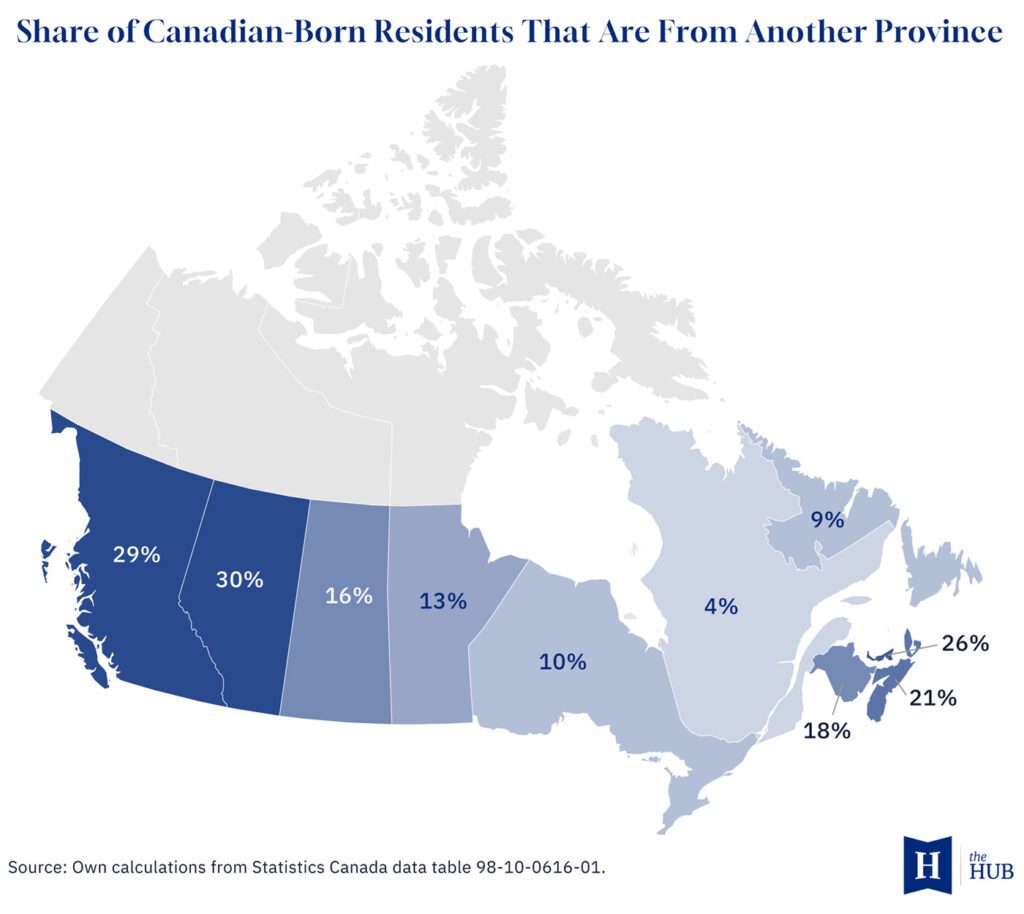
Graphic Credit: Janice Nelson.

This is good for the country. Moves like these help by matching workers’ skills to employers’ needs. But when people move, they take more than their belongings. They take their education and skills with them. That’s massively valuable human capital that one province pays for, and another gets to use.

By my rough estimate, more than $800 billion in taxpayer-funded education (valued at today’s costs) now sits outside the province that paid for it.

This is effectively one of the largest and least-discussed transfers in the federation, with huge implications for how many (especially those in Alberta) might view their province’s place in Confederation.

Putting a price on it

To get a sense of the magnitude, I make a few rough assumptions.

Start with primary and secondary schooling, where each year of such education costs taxpayers about $16,000 per student. Over 12 years, that’s over $190,000 per high-school graduate at today’s costs. The real figure varies by province, and not everyone finishes, but this is a useful benchmark.

Now add post-secondary, which is roughly another $16,000 per year in taxpayer funding per student. Not everyone goes that far, of course, but roughly two-thirds of those over 25 do. Roughly half of Canadians aged 25 to 64 have either a diploma, certificate, or bachelor’s degree. And another 14 percent have a graduate degree.

Put K-12 schooling and post-secondary together, and a rough estimate of the taxpayer-funded education behind the average Canadian adult is around $260,000. Even after adjusting for the ages of the people who actually move, the figure still averages roughly $220,000 per migrant.

That’s massive. Multiply that by the 3.8 million Canadians living outside their province of birth, and you get more than $800 billion in taxpayer-funded human capital now located outside the province that paid the bill.

This is a very rough estimate, to be clear, but the sheer scale of it is what matters. And it doesn’t even count the private human capital investments that individuals and businesses make, nor the value of education provided to new Canadians who first lived as children in another province. It also ignores the value of education provided to people who left for studies and then returned. All that aside, the transfers of human capital are still staggering.

Which provinces win?

Because migrants flow so heavily toward Alberta and B.C., I estimate that about half of that total is in just those two provinces. That’s roughly $200 billion of taxpayer-funded human capital in each—equivalent to more than half of each province’s entire GDP.

To be fair, the flow runs both ways. Alberta and B.C. also educate people who later leave. But that outflow is worth less. For B.C., the net gain after subtracting those who leave still exceeds $130 billion. For Alberta, it’s nearly $100 billion. Every other province, taken together, loses close to $230 billion. As a share of the economy, the gains are substantial: about one-third of B.C.’s and one-quarter of Alberta’s. Elsewhere, the losses are heavier still. They equal roughly 45 percent of GDP across Atlantic Canada— and a staggering 87 percent in Newfoundland and Labrador.
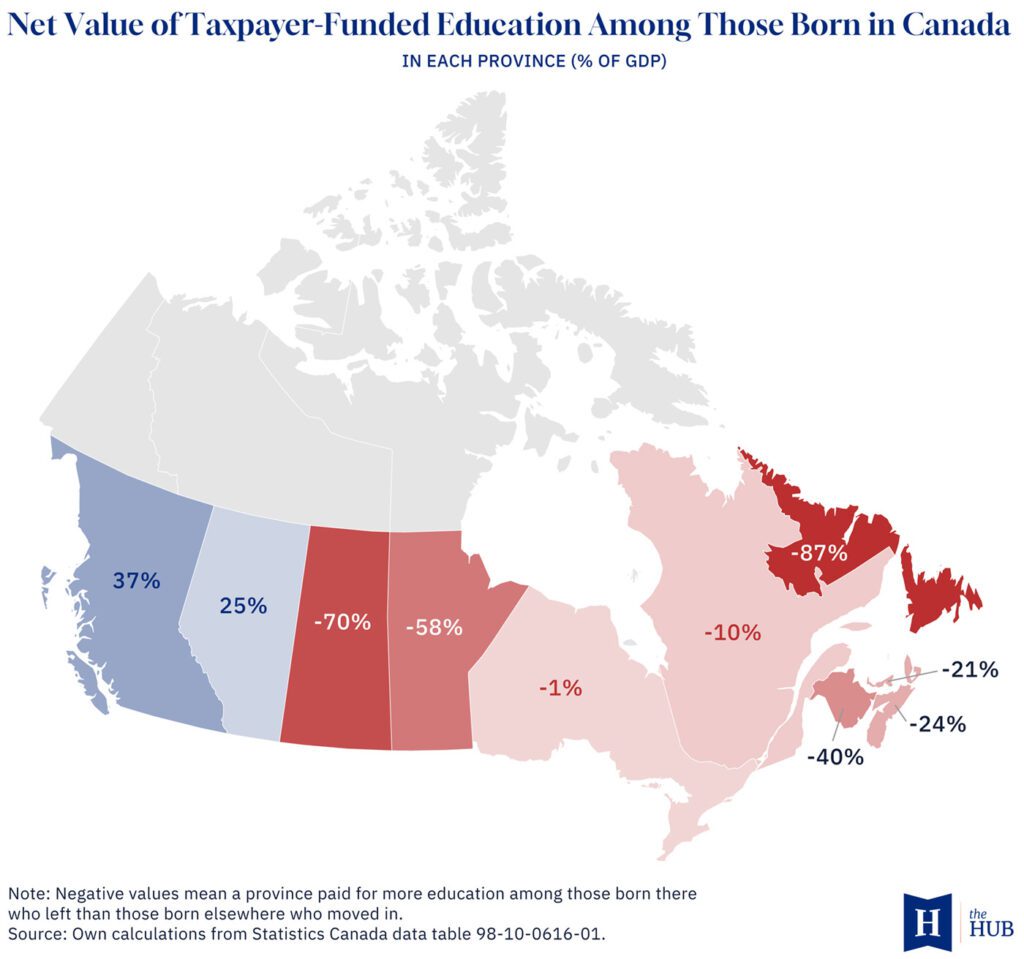
Graphic Credit: Janice Nelson.

Simply put, the brain gains are concentrated in Alberta and B.C., while the brain drain is borne by the rest of the country.

What it means for Confederation

All of this points to why programs that help every province deliver comparable public services matter. Equalization has real flaws and can be improved in many ways. But the underlying principle that each province should have the resources to provide comparable services and education benefits the whole country. It especially benefits strong economies like Alberta’s and B.C.’s.

Consider the scale. In Alberta, the number of residents born elsewhere in Canada, minus the number who left, exceeds 10 percent of the province’s entire population. In B.C., it’s higher still, around 12 percent. The provinces on the other side of that ledger (mainly in Atlantic Canada, but also Manitoba and Saskatchewan) shouldn’t have to carry the full cost of education alone. The payoff from all that education, in more productivity, stronger labour markets, higher incomes (and the income taxes that follow), and so on, flows mostly to Alberta and B.C.

I’ve written often here at The Hub about the value of interprovincial trade. Labour mobility matters just as much, with millions of Canadians now living and working outside their province of birth. That matters as debates over Confederation heat up—especially in Alberta, where much of the talent driving its prosperity arrived pre-paid.


Trevor Tombe is a professor of economics at the University of Calgary, the Director of Fiscal and Economic Policy at The School of Public Policy, a Senior Fellow at the Macdonald-Laurier Institute, and a Fellow at the Public Policy Forum.

Source: The Hub

Related Posts

Trump’s drug price push exposes Canada’s pricing flaws: John Adams and Nigel Rawson for Inside Policy
Health

Trump’s drug price push exposes Canada’s pricing flaws: John Adams and Nigel Rawson for Inside Policy

July 2, 2026
The ownership economy: Kristan Straub and Karen Restoule for Breakthrough Nation
Domestic Policy

The ownership economy: Kristan Straub and Karen Restoule for Breakthrough Nation

June 30, 2026
Justice delayed – Nearly 60% of violent crime cases are stayed or withdrawn in Canada: Dave Snow in The Hub
Justice

Justice delayed – Nearly 60% of violent crime cases are stayed or withdrawn in Canada: Dave Snow in The Hub

June 30, 2026
Next Post
Trump’s drug price push exposes Canada’s pricing flaws: John Adams and Nigel Rawson for Inside Policy

Trump’s drug price push exposes Canada’s pricing flaws: John Adams and Nigel Rawson for Inside Policy

Newsletter Signup

  Thank you for Signing Up
  Please correct the marked field(s) below.
Email Address  *
1,true,6,Contact Email,2
First Name *
1,true,1,First Name,2
Last Name *
1,true,1,Last Name,2
*
*Required Fields

Follow us on

Macdonald-Laurier Institute

323 Chapel Street, Suite #300
Ottawa, Ontario, K1N 7Z2 Canada

613.482.8327

info@macdonaldlaurier.ca
MLI directory

Support Us

Support the Macdonald-Laurier Institute to help ensure that Canada is one of the best governed countries in the world. Click below to learn more or become a sponsor.

Support Us

  • Inside Policy Magazine
  • Annual Reports
  • Jobs
  • Privacy Policy

© 2023 Macdonald-Laurier Institute. All Rights reserved.

This site uses cookies. By continuing to browse the site you are agreeing to our use of cookies.

Privacy Preference Center

Consent Management

Necessary

Advertising

Analytics

Other

No Result
View All Result
  • Home
  • About
    • Who We Are
    • Who Makes MLI Work
    • Fifteenth Anniversary
  • Experts
    • Experts Directory
    • In Memoriam
  • Issues
    • Domestic Policy
      • Economic Policy
      • Justice
      • Rights and Freedoms
      • Assisted Suicide (MAID)
      • Health Care
      • COVID-19
      • Gender Identity
      • Canada’s Political Tradition
      • AI, Technology and Innovation
      • Media and Telecoms
      • Housing
      • Immigration
      • Agriculture and Agri-Food
      • Competition Policy
    • Energy Policy
      • Energy
      • Environment
    • Foreign Policy
      • Israel-Hamas War
      • Ukraine
      • Taiwan
      • China
      • Europe and Russia
      • Indo-Pacific
      • Middle East and North Africa
      • North America
      • Foreign Interference
      • National Defence
      • National Security
      • Foreign Affairs
    • Indigenous Affairs
  • Projects
    • CNAPS (Center for North American Prosperity and Security)
    • Justice Report Card
    • The Promised Land
    • Dragon at the door
    • Canada on top of the world
    • Letter to a minister
    • The Great Energy Crisis
    • DisInfoWatch.org
    • Managing Indigenous Prosperity
    • Judicial Foundations
    • Landmark Cases Council
    • Defending The Marketplace of Ideas
    • Reforming the University
    • Digital Policy & Connectivity
    • Past Projects
      • Double Trouble
      • Canada and the Indo-Pacific Initiative
      • The Transatlantic Program
      • COVID Misery Index
      • Speak for Ourselves
      • The Eavesdropping Dragon: Huawei
      • Talkin’ in the Free World with Mariam Memarsadeghi
      • An Intellectual Property Strategy for Canada
      • Munk Senior Fellows
      • A Mandate for Canada
      • Confederation Series
      • Fiscal Reform
      • The Canadian Century project
      • Fixing Canadian health care
      • Internal trade
      • From a mandate for change
      • Size of government in Canada
      • Straight Talk
      • Labour Market Report
      • Leading Economic Indicator
      • Centre for Advancing Canada’s Interests Abroad
      • Indigenous Prosperity at a Crossroads
  • Events
    • Voices that Inspire: The Macdonald-Laurier Vancouver Speaker Series
    • Upcoming Events
    • Past Events
      • MLI Dinners
      • Great Canadian Debates
  • Latest News
  • Libraries
    • Columns
    • Commentary
    • Papers
    • Books
    • Video
  • Donate

© 2023 Macdonald-Laurier Institute. All Rights reserved.