OTTAWA, ON (April 21, 2026):
Russia is positioning its coast guard as a key instrument to control access to Arctic waters and assert its geopolitical ambitions, according to a new report from the Macdonald-Laurier Institute.
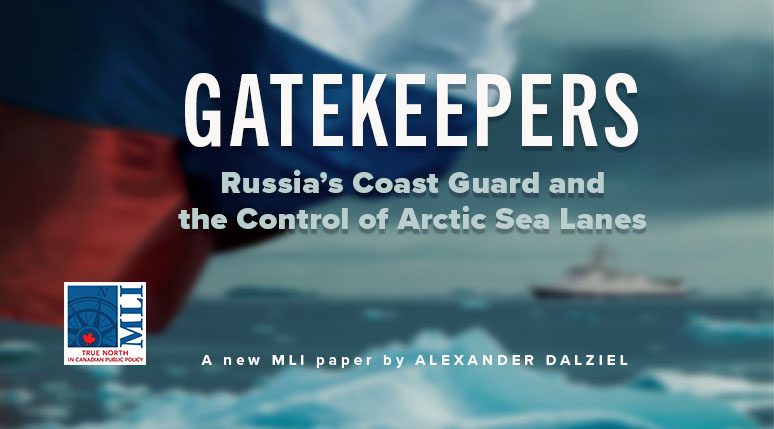
In Gatekeepers: Russia’s Coast Guard and the control of Arctic sea lanes, Alexander Dalziel examines how the Russian Coast Guard (RCG) is being modernized and deployed to support the Kremlin’s strategy in the Arctic, particularly its effort to dominate the Northern Sea Route (NSR).
The report finds that the RCG, formally a law enforcement agency, is taking on an expanded geopolitical role. While “not a military agency,” it has “a military-like culture – and low-end military capabilities,” allowing it to operate in contested “grey zones” below the threshold of open conflict.
A central focus of the report is the Northern Sea Route, a shipping lane running from the Bering Strait to the Barents Sea. Russia aims to control this route and “dictate who can use the Northern Sea Route (NSR) shipping lane that runs through it.”
To achieve this, the RCG is being equipped and trained for more assertive operations. According to the report, Russia is preparing its coast guard crews to operate in “the ‘grey zones’ of international law,” carrying out high-intensity “law enforcement” actions that can advance state objectives without triggering direct military conflict.
Dalziel warns that without improved monitoring and coordination between Canada, the United States, and their NATO allies, the Russian Coast Guard will assert control over Arctic access through its hybrid and grey-zone activities.
To learn more, read the full paper here:

Alexander Dalziel is a senior fellow at the Macdonald-Laurier Institute with over 20 years of experience in Canada’s national security community.
For further information, media are invited to contact:
Skander Belouizdad
Communications Officer
(613) 482-8327 x111
Skander.belouizdad@macdonaldlaurier.ca