Tuesday, April 21, 2026
No Result
View All Result
  • Media
Macdonald-Laurier Institute
  • Home
  • About
    • Who We Are
    • Who Makes MLI Work
    • Fifteenth Anniversary
  • Experts
    • Experts Directory
    • In Memoriam
  • Issues
    • Domestic Policy
      • Economic Policy
      • Justice
      • Rights and Freedoms
      • Assisted Suicide (MAID)
      • Health Care
      • COVID-19
      • Gender Identity
      • Canada’s Political Tradition
      • AI, Technology and Innovation
      • Media and Telecoms
      • Housing
      • Immigration
      • Agriculture and Agri-Food
      • Competition Policy
    • Energy Policy
      • Energy
      • Environment
    • Foreign Policy
      • Israel-Hamas War
      • Ukraine
      • Taiwan
      • China
      • Europe and Russia
      • Indo-Pacific
      • Middle East and North Africa
      • North America
      • Foreign Interference
      • National Defence
      • National Security
      • Foreign Affairs
    • Indigenous Affairs
  • Projects
    • CNAPS (Center for North American Prosperity and Security)
    • Justice Report Card
    • The Promised Land
    • Voices that Inspire: The Macdonald-Laurier Vancouver Speaker Series
    • Dragon at the door
    • Canada on top of the world
    • Letter to a minister
    • The Great Energy Crisis
    • DisInfoWatch.org
    • Managing Indigenous Prosperity
    • Judicial Foundations
    • Landmark Cases Council
    • Defending The Marketplace of Ideas
    • Reforming the University
    • Past Projects
      • Digital Policy & Connectivity
      • Double Trouble
      • Canada and the Indo-Pacific Initiative
      • The Transatlantic Program
      • COVID Misery Index
        • Provincial COVID Misery Index
        • Beyond Lockdown
        • COVID and after: A mandate for recovery
      • Speak for Ourselves
      • The Eavesdropping Dragon: Huawei
      • Talkin’ in the Free World with Mariam Memarsadeghi
      • An Intellectual Property Strategy for Canada
      • Munk Senior Fellows
      • A Mandate for Canada
      • Confederation Series
      • Fiscal Reform
      • The Canadian Century project
      • Fixing Canadian health care
      • Internal trade
      • From a mandate for change
      • Size of government in Canada
      • Straight Talk
      • Labour Market Report
      • Leading Economic Indicator
      • Centre for Advancing Canada’s Interests Abroad
      • Indigenous Prosperity at a Crossroads
        • Aboriginal Canada and Natural Resources
  • Events
    • Upcoming Events
    • Past Events
      • MLI Dinners
      • Great Canadian Debates
  • Latest News
  • Libraries
    • Columns
    • Commentary
    • Papers
    • Books
    • Video
  • Donate
  • Home
  • About
    • Who We Are
    • Who Makes MLI Work
    • Fifteenth Anniversary
  • Experts
    • Experts Directory
    • In Memoriam
  • Issues
    • Domestic Policy
      • Economic Policy
      • Justice
      • Rights and Freedoms
      • Assisted Suicide (MAID)
      • Health Care
      • COVID-19
      • Gender Identity
      • Canada’s Political Tradition
      • AI, Technology and Innovation
      • Media and Telecoms
      • Housing
      • Immigration
      • Agriculture and Agri-Food
      • Competition Policy
    • Energy Policy
      • Energy
      • Environment
    • Foreign Policy
      • Israel-Hamas War
      • Ukraine
      • Taiwan
      • China
      • Europe and Russia
      • Indo-Pacific
      • Middle East and North Africa
      • North America
      • Foreign Interference
      • National Defence
      • National Security
      • Foreign Affairs
    • Indigenous Affairs
  • Projects
    • CNAPS (Center for North American Prosperity and Security)
    • Justice Report Card
    • The Promised Land
    • Voices that Inspire: The Macdonald-Laurier Vancouver Speaker Series
    • Dragon at the door
    • Canada on top of the world
    • Letter to a minister
    • The Great Energy Crisis
    • DisInfoWatch.org
    • Managing Indigenous Prosperity
    • Judicial Foundations
    • Landmark Cases Council
    • Defending The Marketplace of Ideas
    • Reforming the University
    • Past Projects
      • Digital Policy & Connectivity
      • Double Trouble
      • Canada and the Indo-Pacific Initiative
      • The Transatlantic Program
      • COVID Misery Index
        • Provincial COVID Misery Index
        • Beyond Lockdown
        • COVID and after: A mandate for recovery
      • Speak for Ourselves
      • The Eavesdropping Dragon: Huawei
      • Talkin’ in the Free World with Mariam Memarsadeghi
      • An Intellectual Property Strategy for Canada
      • Munk Senior Fellows
      • A Mandate for Canada
      • Confederation Series
      • Fiscal Reform
      • The Canadian Century project
      • Fixing Canadian health care
      • Internal trade
      • From a mandate for change
      • Size of government in Canada
      • Straight Talk
      • Labour Market Report
      • Leading Economic Indicator
      • Centre for Advancing Canada’s Interests Abroad
      • Indigenous Prosperity at a Crossroads
        • Aboriginal Canada and Natural Resources
  • Events
    • Upcoming Events
    • Past Events
      • MLI Dinners
      • Great Canadian Debates
  • Latest News
  • Libraries
    • Columns
    • Commentary
    • Papers
    • Books
    • Video
  • Donate
No Result
View All Result
Macdonald-Laurier Institute

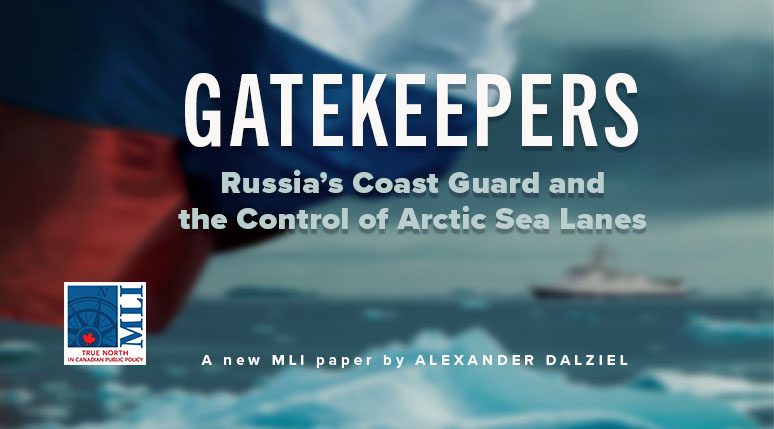
Gatekeepers: Russia’s Coast Guard and the control of Arctic sea lanes

Russia is expanding its control over key Arctic sea routes through a modernized coast guard.

April 21, 2026
in Foreign Affairs, Foreign Policy, Latest News, National Defence, Alexander Dalziel, Europe and Russia, Papers, Arctic
Reading Time: 5 mins read
A A
Gatekeepers file background

By Alexander Dalziel
April 21, 2026

PDF of paper

Executive Summary | Sommaire (le français suit)

Coast guards are essential to all Arctic countries. Whether it is security patrols, law enforcement, search and rescue or supplying remote communities, countries adapt their coast guards to fill the many roles that the Arctic’s unique and challenging conditions and characteristics demand. Russia is positioning itself to be the world’s gateway to Arctic waters. The Russian Coast Guard (RCG) is one element in the Kremlin’s strategy to shape the region’s future.

The RCG is being modernized with ice-capable ships to advance two of the most important dimensions of Russia’s Arctic grand strategy: locking down the Russian exclusive economic zone (EEZ) in the Arctic, and dictating who can use the Northern Sea Route (NSR) shipping lane that runs through it from the Bering Strait to the Barents Sea. In this agenda, the RCG is a low-profile but high-value asset. Primarily a border security police force, it is part of one of Russia’s most powerful ministries, the Federal Security Service (FSB). While not a military agency, it has a military-like culture – and low-end military capabilities.

Russia is prepping the RCG’s crews – known as maritime border guards – to aid in this mission in the “grey zones” of international law. Official publications tell them that they are ensuring Russia’s border and economic security in a hostile world of Western states looking to encroach on Russia’s “rights” in the Arctic. To that end, Russia is priming the RCG fleet to work in icy seas and conduct high-intensity “law enforcement” actions. These actions will enable the FSB Border Service spetsnaz – Russian high-end police and special forces – to fight terrorism and sabotage. These same capabilities, however, set the RCG up to be a “hybrid warfare” tool that can advance Russian goals in the sea lanes of the Arctic below the threshold of open conflict.

China has been a pioneer of aggressive hybrid zone warfare in the contested waters of the western Pacific Ocean. Its Coast Guard has become the RCG’s main international partner since 2022. They signed a co-operation agreement in 2023 and sailed together in Russia’s eastern Arctic waters in 2024, illustrating that Russia is willing to indulge an armed Chinese state presence in the region.

The approaches to the NSR and Russia’s Arctic EEZ in the Arctic, Pacific and Atlantic Oceans are also strategic zones for Canada, the United States and NATO. Off NATO-ally Norway, the Barents Sea is Russia’s access lane to the North Atlantic and nearby is the Kola Peninsula, which hosts a large portion of Russia’s nuclear arsenal. At the other end of the Arctic, the Bering Strait is where China, Russia, and the United States meet – and is a crucial passageway connecting west-coast ports to the western Canadian Arctic. The RCG will be active at these intersections – making it a factor in the maritime security considerations of Canada, the United States, NATO and North Pacific partners like South Korea and Japan.


Les gardes-côtes sont essentiels pour tous les pays arctiques. Qu’il s’agisse de patrouilles de sécurité, d’application de la loi, de recherche et sauvetage ou d’approvisionnement des communautés éloignées, les pays adaptent leurs gardes-côtes pour remplir les nombreux rôles que les conditions et caractéristiques uniques et difficiles de l’Arctique exigent. La Russie se positionne pour être la porte d’entrée mondiale des eaux arctiques. La Garde côtière russe (RCG) est un élément de la stratégie du Kremlin pour façonner l’avenir de la région.

La GCR modernise sa flotte en acquérant des navires capables de se déplacer en eaux glacées, afin d’appuyer deux aspects clés de la grande stratégie arctique de la Russie : le bouclage de la zone économique exclusive russe dans l’Arctique et le contrôle de l’accès à la route qui la traverse, du détroit de Béring jusqu’à la mer de Barents. Dans ce contexte, si le rôle de la GCR est peu voyant, il est tout de même de grande valeur. Avant tout une force de police frontalière, la GCR est subordonnée au puissant Service fédéral de sécurité (FSB). Il ne s’agit pas d’une organisation militaire, mais elle possède une culture – et des capacités de base sur ce plan.

La Russie prépare les équipages de la GCR – les garde-frontières maritimes – pour les « zones grises » du droit international. Selon les publications officielles, ils assurent la sécurité frontalière et économique de la Russie dans un monde inhospitalier, les États occidentaux cherchant à empiéter sur les « droits » russes dans l’Arctique. Ce serait pourquoi la Russie enligne cette flotte pour des missions dans les eaux glacées et des opérations de « maintien de l’ordre » à grande échelle. Ces opérations habiliteront les spetsnaz – unités d’élite des forces spéciales russes – du Service des frontières du FSB à combattre le terrorisme et le sabotage. Ces mêmes capacités feront toutefois de la GCR un instrument de « guerre hybride » destiné à atteindre les objectifs russes dans l’Arctique sans déclencher de conflit ouvert.

La Chine a été à l’avant-garde de la guerre d’agression hybride dans les zones contestées de l’océan Pacifique occidental. Sa garde côtière est devenue le principal partenaire international de la GCR en 2022. Les deux pays ont cosigné un accord de coopération en 2023 et ont navigué ensemble dans les eaux de l’Arctique oriental russe en 2024, ce qui démontre que la Russie est disposée à tolérer une présence étatique chinoise armée dans la région.

Les approches de la route maritime du Nord et de la zone économique exclusive russe dans les océans Arctique, Pacifique et Atlantique représentent également des zones stratégiques importantes pour le Canada, les États-Unis et l’OTAN. Au large de la Norvège, membre de l’OTAN, la mer de Barents représente pour la Russie un corridor vers l’Atlantique Nord; à sa proximité immédiate se situe la péninsule de Kola, qui abrite une partie importante de son arsenal nucléaire. À l’extrémité opposée, le détroit de Béring constitue un point de convergence géopolitique entre la Chine, la Russie et les États‐Unis – également un passage crucial reliant les ports de la côte ouest à l’Arctique occidental canadien. La GCR sera présente à ces intersections – et sera un élément à considérer dans le cadre des enjeux liés à la sécurité maritime du Canada, des États‐Unis, de l’OTAN et des partenaires dans le Pacifique Nord, notamment la Corée du Sud et le Japon.


 

Related Posts

The care deficit: Peter Copeland in Fairer Disputations
Domestic Policy

The care deficit: Peter Copeland in Fairer Disputations

April 21, 2026
The West can’t wrap its head around Islam: Melanie Phillips and Casey Babb for Inside Policy Talks
National Security

The West can’t wrap its head around Islam: Melanie Phillips and Casey Babb for Inside Policy Talks

April 16, 2026
Canada’s Anti-American Defense Industrial Strategy: Daniel Dorman and Jamie Tronnes in the National Review
National Defence

Canada’s Anti-American Defense Industrial Strategy: Daniel Dorman and Jamie Tronnes in the National Review

April 16, 2026
Next Post
The care deficit: Peter Copeland in Fairer Disputations

The care deficit: Peter Copeland in Fairer Disputations

Newsletter Signup

  Thank you for Signing Up
  Please correct the marked field(s) below.
Email Address  *
1,true,6,Contact Email,2
First Name *
1,true,1,First Name,2
Last Name *
1,true,1,Last Name,2
*
*Required Fields

Follow us on

Macdonald-Laurier Institute

323 Chapel Street, Suite #300
Ottawa, Ontario, K1N 7Z2 Canada

613.482.8327

info@macdonaldlaurier.ca
MLI directory

Support Us

Support the Macdonald-Laurier Institute to help ensure that Canada is one of the best governed countries in the world. Click below to learn more or become a sponsor.

Support Us

  • Inside Policy Magazine
  • Annual Reports
  • Jobs
  • Privacy Policy

© 2023 Macdonald-Laurier Institute. All Rights reserved.

This site uses cookies. By continuing to browse the site you are agreeing to our use of cookies.

Privacy Preference Center

Consent Management

Necessary

Advertising

Analytics

Other

No Result
View All Result
  • Home
  • About
    • Who We Are
    • Who Makes MLI Work
    • Fifteenth Anniversary
  • Experts
    • Experts Directory
    • In Memoriam
  • Issues
    • Domestic Policy
      • Economic Policy
      • Justice
      • Rights and Freedoms
      • Assisted Suicide (MAID)
      • Health Care
      • COVID-19
      • Gender Identity
      • Canada’s Political Tradition
      • AI, Technology and Innovation
      • Media and Telecoms
      • Housing
      • Immigration
      • Agriculture and Agri-Food
      • Competition Policy
    • Energy Policy
      • Energy
      • Environment
    • Foreign Policy
      • Israel-Hamas War
      • Ukraine
      • Taiwan
      • China
      • Europe and Russia
      • Indo-Pacific
      • Middle East and North Africa
      • North America
      • Foreign Interference
      • National Defence
      • National Security
      • Foreign Affairs
    • Indigenous Affairs
  • Projects
    • CNAPS (Center for North American Prosperity and Security)
    • Justice Report Card
    • The Promised Land
    • Voices that Inspire: The Macdonald-Laurier Vancouver Speaker Series
    • Dragon at the door
    • Canada on top of the world
    • Letter to a minister
    • The Great Energy Crisis
    • DisInfoWatch.org
    • Managing Indigenous Prosperity
    • Judicial Foundations
    • Landmark Cases Council
    • Defending The Marketplace of Ideas
    • Reforming the University
    • Past Projects
      • Digital Policy & Connectivity
      • Double Trouble
      • Canada and the Indo-Pacific Initiative
      • The Transatlantic Program
      • COVID Misery Index
      • Speak for Ourselves
      • The Eavesdropping Dragon: Huawei
      • Talkin’ in the Free World with Mariam Memarsadeghi
      • An Intellectual Property Strategy for Canada
      • Munk Senior Fellows
      • A Mandate for Canada
      • Confederation Series
      • Fiscal Reform
      • The Canadian Century project
      • Fixing Canadian health care
      • Internal trade
      • From a mandate for change
      • Size of government in Canada
      • Straight Talk
      • Labour Market Report
      • Leading Economic Indicator
      • Centre for Advancing Canada’s Interests Abroad
      • Indigenous Prosperity at a Crossroads
  • Events
    • Upcoming Events
    • Past Events
      • MLI Dinners
      • Great Canadian Debates
  • Latest News
  • Libraries
    • Columns
    • Commentary
    • Papers
    • Books
    • Video
  • Donate

© 2023 Macdonald-Laurier Institute. All Rights reserved.