Saturday, December 13, 2025
No Result
View All Result
  • Media
Macdonald-Laurier Institute
  • Home
  • About
    • Who We Are
    • Who Makes MLI Work
    • Fifteenth Anniversary
  • Experts
    • Experts Directory
    • In Memoriam
  • Issues
    • Domestic Policy
      • Economic Policy
      • Justice
      • Rights and Freedoms
      • Assisted Suicide (MAID)
      • Health Care
      • COVID-19
      • Gender Identity
      • Canada’s Political Tradition
      • AI, Technology and Innovation
      • Media and Telecoms
      • Housing
      • Immigration
      • Agriculture and Agri-Food
      • Competition Policy
    • Energy Policy
      • Energy
      • Environment
    • Foreign Policy
      • Israel-Hamas War
      • Ukraine
      • Taiwan
      • China
      • Europe and Russia
      • Indo-Pacific
      • Middle East and North Africa
      • North America
      • Foreign Interference
      • National Defence
      • National Security
      • Foreign Affairs
    • Indigenous Affairs
  • Projects
    • CNAPS (Center for North American Prosperity and Security)
    • The Promised Land
    • Voices that Inspire: The Macdonald-Laurier Vancouver Speaker Series
    • Dragon at the door
    • Canada on top of the world
    • Letter to a minister
    • Justice Report Card
    • The Great Energy Crisis
    • DisInfoWatch.org
    • Managing Indigenous Prosperity
    • Judicial Foundations
    • Landmark Cases Council
    • Defending The Marketplace of Ideas
    • Reforming the University
    • Past Projects
      • Digital Policy & Connectivity
      • Double Trouble
      • Canada and the Indo-Pacific Initiative
      • The Transatlantic Program
      • COVID Misery Index
        • Provincial COVID Misery Index
        • Beyond Lockdown
        • COVID and after: A mandate for recovery
      • Speak for Ourselves
      • The Eavesdropping Dragon: Huawei
      • Talkin’ in the Free World with Mariam Memarsadeghi
      • An Intellectual Property Strategy for Canada
      • Munk Senior Fellows
      • A Mandate for Canada
      • Confederation Series
      • Fiscal Reform
      • The Canadian Century project
      • Fixing Canadian health care
      • Internal trade
      • From a mandate for change
      • Size of government in Canada
      • Straight Talk
      • Labour Market Report
      • Leading Economic Indicator
      • Centre for Advancing Canada’s Interests Abroad
      • Indigenous Prosperity at a Crossroads
        • Aboriginal Canada and Natural Resources
  • Events
    • Upcoming Events
    • Past Events
      • MLI Dinners
      • Great Canadian Debates
  • Latest News
  • Libraries
    • Columns
    • Commentary
    • Papers
    • Books
    • Video
  • Donate
  • Home
  • About
    • Who We Are
    • Who Makes MLI Work
    • Fifteenth Anniversary
  • Experts
    • Experts Directory
    • In Memoriam
  • Issues
    • Domestic Policy
      • Economic Policy
      • Justice
      • Rights and Freedoms
      • Assisted Suicide (MAID)
      • Health Care
      • COVID-19
      • Gender Identity
      • Canada’s Political Tradition
      • AI, Technology and Innovation
      • Media and Telecoms
      • Housing
      • Immigration
      • Agriculture and Agri-Food
      • Competition Policy
    • Energy Policy
      • Energy
      • Environment
    • Foreign Policy
      • Israel-Hamas War
      • Ukraine
      • Taiwan
      • China
      • Europe and Russia
      • Indo-Pacific
      • Middle East and North Africa
      • North America
      • Foreign Interference
      • National Defence
      • National Security
      • Foreign Affairs
    • Indigenous Affairs
  • Projects
    • CNAPS (Center for North American Prosperity and Security)
    • The Promised Land
    • Voices that Inspire: The Macdonald-Laurier Vancouver Speaker Series
    • Dragon at the door
    • Canada on top of the world
    • Letter to a minister
    • Justice Report Card
    • The Great Energy Crisis
    • DisInfoWatch.org
    • Managing Indigenous Prosperity
    • Judicial Foundations
    • Landmark Cases Council
    • Defending The Marketplace of Ideas
    • Reforming the University
    • Past Projects
      • Digital Policy & Connectivity
      • Double Trouble
      • Canada and the Indo-Pacific Initiative
      • The Transatlantic Program
      • COVID Misery Index
        • Provincial COVID Misery Index
        • Beyond Lockdown
        • COVID and after: A mandate for recovery
      • Speak for Ourselves
      • The Eavesdropping Dragon: Huawei
      • Talkin’ in the Free World with Mariam Memarsadeghi
      • An Intellectual Property Strategy for Canada
      • Munk Senior Fellows
      • A Mandate for Canada
      • Confederation Series
      • Fiscal Reform
      • The Canadian Century project
      • Fixing Canadian health care
      • Internal trade
      • From a mandate for change
      • Size of government in Canada
      • Straight Talk
      • Labour Market Report
      • Leading Economic Indicator
      • Centre for Advancing Canada’s Interests Abroad
      • Indigenous Prosperity at a Crossroads
        • Aboriginal Canada and Natural Resources
  • Events
    • Upcoming Events
    • Past Events
      • MLI Dinners
      • Great Canadian Debates
  • Latest News
  • Libraries
    • Columns
    • Commentary
    • Papers
    • Books
    • Video
  • Donate
No Result
View All Result
Macdonald-Laurier Institute

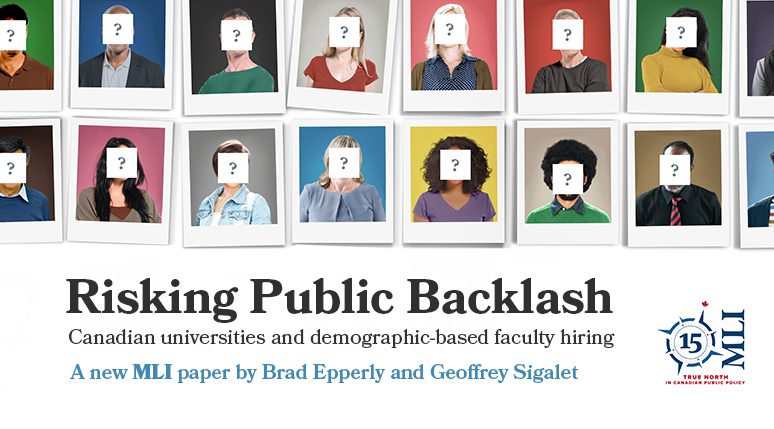
Risking public backlash? Canadian universities and demographic-based faculty hiring

While research shows that Canadians broadly support the values of diversity, equity, and inclusion, studies reveal that a supermajority consistently opposes hiring practices based on demographic criteria.

December 3, 2025
in Domestic Policy, Latest News, Papers, Social Issues, Education, Reforming Universities, Geoffrey Sigalet
Reading Time: 5 mins read
A A
Risking public backlash? Canadian universities and demographic-based faculty hiring

By Brad Epperly and Geoffrey Sigalet

December 3, 2025

PDF of paper

Executive Summary | Sommaire (le français suit)

Canadian universities routinely use demographic criteria to restrict who is eligible for a faculty position. How do these policies shape public attitudes towards the university sector?

Canada’s universities are facing growing public and political scrutiny, a trend recently highlighted in hearings before the House of Commons Standing Committee on Science and Research. Critics are beginning to question the wisdom of diversity policies in academia, particularly those involving “demographic-based hiring,” where characteristics such as sex, race, religion, or sexual orientation are used in selecting or excluding candidates.

While research shows that Canadians broadly support the values of diversity, equity, and inclusion, studies reveal that a supermajority consistently opposes hiring practices based on demographic criteria. Despite this clear disconnect, Canadian universities continue to embed such policies in their strategic plans. However, until now, no research has examined how public attitudes shift when people learn about the practical implementation of these policies in Canadian universities.

Our experimental research shows how learning about these hiring practices affects Canadian public opinion, and the results should be especially worrying to advocates of demographic-based hiring. This research has three main findings:

• First, presenting Canadians with a neutral statement regarding how demographic-based hiring is used in higher education causes a significant decline in support for such practices; these causal effects are both substantively large and highly statistically significant.

• Second, presenting Canadians with an advocacy statement in support of demographic-based hiring fails to increase public support for the practice; the effect is substantively small and statistically significant.

• Third, providing neutral information on demographic-based hiring practices causes a notable, statistically significant decrease in how much Canadians trust the research universities produce.

The primary policy implications are straightforward:

• As Canadians learn more details about how demographic-based hiring practices are used in the university sector, their support declines. This suggests that the already-high levels of opposition to the practice could go higher.

• Information that explicitly advocates for these policies and says they are important does not persuade Canadians that these policies are desirable.

• Our experimental evidence indicates at least one clear downside: demographic-based hiring policies substantially decrease public trust in the research universities produce.

Proponents of demographic-based hiring practices should approach these findings with openness and self-reflection. The results suggest that current arguments for demographic-based hiring practices have not persuaded the majority of Canadians who oppose them, and that not all diversity initiatives are equally popular or low-risk. Pushing forward in the face of widespread public resistance risks eroding trust in higher education. If universities become a partisan flashpoint, they could face reduced public funding and increased scrutiny of international student programs, undermining long-term institutional stability.

Finally, the wisdom of spending substantial public funds on hiring practices opposed by most citizens warrants serious reconsideration. Public opposition grows stronger when people learn how these policies operate, raising questions about their democratic legitimacy. Any defence of such initiatives must address both their high cost and their growing unpopularity.


Les universités canadiennes recourent couramment à des critères démographiques pour sélectionner les candidats à un poste d’enseignement. Comment ces politiques modèlentelles l’opinion publique sur le secteur universitaire?

Les universités font l’objet d’une surveillance publique et politique croissante, une tendance qui ressort des récentes audiences devant le Comité permanent des sciences et de la recherche de la Chambre des communes. Les voix critiques commencent à interroger le bien-fondé des politiques de diversité dans le milieu académique et notamment du « recrutement démographique » qui cible les candidats en fonction de leur genre, de leur race, de leur religion ou de leur orientation sexuelle.

Si les recherches montrent que les Canadiens appuient généralement les valeurs de diversité, d’équité et d’inclusion, la grande majorité s’oppose systématiquement aux pratiques d’embauche fondées sur des critères démographiques. Or, malgré la dichotomie évidente, les universités les intègrent toujours dans leurs plans stratégiques. Pourtant, aucune étude n’a encore analysé comment se comporte l’opinion publique lorsqu’elle apprend leur mise en œuvre.

Nos travaux expérimentaux montrent à quel point la connaissance de ces pratiques d’embauche influe sur l’opinion publique canadienne, ce qui devrait préoccuper ses partisans. Notre recherche permet de dégager les trois grandes conclusions suivantes :

• Tout d’abord, lorsqu’on présente aux Canadiens un énoncé neutre sur le recours au recrutement démographique dans l’enseignement supérieur, leur soutien à cette pratique diminue fortement; l’effet causal est à la fois important et très significatif sur le plan statistique.

• Ensuite, un plaidoyer en faveur du recrutement démographique ne parvient pas à susciter plus de soutien; l’effet est réduit, mais demeure significatif sur le plan statistique.

• Puis, fournir des renseignements neutres sur cette pratique entame la confiance des Canadiens à l’égard de la qualité de la recherche réalisée par les universités, de manière notable et significative sur le plan statistique.

Les principales répercussions politiques sont claires:

• À mesure que les Canadiens en apprennent davantage sur le recours aux pratiques d’embauche fondées sur des critères démographiques dans les universités, leur soutien diminue. Cela permet de supposer que l’opposition déjà élevée risque encore d’augmenter.

• Les renseignements qui permettent de défendre expressément ces politiques et d’affirmer leur importance ne convainquent pas les Canadiens de leur bien-fondé.

• Nos données expérimentales indiquent au moins un inconvénient évident : le recrutement démographique diminue fortement la confiance du public à l’égard de la qualité de la recherche dans les universités.

Les partisans du recrutement démographique doivent évaluer ces conclusions avec ouverture d’esprit et réflexion. Nos résultats laissent entendre que les arguments actuels ne convainquent pas la majorité des Canadiens qui s’y opposent, et que les initiatives de diversité ne soulèvent pas autant d’enthousiasme parmi ces derniers ni ne sont sans risque.

Faire avancer ce type de recrutement malgré l’opposition du public risque de nuire à la confiance dans l’enseignement supérieur. Si les universités devenaient un enjeu partisan, elles pourraient perdre des financements publics et subir un contrôle renforcé sur leurs programmes destinés aux étudiants internationaux, un défi pour leur stabilité institutionnelle à long terme.

Enfin, il convient de reconsidérer sérieusement l’opportunité de consacrer des fonds publics importants pour des pratiques d’embauche rejetées par la majorité des citoyens. L’opposition publique s’intensifie lorsque les gens comprennent leur fonctionnement, ce qui soulève des questions quant à leur légitimité démocratique. Toute défense de ces initiatives doit tenir compte à la fois de leur coût élevé et de leur impopularité croissante.


 

Tags: Brad Epperly

Related Posts

Breakthrough Nation with Karen Restoule: Crystal Smith, Ep. 1
Energy

Breakthrough Nation with Karen Restoule: Crystal Smith, Ep. 1

December 12, 2025
Asia Map
Columns

Survival in Trump, Xi and Putin’s ‘great power’ world: Stephen Nagy in the Japan Times

December 12, 2025
Westminster parliament
Domestic Policy

Dec. 11 is the day Canada gained autonomy. Progressives want us to forget: Christopher Dummitt in the National Post

December 11, 2025
Next Post
Harvard eschews ingrained ideology in order to tackle ‘genuinely hard problems’: Peter MacKinnon in the National Post

Harvard eschews ingrained ideology in order to tackle 'genuinely hard problems': Peter MacKinnon in the National Post

Newsletter Signup

  Thank you for Signing Up
  Please correct the marked field(s) below.
Email Address  *
1,true,6,Contact Email,2
First Name *
1,true,1,First Name,2
Last Name *
1,true,1,Last Name,2
*
*Required Fields

Follow us on

Macdonald-Laurier Institute

323 Chapel Street, Suite #300
Ottawa, Ontario, K1N 7Z2 Canada

613.482.8327

info@macdonaldlaurier.ca
MLI directory

Support Us

Support the Macdonald-Laurier Institute to help ensure that Canada is one of the best governed countries in the world. Click below to learn more or become a sponsor.

Support Us

  • Inside Policy Magazine
  • Annual Reports
  • Jobs
  • Privacy Policy

© 2023 Macdonald-Laurier Institute. All Rights reserved.

No Result
View All Result
  • Home
  • About
    • Who We Are
    • Who Makes MLI Work
    • Fifteenth Anniversary
  • Experts
    • Experts Directory
    • In Memoriam
  • Issues
    • Domestic Policy
      • Economic Policy
      • Justice
      • Rights and Freedoms
      • Assisted Suicide (MAID)
      • Health Care
      • COVID-19
      • Gender Identity
      • Canada’s Political Tradition
      • AI, Technology and Innovation
      • Media and Telecoms
      • Housing
      • Immigration
      • Agriculture and Agri-Food
      • Competition Policy
    • Energy Policy
      • Energy
      • Environment
    • Foreign Policy
      • Israel-Hamas War
      • Ukraine
      • Taiwan
      • China
      • Europe and Russia
      • Indo-Pacific
      • Middle East and North Africa
      • North America
      • Foreign Interference
      • National Defence
      • National Security
      • Foreign Affairs
    • Indigenous Affairs
  • Projects
    • CNAPS (Center for North American Prosperity and Security)
    • The Promised Land
    • Voices that Inspire: The Macdonald-Laurier Vancouver Speaker Series
    • Dragon at the door
    • Canada on top of the world
    • Letter to a minister
    • Justice Report Card
    • The Great Energy Crisis
    • DisInfoWatch.org
    • Managing Indigenous Prosperity
    • Judicial Foundations
    • Landmark Cases Council
    • Defending The Marketplace of Ideas
    • Reforming the University
    • Past Projects
      • Digital Policy & Connectivity
      • Double Trouble
      • Canada and the Indo-Pacific Initiative
      • The Transatlantic Program
      • COVID Misery Index
      • Speak for Ourselves
      • The Eavesdropping Dragon: Huawei
      • Talkin’ in the Free World with Mariam Memarsadeghi
      • An Intellectual Property Strategy for Canada
      • Munk Senior Fellows
      • A Mandate for Canada
      • Confederation Series
      • Fiscal Reform
      • The Canadian Century project
      • Fixing Canadian health care
      • Internal trade
      • From a mandate for change
      • Size of government in Canada
      • Straight Talk
      • Labour Market Report
      • Leading Economic Indicator
      • Centre for Advancing Canada’s Interests Abroad
      • Indigenous Prosperity at a Crossroads
  • Events
    • Upcoming Events
    • Past Events
      • MLI Dinners
      • Great Canadian Debates
  • Latest News
  • Libraries
    • Columns
    • Commentary
    • Papers
    • Books
    • Video
  • Donate

© 2023 Macdonald-Laurier Institute. All Rights reserved.