
This article originally appeared in The Hub.
By Trevor Tombe, July 16, 2026
Canada’s population is aging quickly.
Forty years ago, about one in 10 Canadians was over the age of 65. This year, it is roughly one in five. And looking ahead, Statistics Canada projects the share will approach one in four by 2060 and continue to grow from there.
This isn’t just because of aging Baby Boomers. Canada’s fertility rate has been falling for a long time. In 1970, there were 2.3 births per woman in Canada, while today it is only about 1.3.
None of this is a surprise. Nor, to be absolutely clear, is it necessarily good or bad. But the consequences could be large on two fronts at once: one fiscal, one economic. Although some recent research suggests (somewhat surprisingly!) that a slower-growing and costlier future could be avoided.
The fiscal strain
Let’s start with finances.
Ottawa provides generous tax-funded benefits for seniors through Old Age Security, the Guaranteed Income Supplement, and other measures. As the number of seniors grows, so does the cost, especially after then-prime minister Trudeau increased the generosity of elderly benefits several times, with fewer and fewer workers earning income and paying taxes to cover these rising benefits.
Today, there are about 3.3 working-age Canadians for every person over 65. By 2060, that falls to less than two and a half, down from five as recently as 2009 and over seven in the early 1980s.
Provinces also face their own version of the problem within their health-care systems. Health spending could rise by the equivalent of 2 percent of GDP or more in the coming decades. No province is ready for that. Absent changes to the way health systems are designed and delivered, there will be less spending on other public services, higher taxes, or both.
The growth arithmetic
The economic concern may be even greater, especially over the past 10 years, during which Canada’s rates of economic and productivity growth have been lacklustre.
As people age, they naturally exit the labour force. Over the past 15 years, I estimate aging alone has lowered Canada’s participation rate by about four full percentage points. That is the equivalent of employment falling by roughly 900,000 people, and about $130 billion per year in foregone economic activity.
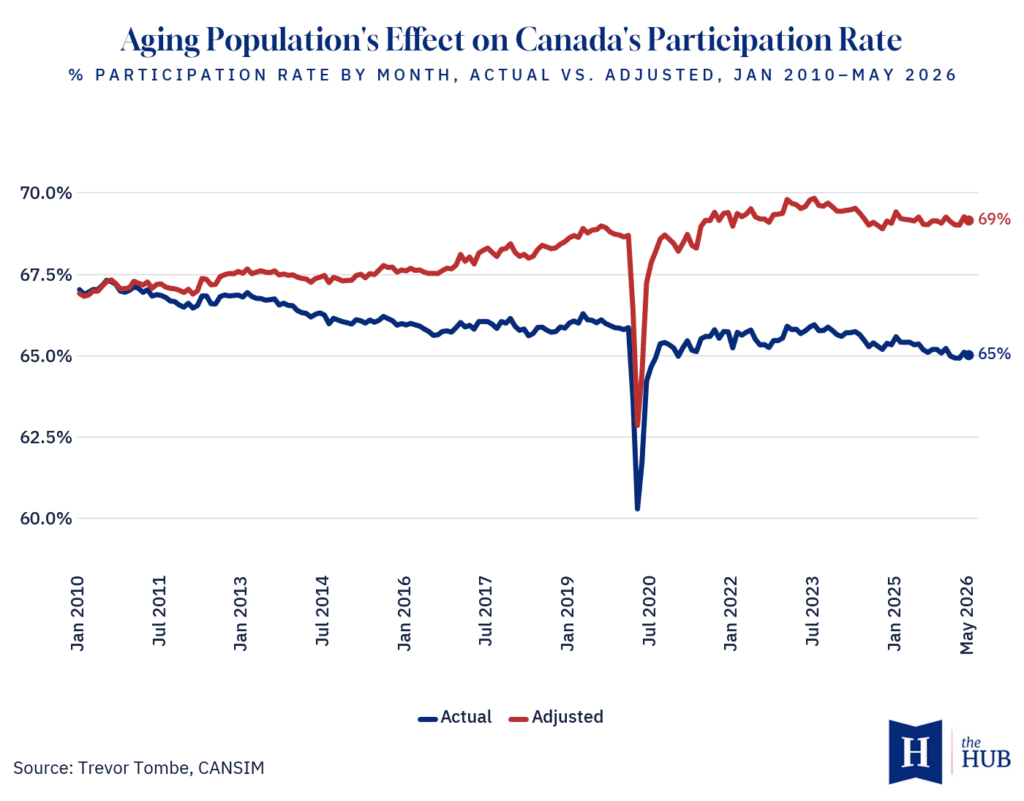
Between now and 2060, aging alone will produce another decline of roughly that magnitude. About half of it arrives by 2035.
Mechanically, a falling participation rate shrinks Canada’s annual growth rate by about 0.4 percentage points over the next decade. That may not sound like much. But in a $3.2 trillion economy, it means giving up around $13 billion in income growth each year, compounding over time.
So governments face growing fiscal strain, and the economy has struggled with low productivity growth for some time. Aging is one more challenge ahead.
Or is it?
A new reason for optimism
There may be more room for optimism than the mechanical forecast suggests. My own thinking has come around on this, thanks to a working paper released this month through the National Bureau of Economic Research by Daron Acemoglu (the 2024 Nobel Prize winner), David Autor, Keelan Beirne, and Andrew Scott.
They begin with a simple observation. Over the past several decades, many countries have seen falling birth rates and aging populations. Many have seen the share of young people in the population drop sharply. These episodes provide ample evidence to work with.
One might expect them to show up as slower growth. They do not.
Using several strands of evidence, the authors find that these demographic changes raised GDP per working-age adult by so much that the gain roughly fully offset the decline in the number of working-age adults. The total size of these economies was left roughly unaffected.
The mechanism matters. Aging is compensated for by productivity gains, and not simply because labour-saving technologies happened to be available. The direction of technological change itself responds to the scarcity of labour. Fewer workers mean stronger incentives to develop and adopt technologies that economize on them.
Their approach to measuring the effect is convincing. To isolate changes in the relative size of young populations, they use military casualties in the Second World War, which fell predominantly on the young. Areas with higher military deaths consistently show higher GDP per worker afterwards.
The rest of the evidence points the same way. Lower birth rates are strongly associated with higher exports of high-tech goods, larger research-and-development-intensive industries, less employment in labour-intensive industries, higher overall productivity, and a shift in patenting toward technologies like automation.
All in, these gains fully compensate for the drag that population aging would otherwise cause.
What it means for Canada
The lesson for Canadian policymakers is not that we need not adapt to rapidly changing demographics. It is that slower growth is not a necessary consequence of them.
If we respond to labour scarcity by adopting new technologies, shifting the composition of economic activity, and boosting productivity, we may fully offset the drag of an aging population on growth.
That requires investment. If barriers prevent firms in Canada from investing at the levels they otherwise would, or prevent economic activity from reallocating toward more capital-intensive sectors, then we may well find that aging is a drag on growth after all. But it is not a future we are stuck with.
There is also value in ensuring that policy is not artificially increasing labour scarcity, just in case innovation doesn’t save the day. Some policies encourage people to exit the labour force. Others weaken work incentives by raising taxes to fund ever more generous elderly benefits. Considering reversing these policy choices should be a part of the conversation.
Canada’s population will age. Whether it slows our growth is a separate question, and the answer largely depends on us.
Trevor Tombe is a professor of economics at the University of Calgary, the Director of Fiscal and Economic Policy at The School of Public Policy, a Senior Fellow at the Macdonald-Laurier Institute, and a Fellow at the Public Policy Forum.