This article originally appeared in National Newswatch.
By Stephen Nagy, February 10, 2026
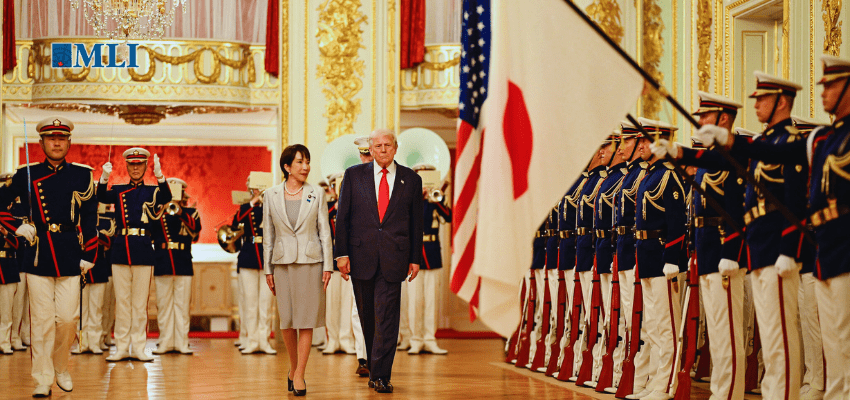
On Feb. 8, 2026, the Japanese electorate delivered a verdict that shattered the conventional wisdom of Nagatacho and sent shockwaves through the capitals of the G7. Prime Minister Takaichi Sanae and her Liberal Democratic Party (LDP) roared back from the political wilderness, securing more than 315 seats in the 465-seat House of Representatives. This supermajority represents a stunning reversal of fortune for a party that, just two years prior, had been sent to the “penalty box”, to borrow a Canadian hockey metaphor, by voters punishing the corruption scandals and feckless leadership that characterized the twilight of the administrations of former Japanese prime ministers Fumio Kishida and Shigeru Ishiba.
But while Takaichi’s victory offers an overwhelming mandate for the LDP as the rightful stewards of the nation, the implications of this landslide extend far beyond the Japanese archipelago. Across the Pacific, Canada’s Prime Minister Mark Carney should be studying this result with intense focus. Takaichi’s victory was a vote for hard-nosed realism in a dangerous neighborhood, not a license for performative nationalism or domestic culture wars.
The electorate’s decisive turn toward Takaichi was driven primarily by a craving for security and clarity, a sentiment that mirrors the anxieties of the Canadian middle class. Japanese voters rallied behind her willingness to stand up to Chinese economic coercion and the massive disinformation campaigns waged against her by Beijing. As Takashi Suzuki noted in his penetrating analysis of China’s United Front Work, Beijing has aggressively sought to co-opt foreign elites and manipulate public opinion to serve its “Great Rejuvenation.” For years, Japanese voters watched as their leaders equivocated. Takaichi’s refusal to buckle, specifically her common-sense assertion that a Chinese attack on Taiwan would necessitate a Japanese defense of its interests, resonated with a public that has watched the geopolitical landscape darken. Her victory is a rejection of the idea that a nation can simply trade its way to safety while ignoring the bayonets at its doorstep.
This brings us to the first crucial lesson for Carney: the domestic mandate is economic, not cultural. In Japan, the election results mirrored the dynamics seen in the United States with the re-election of President Donald Trump. This was an election about the middle class. The priorities were inflation, stagnant wages, and the affordability crisis that has made raising a family in Japan increasingly difficult. Voters are exhausted by the “lost decades” narrative and want tangible economic security. Crucially, identity politics were notably absent from the ballot box. Issues such as same-sex marriage or separate surnames, while important to activists, were not drivers of this supermajority. Takaichi’s mandate is to create “good jobs,” positions that pay living wages and offer genuine work-life balance, rather than engaging in the divisive culture wars that have plagued Western democracies.
For Carney, the message is stark. Canadian voters, much like their Japanese counterparts, are fatigued by performative progressivism, DEI mandates (there is little interest in Japan), and identity politics that seem disconnected from the reality of grocery bills and mortgage payments. Just as Takaichi must avoid the trap of spending political capital on symbolic crusades like Yasukuni Shrine visits, Carney must realize that the path to political survival lies in addressing the affordability crisis and productivity lag, not in lecturing the public on social values. The middle class in both nations is demanding a government that prioritizes their economic well-being over ideological purity.
The second lesson lies in the necessity of the American alliance. The Japanese public is demanding what Takaichi has termed a “limitless” alliance with the United States. As Dan Blumenthal, Mike Kuiken, and Randy Schriver argued in Foreign Affairs, Japan “can’t go it alone.” The voters understand that while American hegemony may be in relative decline, the U.S. remains the indispensable guarantor of Japan’s sovereignty. They want a leader who can navigate this turbulence with a robust alliance that includes greater burden-sharing and industrial cooperation. This logic applies with equal, if not greater, force to Ottawa. There is no viable Canadian Indo-Pacific Strategy, no functional NORAD, no NATO contribution, no Arctic security, and no Canadian economic security without the United States.
It is a delusion to think Canada can navigate the threats of foreign interference from China, Russia, and Iran without the intelligence and security architecture provided by Washington. Plain and clear, Canada needs a limitless alliance with the U.S. just as Takaichi advocates the same for Japan. The fantasy that Canada can act as a totally independent broker, or that it can secure its vast Arctic frontier without American power, is dangerous. Takaichi’s mandate proves that voters respect leaders who acknowledge their strategic dependencies and work to strengthen them, rather than those who offer symbolic resistance to their most critical ally.
The third and perhaps most urgent lesson for Carney concerns the framing of the China relationship. Takaichi’s victory was cemented by the public’s rejection of naive engagement. The turning point for many was the Sept. 3, 2025, military parade in Beijing, where the presence of former Prime Minister Hatoyama Yukio, applauding a display of military might alongside Russia and North Korea, served as a visceral symbol of the failed policies of the past. Voters rejected that subservience. They recognized, as Nobukatsu Kanehara has argued, that in a period of “declining national power,” Japan cannot afford the luxury of delusion.
Japan views the China relationship through the lens of engagement, resilience, and deterrence. It is unthinkable that Beijing could go from being termed an “increasingly disruptive global power” in Canada’s initial Indo-Pacific Strategy to what Prime Minister Carney has recently softened to a partner to be managed. Japan certainly engages with China through trade, but it does so with decades of scar tissue from disinformation, economic coercion, cyberattacks, hybrid operations, and the weaponization of supply chains. And, like Canada, Japan has suffered through hostage diplomacy, a trauma that should bind Ottawa and Tokyo in shared vigilance.

Tokyo is investing heavily in resilience and deterrence precisely so it can engage with China from a position of leverage. Takaichi understands that leverage comes from one source: the strongest possible relations with the United States. Carney’s pivot to managing China suggests a return to the golden era of globalization that no longer exists. Japan’s experience dictates that you cannot manage a revisionist power without the hard power to deter it. By softening his language, Carney risks signaling weakness to Beijing and unreliability to Washington. Japan’s “limitless” alliance is the bedrock of its China strategy; Canada’s vacillation is a liability.
Finally, Takaichi’s victory serves as a warning against the trap of symbolism regarding the U.S. President. Takaichi knows that taking symbolic swipes at President Trump to score domestic political points is a fool’s errand that endangers national interests. Her administration is poised to work pragmatically with Trump, recognizing that the U.S.-Japan alliance is bigger than any single personality. Carney must take the same lesson. Symbolic resistance to Trump may play well with certain urban demographics in Canada, but it is no substitute for strong economic policies at home and the best of relations with the White House.
Prime Minister Takaichi has been handed a historic opportunity to reshape Japan’s trajectory because she offered realism over nostalgia. She has a supermajority because she acknowledged the world as it is: dangerous, competitive, and reliant on American power. Prime Minister Carney faces the same world. He must prioritize the hard work of economic security and alliance integration over the sugar high of culture wars and anti-American posturing. He must distinguish between the public’s desire for a strong defense and a desire for ideological crusades. Japan has chosen realism. Canada cannot afford to choose otherwise.
Stephen R. Nagy is professor of politics and international studies at the International Christian University in Tokyo. Concurrently, he holds appointments as a senior fellow and China project lead at the Macdonald-Laurier Institute, and a visiting fellow at the Japan Institute for International Affairs. The titles of his forthcoming books are “Japan as an Adapter Middle Power State: Navigating Ideological and Systemic Divides” and “Get Over it and Move On: How to run a global business in the emerging world order.”