By James Allan, February 12, 2026
This may come as a surprise to many younger Canadians, and especially to recent law school graduates, but Canadians had rights and freedoms before 1982 and that year’s arrival of the Charter of Rights and Freedoms.
Indeed, it is debatable whether Canadians today enjoy more rights and more civil liberties and more freedom than do close constitutional cousins living in Australia and New Zealand. And remember – Australia, our closest constitutional cousin in the world, has no national bill of rights of any sort to this day. It is like Canada before 1982.
Meanwhile, New Zealand does have a statutory bill of rights, enacted in 1990, but this legislative instrument does not empower the unelected judiciary to strike down or invalidate statutes. Nor have the Kiwi judges thus far used Alice-in-Wonderland interpretive techniques to supercharge their statutory bill of rights. They have avoided the path taken by top United Kingdom judges, who have used their own British statutory bill of rights – a loose copy of the New Zealand model – from at least the 2004 Ghaidan case onwards. Since that ruling, British courts have claimed the power to “read in” words that fundamentally change the meaning of laws, even when the original text is clear. This practice allows judges to bypass the intention of Parliament to make laws “rights-respecting,” stopping only just short of what the court itself termed “judicial vandalism.”
Here’s the thing. Proponents of powerful bills of rights like to reside up in the Olympian heights of moral abstractions that finesse reasonable disagreement. What exactly, say, is “the right to healthcare” in terms of treatment times, who gets prioritized, or how money is spent? Similarly, try asking “Who is in favour of the right to free speech?” When phrased in such vague, amorphous terms the answer is always “everyone.” I have argued against bills of rights in myriad debates around the Anglosphere over many years, often starting with that question to the audience, and no one ever raises his or her hand as being against free speech in the abstract. Yet move down from the Olympian heights to the quagmire of day-to-day line-drawing calls made by Canada’s top judges (or the US’s or Britain’s or the European Court of Human Rights’) in the name of a free speech right (or of any of the enumerated rights) and you find massive disagreement.
And it is reasonable disagreement, with no science-like method – such as a double-blind drug trial – for determining who is correct. There is reasonable disagreement on the question of tobacco advertising; on where to draw the line on hate speech or campaign advertising or euthanasia or abortion or excluding improperly obtained evidence; on whether murderers and rapists and robbers ought to be able to vote; on the desirable scope and limits on a right to strike; on the acceptability of the many variants of shadow banning or deplatforming or silencing of critics that we saw during the Covid lockdowns; the list goes on and on.
In fact, readers should notice that during those two and a half years – what former UK Supreme Court Justice Lord Sumption called “the greatest interference with personal liberty in our history” – not a single court anywhere in the Anglosphere used a bill of rights to lessen or enervate any of the heavy-handed (verging on thuggish) regulations or rules imposed on citizens in the name of safety. Not once did a bill of rights help promote a more rights-respecting outcome for freedom of speech, religion, or association.
Put bluntly, these emotively appealing and broadly articulated rights do not interpret themselves nor self-indicate how they should apply. Rather, it is judges who interpret these instruments and who decide all the above scenarios and more. And judges, of course, also disagree amongst themselves about where – in the name of a right in a bill of rights – to draw these social policy lines.
There are also questions as to whether one side of politics gets more wins from the court than the other and so uses the courts to push through legislation that would otherwise use up too much political capital (or be impossible) if done by the legislature. Professors Dave Snow and Ryan Alford explore this very topic in “The Court Challenges Program: How Your Tax Dollars Fuel Social Justice Activism through the Courts.”
Nor is it true to suggest that the legitimate lawmakers who gave us the Charter of Rights and Freedoms intended our unelected judges to have a sort of wide-ranging freedom to deliver the answers they wanted or thought best.
Readers might also notice that when judges on top courts happen to disagree with one another as to how to interpret a bill of rights (including Canada’s Charter of Rights and Freedoms) there is only ever one decision-making rule. And it is a brutally majoritarian, procedural one. And here is that rule for readers to see: Five judicial votes beat four, full stop, and regardless of the perceived competing substantive merits or moral worth of dissents and majority judgments. As far as how the moral and political disagreements are resolved that underlie all social policy line-drawing, therefore, the only difference between judicial resolutions and ones reached via democracy and the elected legislature is the size of the franchise – nine votes versus tens of millions.
And that brings me to Canada’s Charter of Rights and Freedoms that was entrenched into Canada’s Constitution in 1982. I know because I was just starting law school at Queen’s University that year. And from then to today it has seemed to me that handing that sort of line-drawing power to unelected judges (what the legal philosopher Jeremy Waldron calls “committees of ex-lawyers”) carries with it big risks. First off, what constrains judicial decision-making other than the judges’ sense of what they, the unelected judges, happen to think is best or most rights-respecting – what outside their own brains? (Be precise in answering because that’s a devilishly tough question. The original intentions and understandings at the time of entrenchment is one answer. There are others, too, that might impose at least some mind-independent constraints.)
Secondly, does the decision made by the judges themselves to treat the Charter of Rights and Freedoms as a “living tree” or “living constitution” (in terms of how to interpret its provisions) not magnify that fact of a lack of constraints on what decisions the judges can reach? I think it does. After all, it will only and always be the judges themselves deciding how this “living legal instrument” is to grow and alter as time goes by. Not you. Not me. And not elected legislators – just the judges. So it’s a living tree whose only gardeners all will one day receive judicial pensions.
Thirdly, and relatedly, to what extent does buying an entrenched bill of rights seem to be largely equivalent to buying the political and moral preferences and druthers of the lawyerly caste from which top judges are chosen? That’s an empirical question, of course, but it’s one that is raised in the context of today’s median member of the lawyerly caste having some notably diverging moral and political views from those of the median voter – and so from results the legislature might deliver.
The empirical evidence on this is clear. You can see it starkly in the US, where donations to political parties is public information. You could see it in Australia with the constitutional referendum surrounding “the Voice.” You could see it in Britain around the Brexit referendum. And I think it is patently the same in Canada. And the dominant views in law schools are even greater outliers – more left-leaning politically – compared to those of the median voter, remembering that today’s law students are tomorrow’s lawyers and next week’s judges. For a mere sample see Jonathan Haidt’s 2013 book, The Righteous Mind: Why Good People are Divided by Politics and Religion, and James Phillips’ 2016 article, “Why Are There So Few Conservatives and Libertarians in Legal Academia? An Empirical Exploration of Three Hypotheses.” (Phillips weighs various explanations by looking at citation and publication rates of law professors at the top 16 US law schools. After subjecting the data to regression analysis, propensity score matching and reweighting, nearest neighbour matching, and coarsened exact matching, Phillips concludes that the clear explanation for the lack of conservatives was discrimination – not conservatives’ greater greed, lesser brainpower or lack of interest in such jobs.)

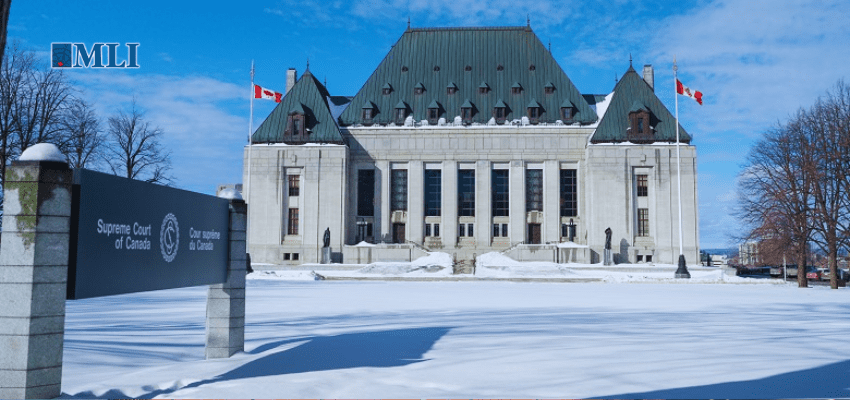
That third query is also one that bears directly on an important case now before the Supreme Court of Canada that involves a challenge asking the top judges to limit or cabin or restrict the use of the s.33 notwithstanding clause – a provision that gives the elected legislature the power to override judicial determinations of what rights entail (for some, not all the enumerated rights and for a five-year renewable period) and that everyone who was around back in 1982 knows was the sine qua non price of achieving the Charter of Rights and Freedoms. Put bluntly, this was a necessary part of the deal between the prime minister and the premiers (remembering that no election or referendum was ever held by Pierre Trudeau asking Canadian voters back then if they wanted an entrenched bill of rights). Moreover, even with that s.33 promise the province of Quebec balked and to this day has never signed up to the 1982 deal. Hence, no s.33, then no Charter.
Solely by way of comparison, Australia’s written constitution – very American in terms of the version of federalism chosen and the sort of powerful upper house Senate with equal representation per state copied – went for a Swiss-style amending formula. In Australia you can’t amend the constitution without asking all voters in a s.128 referendum. And twice the political caste has tried to entrench a bill of rights and twice the voters have said “no,” the most recent time being in 1988 with Canada’s choice in clear view. That 1988 attempt went down to a massive defeat, losing badly nationally and in every single Australian state.
Put differently, to wait more than four decades and then have Canada’s top judges use this current s.33 challenge to rewrite the notwithstanding clause deal – to enervate and weaken the democratic safety check on judicial power that is s.33 and that was insisted upon in 1982 – would be very judicially self-serving. And that is putting things as kindly as is humanly possible.
James Allan is the Garrick Professor of Law at the University of Queensland, Australia and a contributor to the Macdonald-Laurier Institute. His latest book is The Age of Foolishness: A Doubter’s Guide to Constitutionalism in a Modern Democracy. This article is part of the MLI’s Judicial Foundations Project.