By Nino Melikidze and Steven Paolasini
June 24, 2026
Express Entry was never meant to be a Canadian skilled immigration program. It was supposed to be the sorting system layered on top of the existing federal ones.
Introduced by Immigration, Refugees and Citizenship Canada (IRCC) a decade ago, Express Entry was a simple, innovative solution for addressing an overgrown backlog of permanent residence applications and long processing delays. Instead of processing every applicant who applied, the system introduced a candidate scoring and prioritization mechanism. Qualifying for a program was no longer enough. Candidates also had to compete with and outrank one another based on skill level. Every two weeks, IRCC would conduct draws to invite the top-ranking candidates to apply for permanent residence. The system ended up facilitating both higher-skilled immigration and a more predictable application process.
Over time, however, the federal government turned Express Entry into a tool for short-term policy management while consistently lowering admission standards and increasing overall immigration numbers. That is a problem because Canada can no longer rely on high immigration numbers alone as an economic strategy, especially while the economy struggles with weak productivity and falling per-capita growth.
For years, population growth helped support headline GDP, but it did not solve the deeper productivity problem. The real test is not how many people Canada admits. It is whether the system selects people with the skills and earning potential to strengthen the economy over the long-term. Express Entry has drifted from its original purpose. Canada needs to rebuild it into a system that serves our long-term economic and demographic goals.
Express Entry: Revolutionizing organized skilled immigration selection
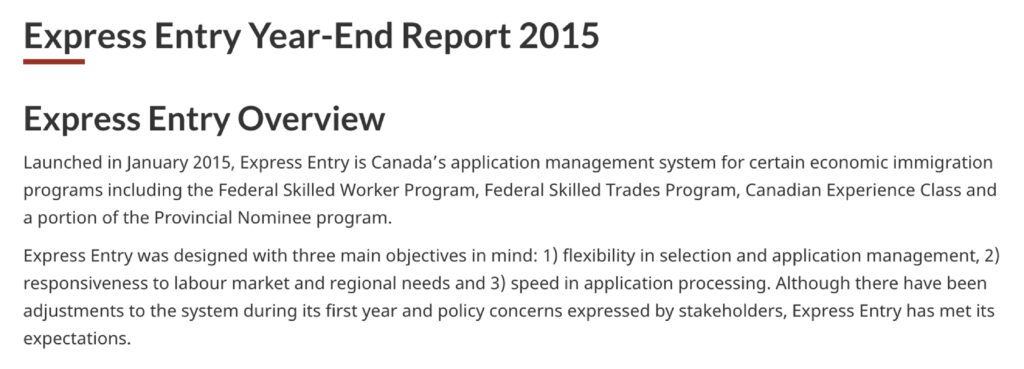
When Canada launched Express Entry on January 1, 2015, it was not building a federal skilled immigration program from scratch (see Figure 1).
Canada already had three core permanent residence programs available to skilled immigrants prior to 2015:
- With roots reaching back to 1967, the Federal Skilled Worker (FSW) program was the country’s main federal skilled-worker pathway.
- The Canadian Experience Class (CEC) program, launched in 2008, gave people with Canadian work or study experience a pathway to stay.
- The Federal Skilled Trades (FST) program, opened in 2013, was created to better capture skilled trades workers.
These programs remained relevant with the introduction of Express Entry – what changed was the selection process.
Before Express Entry, skilled immigration worked much more like a queue. If a candidate met the eligibility for one of these programs, they could submit a full permanent residence application and wait for processing. Over time, that model became increasingly difficult to manage. Too many complete applications entered the system faster than the government could process them. Backlogs grew, processing timelines slowed, and the system became harder to maneuver when Canada’s labour-market needs changed.
Figure 1: Report mentioning launch and purpose of Express Entry application management system
Source: Express Entry Year-End Report 2015.
At the time, Express Entry seemed like a truly unique solution. Instead of allowing eligible candidates to immediately submit full applications, it first moved them into a general pool. To enter, applicants still had to qualify under one of the eligible programs: Federal Skilled Worker, Federal Skilled Trades, or Canadian Experience Class. Once in the pool, the system ranked the candidates, invited selected ones, and then processed their full applications.
The Comprehensive Ranking System (known as CRS) was the innovative heart of the system. The CRS assessed the competitiveness of the candidates and assigned them scores based on factors such as age, education, language ability, and work experience. Additional weight was given for provincial nominations or qualifying job offers. The goal was to select candidates with the strongest indicators for economic success in Canada.
Express Entry also introduced a provincial component into the system by directly connecting them to the core federal immigration programs. Provinces and territories already had their separate permanent residence nomination programs outside Express Entry. However, in this new world, provinces were granted faster nominations for selected candidates if they were also eligible for one of the main federal permanent residence pathways. Essentially, provinces could search the federal pool of candidates and nominate those who matched local labour-market needs. By involving the provinces, Express Entry also became connected to regional economic priorities.
For several years, that model worked well. It was simultaneously ambitious and understandable. Competitive and predictable. Skilled applicants could measure themselves against the system and plan around it, while Canada had a more controlled way to manage intake and prioritize stronger candidates.
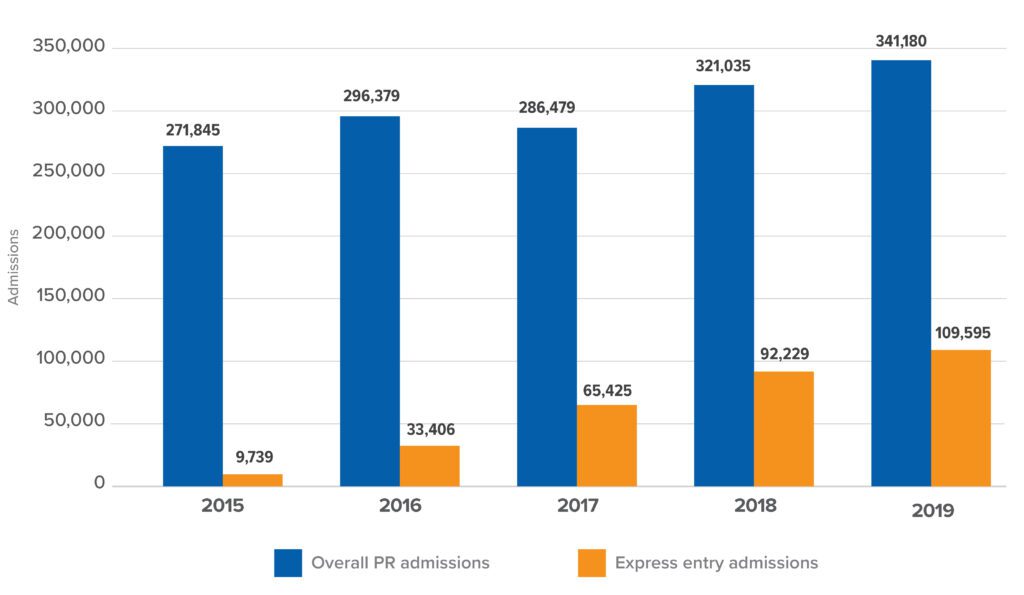
Figure 2: Table summarizing total annual versus Express Entry permanent resident admissions, 2015–19
Source: CIMM – 3.3 – Admissions by category and year – October 30, 2025 and IRCC Express Entry year-end reports (predominantly the 2019 report).
The numbers in Figure 2 show how quickly Express Entry became central to Canada’s immigration system. In 2015, it only admitted 9,739 people while the overall plan targeted 260,000 to 285,000 permanent residents. By 2019, Express Entry had reached 109,595 admissions, while the overall target had grown to 330,800. In a mere five years, Express Entry admissions grew more than 11 times larger.
The system also performed well early on. IRCC began with small and regular invitation rounds while working through older inventories. Many of the early invitees already had Canadian work ties or Labour Market Impact Assessment (LMIA)-backed job offers. Processing was fast: in 2015, 80 per cent of finalized Express Entry cases were processed in 4.4 months, comfortably within the six-month service standard.
By the end of the decade, Express Entry became the main architecture for selecting skilled immigrants.
Deterioration into dysfunction: How Express Entry became unmanageable
Since the launch of Express Entry, IRCC has selected candidates through invitation rounds known as draws. In each draw, IRCC specifies how many candidates it will invite to apply for permanent residence, which program or category the draw applies to, and the minimum CRS score required to receive an invitation. That minimum score is known as the CRS cutoff score.
This matters because, in the early years of Express Entry, cutoff scores were relatively stable. Draws generally happened every few weeks, and candidates could look at recent cutoffs to understand where they stood. That predictability began to break during the COVID-19 pandemic, when Express Entry started moving away from its original purpose.
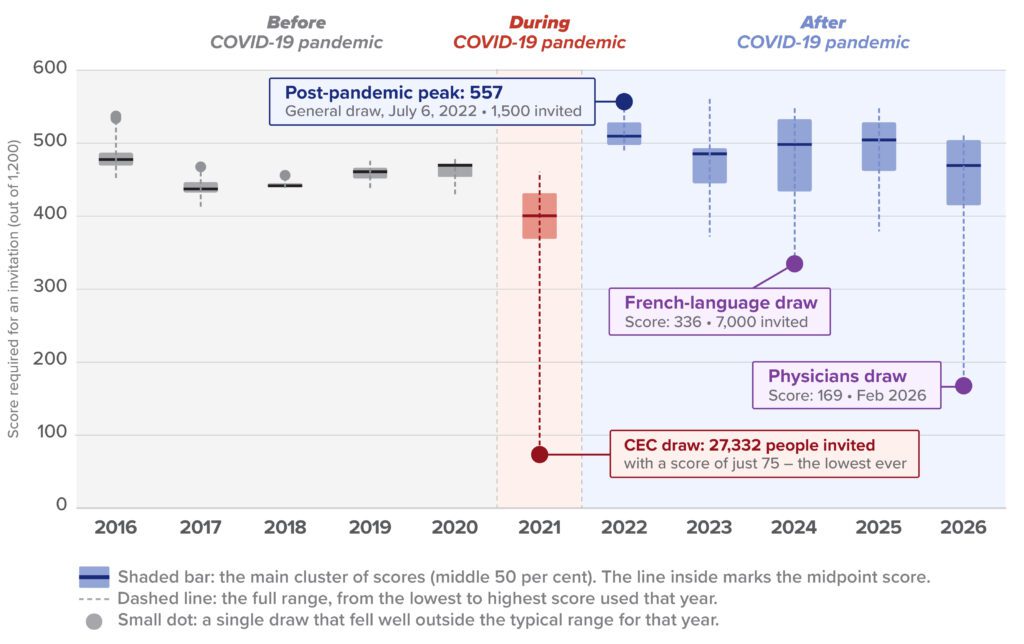
Figure 3 shows that shift. It tracks CRS cutoff scores since 2016 and illustrates how candidate selection became far less consistent over time.
Figure 3: Express Entry CRS cutoff distribution by year, 2016–2026 (excluding Provincial Nominee Program and Federal Skilled Trades draws)
Source: IRCC Express Entry round data, all 304 generalist federal merit draws over the period.
Before 2020, Express Entry was remarkably predictable. In 2018, the middle 50 per cent of CRS cutoff scores sat between 441 and 445 across 25 rounds, only a four-point band. Invitations were issued across all of the programs, and general invitation draws were common. This allowed candidates to clearly understand selection trends and make realistic plans around the system.
In stark contrast, all 42 Express Entry invitation rounds in 2021 were program-specific. There were no invitations issued under the FSW or FST programs. Instead, the government issued 87 per cent of invitations to CEC candidates, including one extraordinary draw that invited 27,332 people with a cutoff score of just 75 CRS points. Compared with the mid-400s cutoffs that were typical before 2020, a score of 75 was not a small adjustment. It was a completely different selection standard. The government used this draw to convert large numbers of temporary residents already in Canada into permanent residents while borders were constrained by the COVID-19 pandemic.
The reasoning behind this decision was understandable at the time. Borders were restricted, overseas processing was disrupted, and the government still had large immigration targets to meet. Candidates already in Canada were easier to process, easier to land, and already attached to the Canadian labour market. But what may have been defensible as an emergency measure set a dangerous precedent.
What began as a pandemic workaround slowly became a broader shift in how Express Entry was used. In the years that followed, the government moved away from treating Express Entry as a prioritization and selection mechanism for the underlying skilled permanent residence programs. Immigration priorities became less predictable, and the skill level and quality of selected applicants were increasingly shaped by short-term government policies rather than the core program criteria.
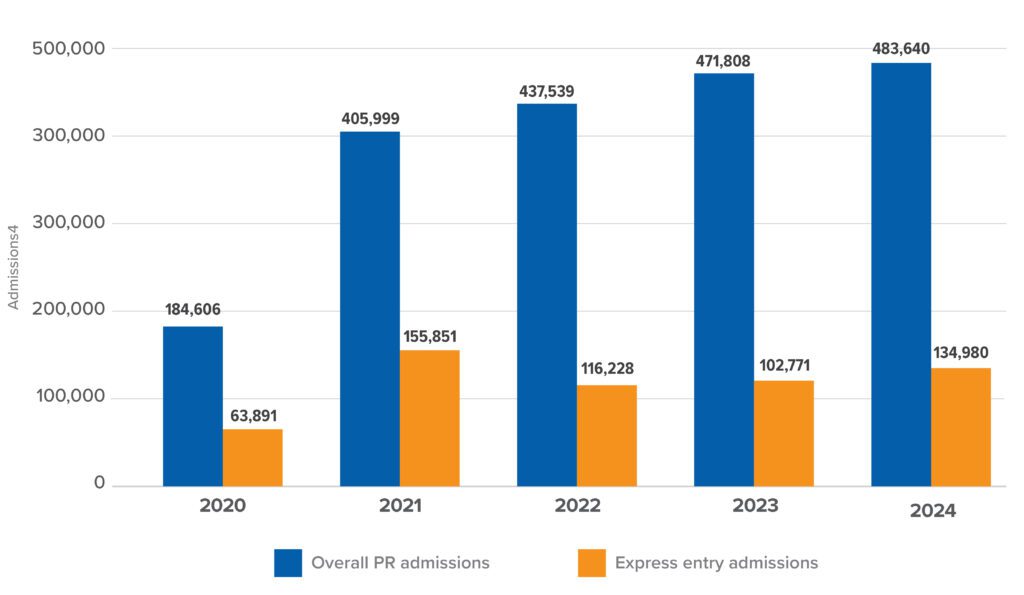
A key driver of this shift was the steady rise in annual immigration targets. As shown in Figure 4, targets rose from 341,000 in 2020 to 401,000 in 2021, 411,000 in 2022, 421,000 in 2023, and 485,000 in 2024, before falling to 395,000 in 2025. To keep up, the government relied more heavily on Express Entry as one of the main tools for meeting those numbers. In practice, that meant the needs and selection logic of the three core programs that Express Entry was built to manage (FSW, CEC, and FST) became less central.
Figure 4: Table summarizing total annual versus Express Entry permanent resident admissions, 2020–24
Source: CIMM – 3.3 – Admissions by Category and Year – October 30, 2025 and IRCC Express Entry year-end reports (predominantly the 2022 report).
Warning signs began to first appear in the education-to-work-to-permanent residence pipeline. In 2023, IRCC began requiring designated learning institutions (DLIs) to verify student letters of acceptance directly with the department to combat fraud. Later federal reporting showed why: officers manually checked 30,832 acceptance letters and found 4,260, or 13.8 per cent, to be fraudulent, altered, or no longer valid.
As education and temporary status became more valuable for permanent residence, the level of fraud in the student stream began to soar. Thousands of foreign students flooded the country, expecting to earn permanent residence at the end of their educational journey via Express Entry. At the same time, a surge in questionable colleges began churning out international students, fueling a “diploma mill” crisis. This lasted from around 2020 to 2023, until Ottawa began to course-correct by tightening international student rules.
At the same time, another crisis erupted over job offers and LMIAs. For years, arranged employment could significantly increase a candidate’s CRS score, making job offers extremely valuable. By December 2024, IRCC removed additional CRS points for job offers, explicitly saying the change was meant to reduce fraud by removing the incentive to “illegally buy or sell labour market impact assessments.” That was a direct admission that one of the system’s strongest scoring levers had become vulnerable to abuse.
Problems also arose in category-based selection. The launch of Express Entry categories in 2023 gave the Immigration Minister authority to issue invitations based on specific candidate attributes, including French-language ability, occupation, education, or work experience.
In theory, this made selection more targeted. In practice, it just added another layer of complexity. Now, a candidate with a strong score of 510 could be competitive in one draw and completely irrelevant in another, depending entirely on the program or category selected that week.
Figure 5: News release announcing category-based selection launch

Source: IRCC newsroom, May 2023
By 2025, most of the Express Entry invites were going to the CEC program (which had an average CRS cutoff of 529) and the French-language proficiency category (which had an average CRS cutoff of 425). The two largest draw categories were operating with a more than 100 CRS point score difference between candidates on average.
The system changed from a stable engine rewarding merit to one with a constantly shifting scoreboard. The draw schedule was inconsistent, categories kept changing annually, and candidate prioritization no longer focused on competitive high skills.
In the end, confusion reigned – and that is the core of the problem.
As we can see, Express Entry did not collapse overnight. It was like a slow-moving car crash. Between 2020 and 2025, it morphed into a tool for political gain and short-term admissions targets. The link between selection and skill weakened. The rewards attached to Canadian credentials, job offers, and temporary status became more arbitrary. With ever-shifting priorities and little transparency, it was almost impossible for high-skilled candidates to adapt.
Government plan for redesigning Express Entry: launch of consultations in 2026
IRCC’s decision to redesign Express Entry did not come out of nowhere. By 2026, the department was effectively acknowledging that the system had become too complex, too duplicative, and not consistently focused on the factors that predict economic success. The three federal high-skilled programs still acted as entry gates into the pool, but the real selection decision was made through the CRS scoring mechanism. That created overlap, confusion, and processing inefficiencies.
In plain terms, Ottawa is now asking whether Express Entry should be simplified into one federal high-skilled pathway and rebuilt around clearer evidence of who is most likely to succeed economically in Canada.
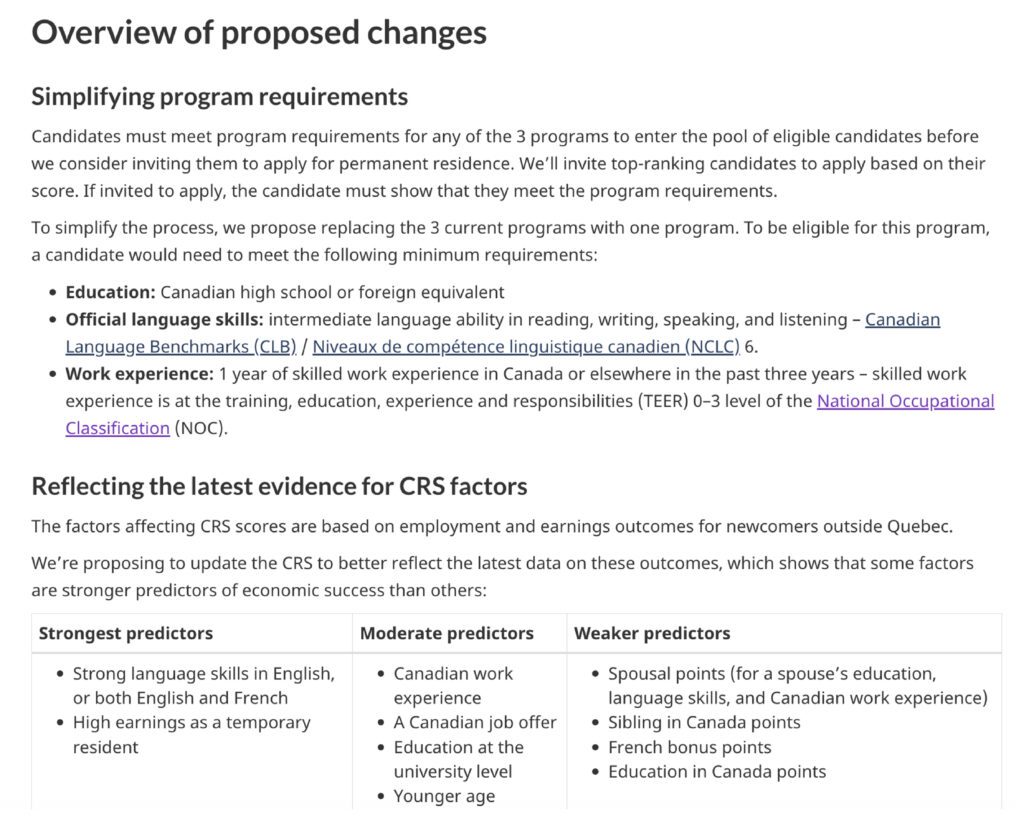
IRCC ran a public consultation regarding the reform of Express Entry from April 23 to May 24, 2026, and the feedback will inform what the department develops next. One of the biggest proposed changes is the possible repeal of the Federal Skilled Worker, Canadian Experience Class, and Federal Skilled Trades programs by replacing them with a single, new federal high-skilled class. The proposed entry rules would be simpler: a Canadian high school diploma or foreign equivalent, CLB/NCLC 6 (language benchmarks for Canada’s two official languages), and one year of skilled work experience in TEER 0–3 (a classification system that gauges labour skill levels) within the last three years. By simplifying the system, the government argues that it reduces overlap and remove older intake-control tools designed for the pre-Express Entry era.
Figure 6: Proposal for changing Express Entry, overview of changes considered
Source: IRCC 2026 consultations on potential Express Entry reforms
The second major piece is the CRS itself. IRCC is now asking whether the current scoring system still rewards the factors most closely linked to labour-market success. The department identifies stronger predictors such as official language ability, high earnings as a temporary resident, Canadian work experience, Canadian job offers, university-level education, and younger age. At the same time, it appears to view some current bonus points, including spousal points, sibling-in-Canada points, French bonus points, and Canadian-study points, as weaker predictors of better economic outcomes for high-skilled immigration candidates.
That direction matters. If done properly, the redesign could move the CRS away from broad point accumulation and closer to measurable labour-market performance. More weight could go to high-wage Canadian work experience, credible job offers, and practice-readiness in regulated fields. IRCC has also raised the possibility of better recognizing Canadian licensure, especially for Red Seal trades and regulated professionals. That would help prioritize candidates who are not just trained, but actually able to work in high-demand trades occupations.
Major structural changes, such as repealing existing federal skilled classes and replacing them with a new high-skilled class, would likely require regulatory amendments before taking effect. IRCC’s Forward Regulatory Plan suggests these reforms could be proposed or finalized within the next two years. In other words, the direction is real, but the redesign is not yet a confirmed policy.
Taken together, IRCC is considering a more centralized, earnings-focused, and streamlined Express Entry model. That is not necessarily a bad idea. A simpler high-skilled class and a better-calibrated CRS could be exactly what the system needs. But the real test is whether the redesign restores Express Entry’s original purpose: to select the strongest-skilled candidates under a clear, predictable structure.
One way to ensure this is to adopt an alternative scoring and selection mechanism that focuses more on the quality of the candidates, economic integration capacity and selection mechanism consistency. Indeed, more ambitious and meticulous changes are needed in order to restore the system to its original purpose.
Back to basics: Redesigning Express Entry to attract high human capital
A serious Express Entry redesign cannot be another patch on the current CRS scoring approach. The entire system has become too easy to bend through temporary categories, shifting priorities, and scoring signals that do not always reflect long-term economic contribution. If Canada wants Express Entry to work again, the high-skill evaluation and scoring process needs to be rebuilt around three things: durable human capital, verified economic establishment, and clear readiness to contribute in high-value work.
Our proposal also starts with one consolidated federal skilled immigration pathway: “General High Skills Express Entry,” replacing the current FSW, CEC, and FST split. Profiles would remain valid for two years, aligned with language-test validity, and candidates would pay a refundable deposit at profile creation to reduce speculative entries into the pool.
To qualify, candidates would need:
- Minimum high school education
- CLB/NCLC 6 in English or French (for minimum official language proficiency)
- Mandatory language testing (to verify the required language proficiency)
- One year of skilled work experience in an eligible occupation (outlined in Figure 8 below)
- Educational Credential Assessment (for validating non-Canadian education credentials)
This keeps the door open to valuable workers below the bachelor’s threshold, especially in regulated trades and TEER 2 healthcare roles, while still setting a meaningful baseline.
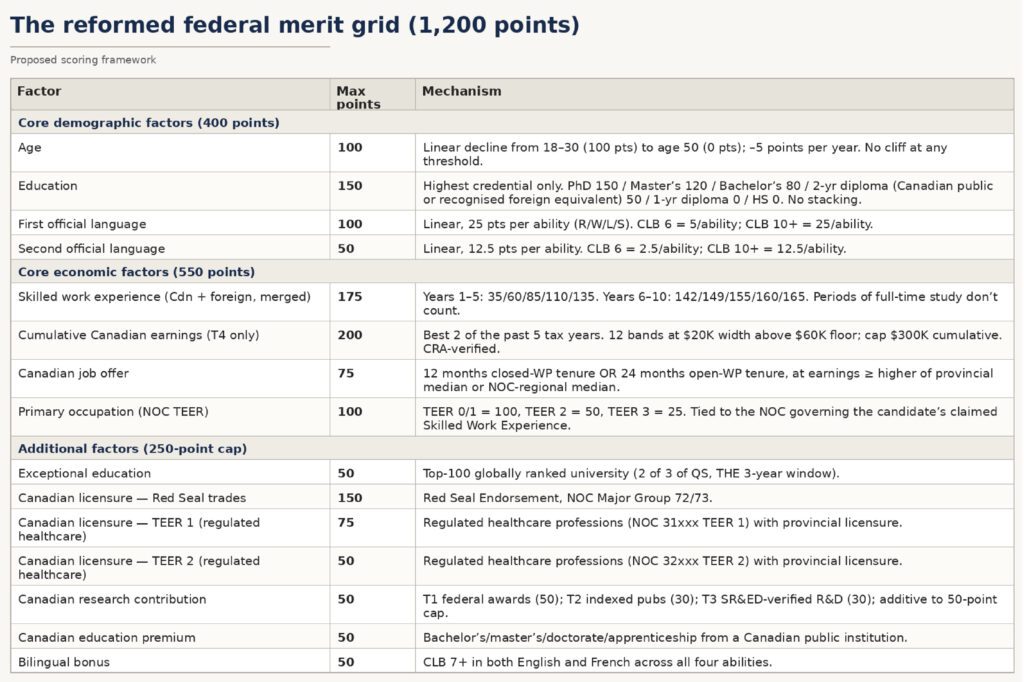
Our proposed grid (detailed in Figure 7) keeps the familiar 1,200-point ceiling, but changes what those points reward. There is no 600-point provincial nomination boost and no LMIA-based job-offer bonus. Every point becomes part of the federal merit calculation instead. The grid rewards factors that are harder to fake and more closely tied to outcomes: age, education, language ability, skilled work experience, Canadian earnings, Canadian job offers, occupation skill level, licensure, Canadian education, research contribution, and true bilingual ability.
Figure 7: Proposed reformed CRS scoring grid of high-skilled candidates for Express Entry
Source: Authors
The biggest shift is the verification mechanism. The current system still places too much weight on claims that can be shaped through reference letters, NOC-code positioning (which organizes jobs in Canada into standardized categories), or soft credentials. Our model keeps work experience relevant but moves the integrity weight toward CRA-verified Canadian earnings, Canadian licensure, and other proof that a candidate has already established themselves economically. Put simply, the system should care less about what someone claims they can do and more about what they can demonstrate.
Selection criteria and scoring
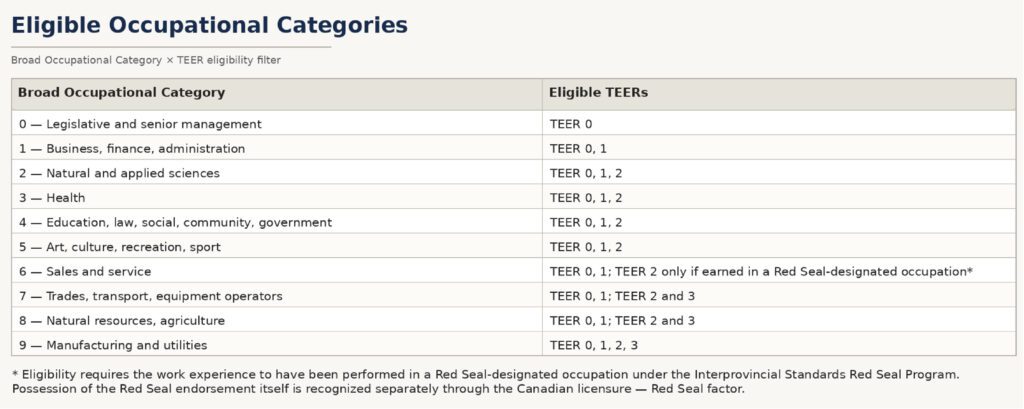
Not every TEER 0–3 occupation should automatically qualify as skilled work for federal high-skill selection. Our proposal uses a more disciplined Broad Occupation Category (BOC) x TEER filter to determine eligibility (as shown in Figure 8). Managerial and professional roles remain eligible. Technical, healthcare, trades, natural resources, manufacturing, and other high-value categories are included where the skill structure supports it.
The main difference in our approach is that lower-wage or easily inflated occupations are not being treated as high-skill simply because they technically fall into TEER 2 or TEER 3 categories. We do not believe the system should reward NOC-code gaming.
Figure 8: Proposed Broad Occupation Category (BOC) x TEER filter for occupational categories eligible to apply for permanent residence through Express Entry
Source: Authors
We also remove and modify three of the weaker features in the current CRS scoring grid:
- Spousal points, which add complexity and create incentives around accompanying status.
- The sibling-in-Canada bonus, which has been identified by IRCC’s own research as a weak predictor of outcomes.
- The standalone French-language bonus, which should be replaced with a true bilingual bonus for candidates who demonstrate CLB/NCLC 7+ in both English and French. That rewards real bilingual capacity without turning French into a separate shortcut through low-score category draws.
Selection mechanism
The selection mechanism should be as predictable as the scoring model.
Draws should happen every two weeks on Wednesdays, for 26 draws per year, with the annual schedule published in advance. Half should be general merit draws, where the overall highest-scoring candidates are invited first. If the federal government retains categories, the other half can be used for category-based selection, but only under clear rules.
IRCC should designate two or three standing categories, such as healthcare, trades, or STEM, and allocate most category draws to those priorities. A smaller portion can be reserved for rotating categories, but those should be announced in advance when annual immigration levels are published. No more changing priorities last minute without warning.
We also propose a default 10 per cent country cap across all draws. No single nationality should dominate Canada’s federal skilled immigration system in a given year. Express Entry should remain a global talent selection system, not a pathway captured by one source country at a time.
Overall skilled immigration architecture
This redesign also requires cleaning up the broader immigration architecture.
Within Express Entry, the current 600-point provincial nomination boost should be removed from the scoring grid completely. Provincial selection should not overwhelm the federal merit system. It should remain Ottawa’s premier high-skill merit pathway, producing roughly 100,000 to 120,000 admissions annually. Provincial Nominee Programs should be separated fully from Express Entry and continue selecting candidates through their own systems. Provinces know their regional and sectoral labour-market needs better than IRCC does.
Francophone immigration outside Quebec should also be handled outside of Express Entry. Quebec retains control of its immigration under the Canada–Quebec Accord, and federal targets should be calculated separately from Quebec’s share. To efficiently support French-speaking communities outside Quebec, Canada should use tools designed for settlement and retention:
- Support the establishment of francophone PNP streams by the provinces themselves
- Enhance rural community pathways (such as the FCIP)
- Create dedicated regional francophone pilots
French-language category draws with cutoffs far below general skilled draws should not be the mechanism for meeting demographic targets inside the country’s main high-skill selection system.
Total annual permanent resident admissions should not exceed 1 per cent of Canada’s population – this currently puts the ceiling around 410,000 people. Within that limit, economic immigration should make up 60–70 per cent of admissions.
Additionally, while the skilled immigration changes are being implemented and the Canadian economy is recovering, we propose lowering total annual immigration admissions to a maximum of 300,000. Prime Minister Mark Carney recently acknowledged that lower immigration helps explain why Canada’s economy has weakened over the last two quarters. That may be true in the short term, but it also exposes the weakness of the current model. Canada cannot keep relying on population growth to support headline GDP. It needs an immigration system that selects fewer but stronger candidates, with a higher share of skilled workers who can contribute more meaningfully to long-term productivity and economic growth.
The core principle is simple: Express Entry should select candidates with strong skills, real economic potential, and evidence that they can contribute successfully in Canada. Labour-market-responsive selection belongs in programs built for that purpose, such as federal-provincial tools tied to actual regional employment needs. Short-term labour shortages should be addressed through temporary worker programs instead.
Day-one transition
The transition should be clean. The existing pool should be wiped and candidates should re-enter under the new rules. To protect people already in Canada, candidates currently in the pool with a CRS score of 450 or higher and valid Canadian employment at launch should receive an automatic six-month interim work permit extension. That gives them time to complete the new requirements, including language testing, ECA, deposit, and profile submission, without falling out of status. Foreign-based candidates can re-enter through the standard pathway.
A soft transition would create years of parallel systems and confusion. A serious redesign requires a clear break.
Moving forward: an open message to IRCC regarding the Express Entry redesign proposal
Canada does not need more categories layered onto a scoring system that already confuses applicants and produces inconsistent results. It needs a system that clearly answers three basic questions: who are we trying to attract, why are they valuable to Canada, and how do we measure that consistently?
The solution proposed here starts from a simple principle: Express Entry should reward a strong foundation and measurable indicators of whether someone is likely to work, earn, integrate, and contribute long-term. Ottawa is right to review the CRS and consider simplifying the federal skilled programs. But merging programs and moving points around will not be enough. A cleaner system on paper is not the same as a better one in practice.
Express Entry should not be forced to do every job at once. Long-term skill selection and short-term labour shortage response are different goals. The system should treat them differently.
This proposal would make Express Entry easier to understand, harder to manipulate, and more consistent in who it selects. Applicants should not have to guess every year whether their profile still matters. Canadians should be able to see why skilled immigrants are being selected and how they are expected to contribute.
IRCC should treat this redesign as more than an administrative cleanup. A high-skill immigration system should select for exactly that: high skill. Now is the time to transform Express Entry into a true, selective economic immigration program – not use it as a tool to facilitate short-term political objectives.
About the authors
Nino Melikidze and Steven Paolasini are leading immigration policy reform advocates involved in the Build Canada network. Melikidze is a Toronto-based immigration tech start-up founder, TEDx speaker, and immigration policy reform advocate. A prominent voice in the Canadian immigration space since 2021, Melikidze runs Immitracker, an immigration application tracking and analysis platform for Canada and Australia and is the former host of the My Immigrant Story podcast. Paolasini is a licensed immigration consultant who works with hundreds of cases through his consultancy and regularly investigates Canadian immigration policy decisions.