Thursday, December 4, 2025
No Result
View All Result
  • Media
Macdonald-Laurier Institute
  • Home
  • About
    • Who We Are
    • Who Makes MLI Work
    • Fifteenth Anniversary
  • Experts
    • Experts Directory
    • In Memoriam
  • Issues
    • Domestic Policy
      • Economic Policy
      • Justice
      • Rights and Freedoms
      • Assisted Suicide (MAID)
      • Health Care
      • COVID-19
      • Gender Identity
      • Canada’s Political Tradition
      • AI, Technology and Innovation
      • Media and Telecoms
      • Housing
      • Immigration
      • Agriculture and Agri-Food
      • Competition Policy
    • Energy Policy
      • Energy
      • Environment
    • Foreign Policy
      • Israel-Hamas War
      • Ukraine
      • Taiwan
      • China
      • Europe and Russia
      • Indo-Pacific
      • Middle East and North Africa
      • North America
      • Foreign Interference
      • National Defence
      • National Security
      • Foreign Affairs
    • Indigenous Affairs
  • Projects
    • CNAPS (Center for North American Prosperity and Security)
    • The Promised Land
    • Voices that Inspire: The Macdonald-Laurier Vancouver Speaker Series
    • Dragon at the door
    • Canada on top of the world
    • Letter to a minister
    • Justice Report Card
    • The Great Energy Crisis
    • DisInfoWatch.org
    • Managing Indigenous Prosperity
    • Judicial Foundations
    • Landmark Cases Council
    • Defending The Marketplace of Ideas
    • Reforming the University
    • Past Projects
      • Digital Policy & Connectivity
      • Double Trouble
      • Canada and the Indo-Pacific Initiative
      • The Transatlantic Program
      • COVID Misery Index
        • Provincial COVID Misery Index
        • Beyond Lockdown
        • COVID and after: A mandate for recovery
      • Speak for Ourselves
      • The Eavesdropping Dragon: Huawei
      • Talkin’ in the Free World with Mariam Memarsadeghi
      • An Intellectual Property Strategy for Canada
      • Munk Senior Fellows
      • A Mandate for Canada
      • Confederation Series
      • Fiscal Reform
      • The Canadian Century project
      • Fixing Canadian health care
      • Internal trade
      • From a mandate for change
      • Size of government in Canada
      • Straight Talk
      • Labour Market Report
      • Leading Economic Indicator
      • Centre for Advancing Canada’s Interests Abroad
      • Indigenous Prosperity at a Crossroads
        • Aboriginal Canada and Natural Resources
  • Events
    • Upcoming Events
    • Past Events
      • MLI Dinners
      • Great Canadian Debates
  • Latest News
  • Libraries
    • Columns
    • Commentary
    • Papers
    • Books
    • Video
  • Donate
  • Home
  • About
    • Who We Are
    • Who Makes MLI Work
    • Fifteenth Anniversary
  • Experts
    • Experts Directory
    • In Memoriam
  • Issues
    • Domestic Policy
      • Economic Policy
      • Justice
      • Rights and Freedoms
      • Assisted Suicide (MAID)
      • Health Care
      • COVID-19
      • Gender Identity
      • Canada’s Political Tradition
      • AI, Technology and Innovation
      • Media and Telecoms
      • Housing
      • Immigration
      • Agriculture and Agri-Food
      • Competition Policy
    • Energy Policy
      • Energy
      • Environment
    • Foreign Policy
      • Israel-Hamas War
      • Ukraine
      • Taiwan
      • China
      • Europe and Russia
      • Indo-Pacific
      • Middle East and North Africa
      • North America
      • Foreign Interference
      • National Defence
      • National Security
      • Foreign Affairs
    • Indigenous Affairs
  • Projects
    • CNAPS (Center for North American Prosperity and Security)
    • The Promised Land
    • Voices that Inspire: The Macdonald-Laurier Vancouver Speaker Series
    • Dragon at the door
    • Canada on top of the world
    • Letter to a minister
    • Justice Report Card
    • The Great Energy Crisis
    • DisInfoWatch.org
    • Managing Indigenous Prosperity
    • Judicial Foundations
    • Landmark Cases Council
    • Defending The Marketplace of Ideas
    • Reforming the University
    • Past Projects
      • Digital Policy & Connectivity
      • Double Trouble
      • Canada and the Indo-Pacific Initiative
      • The Transatlantic Program
      • COVID Misery Index
        • Provincial COVID Misery Index
        • Beyond Lockdown
        • COVID and after: A mandate for recovery
      • Speak for Ourselves
      • The Eavesdropping Dragon: Huawei
      • Talkin’ in the Free World with Mariam Memarsadeghi
      • An Intellectual Property Strategy for Canada
      • Munk Senior Fellows
      • A Mandate for Canada
      • Confederation Series
      • Fiscal Reform
      • The Canadian Century project
      • Fixing Canadian health care
      • Internal trade
      • From a mandate for change
      • Size of government in Canada
      • Straight Talk
      • Labour Market Report
      • Leading Economic Indicator
      • Centre for Advancing Canada’s Interests Abroad
      • Indigenous Prosperity at a Crossroads
        • Aboriginal Canada and Natural Resources
  • Events
    • Upcoming Events
    • Past Events
      • MLI Dinners
      • Great Canadian Debates
  • Latest News
  • Libraries
    • Columns
    • Commentary
    • Papers
    • Books
    • Video
  • Donate
No Result
View All Result
Macdonald-Laurier Institute

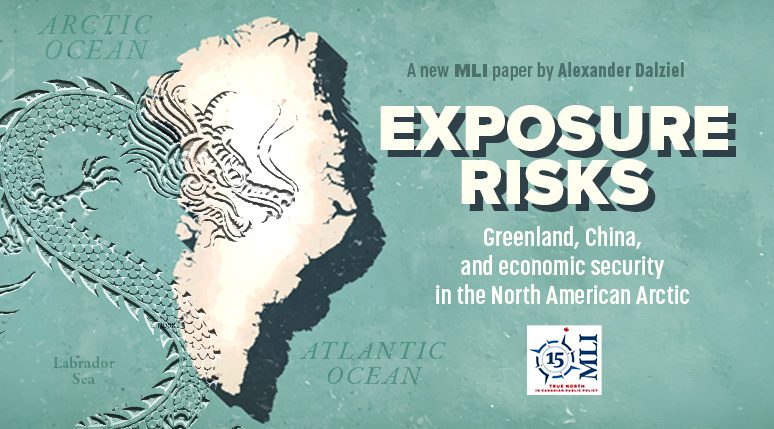
Exposure risks: Greenland, China, and economic security in the North American Arctic

Understanding the dynamics of Greenland’s economic security has lessons for the rest of the North American Arctic, not least for northern Canada.

October 9, 2025
in National Security, Foreign Policy, National Defence, Latest News, Alexander Dalziel, Papers, North America, Arctic
Reading Time: 6 mins read
A A
Exposure risks: Greenland, China, and economic security in the North American Arctic

By Alexander Dalziel

October 9, 2025

PDF of paper

Executive Summary | Sommaire (le français suit)

China is not an Arctic nation – but it has a tremendous influence on the region’s future.

In May 2025, US President Donald Trump warned of China’s economic and security designs on Greenland. Trump claimed that “… we have Chinese boats, gunships all over the place … going up and down the coast of Greenland.” US Vice President J.D. Vance echoed Trump’s warning, saying that Greenland is vulnerable to “very aggressive incursions” from China, and alongside “military threats” he gestured towards “economic pressures” on the island as part of China’s “firm interest.”

For Canada, too, security is a leading concern in the Arctic. However, the picture is somewhat different than the one presented by the US administration. China’s challenge for Greenland is primarily economic security – the threats posed by China’s coercive trade policies and geoeconomic ambitions – not a direct military threat.

Understanding the dynamics of Greenland’s economic security has lessons for the rest of the North American Arctic, not least for northern Canada, because economic security is not just a matter of staving off suspect investments or politically backed foreign ownership.

Sharpening policymakers’ awareness of where the Arctic sits in the global flows of supply and value – and how those relate to the competition between Canada, the US, and its allies on one side, and China and its partner Russia on the other – is crucial. In short, to understand the economic security vulnerabilities of Arctic governments and societies, you need to look through the lens of downstream risks in natural resource sectors.

The Kingdom of Denmark, of which Greenland is a part, has so far staved off proposed investments by Chinese companies in strategic air and seaports on the island. Chinese mining firms’ projects there have fizzled, mostly for commercial reasons. For China, it is getting more difficult to swim upstream in strategic supply chains to sources in the North American Arctic.

The trouble is that China has powerful positions downstream in two areas crucial to Greenland’s future and the whole North American Arctic – fisheries and mining strategic minerals.

China can – and is – politicizing these positions in parts of the world. While China faces hurdles to own mines in Greenland, it can disrupt these industries downstream through its dominance in processing their ores. China has no plans to relinquish that dominance, a key lever in its competition with the United States. Moreover, the rural, coastal economies of Greenland frequently depend on foreign markets to sell their fish products – sales essential to livelihoods across the region. In Greenland’s case, it exports about half of its fish to China. China has been quick to limit access for foreign fish to its markets when tensions have arisen in its foreign relations, notably with Canada, Australia, and Taiwan. There is no good reason to assume the Arctic would be exempt should turbulence arise in China’s relations with the region’s governments.

Greenland is Canada’s northern neighbour. It warrants keen attention. Canada has a real opportunity to collaborate with Greenland to build security on the North American continent. Canadian leaders should visit the island to hold wide-ranging consultations with Greenlandic and Danish counterparts on security, defence, and prosperity, gathering the leaders of the governments, societies, and business communities of Northern Canada and Greenland.

Advancing an economic security partnership with Greenland and Denmark is a distinct Canadian interest – as is doing so in ways that respect Greenlanders’ right to selfdetermination and the current constitutional arrangements of the Kingdom of Denmark. That, ultimately, is something that Canada can, through independent initiative, impress on our closest ally, the United States, to create a safer, more prosperous North American continent. It’s time for Canada to lead by example.


La Chine, un pays pourtant non arctique – a une énorme influence sur l’avenir de la région.

En mai 2025, le président des États-Unis, Donald Trump, a signifié un avertissement contre les intentions de la Chine en matière de projets économiques et de forces de sécurité au Groenland. Il a soutenu que : « … des navires de guerre chinois patrouillaient partout dans les eaux jouxtant le Groenland… ». Son  vice-président, J. D. Vance, a réitéré l’avertissement en soulignant la vulnérabilité du Groenland face aux « incursions particulièrement agressives » de la Chine. Et, tout en dénonçant ses « menaces militaires », il a désigné ses pressions économiques sur l’île comme partie intégrante de ses « intérêts affirmés ».

Pour le Canada également, la sécurité en Arctique est une priorité. Cependant, le portrait diffère quelque peu de celui présenté par l’administration américaine. Le défi de la Chine pour le Groenland est surtout la sécurité économique – les menaces posées par ses politiques commerciales coercitives et ses ambitions géoéconomiques – et pas une menace militaire directe.

Étudier la dynamique de la sécurité économique du Groenland peut éclairer tout l’Arctique nord-américain, et en particulier le nord du Canada, car la sécurité économique va au-delà des investissements jugés suspects et des intérêts politiques étrangers.

Il est essentiel de sensibiliser les décideurs politiques à l’importance de l’Arctique dans les chaînes d’approvisionnement et de valeur mondiales – et à l’impact de ces chaînes sur la concurrence entre, d’une part, le Canada, les États-Unis et leurs alliés et, d’autre part, la Chine et son partenaire russe. En bref, afin de bien saisir les vulnérabilités des gouvernements et des entreprises de l’Arctique en matière de sécurité économique, il faut analyser les risques en aval liés aux ressources naturelles.

Le Royaume du Danemark, dont le Groenland fait partie, s’est toujours opposé aux investissements chinois dans les infrastructures aéroportuaires et navales stratégiques. Mais si les projets miniers chinois là-bas ont échoué, ce fut surtout pour des raisons commerciales. La Chine a de plus en plus de difficulté à remonter les chaînes d’approvisionnement stratégiques vers les sources situées dans l’Arctique nord-américain.

L’ennui, c’est que la Chine détient des positions prépondérantes en aval dans deux secteurs essentiels pour l’avenir du Groenland et celui de tout l’Arctique nord-américain : la pêche et l’extraction des minéraux stratégiques.

La Chine a le pouvoir – et est en voie – de politiser ses positions dans certaines parties du monde. Elle éprouve des difficultés à acquérir des mines au Groenland, mais a le loisir de perturber les industries en aval, car elle domine la transformation, un atout auquel elle n’envisage pas de renoncer. En effet, cette domination est cruciale pour rivaliser avec les États-Unis. En parallèle, les économies rurales et côtières du Groenland dépendent souvent des marchés étrangers pour écouler les produits marins essentiels à leur survie et, effectivement, la Chine en importe environ la moitié. Dans le passé, la Chine n’a pas tardé à restreindre l’accès à ses marchés en réponse aux tensions, notamment avec le Canada, l’Australie et Taïwan. Aucune justification raisonnable ne permet donc d’envisager que l’Arctique sera épargné en cas de désaccords entre gouvernements.

Le Groenland, voisin nordique du Canada, mérite donc qu’on s’y intéresse. Notre pays doit saisir l’occasion de collaborer avec ce dernier afin de renforcer la sécurité en Amérique du Nord. Ses dirigeants devraient se rendre sur l’île pour y conduire de vastes consultations auprès de leurs homologues groenlandais et danois sur les enjeux de sécurité, de défense et de prospérité, et y réunir les chefs de gouvernements, les personnalités influentes et les gens d’affaires du nord du Canada et du Groenland.

Indéniablement, il est dans l’intérêt du Canada de promouvoir un partenariat en matière de sécurité économique avec le Groenland et le Danemark – tout en veillant au respect du droit des Groenlandais à l’autodétermination et des dispositions constitutionnelles en vigueur au Royaume du Danemark. En définitive, il s’agit d’une problématique que le Canada peut, par le biais d’une initiative autonome, faire comprendre à son plus proche allié, les États-Unis, dans le but de construire un continent nord-américain plus sûr et plus prospère. Il est désormais opportun pour le Canada de se positionner en tant qu’exemple à suivre.

 

Related Posts

Property rights are “precarious” in Canada: Paul Warchuk and Peter Copeland for Inside Policy Talks
Domestic Policy

Property rights are “precarious” in Canada: Paul Warchuk and Peter Copeland for Inside Policy Talks

December 4, 2025
Harvard eschews ingrained ideology in order to tackle ‘genuinely hard problems’: Peter MacKinnon in the National Post
Reforming Universities

Harvard eschews ingrained ideology in order to tackle ‘genuinely hard problems’: Peter MacKinnon in the National Post

December 3, 2025
Risking public backlash? Canadian universities and demographic-based faculty hiring
Education

Risking public backlash? Canadian universities and demographic-based faculty hiring

December 3, 2025
Next Post
Roundtable with Sikyong Penpa Tsering of Tibet

Roundtable with Sikyong Penpa Tsering of Tibet

Newsletter Signup

  Thank you for Signing Up
  Please correct the marked field(s) below.
Email Address  *
1,true,6,Contact Email,2
First Name *
1,true,1,First Name,2
Last Name *
1,true,1,Last Name,2
*
*Required Fields

Follow us on

Macdonald-Laurier Institute

323 Chapel Street, Suite #300
Ottawa, Ontario, K1N 7Z2 Canada

613.482.8327

info@macdonaldlaurier.ca
MLI directory

Support Us

Support the Macdonald-Laurier Institute to help ensure that Canada is one of the best governed countries in the world. Click below to learn more or become a sponsor.

Support Us

  • Inside Policy Magazine
  • Annual Reports
  • Jobs
  • Privacy Policy

© 2023 Macdonald-Laurier Institute. All Rights reserved.

No Result
View All Result
  • Home
  • About
    • Who We Are
    • Who Makes MLI Work
    • Fifteenth Anniversary
  • Experts
    • Experts Directory
    • In Memoriam
  • Issues
    • Domestic Policy
      • Economic Policy
      • Justice
      • Rights and Freedoms
      • Assisted Suicide (MAID)
      • Health Care
      • COVID-19
      • Gender Identity
      • Canada’s Political Tradition
      • AI, Technology and Innovation
      • Media and Telecoms
      • Housing
      • Immigration
      • Agriculture and Agri-Food
      • Competition Policy
    • Energy Policy
      • Energy
      • Environment
    • Foreign Policy
      • Israel-Hamas War
      • Ukraine
      • Taiwan
      • China
      • Europe and Russia
      • Indo-Pacific
      • Middle East and North Africa
      • North America
      • Foreign Interference
      • National Defence
      • National Security
      • Foreign Affairs
    • Indigenous Affairs
  • Projects
    • CNAPS (Center for North American Prosperity and Security)
    • The Promised Land
    • Voices that Inspire: The Macdonald-Laurier Vancouver Speaker Series
    • Dragon at the door
    • Canada on top of the world
    • Letter to a minister
    • Justice Report Card
    • The Great Energy Crisis
    • DisInfoWatch.org
    • Managing Indigenous Prosperity
    • Judicial Foundations
    • Landmark Cases Council
    • Defending The Marketplace of Ideas
    • Reforming the University
    • Past Projects
      • Digital Policy & Connectivity
      • Double Trouble
      • Canada and the Indo-Pacific Initiative
      • The Transatlantic Program
      • COVID Misery Index
      • Speak for Ourselves
      • The Eavesdropping Dragon: Huawei
      • Talkin’ in the Free World with Mariam Memarsadeghi
      • An Intellectual Property Strategy for Canada
      • Munk Senior Fellows
      • A Mandate for Canada
      • Confederation Series
      • Fiscal Reform
      • The Canadian Century project
      • Fixing Canadian health care
      • Internal trade
      • From a mandate for change
      • Size of government in Canada
      • Straight Talk
      • Labour Market Report
      • Leading Economic Indicator
      • Centre for Advancing Canada’s Interests Abroad
      • Indigenous Prosperity at a Crossroads
  • Events
    • Upcoming Events
    • Past Events
      • MLI Dinners
      • Great Canadian Debates
  • Latest News
  • Libraries
    • Columns
    • Commentary
    • Papers
    • Books
    • Video
  • Donate

© 2023 Macdonald-Laurier Institute. All Rights reserved.