Friday, January 30, 2026
No Result
View All Result
  • Media
Macdonald-Laurier Institute
  • Home
  • About
    • Who We Are
    • Who Makes MLI Work
    • Fifteenth Anniversary
  • Experts
    • Experts Directory
    • In Memoriam
  • Issues
    • Domestic Policy
      • Economic Policy
      • Justice
      • Rights and Freedoms
      • Assisted Suicide (MAID)
      • Health Care
      • COVID-19
      • Gender Identity
      • Canada’s Political Tradition
      • AI, Technology and Innovation
      • Media and Telecoms
      • Housing
      • Immigration
      • Agriculture and Agri-Food
      • Competition Policy
    • Energy Policy
      • Energy
      • Environment
    • Foreign Policy
      • Israel-Hamas War
      • Ukraine
      • Taiwan
      • China
      • Europe and Russia
      • Indo-Pacific
      • Middle East and North Africa
      • North America
      • Foreign Interference
      • National Defence
      • National Security
      • Foreign Affairs
    • Indigenous Affairs
  • Projects
    • CNAPS (Center for North American Prosperity and Security)
    • The Promised Land
    • Voices that Inspire: The Macdonald-Laurier Vancouver Speaker Series
    • Dragon at the door
    • Canada on top of the world
    • Letter to a minister
    • Justice Report Card
    • The Great Energy Crisis
    • DisInfoWatch.org
    • Managing Indigenous Prosperity
    • Judicial Foundations
    • Landmark Cases Council
    • Defending The Marketplace of Ideas
    • Reforming the University
    • Past Projects
      • Digital Policy & Connectivity
      • Double Trouble
      • Canada and the Indo-Pacific Initiative
      • The Transatlantic Program
      • COVID Misery Index
        • Provincial COVID Misery Index
        • Beyond Lockdown
        • COVID and after: A mandate for recovery
      • Speak for Ourselves
      • The Eavesdropping Dragon: Huawei
      • Talkin’ in the Free World with Mariam Memarsadeghi
      • An Intellectual Property Strategy for Canada
      • Munk Senior Fellows
      • A Mandate for Canada
      • Confederation Series
      • Fiscal Reform
      • The Canadian Century project
      • Fixing Canadian health care
      • Internal trade
      • From a mandate for change
      • Size of government in Canada
      • Straight Talk
      • Labour Market Report
      • Leading Economic Indicator
      • Centre for Advancing Canada’s Interests Abroad
      • Indigenous Prosperity at a Crossroads
        • Aboriginal Canada and Natural Resources
  • Events
    • Upcoming Events
    • Past Events
      • MLI Dinners
      • Great Canadian Debates
  • Latest News
  • Libraries
    • Columns
    • Commentary
    • Papers
    • Books
    • Video
  • Donate
  • Home
  • About
    • Who We Are
    • Who Makes MLI Work
    • Fifteenth Anniversary
  • Experts
    • Experts Directory
    • In Memoriam
  • Issues
    • Domestic Policy
      • Economic Policy
      • Justice
      • Rights and Freedoms
      • Assisted Suicide (MAID)
      • Health Care
      • COVID-19
      • Gender Identity
      • Canada’s Political Tradition
      • AI, Technology and Innovation
      • Media and Telecoms
      • Housing
      • Immigration
      • Agriculture and Agri-Food
      • Competition Policy
    • Energy Policy
      • Energy
      • Environment
    • Foreign Policy
      • Israel-Hamas War
      • Ukraine
      • Taiwan
      • China
      • Europe and Russia
      • Indo-Pacific
      • Middle East and North Africa
      • North America
      • Foreign Interference
      • National Defence
      • National Security
      • Foreign Affairs
    • Indigenous Affairs
  • Projects
    • CNAPS (Center for North American Prosperity and Security)
    • The Promised Land
    • Voices that Inspire: The Macdonald-Laurier Vancouver Speaker Series
    • Dragon at the door
    • Canada on top of the world
    • Letter to a minister
    • Justice Report Card
    • The Great Energy Crisis
    • DisInfoWatch.org
    • Managing Indigenous Prosperity
    • Judicial Foundations
    • Landmark Cases Council
    • Defending The Marketplace of Ideas
    • Reforming the University
    • Past Projects
      • Digital Policy & Connectivity
      • Double Trouble
      • Canada and the Indo-Pacific Initiative
      • The Transatlantic Program
      • COVID Misery Index
        • Provincial COVID Misery Index
        • Beyond Lockdown
        • COVID and after: A mandate for recovery
      • Speak for Ourselves
      • The Eavesdropping Dragon: Huawei
      • Talkin’ in the Free World with Mariam Memarsadeghi
      • An Intellectual Property Strategy for Canada
      • Munk Senior Fellows
      • A Mandate for Canada
      • Confederation Series
      • Fiscal Reform
      • The Canadian Century project
      • Fixing Canadian health care
      • Internal trade
      • From a mandate for change
      • Size of government in Canada
      • Straight Talk
      • Labour Market Report
      • Leading Economic Indicator
      • Centre for Advancing Canada’s Interests Abroad
      • Indigenous Prosperity at a Crossroads
        • Aboriginal Canada and Natural Resources
  • Events
    • Upcoming Events
    • Past Events
      • MLI Dinners
      • Great Canadian Debates
  • Latest News
  • Libraries
    • Columns
    • Commentary
    • Papers
    • Books
    • Video
  • Donate
No Result
View All Result
Macdonald-Laurier Institute

Carney, CUSMA and the perils of calling everything a ‘deal’: David Collins in Canadian Affairs

Carney’s loose remarks around Canada’s arrangement with China highlights that, in fact, a rules-based order still matters.

January 30, 2026
in Domestic Policy, Columns, Latest News, In the Media, Economic Policy, North America, David Collins
Reading Time: 4 mins read
A A
Carney, CUSMA and the perils of calling everything a ‘deal’: David Collins in Canadian Affairs

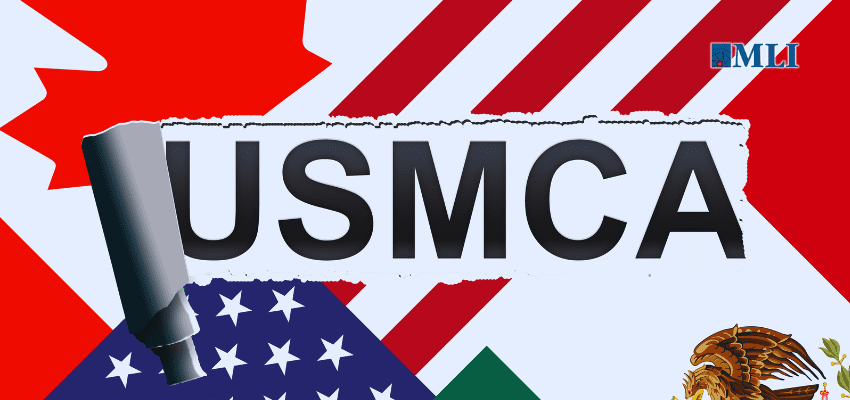
Image via Canva.

This article originally appeared in Canadian Affairs.

By David Collins, January 30, 2026

Even as Prime Minister Mark Carney basks in adulation from his Davos speech proclaiming the end of the globe’s “rules-based order,” he is trying to maintain a North American continental trade pact — a treaty which itself is based on international law.

This contradiction — and the confused posturing around the Canada-U.S. trading relationship that has followed Carney’s outing on the world stage — highlight a stark fact: even as multilateral institutions decline, the rule of law itself remains a key instrument to guide interactions between nations. The prime minister ought to take note.

The much vaunted “rupture” in the international order that Carney spoke of — embodied notably in U.S. President Donald Trump’s declaration that he does not feel bound by international law — has been a tough pill to swallow for international lawyers.

During his visit to Beijing, Carney declared that Canada had reached “a preliminary but landmark trade agreement” with China, only to walk this back the following week once Trump threatened to impose a 100 per cent tariff on all Canadian goods in response.

Carney now insists Canada has no intention of signing a trade agreement with China, rightly acknowledging that doing so could violate the Canada-United States-Mexico Agreement (CUSMA).

It’s not clear whether Carney knew that his remarks about an “agreement” would invoke Article 32.10 of CUSMA, sometimes known as the “China Clause.” This article requires CUSMA parties to notify each other if they are entering into trade agreement negotiations with a non-market economy.

CUSMA parties are allowed to review the full text of any such agreement and, should they wish, terminate the CUSMA on six months’ notice as a consequence. In short, Canada, the U.S. and Mexico are forbidden from entering a trade agreement with China without the others’ permission.

In addition to geo-strategic national security concerns, the reason for the China clause is that the U.S. in particular does not wish to become a dumping ground for cheap Chinese inputs channelled through its preferential trade agreement partners.

Tight rules of origin in the CUSMA also help address this issue by ensuring a sufficient component of composite goods crossing the Canada-U.S.-Mexico borders was actually made in one of the three countries and not elsewhere.

However, the arrangement that Carney achieved in Beijing is not — nor was it intended to be — a “free trade agreement” that would trigger Article 32.10. Rather, what emerged was a narrow set of reciprocal tariff relief commitments, notably on canola oil and electric vehicles.

The confusion appears to have arisen in part because, in recent years, the terms “agreement” and “deal” (a word which Trump tends to favour, as in the title of his famous book) are used interchangeably. But the phrase “trade agreement” has a distinct meaning in international trade law.

Under the World Trade Organization (WTO)’s Most Favoured Nation (MFN) principle — whereby all members of the WTO community get equal tariff treatment — preferential trade agreements must satisfy certain conditions. The most significant of these is that they must cover “substantially all trade” between the partner countries. This means that unless the agreement is comprehensive, across all or nearly all sectors, then it doesn’t count as a WTO-certified free trade agreement.

What Carney negotiated in Beijing, much as what Trump agreed with China President Xi Jinping a few months ago, are better described as “accords.” In the case of slightly more ambitious ones, they may be called “strategic partnerships,” such as the U.K.-U.S. Economic Prosperity Deal. The word “deal” could be used too, but its ambiguity risks fomenting misunderstandings, as would seem to have happened here.

It is not entirely clear why Trump originally appeared unfazed by Canada’s trade mission to China, only to change his mind later. U.S. Trade Representative Jameson Grier had cautioned at the time that Canadian trade negotiations with China could jeopardize the CUSMA’s 2026 renegotiation because of the risk of Chinese inputs finding their way into the U.S. through Canada. Perhaps Trump consulted with Grier after the fact and this changed his mind.

Or it may be, as some have suggested, that Trump was resentful for Carney stealing the spotlight from him at Davos, which itself is debatable.

Here’s the bottom line: even as international law is being dismissed in some circles as irrelevant, countries still need international treaties, like free trade agreements, as well as their lesser cousins — deals, accords and agreements in principle — so that they get along with their neighbours and prosper.

When it comes to trade agreements, as with all treaties, precise language is important. These instruments need to be negotiated by specialized lawyers and interpreted by experienced arbitrators if challenged.

While the international “order” embodied by multilateral institutions like the UN and the WTO itself may be in decline, nation states will continue to interact with each other, hopefully peacefully. For this, the rule of law remains indispensable.


David Collins is a senior fellow at the Macdonald-Laurier Institute, and a professor of international economic law at City St. George’s University of London.


Source: Canadian Affairs

Related Posts

Breakthrough nation ss.
Latest News

Breakthrough Nation with Karen Restoule: Crystal Smith Series 2, Ep. 8

January 30, 2026
Carney’s Davos speech was “bold” — and wrong: Daniel Dorman & Robert Tyler for New Direction
Foreign Affairs

Carney’s Davos speech was “bold” — and wrong: Daniel Dorman & Robert Tyler for New Direction

January 30, 2026
Why Canada needs a foreign intelligence service: Jonathan Berkshire Miller and Christopher Collins for Inside Policy
National Security

Why Canada needs a foreign intelligence service: Jonathan Berkshire Miller and Christopher Collins for Inside Policy

January 30, 2026
Next Post
Breakthrough nation ss.

Breakthrough Nation with Karen Restoule: Crystal Smith Series 2, Ep. 8

Newsletter Signup

  Thank you for Signing Up
  Please correct the marked field(s) below.
Email Address  *
1,true,6,Contact Email,2
First Name *
1,true,1,First Name,2
Last Name *
1,true,1,Last Name,2
*
*Required Fields

Follow us on

Macdonald-Laurier Institute

323 Chapel Street, Suite #300
Ottawa, Ontario, K1N 7Z2 Canada

613.482.8327

info@macdonaldlaurier.ca
MLI directory

Support Us

Support the Macdonald-Laurier Institute to help ensure that Canada is one of the best governed countries in the world. Click below to learn more or become a sponsor.

Support Us

  • Inside Policy Magazine
  • Annual Reports
  • Jobs
  • Privacy Policy

© 2023 Macdonald-Laurier Institute. All Rights reserved.

This site uses cookies. By continuing to browse the site you are agreeing to our use of cookies.

Privacy Preference Center

Consent Management

Necessary

Advertising

Analytics

Other

No Result
View All Result
  • Home
  • About
    • Who We Are
    • Who Makes MLI Work
    • Fifteenth Anniversary
  • Experts
    • Experts Directory
    • In Memoriam
  • Issues
    • Domestic Policy
      • Economic Policy
      • Justice
      • Rights and Freedoms
      • Assisted Suicide (MAID)
      • Health Care
      • COVID-19
      • Gender Identity
      • Canada’s Political Tradition
      • AI, Technology and Innovation
      • Media and Telecoms
      • Housing
      • Immigration
      • Agriculture and Agri-Food
      • Competition Policy
    • Energy Policy
      • Energy
      • Environment
    • Foreign Policy
      • Israel-Hamas War
      • Ukraine
      • Taiwan
      • China
      • Europe and Russia
      • Indo-Pacific
      • Middle East and North Africa
      • North America
      • Foreign Interference
      • National Defence
      • National Security
      • Foreign Affairs
    • Indigenous Affairs
  • Projects
    • CNAPS (Center for North American Prosperity and Security)
    • The Promised Land
    • Voices that Inspire: The Macdonald-Laurier Vancouver Speaker Series
    • Dragon at the door
    • Canada on top of the world
    • Letter to a minister
    • Justice Report Card
    • The Great Energy Crisis
    • DisInfoWatch.org
    • Managing Indigenous Prosperity
    • Judicial Foundations
    • Landmark Cases Council
    • Defending The Marketplace of Ideas
    • Reforming the University
    • Past Projects
      • Digital Policy & Connectivity
      • Double Trouble
      • Canada and the Indo-Pacific Initiative
      • The Transatlantic Program
      • COVID Misery Index
      • Speak for Ourselves
      • The Eavesdropping Dragon: Huawei
      • Talkin’ in the Free World with Mariam Memarsadeghi
      • An Intellectual Property Strategy for Canada
      • Munk Senior Fellows
      • A Mandate for Canada
      • Confederation Series
      • Fiscal Reform
      • The Canadian Century project
      • Fixing Canadian health care
      • Internal trade
      • From a mandate for change
      • Size of government in Canada
      • Straight Talk
      • Labour Market Report
      • Leading Economic Indicator
      • Centre for Advancing Canada’s Interests Abroad
      • Indigenous Prosperity at a Crossroads
  • Events
    • Upcoming Events
    • Past Events
      • MLI Dinners
      • Great Canadian Debates
  • Latest News
  • Libraries
    • Columns
    • Commentary
    • Papers
    • Books
    • Video
  • Donate

© 2023 Macdonald-Laurier Institute. All Rights reserved.