OTTAWA, ON (September 25, 2025):
Canada’s costly gamble on “green” electric vehicles is stalling thanks to a misguided subsidy-driven, top-down attempt to jumpstart a domestic EV industry.
Since 2019, the federal, Ontario, and Quebec governments have committed more than $52 billion to subsidize electric vehicle (EV) plants and supply chains, with promises of tens of thousands of jobs and a world-leading industry. Yet, even before production ramps up, the early warning signs are unmistakable – cost overruns, repeated delays, and subsidies that reward dependence rather than competitiveness.
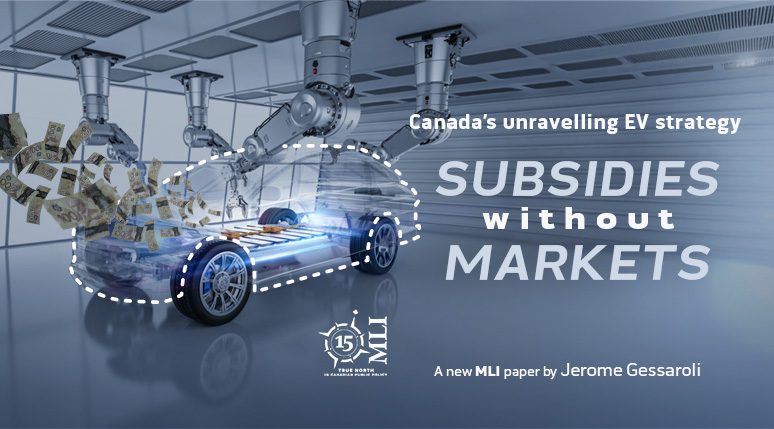
In Subsidies without markets: Canada’s unravelling EV strategy, Macdonald-Laurier Institute Senior Fellow Jerome Gessaroli reveals how delays, cancellations, and corporate failures have turned Ottawa’s “EV strategy” into a case study of failed industrial policy.
“These outcomes are not due to bad luck but to structural flaws,” explains Gessaroli. “Political incentives that reward announcements over outcomes, late entry into a mature industry dominated by global incumbents, and a top-down approach that inadequately addressed coordination, permitting, and workforce gaps.”
According to Gessaroli, the challenges run deep: the government tried to build an entire EV ecosystem at once, without addressing fundamental constraints in supply and labour. Efforts to streamline approvals for mining projects critical to EV production are only now emerging, while shortages of skilled workers in battery chemistry, power electronics, and advanced manufacturing persist.
For Gessaroli, the solution is straightforward: instead of governments trying to steer the economy from the top down, the goal must be to create the conditions for market-led investment through streamlined permitting, competitive markets, modern infrastructure, and support for early-stage research.
“While Canada’s EV industrial policy is still in its early stages, its window for long-term success is narrowing,” warns Gessaroli.
“It is already emerging as a cautionary case of how complex and costly government-led interventions can struggle to succeed in mature industries.”
To learn more, read the full paper here:

Jerome Gessaroli is a senior fellow with the Macdonald-Laurier Institute and leads the Sound Economic Policy Project at the British Columbia Institute of Technology.
For further information, media are invited to contact:
Skander Belouizdad
Communications Officer
(613) 482-8327 x111
Skander.belouizdad@macdonaldlaurier.ca