This article originally appeared in the National Post.
By Nathan Law and Daniel Dorman, November 28, 2025
If Aesop was right that “a man is known by the company he keeps,” then Prime Minister Mark Carney and his government may be due for severe judgment.
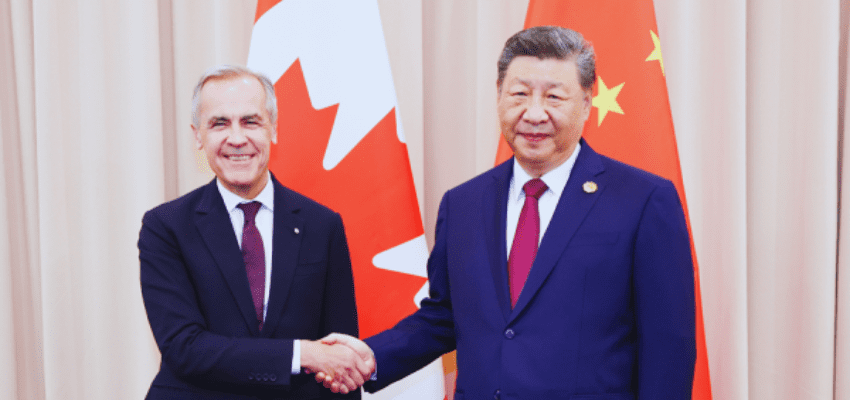
Late last month, Carney met with Chinese President Xi Jinping on the sidelines of the Asia-Pacific Economic Co-operation summit in South Korea, and accepted an invitation to visit China. Carney called the moment a “turning point” in the relationship. This follows the announcement that Beijing and Ottawa agreed to revive a “strategic partnership,” as Foreign Affairs Minister Anita Anand described it, after meeting with her counterpart in China earlier in October. The Canada-China relationship is heating up quickly.
Carney’s re-engagement with China appears motivated by a desire to diversify our exports away from the U.S. and enter closer trade ties with “the economic giants of Asia.”
To Anand’s credit, she couched the revived ties as a “forum to assert Canada’s interests” and Carney apparently raised Canadian concerns around foreign interference with Xi. But beyond these tepid recognitions of the dangerous waters we’re entering, Canada-China relations seem to be progressing in a historical vacuum, as if the last decade of China’s aggression towards Canada and total disregard for human rights was wiped away with the most recent election cycle.
It is worth remembering just who Canada is entering into a so-called “strategic partnership” with.
Canada has just revived relations with a country that engages in hostage diplomacy, most recently kidnapping, detaining, and psychologically torturing two Canadians, the ‘Two Michaels,’ (Kovrig and Spavor) for more than 1,000 days.
The final report of the Hogue Inquiry stated plainly in January of this year that “the People’s Republic of China (PRC) is the most active perpetrator of foreign interference targeting Canada’s democratic institutions.” And it “poses the most sophisticated and active cyber threat to Canada …increasingly using social media and the Internet for disinformation campaigns involving elections.”
One such disinformation campaign, against former MP Kenny Chiu, was documented extensively by The New York Times in an article entitled Canadian Politicians Who Criticize China Become Its Targets.
For those keeping score, this means our newest so-called partner has recently undermined our democracy and kidnapped our citizens.
What of China’s human rights record?
In the midst of Canada’s announcements that the flame was rekindled, The Economist detailed how China is rounding up Christian leaders, using late-night arrest tactics that sound a great deal like scenes from Alexander Solzhenitsyn’s Gulag Archipelago.
Since 2020, Canada has watched dissidents in Hong Kong fall further and further under Beijing’s oppressive thumb through the implementation of the National Security Law.
Just four years ago, Canada’s Parliament unanimously recognized China’s treatment of the Uyghur minority as a genocide.
Stephen Harper’s former deputy chief of staff, Howard Anglin, offered a 2021 assessment that bears repeating: “When we engage with the Chinese government, we deal with an outlaw regime that holds us in even lower contempt than the rule of law. And when we do business under their laws, we should do so with the expectation that those laws mean nothing, or rather will mean whatever the regime says they mean in its sole interest.”
As the formerly detained Canadian diplomat Michael Kovrig said in a recent interview, “If you create dependency on China, it will weaponize it for political purposes and to silence Canada and constrain our foreign policy.”
It is foolish to assume that China will suddenly decide to act as a partner and follow our rules. Canada’s own Indo-Pacific Strategy refers to China as “an increasingly disruptive global power” whose rise has been enabled by “the same international rules and norms that it now increasingly disregards.”
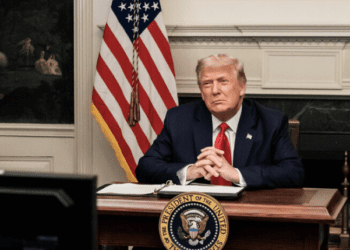
However great (and however justified) Canadians’ distaste for U.S. President Donald Trump and his constant barrage of tariff threats becomes, it serves as no excuse for willingly jumping out of the simmering American frying pan and into the blazing Chinese fire.
Nathan Law, a former Hong Kong legislator and prominent figure in the city’s pro-democracy movement, is the ambassador for Canada-Hong Kong policy at the Macdonald-Laurier Institute.
Daniel Dorman is managing editor and director of operations at the Macdonald-Laurier Institute.