Wednesday, September 2, 2026
No Result
View All Result
  • Media
Macdonald-Laurier Institute
  • Home
  • About
    • Who We Are
    • Who Makes MLI Work
    • Fifteenth Anniversary
  • Experts
    • Experts Directory
    • In Memoriam
  • Issues
    • Domestic Policy
      • Economic Policy
      • Justice
      • Rights and Freedoms
      • Assisted Suicide (MAID)
      • Health Care
      • COVID-19
      • Gender Identity
      • Canada’s Political Tradition
      • AI, Technology and Innovation
      • Media and Telecoms
      • Housing
      • Immigration
      • Agriculture and Agri-Food
      • Competition Policy
    • Energy Policy
      • Energy
      • Environment
    • Foreign Policy
      • Israel-Hamas War
      • Ukraine
      • Taiwan
      • China
      • Europe and Russia
      • Indo-Pacific
      • Middle East and North Africa
      • North America
      • Foreign Interference
      • National Defence
      • National Security
      • Foreign Affairs
    • Indigenous Affairs
  • Projects
    • CNAPS (Center for North American Prosperity and Security)
    • The Promised Land
    • Dragon at the door
    • Justice Report Card
    • DisInfoWatch.org
    • Managing Indigenous Prosperity
    • Judicial Foundations
    • Landmark Cases Council
    • Closing Canada’s Border, Policing, and Legal Gaps
    • Reforming the University
    • Digital Policy & Connectivity
    • Defending The Marketplace of Ideas
    • Letter to a minister
    • Past Projects
      • The Great Energy Crisis
      • Canada on top of the world
      • Double Trouble
      • Canada and the Indo-Pacific Initiative
      • The Transatlantic Program
      • COVID Misery Index
        • Provincial COVID Misery Index
        • Beyond Lockdown
        • COVID and after: A mandate for recovery
      • Speak for Ourselves
      • The Eavesdropping Dragon: Huawei
      • Talkin’ in the Free World with Mariam Memarsadeghi
      • An Intellectual Property Strategy for Canada
      • Munk Senior Fellows
      • A Mandate for Canada
      • Confederation Series
      • Fiscal Reform
      • The Canadian Century project
      • Fixing Canadian health care
      • Internal trade
      • From a mandate for change
      • Size of government in Canada
      • Straight Talk
      • Labour Market Report
      • Leading Economic Indicator
      • Centre for Advancing Canada’s Interests Abroad
      • Indigenous Prosperity at a Crossroads
        • Aboriginal Canada and Natural Resources
  • Events
    • Voices that Inspire: The Macdonald-Laurier Vancouver Speaker Series
    • Upcoming Events
    • Past Events
      • MLI Dinners
      • Great Canadian Debates
  • Latest News
  • Libraries
    • Columns
    • Commentary
    • Papers
    • Books
    • Video
  • Donate
  • Home
  • About
    • Who We Are
    • Who Makes MLI Work
    • Fifteenth Anniversary
  • Experts
    • Experts Directory
    • In Memoriam
  • Issues
    • Domestic Policy
      • Economic Policy
      • Justice
      • Rights and Freedoms
      • Assisted Suicide (MAID)
      • Health Care
      • COVID-19
      • Gender Identity
      • Canada’s Political Tradition
      • AI, Technology and Innovation
      • Media and Telecoms
      • Housing
      • Immigration
      • Agriculture and Agri-Food
      • Competition Policy
    • Energy Policy
      • Energy
      • Environment
    • Foreign Policy
      • Israel-Hamas War
      • Ukraine
      • Taiwan
      • China
      • Europe and Russia
      • Indo-Pacific
      • Middle East and North Africa
      • North America
      • Foreign Interference
      • National Defence
      • National Security
      • Foreign Affairs
    • Indigenous Affairs
  • Projects
    • CNAPS (Center for North American Prosperity and Security)
    • The Promised Land
    • Dragon at the door
    • Justice Report Card
    • DisInfoWatch.org
    • Managing Indigenous Prosperity
    • Judicial Foundations
    • Landmark Cases Council
    • Closing Canada’s Border, Policing, and Legal Gaps
    • Reforming the University
    • Digital Policy & Connectivity
    • Defending The Marketplace of Ideas
    • Letter to a minister
    • Past Projects
      • The Great Energy Crisis
      • Canada on top of the world
      • Double Trouble
      • Canada and the Indo-Pacific Initiative
      • The Transatlantic Program
      • COVID Misery Index
        • Provincial COVID Misery Index
        • Beyond Lockdown
        • COVID and after: A mandate for recovery
      • Speak for Ourselves
      • The Eavesdropping Dragon: Huawei
      • Talkin’ in the Free World with Mariam Memarsadeghi
      • An Intellectual Property Strategy for Canada
      • Munk Senior Fellows
      • A Mandate for Canada
      • Confederation Series
      • Fiscal Reform
      • The Canadian Century project
      • Fixing Canadian health care
      • Internal trade
      • From a mandate for change
      • Size of government in Canada
      • Straight Talk
      • Labour Market Report
      • Leading Economic Indicator
      • Centre for Advancing Canada’s Interests Abroad
      • Indigenous Prosperity at a Crossroads
        • Aboriginal Canada and Natural Resources
  • Events
    • Voices that Inspire: The Macdonald-Laurier Vancouver Speaker Series
    • Upcoming Events
    • Past Events
      • MLI Dinners
      • Great Canadian Debates
  • Latest News
  • Libraries
    • Columns
    • Commentary
    • Papers
    • Books
    • Video
  • Donate
No Result
View All Result
Macdonald-Laurier Institute

A trade treaty with the US isn’t much of a threat to Canada’s ‘sovereignty’: David Collins in City Law Forum

Issues should have been discussed in good faith between the Canadian and American negotiators and not at the eleventh hour.

September 2, 2026
in Foreign Affairs, Latest News, Columns, Foreign Policy, In the Media, North America, David Collins
Reading Time: 4 mins read
A A
A trade treaty with the US isn’t much of a threat to Canada’s ‘sovereignty’: David Collins in City Law Forum

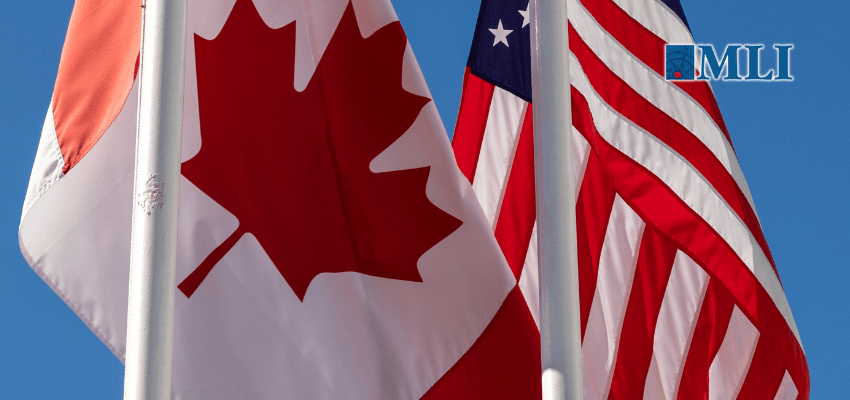
Image via Canva.

This article originally appeared in City Law Forum.

By David Collins, September 2, 2026

Although there has been much opacity regarding the precise reasons that trade negotiations between Canada and the US failed, numerous reports, including from Canadian Prime Minister Carney himself, suggest that one of the main reasons was that the US was attempting to interfere with Canada’s trade relations with third countries. Carney boldly framed this as an unacceptable interference with Canada’s “sovereignty” – surely as strong a reason as any to walk away from trade talks with the Americans, particularly given the provocative comments from President Trump regarding making Canada the 51st state.

But there is much irony, hypocrisy even, in Carney’s warning to Canadians about the threat to their sovereignty posed by a trade treaty with the US. As Governor of the Bank of England during the tense Brexit years, Carney made it one of his top priorities to keep the UK in the EU, despite the referendum result. He regularly used his public platform to admonish the government of the day about the damage that leaving would do to the UK economy. Of course, being a member of the EU’s customs union meant that the UK could not sign its own trade agreements with third countries, a massive afront to that country’s economic sovereignty.

What is more interesting is that the USMCA, which remains in force for the time being, already contains some restrictions on the capacity of its signatories to engage in trade relations with third states. Its “anti-China” clause (Art 32.10) prevents Canada, Mexico or the US from entering into a free trade agreement with a non-market economy. While this provision applies generally, it was designed with China in mind. Should one of the USMCA signatories (including the US) sign such an agreement with China, it entitles the other two members to terminate the agreement, effectively making the trilateral treaty a bilateral one. Consequently, Canada’s capacity to have trade relations with third states is already constrained. Indeed, this feature of the USMCA required Carney to clarify that his trip to China last year did not result in a trade agreement but merely the mutual cessation of certain anti-dumping duties.

While again we do not know what specific provisions the Americans were proposing in trade negotiations in this regard, it is quite likely that they were pushing for trade policy alignment in manner they have been pursuing in their Agreements on Reciprocal Trade (ARTs) which they have concluded with a number of Asian and Latin American countries over the last year. The ART’s “complementarity” provisions require the US treaty partner to mirror the US in terms of their anti-dumping and anti-subsidy duties against third states as well as with the US’s national security-oriented trade restrictions. The US-Malaysia ART, to take one example, further enables treaty termination if Malaysia enters into a free trade agreement with a country that “jeopardizes essential US security interests.” These provisions, which are now standard terms in US bilateral free trade agreements, are designed to ensure US economic hegemony by offering favourable trade terms in exchange for geopolitical alignment. They were pursued in conjunction with the removal of Trump’s 2025 “Liberation Day” tariffs.

Thus far the US has only concluded ARTs with smaller economies, although it is noteworthy that the US negotiating objectives of a planned UK-US FTA contained similar language. Canadian negotiators should therefore have expected that complementarity provisions of some kind would at least be proposed by the US. That they were suddenly raised at the last minute, or that Canadian negotiators were blindsided by them, is not credible.

Whether Canada should have accepted “anti-China plus” type complementarity provisions in a new USMCA, effectively committing themselves to shadowing US trade policy is debatable. It would limit Canada’s trade dealings with countries that have historically not been aligned with the West (e.g. China, Iran, Venezuela) but it would yield greater economic benefits from the US, Canada’s largest trading partner and (still) closest ally. It is doubtful that agreeing to mirror US trade policy would have much of an effect on Canada’s trade strategy in the long term given that it is already so reliant on the US, especially with regards to integrated manufacturing supply chains. Moreover, as members of NATO, US and Canadian security objectives are also broadly aligned.

It should be added that the precise wording of the complementarity commitments is different across various US ARTs. For example, Art 5.1.1 of US-Cambodia ART specifies that Cambodia cannot be act in a way that infringes on Cambodia’s “sovereign interests.” There is clearly some wriggle room here. These issues should have been discussed in good faith between the Canadian and American negotiators and not at the eleventh hour. Perhaps they were – again we do not know as the Liberal government has been short on details. Complementarity may yet be raised and fairly considered should negotiations resume.

What is clear is that the complementarity provisions of the US ARTs are nowhere near as restrictive of sovereignty as are those of the Lisbon Treaty (which binds EU Member States), creating a continent-wide trade policy including common external tariffs. That the relentlessly pro-EU Carney would reject US overtures on the basis that they limited Canada’s trade with strategically unaligned countries suggests that “sovereignty” had very little to do with why Canada walked away.


David Collins is a senior fellow at the Macdonald-Laurier Institute, and a professor of international economic law at City St. George’s University of London.
Source: City Law Forum

Related Posts

The U.S.–Canada tariff war – When the elites fight, we all pay: Jamie Tronnes
North America

The U.S.–Canada tariff war – When the elites fight, we all pay: Jamie Tronnes

September 2, 2026
How Trump kneecapped his own China policy with a 50% tariff on Canada: Anthony De Luca-Baratta in the Washington Examiner
North America

How Trump kneecapped his own China policy with a 50% tariff on Canada: Anthony De Luca-Baratta in the Washington Examiner

September 2, 2026
It costs Canada millions to discriminate against white male academics: Eric Kaufmann in the National Post
Education

It costs Canada millions to discriminate against white male academics: Eric Kaufmann in the National Post

September 2, 2026
Next Post
The U.S.–Canada tariff war – When the elites fight, we all pay: Jamie Tronnes

The U.S.–Canada tariff war - When the elites fight, we all pay: Jamie Tronnes

Newsletter Signup

  Thank you for Signing Up
  Please correct the marked field(s) below.
Email Address *
1,true,6,Contact Email,2
First Name *
1,true,1,First Name,2
Last Name *
1,true,1,Last Name,2
*Required Fields

Follow us on

Macdonald-Laurier Institute

323 Chapel Street, Suite #300
Ottawa, Ontario, K1N 7Z2 Canada

613.482.8327

info@macdonaldlaurier.ca
MLI directory

Support Us

Support the Macdonald-Laurier Institute to help ensure that Canada is one of the best governed countries in the world. Click below to learn more or become a sponsor.

Support Us

  • Inside Policy Magazine
  • Annual Reports
  • Jobs
  • Privacy Policy

© 2023 Macdonald-Laurier Institute. All Rights reserved.

No Result
View All Result
  • Home
  • About
    • Who We Are
    • Who Makes MLI Work
    • Fifteenth Anniversary
  • Experts
    • Experts Directory
    • In Memoriam
  • Issues
    • Domestic Policy
      • Economic Policy
      • Justice
      • Rights and Freedoms
      • Assisted Suicide (MAID)
      • Health Care
      • COVID-19
      • Gender Identity
      • Canada’s Political Tradition
      • AI, Technology and Innovation
      • Media and Telecoms
      • Housing
      • Immigration
      • Agriculture and Agri-Food
      • Competition Policy
    • Energy Policy
      • Energy
      • Environment
    • Foreign Policy
      • Israel-Hamas War
      • Ukraine
      • Taiwan
      • China
      • Europe and Russia
      • Indo-Pacific
      • Middle East and North Africa
      • North America
      • Foreign Interference
      • National Defence
      • National Security
      • Foreign Affairs
    • Indigenous Affairs
  • Projects
    • CNAPS (Center for North American Prosperity and Security)
    • The Promised Land
    • Dragon at the door
    • Justice Report Card
    • DisInfoWatch.org
    • Managing Indigenous Prosperity
    • Judicial Foundations
    • Landmark Cases Council
    • Closing Canada’s Border, Policing, and Legal Gaps
    • Reforming the University
    • Digital Policy & Connectivity
    • Defending The Marketplace of Ideas
    • Letter to a minister
    • Past Projects
      • The Great Energy Crisis
      • Canada on top of the world
      • Double Trouble
      • Canada and the Indo-Pacific Initiative
      • The Transatlantic Program
      • COVID Misery Index
      • Speak for Ourselves
      • The Eavesdropping Dragon: Huawei
      • Talkin’ in the Free World with Mariam Memarsadeghi
      • An Intellectual Property Strategy for Canada
      • Munk Senior Fellows
      • A Mandate for Canada
      • Confederation Series
      • Fiscal Reform
      • The Canadian Century project
      • Fixing Canadian health care
      • Internal trade
      • From a mandate for change
      • Size of government in Canada
      • Straight Talk
      • Labour Market Report
      • Leading Economic Indicator
      • Centre for Advancing Canada’s Interests Abroad
      • Indigenous Prosperity at a Crossroads
  • Events
    • Voices that Inspire: The Macdonald-Laurier Vancouver Speaker Series
    • Upcoming Events
    • Past Events
      • MLI Dinners
      • Great Canadian Debates
  • Latest News
  • Libraries
    • Columns
    • Commentary
    • Papers
    • Books
    • Video
  • Donate

© 2023 Macdonald-Laurier Institute. All Rights reserved.